The Open-Source Sky

dish_astronomynet

Professional astronomers have been looking at Flickr to better understand the universe:

To get detailed images of deep space, astronomers have a couple of options…. They can either use a long exposure to capture one really detailed image, or stack multiple less-detailed images together. [Astronomer Dustin] Lang and colleagues opted for the second approach. But rather than using multiple photos taken with the same telescope, they looked to the web.  The team used a new alogorithm to stack nearly 300 images of the Galaxy NGC 5907 that they found on Flickr, Bing, and Google. They did this by “[l]iterally searching for ‘NGC 5907’ and ‘NGC5907’,” explains Astrobites.

For a photo of the night sky to be useful, though, the scientists first needed to know exactly what they were looking at. For that they turned to Astrometry.net*, a site that pinpoints exactly which patch of the sky is shown in an image. … Once they were stacked together, the images revealed faint features that offered information on the mass, age and orbitial configurations of the celestial bodies in galaxy NGC 5907–information that was not present in a single photo.

(Image via Openiduser2916 via Astronomy.net)

Quote For The Day II

Tensions Remain High At Israeli Gaza Border

“Gaza is part of our Land and we will remain there forever. Liberation of parts of our land forever is the only thing that justifies endangering our soldiers in battle to capture land. Subsequent to the elimination of terror from Gaza, it will become part of sovereign Israel and will be populated by Jews. This will also serve to ease the housing crisis in Israel. The coastal train line will be extended, as soon as possible, to reach the entire length of Gaza.

According to polls, most of the Arabs in Gaza wish to leave. Those who were not involved in anti-Israel activity will be offered a generous international emigration package. Those who choose to remain will receive permanent resident status. After a number of years of living in Israel and becoming accustomed to it, contingent on appropriate legislation in the Knesset and the authorization of the Minister of Interior, those who personally accept upon themselves Israel’s rule, substance and way of life of the Jewish State in its Land, will be offered Israeli citizenship,” – MK Moshe Feiglin, outlining a future for Gaza that will also surely, eventually, after another provocation, be applied to the West Bank.

(Photo: A man stands with an Israeli flag on a hill overlooking the Gaza Strip on July 20, 2014 near Sderot, Israel. By Lior Mizrahi/Getty Images.)

The Shocking Truth, Ctd

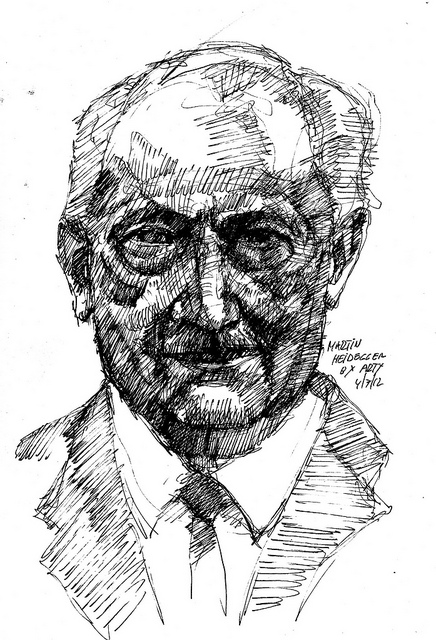
Recently the Dish noted new research suggesting that people prefer getting electric shocks to being alone with their thoughts. Remarking on the study, Damon Linker gives our restlessness an existentialist gloss. He turns to the German philosopher Martin Heidegger for an explanation of why we crave distraction:

Heidegger proposed that we human beings are uniquely terrified of our own mortality because we’re more keenly aware than any other animal of all we have to lose 7499910498_5bc8525143_z by dying. Each of us inhabits a world overflowing with meaning. We care deeply, almost infinitely, about ourselves, our lives, our loved ones. And the prospect of losing it all — of the world and everything in it winking out of existence when we cease to be — is unspeakably horrifying. Heidegger also suggested that we spend much of our lives fleeing from the fact of our finitude, throwing ourselves into the world and its concerns, including technological distractions and diversions.

But there are also moments when the truth reveals itself to us. This happens in certain moods, among them anxiety and boredom, when a dawning awareness of the groundlessness of our ordinary, everyday pursuits transfigures the world. When that happens we grasp as we otherwise rarely do that our lives are lived hovering over an abyss that at some level we know with complete certainty will eventually — perhaps a mere moment from now — swallow us whole, along with everything we’ve ever cared about.

Nothingness: that is what we’re trying to wave away when we reach for our phones in line at the grocery store, and when the obtrusive music played during a meal rescues us from what would otherwise be an excruciatingly awkward silence.

(Image of sketch of Heidegger via Arturo Espinosa)

Theology For Technologists

Scott Adams, who was raised Methodist and later became an atheist, describes how he’s now come around to seeing religion as the “user interface to reality.” He writes that “when I hear people debate the existence of God, it feels exactly like debating whether the software they are using is hosted on Amazon’s servers or Rackspace”:

Religion is similar to software, and it doesn’t matter which religion you pick. What matters is that the user interface of religious practice “works” in some sense. The same is true if you are a non-believer and your filter on life is science alone. What matters to you is that your worldview works in some consistent fashion. If you’re deciding how to fight a disease, science is probably the interface that works best. But if you’re trying to feel fulfilled, connected, and important as you navigate life, religion seems to be a perfectly practical interface. But neither science nor religion require an understanding of reality at the detail level. As long as the user interface gives us what we need, all is good.

Some of you non-believers will rush in to say that religion has caused wars and other acts of horror so therefore it is not a good user interface to reality. I would counter that no one has ever objectively measured the good and the bad of religion, and it would be impossible to do so because there is no baseline with which to compare. We only have one history. Would things have gone better with less religion? That is unknowable. … What I know for sure is that plenty of people around me are reporting that they find comfort and social advantages with religion. And science seems to support a correlation between believing, happiness, and health. Anecdotally, religion seems to be a good interface.

Face Of The Day

Ellyn Ruddick-Sunstein spotlights an empowering photo series:

In a world where the words “bikini season” are met with judgement, panic, and dread, it canenhanced-29149-1400922911-3 be hard to embrace our bodies as they are. For breast cancer survivors and patients who have undergone single or double mastectomies, the season’s swimsuits can be alienating, as they are most often designed to accommodate twin bosoms.

Hoping to challenge the damaging pressures and judgements placed on the female chest, Ph.D. Elina Halttunen came up with the idea to manufacture bathing suits specifically for women who, like she, have one breast. With the help of design duo Tärähtäneet ämmät (Nutty Tarts), a group of trailblazing Finnish designers, and a dedicated group of models, all of whom had undergone mastectomies, her dream became a reality. Their fashions and images are all part of the project Monokini 2.0.

Taking inspiration from legendary fashion photographer Helmut Newton, the team at Nutty Tarts have conceived of glamorous, edgy designs with a distinctive yet cohesive aesthetic. The Monokini 2.0 designs comprise looks that convey both strength and softness. Designer Outi Pyy creates pieces designed with warriors and mermaids in mind. Tyra Therman, who works in luxury underwear, sees the project as a way to redefine femininity and celebrate the courage of women.

Support their Kickstarter here.

Loving Your Oppressor

Imam Sohaib N. Sultan offers a Ramadan reflection on the theme:

The Qur’an often describes sins and wrongdoings as “oppressing one’s own soul” (7:23). It begs the question, therefore, what the difference is between the oppressor who commits wrongdoing and the oppressed that is wronged if both are, ultimately, being oppressed. I think, the answer may lie in that oppression attempts to strip the oppressed of their rights and dignity; whereas oppressing strips the oppressor of their very own humanity. …

It is worth noting that the Prophet referred even to the oppressor as “your brother.” When we encounter the tyrant, our first instinct is to wash our hands of him or her and to deny that we have anything to do with them. While this instinct is understandable, the reality is that even the worst of human beings are related to us in humanity, if not faith. And, therefore, opposing the tyrant is an act of sincere love, the same sincerity that one would naturally show to their brother. Opposing oppression must never be rooted in hatred, for that would, inevitably, cause the cycles of oppression to continue.

Bertrand Russell, Peacenik?

Bertrand_Russell_leads_anti-nuclear_march_in_London,_Feb_1961

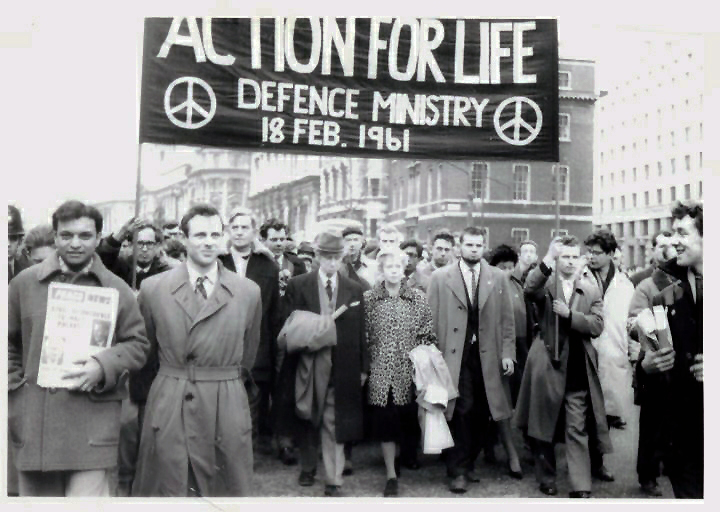
Surveying the British philosopher’s pacifist writings and activism, Jonathan Rée isn’t quite persuaded by how he formulated the nature of war:

The peace agenda of Russell and his followers was always based on the assumption that war is simply a euphemism for the madness of state-sponsored mass murder, and that we could prevent it by standing up for moral and political sanity – by committing ourselves to global justice and the relief of poverty, for instance, or social and sexual equality, or common ownership, or world government…. But the paths to war are paved not with malice but with righteous self-certainty. People who choose to participate in military action are more likely to be altruists than egotists: they are prepared to sacrifice their own lives for the sake of something that transcends them, such as their country or their religion, or socialism, secularism or democracy, or a world where peace and tolerance will reign in perpetuity. Of course they are liable, like the rest of us, to be seriously mistaken in countless ways:

they probably have an inconsistent scale of values, a shaky grasp of facts and a faulty sense of proportion. They may, just possibly, be open to persuasion through tactful argumentation, subtle negotiation and ingenious rhetoric, but nothing will be gained by accusing them of selfishness, nihilism or moral idiocy, or delivering lectures about self-sacrifice, high principle and the future of humanity.

Different threats to peace, like different threats to health, require different precautions and different interventions, depending on the individual case, and success in averting war is going to depend on luck as much as judgement. If the prospect of nuclear extermination has receded since the time when Russell was prophesying it, the explanation lies less in campaigns for peace and freedom than in the unexpected consequences of developments that no one could have foreseen – the calculations and miscalculations of Mikhail Gorbachev, for instance, or the accidental canniness of Ronald Reagan. Irony is a force of history as well as a figure of speech, and in politics you need to be prepared for surprises, even if you are as clever as Bertrand Russell.

(Image: Bertrand Russell and his wife, Edith Russell, lead an anti-nuclear march by the Committee of 100 in London on February 18th, 1961, via Wikimedia Commons)

When Dear Leader Can Do No Wrong

Xavier Marquez unpacks the political psychology referred to as the “good Tsar” bias, when leaders escape blame for the disasters and mistakes that happen under their rule – anyone or anything but the ruler is held accountable:

The “good Tsar” bias does not incline people to say that the world is just, or to rationalize injustice as somehow deserved, only to deny that those leaders who are closely tied to the symbols of the nation (the Tsar, the Führer, the King, etc.) bear responsibility for bad outcomes in everyday life; that responsibility, instead, is assigned to subordinates. In this respect, the bias appears to be more closely related to what Dan Kahan and others have called “identity-protective cognition“: the closer a leader is tied to the symbols of the nation or group with whom they identify, and the closer people’s identification with the nation or group is, the more difficult it should be for them to accept that the leader is responsible for bad outcomes, since such acceptance threatens one’s identity, and the more likely it will be for them to displace that responsibility onto subordinates as a protective measure. And leaders, like Hitler, who are the focus of high-intensity rituals associated with big national occasions — plebiscitary elections, victories in war, even set-piece speeches on the occasion of good economic news — are precisely the sorts of leaders who become associated with important community symbols; indeed, in important ways, they come to symbolize the community, as long as the rituals are successful.

Dreher applies the theory to various aspects of contemporary American life:

We saw it in Catholic circles post-Boston, with the desperate attempts by some conservative Catholics to wall of John Paul II from the catastrophe. If you were reading certain Catholic blogs at the time, the rationalizations for John Paul’s inaction were legion. The Holy Father was kept in the dark by disloyal subordinates. The Holy Father was too sick to act. The Holy Father has a secret plan to deal with the scandal. Et cetera.

There is no theological reason for this strategy. Papal authority, even papal infallibility, does not depend on the capability of a pope to govern prudently. Dante, in the Commedia, exemplifies the perfectly Catholic position: loyalty to the Church and to its teachings, including the papacy, but unleashing hell on the corrupt popes. The “Good Pope bias” here was not really a theological defense — a theological defense was not strictly necessary — but a psychological one.

It doesn’t have to be focused on a person. You’ve probably heard the line, “conservatism cannot fail; it can only be failed” describing, from a liberal perspective, the way movement conservatives rationalize the failures of conservative government. For these people, corruption, bad judgment, or ineptitude on the part of elected conservative leaders doesn’t disprove conservative ideas or principles; it only means they weren’t really tried. The failed presidency of George W. Bush had nothing to do with the wrongness of conservative ideas, you see; it was because Bush wasn’t sufficiently or genuinely conservative. In this case, the Good Tsar is not a person, but an ideology.


“Forgive Me” – Father, Ctd

Responding to criticism that Pope Francis hasn’t acted swiftly or decisively enough on the issue of sex abuse by Catholic priests, Garry Wills offers a theory why –  Francis realizes that “without addressing structural issues in the Vatican, meaningful action to restore trust in the priesthood and church authority cannot get far.” One issue is celibacy:

Yes, celibacy does not directly and of itself lead to sexual predation. There are many unmarried men and women who are not predators. But Catholic celibacy is not simply an unmarried state. It is a mandatory and exclusive requirement for holding all significant offices in the Church. This sets up a sexual caste system that limits vision, empathy, and honesty. It enables church rulers to be blithely at odds with the vast majority of their own people. According to a 2011 Guttmacher Institute study, 98 percent of American Catholic women of child-bearing age have had sex—and, of that 98 percent, 99 percent have used or will use some form of contraception. Yet celibate priests tell us they know what sex is really about (by their expertise in “natural law”), and in their view it absolutely precludes birth control. There is an induced infantilism in such cloistered minds, an ignorance that poses as innocence. This prevents honesty at so many levels that any trust on sexual matters begins in a crippled state, handicapping all treatment of sexual predation in the Church.

Another problem that stands in the way of true reform is clericalism:

The previous three problems [celibacy, homophobia, and patriarchy] converge on the clerical mindset that afflicts all bureaucracies, but especially sacred ones. Advancement of one’s career involves deference to those above, adherence to corporate loyalties, and a determination not to hurt the institution (demonstrated by signal loyalty). Questioning “church teaching” is subversion. This leads to support of one’s own in all ways possible—as far as one can go, for instance, in denying sin among one’s colleagues. This is the area in which Pope Francis has made some initial moves, challenging the power of the Curia (Rome’s bureaucracy).

But challenge is not change, and so long as these structural issues persist, it will be impossible to restore trust in the Vatican’s authority. No pope can change all these things all by himself, even one as winning as Francis is proving. If it is to be done at all, it must be by a joint effort of the whole People of God. Perhaps that is what Francis is waiting for. I suspect he would welcome it.

Recent Dish on the topic here.