Reading Across The Sea

Tim Parks considers American fiction’s outsize role in world literature:

[An] openness to American literature is general across Europe. Go into any European bookshop and you find 50 per cent to 70 per cent of novels are translations, the vast majority from English, above all American English. Since the 1960s European readers have grown used to reading fiction set in a society quite distant from their own. So constant is the presence of Americana in their lives that no mediation is required beyond the act of translation. Jonathan Franzen can pack his descriptions with every kind of American paraphernalia – mechanised recliners, air-hockey tables, refrigerated beer kegs – and still be widely read.

The same is not true the other way round. American and English readers are not overwhelmed by foreign texts and, with the exception perhaps of crime novels, show significant resistance to the minutiae of countries they know little about. Only three per cent of the novels on British and American shelves are translations. But then Europeans show the same resistance towards cultures they do not know. A writer from, say, Serbia, offering the same density of local cultural reference Franzen has, would require significant editing, or some radical act of mediation before being accepted for publication in Italy or Spain.

 

A GIFted Artist

dish_oamulflowersgif2

MessyNessy profiles the GIF artist Oamul, particularly praising his On the Road series:

Oamul is a talented young illustrator and animator from China who brings his hand-drawn illustrations to life in these enchanting GIFs. His subject matter ranges from things he sees, hears and experiences on his travels and in his daily life to his favourite movie scenes….

In an interview last year, Oamul talked about how he became an illustrator:

When did you first discover you liked illustration? What were your influences?

When I was a kid, I saw my sister had drawn a picture about Sailor Moon. At that time, I wanted to draw things that I enjoyed and liked, so I began to use a pen to sketch everyday.

How was your design education? Were you formally educated in design, or was it just a hobby?

After my parents discovered I was gifted at drawing, they decided to send me to formally learn art. When I went to university though, I chose Interior Design. Although interior design is very different from what I create now, it still has a big influence in my work. After I graduated, I learnt 3D animation in a computer game company. Those experiences were crucial in influencing my work today.

What do you think of Design and illustration in China? Do you think it has its own style, or do you think that it is still influenced by the West?

I think today, China’s illustration is becoming more and more diverse, all designers having their own style. But we are still learning all the time from many influences all over the world.

See more of his work here.

What We’re Not Reading Lately

Recently, Jordan Ellenberg noticed that, judging by the most-frequently-highlighted passages in Kindle bestsellers, the overwhelming majority of people who buy Thomas Piketty’s 700-page Capital in the Twenty-First Century don’t make it far past the first pages. As William Falk observes, “the Kindle formula also works with fiction”:

Ellenberg’s dullness detector uncovered a curious phenomenon among readers of The Goldfinch by Donna Tartt, which won the Pulitzer Prize this year. The five most popular highlights all occur in thelast 20 pages of the 771-page novel. Is that a compliment? I suspect not. The Goldfinch is one of those self-conscious “masterpieces” that some readers and critics adore — and some, like me, find bloated and self-indulgent. To get to the end, I found myself skimming over dense chunks of pointless description and meandering subplots. … I think Tartt’s novel would benefit if it were cut by, say, 250 pages. Kindle doesn’t lie: To be read more, write less.

Meanwhile, Tom Lamont advocates abandoning boring books early on:

[O]f course you should stop reading when the fireworks aren’t there. When you aren’t impressed, lulled, entertained, lightened, depressed, remoulded, whatever you go to books for. Even if it means reshelving the thing with that telltale halt in the creases on the spine, or admitting to friends, spouses or book clubs that you’ve bunked a recommendation.

Alex Clark differs:

Believe me, I am not defending every book that gets published, nor telling people to force themselves onwards when something is clearly a) dross or b) so completely antithetical to everything they as a reader hold dear that only misery awaits. That would be ludicrous, masochistic and likely to result in a more total disenchantment with reading. … But I am saying that if you give up on a book the minute you don’t like a character, twig a plot development, see quite where the author’s going with it all, have a sudden yen for a game of Candy Crush – then you’re going to miss out. I’ve nothing against reads that are quick and dirty fun, but seriously good books are immersive experiences, demanding of time and patience. Respect them.

Previous Dish on Piketty here, and previous Dish on The Goldfinch here.

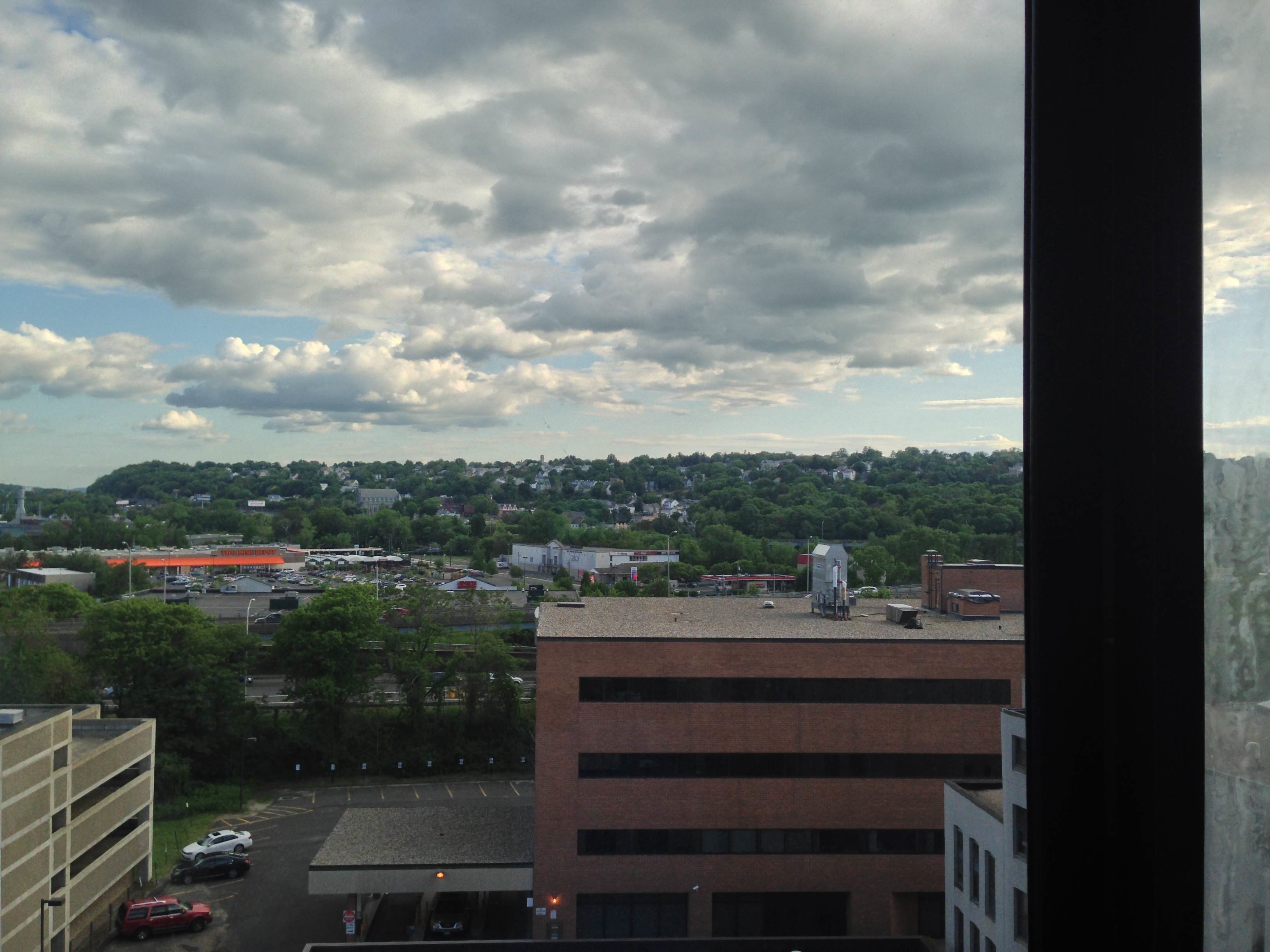
The View From Your Window Contest

VFYWC-214

You have until noon on Tuesday to guess it. City and/or state first, then country. Please put the location in the subject heading, along with any description within the email. If no one guesses the exact location, proximity counts.  Be sure to email entries to contest@andrewsullivan.com. Winner gets a free The View From Your Window book or two free gift subscriptions to the Dish. Have at it.

Autism On The Rise

Virginia Hughes explores why autism studies have exploded in the 21st century. Considering that many more males than females are diagnosed with the disorder, she explores how gender factors into funding:

In 2009, the National Institutes of Health spent $196 million on autism, compared with $186 million on Parkinson’s disease and $22 million on Down syndrome. In her new paper, [science historian Sarah] Richardson takes a close look at hundreds of grant applications and published studies related to autism and sex differences. Many grant applications cite autism’s rising prevalence as prime motivation. But they also frequently site the sex bias and [psychologist Simon] Baron-Cohen’s theory [that autism’s “primary characteristics are just an exaggeration of typical differences between men and women, and that they’re caused by excessive exposure to male sex hormones in the womb”].

Richardson describes grant proposals investigating autism’s sex bias through the lens of genetics, epigenetics, gene-hormone interactions, brain anatomy, chemical exposures, rat brain cells, and even the nervous system of worms.

She also found 442 studies related to autism and sex differences that have been published since 1980. Of these, 86 percent came out after 2001, and 10 percent were authored by Baron-Cohen. The rest came from laboratories in a variety of fields, including endocrinology, genetics, brain imaging, and molecular biology. Since 2001, animal research on this topic has exploded.

This is all evidence, Richardson says, that autism has become a “biomedical platform” for scientists of all stripes who are looking for funding, particularly in this era of shrinking science budgets. “We show how, over time, researchers have begun to link their very basic research — even if it’s on nematodes — to frame it as a contribution to autism,” she says. “In the funding and publication structure, there’s been a real shift toward opportunistically using extreme-male-brain-type theories to gain research funding.”

Previous Dish on autism here, here, here, and here.


A Poem For Saturday

3035891049_b4197fe4f3_o

Dish poetry editor Alice Quinn writes:

In 1998, the poet and editor Deborah Garrison published her debut collection, A Working Girl Can’t Win. At the time, she and I were colleagues at The New Yorker. Now she is poetry editor at Alfred A. Knopf, where I once had the same wonderful job, as well as a senior editor at Pantheon Books.

Her book was highly praised, drawing compliments from A. Alvarez (“A triumph of wit and modesty.”), The New York Times Book Review (“An intense, intelligent and wonderfully sly book of poems.”), and John Updike, who wrote, “Many a working girl will recognize herself in the poems’ running heroine, and male readers will part with her company reluctantly.”

What struck me rereading the book last weekend were the poems about a young marriage. We’ll post three in the hope that many of you will find them as winsome and dear as we do.

“3:00 A.M. Comedy” by Deborah Garrison:

Sometimes it’s funny, this after-hour when
whatever hasn’t happened between us
hasn’t happened again, and I pretend

to be another kind of woman, who spends
the night on the couch in a rage,
on strike for affection—

How ridiculous.
I’m always in this bed,
if not having you, then forgiving you

exquisitely, consoling myself
with a lame joke: I’m a shrinking
being, tinier and tinier I grow,

there I go!
The last woman on earth
who even bothered about sex,

and now I’m nothing but a speck.
What a shame for all those lusty men;
their world without me is barren.

While you, my dear, get
larger: you’re a hulking, man-
shaped continent, a cool green

giant (I can hardly reach your leafy
parts), or a statuesque
philosopher-king, whose sleep soars

above mathematics, his loftiest argument.

(From A Working Girl Can’t Win © 1998 by Deborah Garrison. Used by permission of Random House, an imprint and division of Random House LLC, a Penguin Random House Company. Photo by Flickr user Sholeh)

America’s Unhappiest Cities

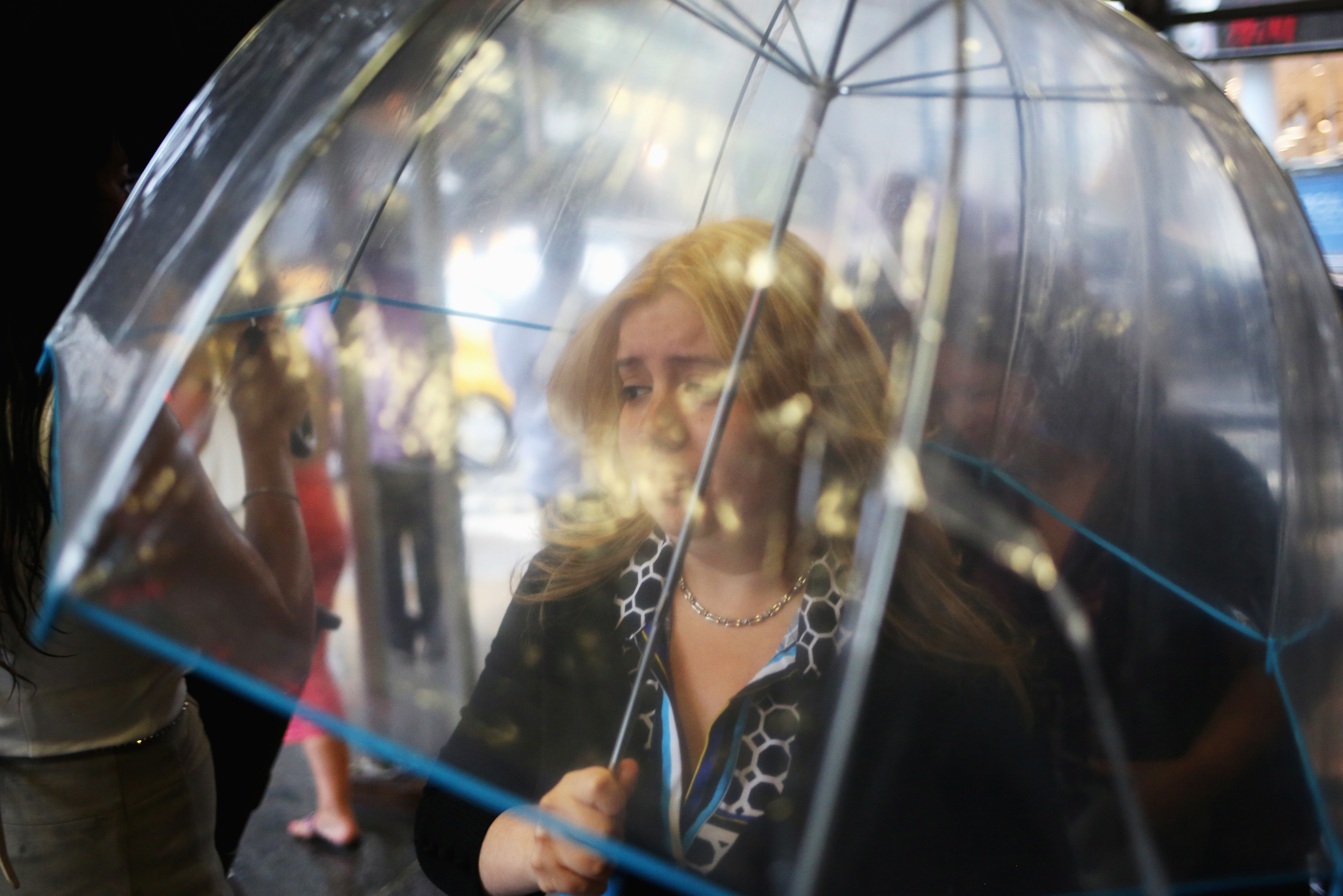
Torrential Rainstorm Pounds Manhattan, Adding To An Already Above Average Rainy July

Would you believe New York is one of them? Eric Jaffe examines a new working paper on the subject:

Some of the happiest cities measured by [economist Edward] Glaeser and company were Charlottesville, Virginia; Rochester, Minnesota; Lafayette, Louisiana; Naples, Florida; and Flagstaff, Arizona – in keeping with a classic theory that people like to go where it’s warm. Some of the least happy places were Scranton and Erie, Pennsylvania; South Bend and Gary, Indiana; New York, Pittsburgh, and Detroit.

These relationships held true even after controlling for income and employment, and after considering factors like education, race, and age. … What’s more, these unhappy places tended to have unhappy histories. Glaeser and collaborators found that the connection between place and happiness held true whether they took into account long-term residents or those who just moved there. In other words, it’s not that these places were once happy and then became unhappy after just a few years of decline. Rather, in the eyes of the researchers, these are and have long been “unhappy cities.”

Ben Casselman further unpacks the research and notes:

The authors find that in past decades, places with lower levels of happiness tended to have higher average wages; more recently, less happy places have had lower average rents.

(Photo: A woman walks through the rain under an umbrella on 5th Avenue in Midtown Manhattan on July 15, 2014 in New York City. By John Moore/Getty Images.)

Reminiscing Was Better In The Old Days

So argues James Wolcott in an essay exploring the recent 90s nostalgia craze:

Nostalgia isn’t the worst narcotic, but it used to feed a different vein. It was both generational and individual, a distillation of personal experience as unrecoverable as blushing youth. When F. Scott Fitzgerald, the dewiest prose lyricist of the Jazz Age, peered back at the reckless abandon and champagne fizz of the 20s through the clouded curtains of the Depression-era 30s, he elegized himself, Zelda, and the rest of his strewn generation for who they were and what they did. Sixties nostalgia operated that way too, the pang of regret over who so many of them were (rebels, hippies, wanderers, crusaders) and what they became (reactionaries, office drones, commuters, cynics).

In our media-saturated age, when every couch potato is king, this mode of nostalgia no longer applies.

It isn’t about who we aspired to be as fledglings leaving the nest—full of hopes and dreams and boogying hormones—but about what we watched, played, listened to, downloaded, and identified with as junior consumers. Before the Web became our neural extension, when print and celluloid held reign, the passage of time and the discrimination of critics and enthusiasts winnowed away the flotsam and jetsam of the past, allowing its true achievements and revelatory visions (even those unheralded or derided at the time) to surface and radiate.

The Internet, however, is an inexhaustible suction pump that indiscriminately dredges up the dreck along with the sunken pearls. Search engines are scouring devices, algorithms have no taste buds, and monster Web-site aggregators such as BuzzFeed—which one writer called the Hellmouth of 90s nostalgifying, with its inane quizzes (“Which ‘Dawson’s Creek’ Character Are You?”) and dipstick listicles (“32 Reasons Christmas Was Better in the ’90s”)—are to curating what hoarders are to connoisseurship.

Dance Of The Sunflowers

Why do sunflowers track the Sun from east to west every day? New research indicates the plants “are not responding simply to light, but also to an internal clock”:

Plant biologists Hagop Atamian and Stacey Harmer of the University of California in Davis grew sunflowers in a field and then transferred them to growth chambers with a fixed overhead light that was always on. The plants continued their daily journey from east to west and back for several days after the transfer, suggesting that they were not responding only to the direction of the light, but their own timekeeper….

The researchers went on to study gene expression on each side of the plant. Atamian hopes to use this data to learn more about how a sunflower’s internal clock can alter growth on one side of the stem but not the other. “Somehow the same clock in the same organ is having opposite effects on opposite sides of the stem,” he says. “It’s a big open question.”

Other plants perform a similar diurnal dance, including agriculturally important crops such as soybeans, cotton and alfalfa. Such solar tracking has been shown to boost plant yield. But sunflowers eventually weary of the waltz. Mature sunflowers stop tracking the Sun and stand straight — often facing the east, ready to soak up each new sunrise.

Mambo De Moscow

Over the past week, Russia has taken a number of steps to revive its partnership with the Castro regime in Cuba. Ahead of a visit to Havana last Friday, Putin announced that he was writing off $32 billion of the island’s debt to Moscow, and just Wednesday, Russian media broke the news that Putin would reopen a Soviet-era intelligence facility there:

Opened in 1967, the Lourdes facility was the Soviet Union’s largest foreign base, a mere 155 miles from the US coast. It employed up to 3,000 military and intelligence personnel to intercept a wide array of American telephone and radio communications, but Putin announced its closure in 2001 because it was too expensive – Russia had been paying $200m (£117m) a year in rent – and in response to US demands. … “Lourdes gave the Soviet Union eyes in the whole of the western hemisphere.

Jay Ulfelder expects this revival to delay, but not forestall, Cuba’s economic reckoning:

Putin’s government seems to be responding in kind to what it perceives as a deepening U.S. threat on its own borders, and this is important in its own right. As a specialist on the survival and transformation of authoritarian regimes, though, I am also interested in how this reinvigorated relationship affects prospects for political change in Cuba. …

None of these developments magically resolves the fundamental flaws in Cuba’s political economy, and so far the government shows no signs of rolling back the process of limited liberalization it has already begun. What’s more, Russia also has economic problems of its own, so it’s not clear how much help it can offer and how long it will be able to sustain that support. Even so, these developments probably do shrink the probability that the Cuban economy will tip soon into a deeper crisis, and with it the near-term prospects for a broader political transformation.