Why Undertipping Makes You A Real Jackass, Ctd

More readers chip in:

The tipping debate seems to rear its head somewhere online every year or so now, and I’ve never understood what the big fucking deal is. I’m a former server, bartender, and front-of-house manager; I’ve worked at family restaurants and bars in the Midwest and a tourist trap in New York City (which was probably the most fun job I’ve ever had). My experience is far from exhaustive – there are plenty of people who’ve been in the industry longer and worked at more places in more parts of the country – but I have some idea what I’m talking about, and I am staunchly pro-tipping. Here’s why:

1. I’ve never heard a server complain they weren’t making enough. Whenever I hear some concerned soul expressing anxiety over how servers need to stop getting tipped and be paid a real minimum wage, I’m reminded of the activists who want to stamp out all sex work without asking any sex workers how they feel about it. There were a lot of things that bugged me about waiting tables, but the money I made was never one of them. Yes, you can have a bad shift. Generally speaking, though, my coworkers and I came out making substantially more per hour in tips than we would have getting paid minimum wage. (I will absolutely grant that this may not be the case at every establishment, especially right now – but I would guess that’s more a function of the economy than of tipping itself.)

2. Tipping gives everyone more freedom and flexibility. As you rightly noted, if restaurants have to pay higher hourly wages, they are going to build that additional expense into the cost of the meal. So the customer will still end up spending the money. As a customer, wouldn’t you rather be able to exercise control over where your money goes? With tipping, if you get crappy service, you pay for your food and can leave your server what little or none they deserve. Without tipping, you’re paying for your food and you’re paying a premium for the service, regardless of quality. (Also: If the anti-tipping crowd really thinks all the additional money from raising prices would make its way into servers’ pockets, I think they’re deluding themselves about how businesses work.)

3. Tips are fun!

I never see anyone talk about this, but tips are largely what makes waiting tables fun. It’s a little game – I think I’m doing a good job. How much are they gonna leave me? Tipping encourages upselling, which is good for the business, good for the economy, and, frankly, a plus for diners. (I’ve never seen anyone uncomfortably coerced into ordering dessert or another drink; I have known hundreds of customers who just needed a little nudge and were very glad for it.) And it’s so much fun to pick up the cash or the credit card slip after they leave. Plus, for all the cheap jerks out there, there are also many people who overtip, especially on special occasions. Sure, hypothetically they still could do so if we abolished tipping as a general practice – but in reality, it wouldn’t happen nearly as often.

Waiting tables is a sales business, and salespeople tend to be motivated by commission. Tips are our commission. Why do people want to take that away, just so (1) we can make less money, (2) they can be forced to pay more for bad service, and (3) we can enjoy our jobs less?

Another is less enthusiastic about the practice:

I wish tipping would go away. It would level the playing field in other ways.

Currently, I overtip because I drink water with restaurant meals – no soda, no alcohol, no coffee or tea, no milkshake. So my check is smaller even though I’m in the seat for the same amount of time as a person having a glass of wine with the meal. I feel I shouldn’t shortchange the waitstaff for my abstinence.

The thing is, I’ve noticed some places the tips appear to be dumped into a common container and pooled. This may help reduce fraud and split the money equally, but it doesn’t reward the server who recognizes me and gives good service. Furthermore, it means my more generous tips just subsidize someone else’s cheapness.

Set the price based on what running the restaurant costs. Stop tipping in all but the really high-end restaurants, and consider stopping it there. Tipping in restaurants is kind of like John Oliver’s “America Ball” lottery, where the servers in high-end venues get richer, but servers at all other restaurants don’t receive increases consonant with the cost of living because people refuse to tip generously, can’t afford to tip, or are living so long their ingrained tipping habits result in undertipping. There are also teens who go on group trips – say, a sports clinic at a nearby college – eat someplace where they are waited on, and totally stiff the servers because either they’re poor, short of money or ignorant because they’re used to paying for fast food, where the labor cost is part of the posted prices.

2408593449_f40a675123_zI hope this would mean that places like sandwich shops and bagel stores, which never had tipping but have to pay minimum wage, would stop with the tip jar by the register, too. Delis and doughnut shops never used to do that kind of begging until the minimum wage stagnated and someone decided taking your order was the same as providing table service. I guess that proves I’ve become an old fogey, too, if not a jackass in one respect.

(Photo by Flickr user Lightsight)

The Case For Cameras In The Jailhouse

Pell v. Procunier, which upheld the constitutionality of the California Department of Corrections’ decision to forbid press interviews with specific inmates, was decided 40 years ago this summer. Looking back on that ruling and on Angela Davis’ famous 1972 prison interview (above), Adrian Shirk traces the ruling’s ramifications through the decades and explains why the rarity of such interviews today is a bad thing:

Since Pell v. Procunier, access to inmates has diminished steadily from coast to coast.

In 2013, media-access scholar Jessica Pupovac noted in The Crime Report that today, “at least five states (Arizona, Alabama, Georgia, Louisiana and Michigan) make any access the exception to the rule” and that Kansas and Michigan flat out refuse to arrange interviews with specific inmates. In Florida, Kansas, Michigan, New York, and New Hampshire, inmates must “put reporters on their visitation or phone call list if they wish to speak to them, thus forfeiting a visit or call with family or friends.” In Wyoming, officials can screen all questions ahead of time, and if an interview veers from the approved list, a minder can end it. Even state correctional departments that don’t explicitly deny media access to specific inmates still have sanction under Pell to make ad-hoc restrictions and deny access on a case-by-case basis. Meanwhile, the California State Correctional Manual remains unchanged.

The fact that journalists are still allowed direct contact through mail protects a decent portion of testimonial integrity. But what if the inmate is illiterate? Or dyslexic? Or simply can’t communicate well on the page? The ruling also assumes that visual and sonic information is not integral to reporting and does not carry its own unique body of information. In Freedom of the Press: A Reference Guide to the United States Constitution, Lyrissa Barnett Lidsky and R. George Wright propose that while a document like Martin Luther King Jr.’s “Letter from the Birmingham Jail” may have had deeper and broader effects than any number of broadcast interviews, a “televised interview may convey a sense of visual immediacy and dynamism far beyond the capacity of typical letter writing or letter reading.”

Teaching To The Text

Meredith Broussard argues that standardized tests measure “specific knowledge contained in specific sets of books: the textbooks created by the test makers”:

All of this has to do with the economics of testing. Across the nation, standardized tests come from one of three companies: CTB McGraw Hill, Houghton Mifflin Harcourt, or Pearson. These corporations write the tests, grade the tests, and publish the books that students use to prepare for the tests. Houghton Mifflin has a 38 percent market share, according to its press materials. In 2013, the company brought in $1.38 billion in revenue.

Put simply, any teacher who wants his or her students to pass the tests has to give out books from the Big Three publishers. If you look at a textbook from one of these companies and look at the standardized tests written by the same company, even a third grader can see that many of the questions on the test are similar to the questions in the book. In fact, Pearson came under fire last year for using a passage on a standardized test that was taken verbatim from a Pearson textbook.

Jarvis DeBerry adds:

If standardized tests are going to be based on textbooks that school systems can’t afford, [Broussard] writes, then you can guarantee that poor school districts are going to fail. She points out that in the 2012-13 school year, a school in Southwest Philadelphia used a reading curriculum by Houghton Mifflin called the Elements of Literature. The textbook paired with that curriculum costs $114.75. The school’s entire textbook budget per child? $30.30.

Update from a reader:

So we’ve gone from “teaching to the test” to “teaching to the text?” What’s the difference? None, actually! And what’s wrong with either of them? Why would you NOT want to test for the success of what you’ve taught or trained students to do? It’s absurd that this would even be a question.

Would you give a test in physics for a class in English? Well, maybe if you wanted to test the student on the reading of physics, but in order to do that you have to be able to understand physics. Reading is for one of two things – pleasure or gaining knowledge – and in order to comprehend one of the key elements is background knowledge.

Background knowledge, or rather the lack of it, is the root of the reading problem. If a child from an impoverished area has never heard of let alone seen about painting a fence, how can they even understand the concept?

Standardized testing is a problem. Personally, I believe it should never be used in measurement for evaluating. It should be a tool to decide what is missing and what needs to be the next step. Politicians and corporations are responsible for the evaluating turn. The tests are written for recall and regurgitation. They do not show what a student is capable of accomplishing.

The Common Core has been assailed for many different reasons. The #1 we’ve seen is parents not understanding the questions. Louis C.K. made a big deal because of a math problem his daughter had that he couldn’t understand. He said there was no answer. There was an answer, but he was looking for 2+2=4 and the question asked why the student had solved the question incorrectly. No one tried to even identify the multiple problem solving steps that had to be in play. Well, at least the adults didn’t; all they did was bitch because they actually felt stupid – well, ignorant actually. A 4th grader would be trained to answer the problem; the first step they have to take is to solve the stated question correctly; they then work back to see what the other student did incorrectly. This, in itself, is invaluable.

Education has this problem of reinventing the wheel. It usually comes from the insistence of outside influences. Influences that have no idea of what they speak. Something interesting has been quietly happening in schools around the country. Teachers & principals are re-finding John Dewey’s Progressive Education. They are also being incredibly successful, not only with the kids but also doing better & better on the standardized tests.

Oh, if you look closely at Common Core, you can discover that most of it is based on John Dewey. Here is a link to Wiki. If you just look at the bullet points at the beginning, you can get an idea of what it’s about – Progressive Education.

Haute But Reheated

fast foie gras

Sandra Haurant reports on a new French law that asks restaurants to label their dishes as from-scratch or otherwise:

It might be surprising that a country whose cuisine has World Heritage status needs such a law. And yes, there are plenty of restaurants across France serving delicious freshly cooked food. But midrange restaurants in particular have faced criticism for using factory-made shortcuts in the kitchen.

A survey carried out by French catering union Synhorcat suggested 31% of restaurants (not including cafeterias, bars and fast food outlets) used industrially prepared foods Others claim the proportion is much higher – Xavier Denamur, restaurateur and fresh-food campaigner and filmmaker, carried out his own personal survey, which took him to dozens of restaurants throughout France. He believes closer to three quarters of restaurants relied on industrially produced food.

Lizzie Porter, meanwhile, argues that French cuisine’s greater flaw is monotony, which bureaucratic intervention doesn’t address:

[T]he last thing France needs is yet more rules and symbols to nurture and promote its best cuisine. Already, diners are confronted by an army of stamps and logos that purportly mark quality. Label Rouge denotes free-range eggs and poultry “reared using traditional, free-range production methods”, for example, while AOC – “appellation d’origine contrôlée” (controlled designation of origin) – specifies products, including cheese, meat, lavender and lentils, which have been grown and processed by specific producers in designated geographical areas.

The ins and outs of all the various quality stamps are enough to leave even the most passionate foodie scratching his or her head. Indeed, the proof is in le burger when it comes to younger French generations, who seemingly cannot get enough of fast food chains like McDonald’s and Quick (a French version of Maccy D’s). And when the first Parisian Burger King opened last year, locals queued around the block for a taste of the Whopper.

While France has commendably preserved an independent restaurant industry and pockets of excellent regional cuisine, the latter of which has all but fallen by the wayside in Britain, its haughty belief that its classics are better than everyone else’s is the bigger concern. Instead of stifling restaurant owners with another layer of bureaucracy with which they may comply (inspections on restaurants claiming to offer food “fait maison” are to come into force next year), the French government would be better to foster an environment in which diversity and ingenuity in cooking are encouraged.

(Photo by Amy Ross)

Harassment In The Field

Not even scientists are safe from it:

The paper, published in PLOS ONE, surveyed more than 600 anthropologists, archaeologists, biologists, zoologists, and other scientists about their experiences while doing fieldwork away from the university. And the picture was disturbing – here were many experiences of sexual harassment and assault, as well as little awareness of how to report abuses.

Now, the survey was not a random sampling of researchers – so this can’t be used to extrapolate the frequency of sexual harassment. But it’s the best existing data set yet on harassment and assault within science. And the data suggests that this indeed an issue in need of closer attention.

Brandy Zadrozny delves into the findings:

Incidences were much more common with women: 71 percent of women reported harassment and 26 percent reported assault on site, compared to men’s 41 percent and 6 percent respectively. …

[T]he majority of women victims were subordinates who oftentimes worked directly under their perpetrators, while harassment aimed at men usually came from peers. Similar to existing harassment research that shows the most vulnerable are often predominantly targeted, 96 percent of women reported they were trainees or employees at the time of unwanted sexual attention. Five were still in high school.

Caelainn Hogan revisits one woman who came out about her experiences:

Two years ago, a young woman identified as “Hazed” spoke out about her experience of sexual harassment in the field and her professor who joked that only “pretty women” were allowed work for him, confiding in [study coauthor Kate] Clancy who made the story public in a blog post on Scientific American in 2012. “There were jokes about selling me as a prostitute on the local market,” the young woman wrote. The size of her breasts and her sexual history were openly discussed by her professor and her male peers, and daily pornographic photos appeared in her private workspace. “What started out as seemingly harmless joking spiraled out of control, I felt marginalized and under attack, and my work performance suffered as a result,” she wrote.

Henry Gass notes that this is the first study to examine harassment during scientific field studies:

The trips can last for weeks or months, taking scientists to wild and remote areas, far from home and support systems. …. While there isn’t much data to support it, [Study coauthor Katie] Hinde said many survey respondents had described a “what happens in the field, stays in the field” attitude. “I speculate that yes, some academics consider ‘the field’ as different from other workspaces such as the office, lab, or classroom in such a way that relaxes or suspends workplace norms of behavior,” Hinde wrote in a follow-up email.

The Best Of The Dish Today

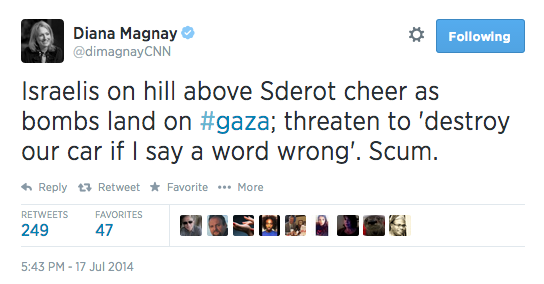
Dorsey Shaw flags the above video and notes that “a few minutes later, the reporter, CNN’s Diana Magnay, tweeted this and then deleted it about 20 minutes later:”

enhanced-31646-1405634778-17

She was right the first time. As if on cue, the US Senate passed a resolution backing Israel’s new invasion of Gaza:

Sens. Bob Menendez (D-N.J.) and Lindsey Graham (R-S.C.) authored S.Res. 498, which reaffirms Senate support for Israel, condemns unprovoked rocket fire and calls on Hamas to stop all rocket attacks on Israel. “The United States Senate is in Israel’s camp,” Graham said on the Senate floor Thursday.

We knew that already, Butters. Only too well.

I have only two thoughts about the horrifying events in Ukraine. First, a prayer for the souls lost and their loved ones. Second, a provisional inference: If the plane was downed by the Russian separatists – as seems pretty obvious from the smoking gun audio – then Putin has just found out how reckless grandstanding can come back and bite you back in the posterior. It will change a huge amount in the fraught politics between Putin’s neo-fascist Russia and Europe. The new Tsar will soon have a choice: to keep lying and become an international pariah, or to back down and get a grip. I suspect he’ll keep lying … and quietly back down. But these are Thursday night conjectures. They may evaporate with more information by the morning.

You can read all our Ukraine coverage of today in one place here. And you can read all our coverage of the Gaza war in one place here.

We’re now at 29,550 subscribers. You can join them and help get us to 30,000 here – and get access to all the readons and Deep Dish – for a little as $1.99 month. Gift subscriptions are available here. A new Dishhead writes:

Just wanted to say I subscribed this evening for the first time. I discovered your blog a few months ago when that horrendous gay discrimination bill in Kansas blew over and was really impressed with the quality of the discussion, so I’ve stuck around since then, religiously reading the posts as they come in. After today’s one-two punch of the Israeli invasion of Gaza and the shooting down of the plane over Ukraine, coming here for the news is like night and day compared with the sensationalism of traditional media. Looking forward to scouring the Deep Dish in the weeks to come. Keep it up.

See you in the morning.

Will Israel Crush Hamas?

That appears to be the objective as IDF ground troops continue to infiltrate Gaza:

This morning’s reports that a cease-fire could occur by Friday morning are now looking much less likely. “The IDF’s objective as defined by the Israeli government is to establish a reality in which Israeli residents can live in safety and security without continues indiscriminate terror, while striking a significant blow to Hamas’ terror infrastructure,” the Israel Defense Forces said in a statement late Thursday, confirming it had begun a ground operation in Gaza.

“The prime minister and defense minister have instructed the IDF to begin a ground operation tonight in order to hit the terror tunnels from Gaza into Israel,” Benjamin Netanyahu’s office confirmed. “In light of Hamas’ continuous criminal aggression, and the dangerous infiltration into Israeli territory, Israel is obligated to act in defense of its citizens.” Casualties have already been reported.

Josh Marshall interprets this as a sign that Netanyahu has capitulated to his coalition’s right flank:

The backstory on the Israeli side has been a tug of war between the military chain of command and the government over whether to intensify the campaign in Gaza and whether to launch a ground invasion. The military, cognizant of 2009, has generally been trying to avoid an intensification of the campaign. And Netanyahu himself seems to have been generally siding with the generals, but with intensifying demands from members of his own government for a full out ground assault. As the rocket fire out of the strip has continued, the pressure to launch a ground invasion has escalated. That question now seems to have been answered.

While that may be the case, Yishai Schwartz argues, “the more likely explanation is that Israel just didn’t have any other options”:

Israel could have continued its aerial and artillery exchanges with Hamas, but this campaign did not appear to be damaging either the will or the capability of Hamas. It could have loosened its rules of engagement and struck Hamas more effectivelybut doing so would have inflicted unconscionably disproportionate civilian damage. It could have capitulated to Hamas’s ultimatums to release hundreds of security prisoners and reopened Gaza to shipments of arms- and tunnel-making materials. Apart from the moral implications of such a concession, doing so would simply have strengthened Hamas and ensured additional fighting. An extended cease-fire would be ideal. But so far, Egyptian attempts to broker such a cease-fire seem to have fallen on deaf ears. So Netanyahu was left with a choice that wasn’t really much of a choice.

Fred Kaplan believes Israel is no longer thinking strategically:

[L]et’s say an invasion crushes Hamas, a feasible outcome if the Israeli army were let loose. Then what? Either the Israelis have to re-occupy Gaza, with all the burdens and dangers that entails—the cost of cleaning up and providing services, the constant danger of gunfire and worse from local rebels (whose ranks will now include the fathers, brothers, and cousins of those killed), and the everyday demoralization afflicting the oppressed and the oppressors. Or the Israelis move in, then get out, leaving a hellhole fertile for plowing by militias, including ISIS-style Islamists, far more dangerous than Hamas.

Either way, what’s the point?

Mataconis speculates:

This could simply be a relatively small operation on Israel’s part designed to maximize the gains it has made against Hamas in the current conflict before a cease fire takes hold. That is not an uncommon tactic in war, of course, so it would make sense if that’s what’s going on here. For the moment at least, though, there doesn’t seem to be any indication that the military is limiting its objectives in this operation, and Hamas seems to be fighting back as vigorously as they can. Given all that, I’d put the odds of a cease fire at any time in the [near] future as being pretty slim if not non-existent.

Indeed, ceasefire talks are going nowhere fast:

Earlier in the day, Palestinian Authority President Mahmoud Abbas and Arab League Secretary-General Nabil Al-Arabi conducted cease-fire talks in Cairo. The session was also attended by an Israeli delegation but it left after several hours of discussions. For the time being, Arab diplomats in New York were waiting to see whether talks in Egypt on a cease-fire progress before deciding whether to turn to the U.N. Security Council for help in stopping the fighting. “There is intense effort being made by President Abbas in Cairo in trying to finalize what would be a cease-fire,” said one Arab diplomat. “That’s where all the efforts are for the moment.”

Even if a ceasefire does takes hold, Ibrahim Sharqieh stresses, nothing will be resolved:

It is delusional to assume that when the current battle ends, both parties will return to their communities to resume normal lives. The Israeli-Palestinian conflict has created two meanings of normality. The 40,000 Israeli reservists who were called up this time will, for the most part, go back to their jobs and homes when the fighting ends. But Gazans, 39% of whom are unemployed, will go back to their “normal” lives under the brutal conditions of the Gaza blockade and be at the mercy of Israel’s rules about what type and quantity of food and other basics are allowed into Gaza. The Palestinians in the West Bank will go back to their daily humiliation of roadblocks and expanding Israeli settlements at the expense of their livelihoods. …

To prevent another tragic war in the future, things must change. Palestinians mainly need two things: dignity and bread. Israel must end the occupation in general and the Gaza blockade in particular. The mistake of the 2008 and 2012 mediation efforts was that they produced cease-fires that allowed the Israelis to go back to business as usual — but left the Gaza blockade intact and perpetuated untenable conditions, which led to further and bloodier fighting.

The Timing Of Our Sanctions

It’s quite a coincidence. Yesterday, before today’s tragedy, the US Treasury announced new sanctions on a number of Russian individuals and businesses. Beauchamp tries to understand the rationale behind them:

What’s the point of imposing them now?

“I’d assume it’s the blatant transfer of Russian weapons to the rebels,” Dan Drezner, a professor at Tufts’ Fletcher School and an expert on sanctions, said. Indeed, Russia has been openly dumping weapons — including tanks and rocket launchers — into East Ukraine. That’s because the Ukrainian military had been slowly getting the upper hand over the Russian-backed separatists, including retaking two major rebel-held cities, Slovyansk and Kramatorsk, in early July.

Keith Johnson and Jamila Trindle explain the sanctions:

Despite the tough talk, the United States didn’t cut off whole sectors of the Russian economy, but it went after four big energy and finance firms. The Treasury Department banned a pair of big Russian banks — Gazprombank and VEB, Russia’s state-owned development bank — from issuing any new debt or equity in U.S. markets. It also banned two energy giants, Novatek and Rosneft, from tapping U.S. debt markets. But the United States did not target Gazprom, Russia’s mammoth oil and gas firm, directly. The United States also blacklisted eight Russian arms firms and a list of senior Russian officials.

The sanctions announced Wednesday will essentially close U.S. capital markets to those big firms. That limits those big firms’ abilities to roll over or refinance their debts, making it more expensive for them to borrow new money. Officials said those firms would likely have to turn to Russia’s Central Bank to try to fill their financing needs.

Leonid Bershidsky is unimpressed:

[The announcement] names large companies such as the state-controlled oil major Rosneft, second-biggest natural gas producer Novatek, third biggest bank, Gazprombank, and government-owned development bank, VEB, which makes for impressive headlines. But the sanctions against them are narrow.

The banks are not banned from dollar clearing, and Gazprombank-issued Mastercard and Visa cards will still work, unlike for a few previously sanctioned small Russian banks. The energy companies can still trade with U.S. entities. Igor Sechin, Rosneft CEO and Putin’s close friend, says he is confident his company’s several big projects with ExxonMobil are going ahead, and nobody in the U.S. has contradicted him.

The only thing denied to the big Russian companies will be new financing with a maturity of more than 90 days from U.S. entities and individuals. The markets have already taken care of that: In recent months, it has become hard for Russian public and semi-public companies to line up foreign credit.

Although the new sanctions include “tons of loops and caveats,” Ioffe is persuaded that they might be effective in the longer term:

In sum, it’s a gradual ratcheting up, as slow-motion as the conflict on the ground. But it’s definitely a powerful crank of the handle. Take, for instance, ExxonMobil: the sanctions don’t kill its multi-billion-dollar deal with Rosneft outright, but they might eventually. The official said that these sanctions “don’t provide an exemption for Exxon.” Under this latest order, certain types of transactions and refinancing could easily be blocked, throwing the whole deal into jeopardy. (Apparently, these plans weren’t shared with Exxon in advance and the sanctions team seems pretty indifferent to the oil giant’s coming travails. “What they do now I cannot say,” the official said.)

“It’s as much a signal to Wall Street as it is to the Kremlin,” says [the head of Russia research for the Eurasia Group, Alexander] Kliment. “While the measures are limited in certain ways, the U.S. is making clear that its not scared to go after major Russian companies. It’s a pretty wide noose at the moment, but it’s one the U.S. is prepared to tighten.”

Robert Kahn is cautiously optimistic that the sanctions will bite, especially if Europe plays along:

It is not quite full “sectoral” sanctions–both because it is limited in what it blocks (new debt and equity of maturity greater than 90 days) and because it excludes Sberbank, which holds the majority of Russian deposits. But I would argue that the reach of this new executive order in terms of institutions covered is sufficiently broad that the effects on the Russian financial system could be systemic.

Europe chose not to match these sanctions, so it is critical that large European banks not fill the gap left by the withdrawal of U.S. banks.  Moral suasion from European leaders on their banks (and the desire of those banks not to run afoul of U.S. law in this space post BNP/Citi fines) should be effective, and U.S. officials appear confident that the easy loopholes are closed.  In addition, if any leg of the transactions require U.S. institutions, the deals will fail based on U.S. action alone.  In this sense, the U.S. can go ahead of Europe and pull them along.

Henry Farrell wonders if the downing of MH17 will push EU leaders to impose harsher sanctions of their own:

If it turns out that Russian sponsored rebels have used Russian advanced weaponry to down an aircraft bound from the Dutch capital to Kuala Lumpur, it may transform Europe’s debate, and make it far harder for countries like Italy to remain holdouts. EU member states – like all states – tend to be pretty hard nosed about pursuing their self-interest, and it could be that several countries would prefer to limit their actions to rhetorical condemnations. …

However, as Frank Schimmelfennig shows in his account of bargaining over E.U. enlargement, states can also find themselves “entrapped” by rhetoric into taking positions that run counter to their true preferences.

But, even if the EU decides against new sanctions, Russian trade with Europe is already on the downslope:

According to new data out today (pdf), trade with Russia shrank particularly sharply in the first four months of 2014, a period that includes the annexation of Crimea in March and a few rounds of EU travel bans and asset freezes against Russian officials. The EU’s imports from Russia—mainly oil and gas—fell by 9% in the year to April, while exports from the EU to Russia dropped by 11%. Given steadily souring relations, further declines seem likely. …

But even without explicit sanctions, the EU has been hitting Russia where it hurts. Various technical and bureaucratic hurdles have been erected to limit the flow of Russian gas into the EU via Germany, Ukraine, and a proposed southern pipeline. Today the EU delayed, again, a decision on allowing more Russian gas to flow through a pipeline to Germany. Structural, long-term dynamics in global energy markets won’t be kind to Russia’s key exports, either. It all adds up to more trouble ahead for Russia’s sputtering economy.

The Dish covered the two previous rounds of US sanctions on Russia here, here, here, and here.

What The Hell Just Happened Over The Skies Of Ukraine? Ctd

UKRAINE-RUSSIA-POLITICS-CRISIS-MALAYSIA-ACCIDENT-CRASH

The latest developments via Twitter:

A reader reacts to that statement:

That’s all I need to know that Russia and/or its Ukrainian rebels shot down the airline. Putin is preemptively seeking to muddy the waters of blame.

All of our crash coverage is here.

(Photo: A woman lights a candle in front of the Embassy of the Netherlands in Kiev on July 17, 2014, to commemorate passengers of Malaysian Airlines flight MH17 carrying 295 people from Amsterdam to Kuala Lumpur which crashed in eastern Ukraine. By Sergei Supinsky/AFP/Getty Images)