Face Of The Day

Air Malaysia Passenger Jet Crashes In Eastern Ukraine

Family members are leaving Schiphol airport in Amsterdam, Netherlands in a provided bus on July 17, 2014. Air Malaysia flight MH17 travelling from Amsterdam to Kuala Lumpur has crashed on the Ukraine/Russia border near the town of Shaktersk. The Boeing 777 was carrying 280 passengers and 15 crew members. By Robin Utrecht Photography/Getty Images.

Flying Over A Conflict Zone

It’s more common than you’d think:

Since April, the Federal Aviation Administration had banned U.S. carriers from flying over Crimea and the Black Sea (due to potential miscommunication between Ukrainian and Russian air traffic officials and “related potential misidentification of civil aircraft”). But that no-fly zone did not include the mainland part of Ukraine where the Malaysian flight appeared to go down — and where the airline had flown regularly, once a day, in recent weeks.

The jet was on a major route:

Even more worrying is that the planned path that brought MH17 near the disputed region, known as airway L980, is one of the most popular and most congested air routes in the world. L980 is a key link between major international hubs in Europe, such as London Heathrow, Amsterdam Schiphol, and Frankfurt, and Asian megacities, like Singapore, Mumbai, and Hong Kong. The airspace over Ukraine is traveled by virtually every commercial flight from Western Europe to south Asia.

But they are avoiding that airspace now:

“A Game-Changer For Ukraine”

That’s Feaver’s read of the tragedy:

[I]f Ukraine is at fault, then Obama’s options of response are more limited: mainly reinvigorating efforts at negotiation. If Russia or pro-Russian forces are at fault, we will UKRAINE-AVIATION-ACCIDENT-RUSSIA-MALAYSIAlikely see much greater pressure to ratchet up sanctions even more significantly than has happened thus far, albeit in conjunction with reinvigorated efforts along the diplomatic track. Moreover, if Russia or pro-Russian forces are at fault, this puts Putin on the defensive to the point where a meaningful retreat is plausible — not a retreat from Crimea, which appears to be lost, but a retreat on Eastern Ukrainian pressure points — provided that Obama does in fact re-engage at a level commensurate with the stakes.

Ioffe agrees that this is major:

Make no mistake: this is a really, really, really big deal. This is the first downing of a civilian jetliner in this conflict and, if it was the rebels who brought it down, all kinds of ugly things follow. For one thing, what seemed to be gelling into a frozen local conflict has now broken into a new phase, one that directly threatens European security. The plane, let’s recall, was flying from Amsterdam.

For another, U.S. officials have long been saying that there’s only one place that rebels can get this kind of heavy, sophisticated weaponry: Russia. This is why a fresh round of sanctions was announced yesterday. Now, the U.S. and a long-reluctant Europe may be forced to do more and implement less surgical and more painful sanctions.

This also seems to prove that Russia has lost control of the rebels, who have been complaining for some time of being abandoned by President Vladimir Putin.

(Photo: A picture taken on July 17, 2014 shows bodies amongst the wreckages of the Malaysian airliner carrying 295 people from Amsterdam to Kuala Lumpur after it crashed, near the town of Shaktarsk, in rebel-held east Ukraine. By Dominique Faget/AFP/Getty Images)

Did The Rebels Do It?

Ukraine

Max Fisher examines a big piece of evidence:

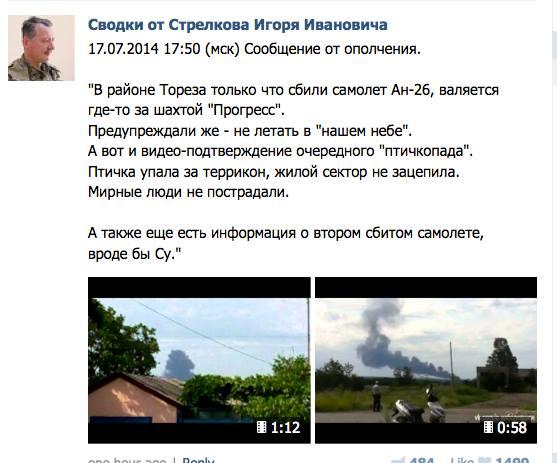
It looked like the smoking gun: exactly 35 minutes after Malaysia Airlines flight 17 went down over eastern Ukraine, a social media account belonging to the eastern Ukrainian rebel commander Igor Strelkov posted a message bragging of having “brought down” an aircraft.

But there this isn’t as clear-cut as it first seemed:

(1) Strelkov’s post, on the Russian social networking site VK, was quickly deleted. A later post appeared to blame Ukrainian government forces for shooting down the plane.

(2) The VK account may not actually be run by Strelkov at all. BuzzFeed’s Max Seddon spoke to eastern Ukrainian rebels who said the page “is a fake made by fans.” If that’s the case, it may be that Strelkov fanboys saw the plane go down, surmised (perhaps wrongly) that rebels had shot them down, and bragged about it on the VK page. It is also possible, to be fair, that the rebels were lying to Seddon about the VK page.

(3) Strelkov’s post appeared to claim credit for shooting down not a civilian airliner but an Antonov AN-26, a two-prop transport plane that is often used by militaries in eastern Europe. The AN-26 is 78 feet long; MH17 was a Boeing 777, which is 242 feet long. It’s possible that rebels mistook the large Boeing 777 for a much smaller AN-26, especially from thousands of feet away. But this casts a bit further doubt on the idea that people fired on the airplane and then posted on VK about it; if someone fired on the plane they likely would have noticed it was a large jet and not a small-ish prop plane.

Ukraine is blaming Russia:

On The Ground In Gaza: Tweet Reax

https://twitter.com/jetpack/status/489863843749707777

https://twitter.com/SullyR_/status/489867655776845825

How Hard Is Shooting Down A Jetliner?

Elena Holodny talked to sources on the ground that confirm seeing a Buk missile system near the site of the crash. Alexis Madrigal explains that “it may sound implausible that a group of rebel fighters could take out a 777, but, given the right anti-aircraft weaponry, it is not”:

The Buk system was developed by the old Soviet Union. Its missile batteries are portable. The missiles themselves are radar guided. If one is in the area, and there are people who can operate it, it has the technical capability to shoot missiles far beyond 33,000 feet.

A passenger jet, in particular, would make an easy target, relative to a fighter jet or a rocket. They are big and they move in very predictable straight lines across the sky. Passenger planes emit a transponder signal, too, which could be used for tracking.

Linda Kinstler suspects that whoever “shot down the Malaysia Airlines flight MH17 over Donetsk on Thursday, killing all 295 people aboard, probably didn’t know what they were shooting at”:

It appears that the plane was taken down by a Soviet-era Buk missile system, which separatists claimed to have gotten their hands on when they gained control of a Ukrainian air defense base on June 29. The Buk is a Soviet-era air defense system used by both Ukrainian and Russian defense forces.

“When you’re sitting behind a radar screen of one of these things, there’s no way to tell what it is. With the Buk, there’s no way to distinguish between friendly and foe. You’re just going to take a shot at it,” says Raymond Finch, a Eurasian military analyst at the Foreign Military Studies Office. “If [the separatists] had reports that the Ukrainians were flying over their airspace, they would shoot. It begs the question of who is sitting behind the trigger. Are they highly trained? My guess is no they are not.”

It’s highly possible that the civilian airliner was mistaken for a Ukrainian Il-76 military transport plane, the same model that separatists in Luhansk shot down on June 14, killing all 49 people on board, mostly Ukrainian servicemen.

A Slow Injustice?

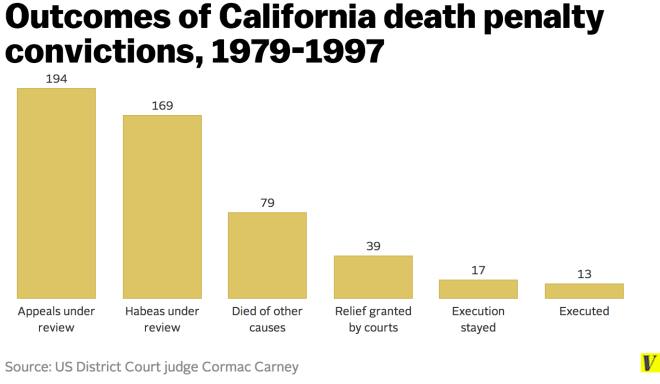
Outcomes_of_California_death_penalty_convictions__1979_1997

A California judge has ruled that the state’s death penalty is unconstitutional because it’s too slow and unpredictable:

In a case brought by a death row inmate against the warden of San Quentin state prison, [US District Court Judge Cormac] Carney called the death penalty an empty promise that violates the Eighth Amendment’s protection against cruel and unusual punishment. “Inordinate and unpredictable delay has resulted in a death penalty system in which very few of the hundreds of individuals sentenced to death have been, or even will be, executed by the State,” the ruling read. A death penalty appeal can last decades, Carney said, resulting in most condemned inmates dying of natural causes.

Dylan Matthews looks closely at the ruling:

Carney’s opinion was accompanied by a long appendix table detailing the outcomes of every death sentence between 1979 and 1997 [see above chart]; he excluded sentences after that year because “for all but a small handful of those individuals, state proceedings are still ongoing, and none have completed the federal habeas process.” The data excludes convictions that were overturned by the California Supreme Court and those whose “post-conviction proceedings have not been stayed based on their lack of mental competency to face the death penalty.”  …

What’s more, Carney argues, there isn’t anything separating the rare cases where executions actually occurred from the vast majority where they didn’t. Whether someone dies by execution is primarily determined, he writes, “depend[s] upon a factor largely outside an inmate’s control, and wholly divorced from the penological purposes the State sought to achieve by sentencing him to death in the first instance: how quickly the inmate proceeds through the State’s dysfunctional post-conviction review process.”

Andrew Cohen grimly notes that Carney’s rationale “isn’t that the state’s capital system is prone to error, or rife with racial disparity, or arbitrary in its application, even though it is plaintively all of those things”:

Instead, this appointee of George W. Bush concluded that the “machinery of death” grinds too slowly in California for it to sustain itself under the Eighth Amendment. Delay, he contends, is the decisive constitutional flaw in the grim mechanism.

“Just as inordinate delay and unpredictability of executions eliminate any deterrent effect California’s death penalty might have,” Judge Carney wrote, “so too do such delay and unpredictability defeat the death penalty’s retributive objective.” And without those two justifications for capital punishment, deterrence and retribution, the judge argues, there is no constitutional basis for the government to kill one of its citizens, at least none the United States Supreme Court has recently recognized.

Tom McKay calls the ruling “a major state-level victory for death penalty abolitionists,” and law professor Hadar Aviram describes it as “the first time I can think of since the 1970s that a judicial opinion has taken on the death penalty as a whole rather than just the individual.” But Scott Shackford warns opponents of capital punishment not to get too excited:

The ruling is very specific to the nature of the delays in California and thus it’s not clear whether the case has implications outside of the Golden State. Certainly it takes years for other states to coordinate their executions, but it’s not necessarily the case that California’s slow (and extremely expensive! Let’s not forget how expensive it is! California’s highest public salaries are in the prisons and criminal justice spheres.) process is like those in other states.

And also, before anti-death-penalty advocates celebrate, this ruling is about the process, not the outcome. It is not a judgment against the use of the death penalty. It is a judgment against California’s broken system and its inability to apply it fairly and consistently.

Ashby Jones has more on the Golden State context:

For years, critics of the death penalty in California have argued that the system in the state, which often involves numerous appeals and lengthy waits for qualified, court-appointed lawyers, is woefully inefficient. For instance, a 2011 study co-authored by Arthur Alarcón, a judge on the Ninth Circuit, found California had spent more than $4 billion on capital punishment since it was reinstated in 1978 – about $308 million for each of the 13 executions since then.

Mark Berman adds:

Voters in California rejected an attempt to eliminate the state’s death penalty in 2012. There was a push this year to speed up the execution process and shorten appeals (an initiative supported by three former California governors), but it failed to make it on the ballot, so organizers are planning to make a push for November 2016.

But, he notes, the national picture looks very different:

There has been a shift in recent years away from the death penalty, with one-third of the states that have banned capital punishment doing so since 2007. The last state to abolish the death penalty was Maryland last year, though New Hampshire came very, very close earlier this year. Still, executions are happening less often than they did even two decades ago, a decline that has occurred as American support for capital punishment has also fallen.

Dan Markel zooms out:

Having worked my way through the opinion by Judge Cormac Carney (a GWB appointee), I imagine the outcome won’t stand on appeal to SCOTUS should it get there. That said, with Justice Kennedy as the swing vote deciding on California issues, you never know for sure. Moreover, Justice Breyer has in the past voiced concern about foot-dragging death penalty delays.

What The Hell Just Happened Over The Skies Of Ukraine? Ctd

A reader adds:

Reading the coverage and the collection of tweets on your blog, I think it’s worth pointing out that whatever the rebels and anyone else might say, the rebels themselves were touting that they had the Buk system less than three weeks ago!

Another:

After reading this remarkable post on the Guardian site, I discovered a report from only hours ago on the ITAR-TASS site about a Ukrainian military craft being downed by rebels (an An-26 mentioned above). It’s too early to conclude anything, of course, but the evidence so far sure seems to point to a fuck up of horrible dimensions on the part of the rebels.

But another urges caution:

I got home from work early and am a bit of an airplane nut, so I turned on the TV to see if there was anything on about the Malaysian Airlines flight.  I’m flipping through channels and I see wall-to-wall coverage of this crash.  Why?  I’ve been watching an ABC News Special Report and you have Ray Kelly talking about terrorism, you have Richard Clarke talking about terrorism, you have (the normally more composed) Martha Raddtz talking about how this is the scariest time in the world that she can recall.

What the hell are these people talking about???

The only story here is that a passenger plan may have been shot down IN THE MIDDLE OF A MILITARY CONFLICT where there were warnings for commercial flights not to pass through the area.  There is NO suggestion of “terrorism.”  There is NO connection to anything occurring in Israel/Gaza, Syria, Yemen, or Iraq. There is NO connection to ISIS.  So why is the media treating these current events as if they are all connected and that the connection is that they all pose an immediate threat to the United States?

There is an interesting story here, particularly for ramifications for Russia’s relations with the EU and how the Ukraine situation is handled in the future.  But this is not going to cause the U.S. to become involved in World War III with the Russians.  Though it’s hard to think that the U.S. media doesn’t want that.

The hysteria is completely out of control and incredibly irresponsible.  I’m not sure there is anything that can be done about this, but covering these kind of events as if they were 9/11 all over again is going to cause the same post-9/11 mistakes and overreach to be made all over again.

We are tracking the coverage and will post credible updates as soon as we get them. Update from a reader, who responds to the most recent one above:

Terrorism doesn’t begin and end with 9-11 and the Middle East or threats to the United States. I guess I understand how many Americans don’t know about much of the past 50 years of activity of ETA, IRA, Red Army Faction/Baader-Meinhof Group terrorism throughout the world. Even that leaves out terrorism by states such as bombing of Venezuelan commercial airline flights by the CIA. Many people around the globe took to America’s post-9/11 propaganda technique of calling their military opponents “terrorists.” This isn’t anything new.

Another reason this is being called “terrorism” is because the Ukrainian government has called these Russian special forces troops masquerading as separatists “terrorists” from the beginning of the conflict. When Ukraine announced the downing this morning, they immediately called it an act of terror. The only difference between these Russian special forces troops and IS (ISIS) and Al-Qaeda besides affiliations is probably suicide missions. IS is no more deadly than when Russian forces were operating in Chechnya. As was previously reported, these same guys in Ukraine have been doing the same thing for years in Georgia and elsewhere. For a good idea on just what types of scheming Russia is doing to regain some territory lost after the fall of communism check out this Foreign Affairs article. Estonia dealt with the exact same pre-op setup with Russians claiming mistreatment of Russian Estonians and fake protest rallies. Most of the protesters in that situation were undercover Estonian security operatives. Estonia never allowed things to progress to a Crimea or Georgia level.

Another:

If this video posted by the Ukrainian security services isn’t a fake, it is a smoking gun:

It’s in Russian, but essentially you have rebel commanders bragging about shooting down a plane, happily acknowledging it is a civilian one, and subsequently discovering it is Malay.

How Americans See The Border Crisis

immigration2c

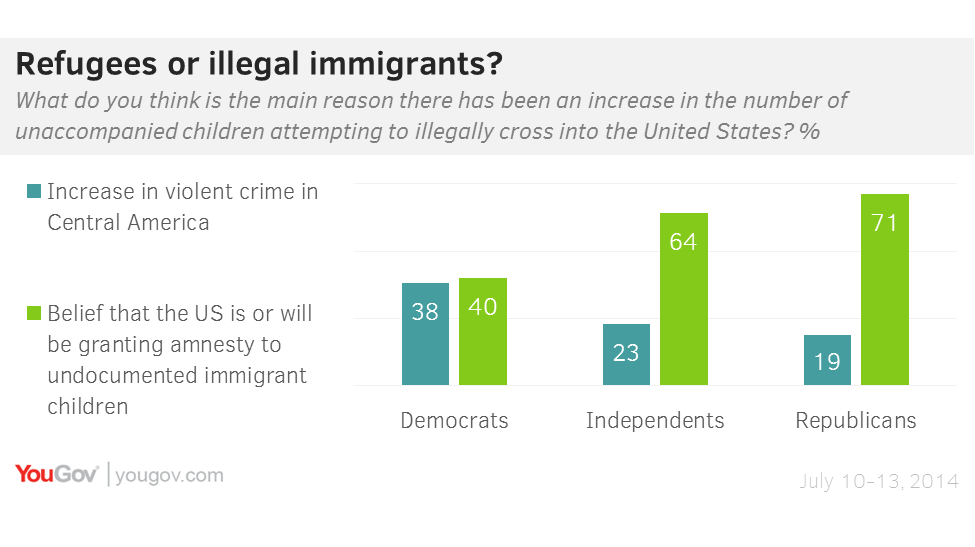
A new YouGov poll shows that more Americans attribute it to US immigration policy than to Central American gang violence:

The latest research from YouGov shows that most Americans (58%) think that the main reason behind the surge in child illegal immigration is a belief that the US is or soon will be granting amnesty to children. Only 27% think that the main cause is the increase in violent crime in Central America.

The same poll finds that 58 percent disapprove of the president’s handling of the situation and that 47 percent believe that deporting the migrant children as soon as possible should be a top priority. Dara Lind scrutinizes this last finding:

More than anything, the poll shows that Americans don’t agree on the right policy response because they don’t agree on the facts.

Americans are split on whether or not children would be safe in their home countries; 39 percent think they’re fleeing unsafe places, while 36 percent think they have somewhere safe to return. … It’s easy to look at this sort of confusion and take away the idea that Americans generally want tens of thousands of kids to be deported. The poll does show that’s true, to an extent. But that’s also because Americans are looking at the confusion in Washington and on the border and gravitating toward the option that seems most decisive — and in this case, that’s throwing more money at the border, and fast and furious deportations.