Which Religions Does America Like?

Emma Green flags a Pew survey on how different religious groups view each other:

As the researchers pointed out, respondents were much more likely to report feeling “warmly” toward the religious group they wereReligions part of; Catholics were all about other Catholics, evangelicals were enthusiastic about evangelicals, etc. Of all the groups in the survey, Jews felt most loyal to their own tribe; their mean “warmth” rating of other Jews was “89” out of 100, which roughly translates to “we’re totally awesome guys” on Pew’s ratings scale.

Still, despite the home-team advantage of the Christians in the survey, who made up more than two-thirds of the sample, Jews got the highest overall ratings. A good chunk of the respondents said they don’t even know any Jewish people; only 60 percent said they’d ever met a Jew. These feelings of warmth toward Jews aren’t just fond personal memories of Mrs. Rosenberg from down the street, who makes an excellent kugel; they’re a sign of a broad acceptance and appreciation of Jewish culture. Outside of New York City, Jews are generally rare in terms of numbers. Yet in spite of this, they’ve become seen as normal—and popular—by the population at large.

And yet the specter of anti-Semitism forever stalking the land is almost a trope now of the Greater Israel lobby. Josh Kovensky highlights more details from the survey:

Jews and atheists, though only 2 percent of the population each, are familiar to the majority of the public, with 61 percent of Americans knowing a Jew and 59 percent knowing an atheist (that they’re aware of, at least). These two groups had the “coolest” view toward Evangelicals out of any group, with atheists giving Evangelicals a 28, a rating rivaled in its frigidity only by Evangelicals’ perception of atheists, at 25. Evangelicals rated Jews at 69as the report notes, “only Jews rate themselves more highly” at 89, the highest rating of any group by any group surveyed. The approval, however, is unrequitedJews rated Evangelicals a 34. Atheists and Evangelicals share the same self-love, with each group giving members of their own tribe an 82.

Allahpundit ponders Evangelicals’ unrequited love for Jews:

White evangelicals view Jews “warmly” with a rating of 69; Jews, meanwhile, give evangelicals a rating of … 34, which is a point lower than their rating of Muslims. Could be that evangelicals, when asked about Jews, instinctively think of Israel and foreign policy whereas Jews, most of whom lean Democratic, think mainly of domestic policy when asked about evangelical Christians. Go figure that a socially liberal, solidly Democratic group would look skeptically at the GOP’s conservative base. When you ask Jews about a Christian group that’s not closely identified with either party, i.e. Catholics, the rating shoots up to 58, the second highest number (behind Buddhists) that Jews gave to any other group. That’s the proof, I think, that the numbers here are to some extent a proxy for politics rather than a gauge of religion.

Christopher Ingraham focuses on the left-right divide in the survey:

Overall, the Democratic spread between most-liked and least-liked faith groups is 18 points, compared to 38 points among Republicans. This reflects a number of political realities, the first being that Republicans are more than three times as likely as Democrats to be white evangelical Protestants. Republicans are also more likely to say that religion plays an important role in their lives. … Religious identity is less fundamental to the Democratic party, so Democrats’ disposition toward religious groups are more muted than Republicans’. In the end this makes for a broader religious coalition, but one with less intensity of feeling.

How Gay Is America?

Not very, according to the CDC:

The National Health Interview Survey, which is the government’s premier tool for annually assessing Americans’ health and behaviors, found that 1.6 percent of adults self-identify as gay or lesbian, and 0.7 percent consider themselves bisexual. The overwhelming majority of adults, 96.6 percent, labeled themselves as straight in the 2013 survey. An additional 1.1 percent declined to answer, responded “I don’t know the answer,” or said they were “something else.”

The figures offered a slightly smaller assessment of the size of the gay, lesbian and bisexual population than other surveys, which have pegged the overall proportion at closer to 3.5 or 4 percent. In particular, the estimate for bisexuals was lower than in some other surveys.

Eugene Volokh notes that, according to the CDC, lesbian and bisexual women slightly outnumber their male counterparts:

1.8 percent of men self-identify as gay and 0.4 percent as bisexual, and 1.5 percent of women self-identify as lesbian and 0.9 percent as bisexual. The results are generally in the same ballpark as past estimates — and far below the long-debunked 10 percent estimate. But past data that I’ve seen had suggested that there were about twice as many gay or bisexual men as lesbian or bisexual women; this data suggests that there is no such gender gap.

Meanwhile, Arit John considers the importance of framing:

The survey comes up with a number that’s lower than the 3.5 to 4 percent figure found in other surveys. And as we’ve seen from past surveys, what’s asked matters. Specifically, the broadness of the answers available to respondents makes a difference.

In 2007, researchers at Cornell University interviewed 20,000 individuals in 80 communities. “Mostly heterosexual” was an option for respondents, and the results showed a higher percentage of nonheterosexuality, especially among women:

85.1 percent of the young women identified as heterosexual; 0.5 percent reported no sexual identity; and the remaining 14.4 percent were sexual but not strictly heterosexual, i.e. either lesbian or bisexual. Among young men, 94.0 percent identified themselves as heterosexual; 0.4 percent of the men reported no sexual identity; and the remaining 5.6 percent identified as gay or bisexual.

Meanwhile, the study showed that gay and lesbian Americans were healthier than US heterosexuals in some respects and less so in others – more likely to drink, for example, but also more likely to exercise.

The Limits Of Universalism

PALESTINIAN-ISRAEL-CONFLICT-FUNERAL

Fallows, in a post about the effectiveness of Israel’s US-financed Iron Dome, excerpts a moving letter from an American rabbi in Jerusalem about huddling in an air-raid shelter during a Hamas rocket raid. In a follow-up post, Jim notes that,

After quoting his message, I said that from past correspondence I knew the writer to be a person of broadly universalistic, rather than narrow, human sympathies. Although he had sent his note before the latest horror of the four Palestinian boys killed while playing on the beach, I said that I knew he must be aware of the fear and grief on both sides—with the great disproportion of the recent death and grieving occurring among the Palestinians.

Not so fast. The rabbi wrote back indignantly:

I was taken aback by your juxtaposition of my comment to your reporting of the deaths of the Palestinian children the next day. Those deaths were beyond horrible and tragic. But I found it very troubling that you sought to create a perception of parity between my experience and perspective and the death of Palestinian innocent civilians on the other. The death of those innocents lies at the feet of Hamas who began this terror offensive and continued it despite the Israeli government’s agreement to adhere to a cease fire.

The idea that there is any parity between those civilians sheltering from rockets in Israel and civilians enduring the bloody and largely unprotected siege of Gaza is something that takes the rabbi aback.

(Photo: Palestinian hospital workers prepare the body of six-year-old Osama Al-Astal, who was killed in his home along with his four-year-old sister and two relatives following an Israeli air strike, ahead of his funeral in Khan Yunis in the southern Gaza Strip on July 17, 2014. By Mahmud Hams/AFP/Getty Images.)

The Internet Is For Sleuthing

Peter Baker interviews author Deborah Halber about her book on amateur detectives who use the Internet to solve cold cases:

“An unidentified corpse is the Blanche DuBois of the forensic world: completely dependent on the kindness of strangers,” says Deborah Halber in her book about amateur Web sleuths who solve cold cases. According to a 2004 survey—the first and only of its kind—there are at least 13,486 Blanches nationwide, with about a thousand more added to the rolls each year. Amateur sleuths congregate online, swapping information and theories, looking for details or connections, poring over facial reconstructions, dental records, and serial numbers on breast implants and artificial joints. Halber says these forums have “propelled a remarkable shift in the number of cases solved, and in the relationship between the public and law enforcement.”

America has always loved the amateur detective, or the pro gone rogue. … Add the Internet to this strain of American do-it-yourself amateurism and you get the group of Web gumshoes Halber calls “the Skeleton Crew.” She recounts several cold cases, and she profiles active hunters. Some know the hurt of going years without information about a missing relative, and take satisfaction in relieving others from that pain. (This almost always means letting them know the person in question is definitely dead—a comforting if not happy finality. “I’m trying to help families get closure, because I don’t seem to be able to get it for myself,” says one sleuth.) Some are men fixated on the corpses of pretty women. Some read about a case in the news, then get sucked in by the online vortex of possibly relevant evidence, the connections radiating in every direction, the allure of scoring a “solve.” Many amateurs find, online, possibilities for creative thinking and meaning they lack in the drudgery of daily life.

Churchill’s Leading Role

Reviewing Jonathan Rose’s The Literary Churchill: Author, Reader, Actor, Michael F. Bishop appreciates the insights offered by approaching Sir Winston through the writing he both produced and loved:

Like Abraham Lincoln, the greatest statesman of the 19th century, Winston Churchill, the 640px-Churchill_waves_to_crowdsgreatest of the 20th, had a genius for language. But unlike Lincoln, Churchill made a lucrative living as an author, inflating both his bank balance and his reputation with prodigious (and shrewdly self-promoting) feats of literary craftsmanship. In this sometimes speculative but immensely enjoyable biography, Jonathan Rose shows that Churchill’s authorial and political careers were entwined and inseparable. And he convincingly argues that while “tracking down literary influences is often dismissed as a purely academic exercise . . . sometimes the lives of millions depend on what their rulers read.”

According to Rose, Churchill was principally driven in life by “the desire to frame a thrilling story” for himself, and “once we understand that as his life goal, then Churchill’s impulsive courtship of danger becomes predictable, explicable, and eminently reasonable.” To Rose, his performance on the world stage was influenced in part by the theater, especially the Victorian melodrama of his youth. This sense of life as a drama, with him in the starring role, prompted both rash judgments and acts of dazzling courage. While a more prosaic outlook might have helped him avoid misadventures, it would have deprived Britain of its “finest hour” in 1940.

In an earlier take on the book, Sam Leith had more on how Churchill’s flair for the dramatic helped  him understand Hitler’s rise:

Rose paints Churchill as a man in love with the bold stroke — the coup de théâtre — and mired in a view of the world as Victorian melodrama. While the fractured categories and stalled certainties of modernism were making the literary weather, Churchill looked backwards. His was a world of clear identities, dramatic reversals and good triumphing pluckily over evil. His ideas of everything from Irish Home Rule to the government of native populations in India are credited with having been formed by the view from the cheap seats. He spoke claptrap — which, as Rose tells us more than once, is a term from melodrama: the inspiring speech the hero makes with his back to the wall, trapping the audience into applause.

This is the stopped-clock version of how Churchill got the fascists right: Hitler was one type of melodramatic villain (dark, shouty, moustachioed); Mussolini (treacherous, semi-comic) another. It just happened that silly old Winston, who sonorously predicted the final crisis of western civilisation once a week or so, happened to coincide with the real thing. Rose’s dimmish view of Churchill seeps up like ground-water. He presents him as an egotistical lunatic obsessed with being remembered as one of the great men of history, heedless of who died to make that dream come true, and with a script for achieving it based, more or less, on a bunch of babyish Victorian pantos.

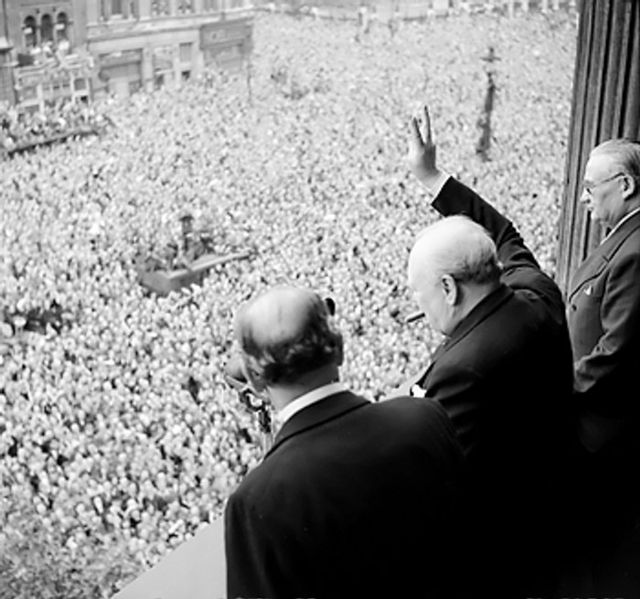
(Image: Churchill waves to crowds in Whitehall on the day he broadcast to the nation that the war with Germany had been won, 8 May 1945, via Wikimedia Commons)

Exercise Is Good For You

But some cardiologists worry that too much is bad for the heart. Lisa Rosenbaum examines their claims:

After reviewing the data and interviewing experts in the field, my own impression is that among people without known cardiovascular disease there is no compelling data to suggest that mortality significantly differs between moderate and extreme exercisers. There is thus no way to precisely define an upper limit of exercise for an average healthy individual. I suspect, though, that part of what sustains the “too much exercise can kill you” myth is the widespread recognition of the so-called exercise paradox. That is, while consistent exercise decreases the likelihood that you will have a heart attack, if you are destined to have one it is more likely to happen while you are exercising. That’s why no one can issue a blanket statement that extreme exercise is safe. It’s also why so many researchers have attempted to figure out how to make extreme exercise as safe as possible.

The Moral Case Against Zoos

Intercoastal System

Pivoting off Alex Halberstadt’s piece from last week, Benjamin Wallace Wells argues forcefully against keeping animals captive:

A giraffe who freaks out about men with large cameras, a brown bear whose cage door is the subject of his obsessive compulsive disorder, a 5,000-pound killer whale who shows her trainer who is boss by dragging him underwater for just about as long as he can live, before letting him go — these episodes seem like something more complicated than simple errors of confinement. It is hard to avoid the conclusion that in some way the animals understand that the world around them is an artificial one, that these phobias and psychotic episodes represent reactions to that artifice, or subversions of it. Which means that the central illusion of the zoo is no longer holding. The animals know.

All of which makes [veterinarian] Vint Virga’s project — sustaining that illusion, by incremental changes in how the animals are treated — seem more than a little quixotic. Last August, the Costa Rican government announced it was closing all its zoos. The new policy, the government declared, was “no cages.” (A court ruling has so far kept the zoos open.) I think we’re moving slowly toward the same sensibility. In 25 years, there will likely still be some way for Americans to see exotic animals. But I will be pretty surprised if those places have cages, mirrors, smoke machines, and conference-room tanks for 12,000-pound whales. There may be nature preserves. But it seems to me that we’re pretty rapidly reaching the end of the era of the modern urban zoo.

Relatedly, Laurel Braitman reports on the giving of psychiatric drugs to zoo animals. Here’s the story of the Central Park Zoo’s polar bear Gus:

[T]he zoo staff didn’t want Gus to scare children or their parents, so they put up barriers to keep visitors farther away from the window. Gus soon started to swim in endless figure eights.

Hoping to curb the neurotic behavior, the zoo hired Tim Desmond, an animal trainer who had trained the orca who played Willy in the film Free Willy. Desmond was able to reduce Gus’s compulsions by giving him new things to do, such as bear food puzzles or snacks that took him longer to eat: mackerel frozen in blocks of ice or chicken wrapped in rawhide.

The zoo redesigned his exhibit and installed a play area stocked with rubber trash cans and traffic cones that Gus could pretend-maul. They also put him on Prozac. I do not know how long he was on the drug, or even if it was as effective as his new exhibit and entertainment schedule, but eventually Gus’s compulsive swimming tapered off, though it never went away entirely.

(Image from Daniel Kukla’s Captive Landscapes series. Earlier Dish on Kukla’s work here. See more of it here.)

When Bacteria Get Sick

Michael Byrne explains what happens:

It’s tempting to look at bacteria as a kind of binary realm, with “good” and the “bad” sorts that have good and bad impacts on health, when it’s really not that easy. Our own personal bacterial flora might help keep harmful bacteria at bay through competitive pressure, but the goodness of these tiny helpers is less a function of benevolence than geography – set them loose elsewhere in the body, beyond the inner-outside of the digestive tract, and very bad things will happen. A different set of bad things awaits a host with just a bit too much or too little friendly bacteria, ranging from cancer to inflammatory bowel diseases. While it’s possible to live without gut flora, such an existence portends a wide variety of troubles.

One fascinating aspect of this would-be dualism is how the bacteria that we provisionally know as friendly and harmful interact with each other. We know well enough that our gut flora help us out with immunity and keeping virulent bacterial invaders at bay, but it’s hardly because of some secret intraspecies armistice. A study out [last] week in the journal PLOS ONE examines the response of gut flora (in mice) to colitis-causing bacterial infection elsewhere in the body, finding that our own personal colonies of helper bacteria get sick themselves in a very real sense. It’s an observation that paves the way for not just better understandings of bacterial interrelationships, but also “early warning” tools for diseases.

The Crossword’s Puzzle

3167153820_a4eb3c4cc2_z

Tanya Basu considers the future of the newspaper standard:

A print loyalist, [Binghamton University English professor Michael Sharp] notes that demographics of newspaper readership dictate the content of the crossword puzzle and therefore, what segment of the population is interested in it. In fact, he predicts the average puzzle solver is a college-educated white woman in her sixties. “It’s still older college-educated white people who dominate the solver base, and I don’t think apps change that,” Sharp remarked. “It’s worth noting that solver demographics might look very different if you move off of the Times and more elite puzzles.”

But apps are the future of crosswords, and puzzle aficionados realize this. According to a Pew report, tablet usage has spiked among those over 65, with 27 percent of senior citizens owning a device; only 18 percent of seniors own a smartphone. But paper is still the preferred method by which seniors get their news: while 59 percent go online every day, they lag behind their younger counterparts. Something, however, gets muddled in using a tablet versus newsprint, and puzzlers worry about the loss of the ink-on-paper experience.

(Photo via Flickr user Pete)

When Your Heart Goes Out, Ctd

A few readers respond to our post on people who pass away after the death of loved ones:

This reminded me of one of my favorite Kurt Vonnegut gems, from Cat’s Cradle. Without getting too into Bokononism, Vonnegut describes a specific kind of karass called a “duprass” which is a pairing of people who stay together for life. Whenever I hear about someone who dies from grief soon after the death of their spouse, I always think of the duprass. Per Vonnegut:

“A duprass … is a a valuable instrument for gaining and developing, in the privacy of an interminable love affair, insights that are queer but true.”

“A true duprass … can’t be invaded, not even by children born of such a union.”

“Members of a duprass always die within a week of each other.”

Another raises a related issue:

Don’t ignore advance care planning, the process that can relieve so much of the stress, pain, and spiritual distress you write about so eloquently. If we have rich, reflective discussions about our past experiences, choose an agent wisely, and share our values and wants with them as we move through life, the whole dying process is different.

I’m gonna keep bugging you about this. Advance care planning is great policy and superb blog fodder. I’m a loyal Dishhead and something of a leader in this movement, and ready to share more as soon as you are. One video introduction to the concept is here.