Far more entertaining than butter melting:
Category: The Dish
An Archbishop Heightens The Contradictions, Ctd
Yesterday, we got a glimpse of the actual affidavit filed by the former chancellor of the archdiocese of St Paul and Minneapolis that charges the Archbishop and others of continuing to ignore child sex abusers in their midst. Jennifer Haselberger appears to be a rare figure who actually cared about the safety and welfare of children in the archdiocese and tried to keep the entire place operating professionally and legally. And failed on both counts. What makes this case different is that the cover-up of child-abuse is occurring long after new rules were put in place to prevent it, and we have in Haselberger an unprecedented whistle-blower from the inside:
Most clergy abuse lawsuits rely on decades-old documents, testimony from a handful of experts on church law, and depositions from recalcitrant church officials and abusive priests. Top chancery officials rarely come forward to disclose the church’s secrets. [Attorney Jeff] Anderson called the affidavit “historically important” in the history of the clergy sexual abuse scandal in the U.S. Catholic Church.
Haselberger resigned in April 2013 in protest over the archdiocese’s handling of abuse cases. She contacted MPR News in July 2013 and disclosed how Nienstedt and other top officials gave special payments to abusive priests, failed to report alleged sex crimes to police and kept some abusers in ministry. Her account was especially stunning because it involved decisions made by church leaders as recently as April 2013.
To add to this toxic stew, Nienstedt is fighting back against “multiple allegations” of inappropriate sexual encounters with seminarians, priests and other men – including one accused of child abuse. He is also – surprise! – an almost fanatical opponent of marriage equality and a constant, obsessive voice against the evils of homosexuality. Dreher flips out at the prospect of another theocon revealed as a fucked-up fraud:
Haselberger says what drove her to quit in anger was realizing how little the archdiocese cared about protecting children, only protecting priests — even priests they knew were guilty — and how vulnerable children were. She says that Archbishop Nienstedt was such a micromanager that he would send stern notes (“nastygrams”) to chancery employees for such petty offenses as leaving the lights on, or not wearing a tie — but when it came to dealing with clerical sexual misconduct, he was seemingly indifferent … If Haselberger is telling the truth, it staggers the mind to think that Pope Francis — who has the right to remove Nienstedt — tolerates this man remaining in charge a single day longer.
It will and should be another acid test for this Pope on child abuse. This is about enforcing rules that have now long been implemented; it’s about retaining even a sliver of moral credibility; and it’s about protecting children from psychologically damaged products of the church’s incoherent and impossible teachings on sex. I wish I were more hopeful. But who can be, at this point?
Nah – The Young Are Still Leaning Left

Using some new Gallup data, Leonhardt pushes back on the notion that today’s teenagers are more conservative than millennials:
For starters, the Gallup data indicates that today’s oldest teenagers do not identify themselves as any more conservative than people in their 20s. About 27 percent of 18- to 21-year-olds identify as liberal, compared with about 25 percent who call themselves conservative. Among 25- to 29-year-olds, the liberal lead is 28 percent to 27 percent. … Eighteen- and 19-year-olds look roughly as Democratic-leaning as people in their 20s. The Democrats have an advantage of about 14 or 15 percentage points.
Chait chimes in:
As Leonhardt notes, there may be a slight tilt away from the Democrats. But that still would count not so much as good news for Republicans as somewhat less terrible news.
As every election cycle, older, Republican-leaning voters die off and are replaced by newer, Democratic-leaning ones. If the youngest and newest cohort is somewhat less Democratic leaning than the previous one, it would slow the process. But it’s like having your house flood at a slightly less rapid pace. The fabled new teenage conservatism remains as yet illusory.
Yglesias feels that the GOP is simply out-of-touch with today’s youth:
There’s something very oldsterish about contemporary conservative politics. The constant bickering about Ronald Reagan is very odd to anyone too young to have any particular recollection of the Reagan years. Calling a group of people “Beyoncé Voters” as an insult is weird. Some of this oldsterism is just ticks, but some of it has policy implications. The sort of budgetary priorities that call for huge cuts in all domestic spending, except no cuts at all for anyone born before 1959 is kind of weird. The huge freakout over New York City starting a bicycle program last summer was bizarre. It’s easy to imagine a political party that’s broadly favorable to low taxes and light regulation without sharing this particular set of ticks. And then there was the time George Will wrote a column-length rant against blue jeans.
Bernstein bets this will change eventually:
Republicans will adapt to the biases and preferences of people who vote Republican in the 2020s, rather than only attracting people who are drawn to the current Republican mix of policies and rhetoric. And why will people be Republicans? Because they started out as Republicans (either by inheritance, or because they started voting in good Republican years). If the economy collapses when a Democratic president is in office, Republican “oldster” rhetoric isn’t going to matter much.
Or, to put it another way: The reason that Democratic positions and rhetoric, especially on second and third-tier issues, sound good to Yglesias and those younger than him is that he and so many of those folks are Democrats. Not the other way around. And when younger voters are mostly Republican (and, yes, that’s going to happen at some point), then Republican rhetoric and policy preferences will adapt to that cohort.
Book Club: Montaigne As Your Mentor, Ctd
On Monday I’m planning to start the discussion over Sarah Bakewell’s How to Live: Or A Life of Montaigne in One Question and Twenty Attempts at an Answer, so buy the book here if you’d like to join in. My intro to the book selection is here. A reader writes:
Great book recommendation, but I’m pretty pissed at the number of Game Of Thrones
spoilers that Bakewell crams in her work. Henri II is killed in a jousting tournament when his visor is knocked off and a splinter is lodged in his brain? Then his adolescent son takes over under the domineering regency of Cersei – I mean Catherine de Medici? Just replace “Huguenots” with “White Walkers” and I think I know how George RR Martin will end Song of Ice and Fire.
Seriously, this small passage in page 70 of my copy of How To Live was a great reminder that the Middle Ages were more brutal and hostile than even our modern imaginations. Actual history beats the hell out of fantasy.
Another:
I’m a subscriber to Dish, and enjoy the quality of its thought and breadth of exposure to interesting issues. For the second time now, I’ve downloaded a book you’ve recommended (just bought How to Live and just finished On Looking). But when I click on a link to give you credit for the purchase, it only takes me to the Kindle edition. I prefer Apple iBooks, to be read on my iPad. (Yes, I’ve drunk the
iKoolAid.) So I get out of Amazon, go to Apple, and buy the book there, but then you don’t get any credit, or even the knowledge that people are buying stuff you recommend. You might consider additional links to those of us who prefer a different online format.
The iBooks link is here. To help you find the book at a public library, go here. But this link to Amazon is the only way to support the Dish with some affiliate revenue (especially if you purchase other things on your shopping list during that web session). It’s pennies on the dollar, but those pennies add up for a small independent company.
A Shoddy Infrastructure Bill
Arit John sums up yesterday’s news:
The House overwhelmingly passed an unpopular proposal to use revenues from underfunded pensions to pay for one year of funding for the Highway Trust Fund. According to NBC News, the House bill will pay for a 10-month funding extension for road and infrastructure projects “using pension tax changes, customs fees and a transfer from the Leaking Underground Storage Tank Trust Fund.” Despite threats from conservative groups Club for Growth and Heritage Action, only 45 Republicans voted against the bill.
Sargent explains why Republicans voted for the bill:
The battle over infrastructure in the context of the HTF is one area where GOP anti-government rhetoric collides with reality.
It’s easy for Republicans to strut around ranting about crony capitalism, and they know they can attack the Export-Import Bank’s efforts to help U.S. exporters as improper Big Gummint meddling in the economy because no one cares about it. But here was a case where infrastructure projects — and jobs — could have been put on ice in many GOP districts.
Plumer rattles off critics’ objections to the legislation:
For one, the House bill would only avert the crisis until next May — and doesn’t address the underlying structural problems with the Highway Trust Fund. Some Democrats would prefer to deal with the highway problem this December, in the lame-duck session right after the midterm elections. … Other tax experts have criticized the “pension smoothing” provision. As Len Burman points out, the move may not actually raise any money: Yes, companies can reduce their pension contributions now under the rules. But the amount those companies will eventually owe in pensions doesn’t change — which means they’ll have to increase their contributions later (and tax revenues will fall).
Bloomberg View’s editors pine for a long-term fix:
It’s a shame that Obama and members of Congress, including those who wanted to raise the gas tax, didn’t find another solution to the funding problem. The president reluctantly endorsed the House bill, explaining that he does not want to see the fund run dry in August, as the Department of Transportation says it will. That’s understandable, but it’s also shortsighted.
If the bill could be stopped, the economic impact would be limited. Work wouldn’t cease on projects already under way; funding for those is guaranteed. Some states might be forced to delay future projects, but this would help push unions and governors to increase the pressure on Congress to find a better answer. Without strong political pressure, Congress will keep the gimmicks coming — and that needs to stop.
Reform That’s Borderline Impossible
A new WaPo/ABC News poll dings both Obama and Republicans in Congress for their handling of the border crisis:
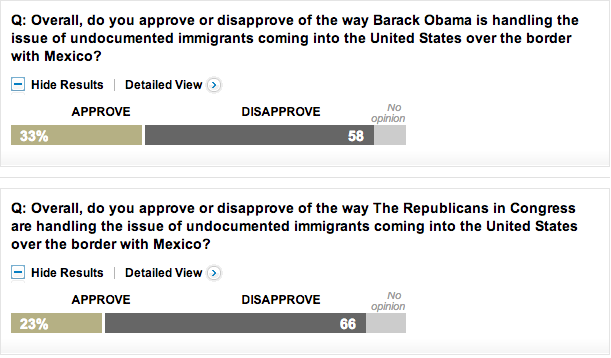
The Republicans fare especially badly, but Noah Rothman attributes that to dissension in the ranks:
Republicans in Congress, who receive poor marks from nearly two-thirds of the public, can attribute some of that antipathy to their own voters. “Almost as many Republicans disapprove of their party’s handling of the issue as say they approve, with negative ratings rising to a majority among conservatives,” reads The Post’s write up of the poll. 48 percent approve of the GOP’s approach to the crisis while 45 percent disapprove. Only 22 percent of independents and 9 percent of Democrats approve of the GOP’s approach to the crisis.
The president, meanwhile, maintains the support of 57 percent of Democrats who approve of his approach to the border crisis. 12 percent of Republicans and 28 percent of independents agree. If the GOP maintained the intraparty unity that Obama benefits from, their numbers would look similar to the president’s.
The poll also asked respondents about the government’s $3.7 billion proposal to address the crisis. Sargent believes these results augur poorly for the plan’s fate in the House:
Crucially, only Republicans and conservatives oppose the plan. A majority of independents (51 percent) and moderates (58) support it, but only 35 percent of Republicans back it, versus 59 percent who are opposed, and only 36 percent of conservatives back it, versus 59 percent who are opposed. Among “conservative Republicans,” those numbers are a dismal 29-66.
This again raises the question: Can any plan to address the crisis pass the House? As I noted the other day, conservative groups such as Heritage Action are opposed, and may “score” the eventual vote on it, meaning more pressure on GOP lawmakers to vote No. Any funding plan first has to clear the Senate, which will be hard, but Democratic aides believe it will be doable. The House is another matter.
Drum agrees:
So Democrats are split and Republicans are opposed. This is not fertile ground for any kind of compromise. The only thing Obama has going for him is that what’s happening on the border really is a crisis, and at some point everyone might genuinely feel like they have to do something. But what? Even Obama’s fairly anodyne proposal has already drawn significant opposition from both sides, and any proposal that moves further to the left or the right will draw even more opposition. This could take a while unless, by some miracle, both parties decided they’re better off just getting this off the table before the midterm elections. But what are the odds of that?
“They Are Only Children!”
The Guardian has a gripping and harrowing firsthand account of the killing of four boys playing soccer today on the beach in Gaza. Others were on the scene:
The Washington Post’s William Booth also witnessed the attack; read his report here. NBC’s Ayman Mohyeldin did as well. The Instagram photo taken by NBC’s Ayman Mohyeldin, shows the mother of one of the victims.
And the beat goes on …
Dissents Of The Day
LIVE UPDATES: Gaza death toll from Israeli strikes up to 202, Palestinian health ministry says http://t.co/1Prlp1PGdE pic.twitter.com/09tF4Gc2FD
— Haaretz.com (@haaretzcom) July 16, 2014
Several readers take issue with my 23 -1 post on proportionality:
A “fair fight”? When did that become an element in the definition of a Just War? The most merciful of wars are probably the ones where one side overwhelmed the other as completely and quickly as possible. Whatever one may think of WWII, its finish (atom bombs and crushing superiority) was certainly not a “fair fight”.
Agreed that the conflation of “fair fight” with “just war” confuses much more than it clarifies. Just war requires never targeting civilians, period. I can merely see the desperate logic behind it, but that doesn’t excuse it for an instant. Another elaborates:
Are you really arguing that “proportionality” means an eye for an eye and that it would be proportional for Israel to shoot the same rockets back at Hamas as Hamas shoots at it but it is totally unfair for Israel to use its technological advantage? Or perhaps Israel is meant to send suicide bombs into civilian areas or something. Maybe the US should have invaded Afghanistan with only the same tools the Taliban had.
Don’t be silly. Proportionality doesn’t mean it has to be a “fair fight”. Israel acts badly in this, but not because it’s better equipped and more powerful than Hamas.
I think Israel‘s best tactic IS to stop responding to Hamas, take purely protective action and say to the world “see, these people keep trying to kill us no matter what we do”. Or maybe Hamas would actually stop attacking and there would be a peace to negotiate in. Stranger things have happened.
Let’s all remember that the Arabs tried repeatedly to wipe out Israel from the moment it was declared to exist. There WAS a two-state solution and they tried to drive it into the sea. If they had lived and let live there would be a two-state solution today. This is all historical fact. The Arab side tried to obliterate Israel, still denies Israel‘s right to exist, and only fails because Israel (with the help of the USA) became too strong for it. I feel sorry for the Palestinian people, but their leadership is what has created this situation. They are not some innocents trodden on by an evil imperialist Israel.
I’m not defending Palestinian leadership over the last several decades because it’s not worth defending. But the West Bank has produced a generation of peaceful leaders in the last decade who have been rewarded for their moderation by ever more settlements and humiliations. And of course, Israel’s original establishment was a radical intervention in another people’s land to which those existing inhabitants never consented. To note Palestinian resistance without noting the Israeli incursion and violence and terror that is known by Palestinians as the nakba is to miss exactly half the story, and to misread everything thereafter. Another reader:
Until Hamas declined the ceasefire, I was largely aligned with your recent coverage of recent events. Even though Israel does not intend to kill those innocents it does, it knows that it will happen, and thus doing so is immoral if the back and forth can be stopped. And I figured if Israel stopped shelling, Hamas would stop wasting its ineffectual missiles. So I put the blame on Israel. I was wrong.
And, yes, the missiles are largely ineffective, but that doesn’t change the fact that Israelis simply shouldn’t ever have to accept that hundreds of missiles fired per day is normal, that no attempt to squelch them is justified. Some Israelis sitting on a hill is a small sample size and proves nothing. There are countless others who describe their fear. As long as Hamas rejects a cease fire, there is no moral ambiguity here.
Even apart from the recent conflict, you routinely neglect to reference a single key fact that really informs my view of the conflict, generally, when I feel torn about what’s “moral” and “right.” And the reader who wrote in on your most recent post “23-1” ignores it entirely.
Only ONE side in this conflict has the power to lay down their arms and renounce violence without the fear of instant death and/or destruction. Hamas, Fatah, and/or Palestinians generally, have the power to actually change the situation. Renounce violence, renounce the right of return, renounce any hold over part of Jerusalem (frankly, I’ve never understood why any country in control of its capital should ever be willing to give part of it up to an enemy that reviles its very existence). If a campaign of peace and acceptance of Israel’s existence swept through the Palestinian communities, then Israel would have no reason to fear opening the West Bank’s border with Jordan, would have no reason to keep Gazans penned, and would have no reason to exist in a state of fear.
And if Netanyahu and his right-wingers in government still kept the situation as is, there would be no ambiguity. It would be immoral with no possible justification. As it is, though, how can you sit here and expect a country with terrorists at its borders to relax and treat the Palestinian communities that support those very terrorists with any kind of respect or trust? How can you suggest that Israel is to blame for the current situation when Israelis (not “Greater Israelis,” who are no better than Hamas) would be happy to live in peace if their neighbors would let them do so? It is a somewhat fanciful notion, given history, but the fact is that Palestinians hold their own salvation in their hands, they just choose to hate instead. Israelis do not have a choice.
I’ll end this just by saying that while Gaza may be on open air prison, and there may be resulting psychological effects from that, Israel is an open air bunker, something that comes with its own attendant psychological effects. Israel is comprised of a bunch of Jews (and some Arabs) surrounded by a sea of millions more who hate them passionately. If you choose to give the Palestinians of Gaza the benefit of the doubt for being imprisoned, you have to do the same for the Israelis.
Is my reader saying that if Israel stopped its Gaza campaign, it would face “the fear of instant death and/or destruction”? Isn’t that exactly what has been disproved in the past decade, as the wall has severed the West Bank and Palestinians from most Israelis and reduced terrorist deaths in Israel proper to a fraction of the past? Hasn’t the Iron Dome also made the notion of instant destruction largely moot, given the pathetic home-made rockets Hamas is sending into the air? Yes, the Palestinians have a choice; but so too do the Israelis. They are the regional super-power. They have virtual impunity for anything they do. Within that context, their extra security on the Jordan border could easily be guaranteed by other countries, and the US has offered to do just that. Israel could easily acquiesce to a real, democratic Palestinian state on the West Bank, and use its success as a way to lure Gazans out of Hamas’ embrace. But Israel not only refuses to do this; it has intensified its colonization of the West Bank, while balking at any efforts to freeze or restrain it; and has fostered an atmosphere of hatred and intolerance that makes any future compromise increasingly hard to envisage at all.
I cannot and won’t justify Hamas’ desperate, criminal, cynical tactics. But there is nothing to negotiate with Bibi Netanyahu over, except the degree to which you are completely fucked. The goal – as plain as day – is to entrench Greater Israel as a permanent state, and, if the brutal logic holds, eventual ethnic cleansing to keep its tenuous Jewish majority. My view is that anyone who does not see that is doomed to misunderstand what’s going on. Which is a sliding, intensifying tragedy.
The View From Your Window

Ann Arbor, Michigan, 11.57 am
Quote For The Day
“Gaza … is a maximum-security facility. It is difficult to visit and impossible to leave. We allow in essential food, water, and electricity so that the prisoners don’t die. Apart from that, we don’t really care about them—that is unless they approach the prison fence, or the “forbidden” perimeter, where anyone who wanders too close is shot, or if they try to throw something over the fence. Indeed, they occasionally throw some homemade bombs made of things they’ve managed to smuggle into prison, and when they fall on our heads, it is really unpleasant. So we send our snipers to the watchtowers built around the prison and shoot them like fish in a barrel until they calm down. And when they finally do calm down, we cease firing because we are not the kind of bastards who shoot people for fun,” – Noam Sheizaf.
 The Dish