The Heart Of Vegetarianism

Looking back at the arguments in Peter Singer’s groundbreaking 1975 book, Animal Liberation, Thomas Rodham Wells realizes he became a convert to vegetarianism more through his heart than his mind:

What won me over was not the rigour or deftness of Singer’s intellectual moves, but a much more basic reshaping of my moral sentiments. I don’t feel a triumph of rationality over desire. I didn’t conclude that I should stop eating meat because that would make the world a better place. Rather, I found my tastes themselves changed by the recognition of the obvious sentience of non-human animals, their possession of personalities, emotional states, and perhaps even firm opinions on some issues (favourite kinds of grass, for example). The repugnance I have come to feel about eating them is an extension of what I would feel about eating my pet cat rather than the product of some calculation of quanta of suffering. My vegetarianism is built up from my moral sentiments, a reluctance to be implicated in the unnecessary suffering of sentient creatures that might be characterised as a kind of moral disgust for cruelty. Unlike the official highly theoretical justification for vegetarianism offered by Singer, mine is visceral, muddled and inconsistent, as I think much of real moral life must be.

Read previous Dish threads on vegetarianism here and here.

The Public Opinion Of Court

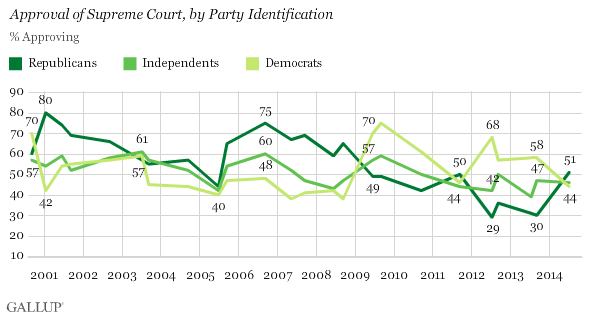
Gallup’s latest poll on the Supreme Court shows a sharp uptick in support among Republicans and a concomitant decline among Democrats:

SuCoGallup

Aaron Blake attributes the partisan split to, well, partisanship:

Just two years ago, after the court upheld the individual mandate portion of Obamacare, Democratic support for the court spiked to 68 percent – near a decade -high. Today, after the Supreme Court ruled that religious employers should be exempt from providing birth control to their employees and continuing rolling back campaign finance rules in McCutcheon v. FEC, the 44 percent of Democrats who endorse the court’s work is near a new low. Similarly, GOP support for the court plunged to 29 percent after the Affordable Care Act decision in 2012 — a new low for the 21st Century. Today, it has spiked to 51 percent — higher than Democrats’.

Even before the current court took over, though, this “what have you done for me lately” attitude was apparent. Republican support for the court peaked at 80 percent after the court signed off on George W. Bush’s 2000 presidential campaign victory. It stayed higher than Democrats for most of the next decade, until more liberal justices were introduced on the current court.

To Ian Millhiser, the chart shows “that most Americans have very short memories when it comes to the Supreme Court”:

And it also suggests that public opinion of the Court is driven by singular, high-profile events rather than by a holistic assessment of the Court’s performance. Democratic support for the Court remained fairly high, for example, after the Supreme Court struck down the anti-gay Defense of Marriage Act in 2013, even though the justices also gutted much of the Voting Rights Act and shielded many bosses who engage in sexual or racial harassment the very same week as the DOMA decision.

Hey Baby

Straight guys often try to charm the ladies with a form of baby talk:

In an article soon to be published in the journal Evolution & Human Behavior, [psychologist Juan David] Leongómez and his colleagues discovered that when (heterosexual) men, for instance, are asked to flirt with a beautiful woman, two noticeable things begin to happen to their voices. First, their voices get deeper … or rather their voices achieve a deeper minimal octave than under comparison conditions. And second, men’s voices become more sing-songy or pitch-variable when speaking to a pretty woman, sort of like, well, how you’d speak to a baby.

It isn’t quite as pronounced as such prosodic “infant-directed speech” (and it’s probably unwise, I hasten to add, for a man to speak to any woman as if she were a puppy), but nonetheless, the investigators found these male voice adjustments during verbal courtship to be an empirically demonstrable effect. What this means is that not only do men’s voices get deeper when they’re chatting up some lovely woman, but they also get higher compared to when their speech is directed at another male or to an unattractive female listener. This effect appeared in both of the language samples tested – native male English and Czech speakers – and even after controlling for the unscripted content of the men’s speech.

What the researchers found about how straight women talk to men:

Interestingly, this so-called paralinguistic courtship modulation effect didn’t occur in women’s voices when they believed that they were speaking to a good-looking man, but it did occur when they were speaking to an attractive woman. That’s to say, when (heterosexual) women thought that they were communicating with an especially pretty member of the same sex, they began to stress their pitch modulation. The reason for this isn’t entirely clear, but it could be, as the authors suggest, that these female speakers’ intended audience is in fact desirable male mates, such that women are attempting to enhance their vocal appeal relative to these highly desirable female competitors. “Pfft. She’s not all that,” in other words. “Check out my natural speaking range.”

Update from a female reader:

I skimmed the post and got to the end and read the ridiculous conclusion of why heterosexual women’s modulation changes while speaking to other attractive heterosexual women, and I scrolled back-up and knew that the study was written by a man. So a heterosexual woman when speaking with an attractive man doesn’t find it necessary to change her voice modulation to attract him but she’s so competitive with other attractive women for a male’s attention that she changes her voice modulation for her? That makes no sense. When I go out with my friends, especially if I haven’t seen them in awhile, I always up the make-up. I wear eye-shadow for my girlfriends. I am not alone. I saw a dear friend this weekend, and after we hugged she said, “I curled my hair for you.” So maybe these women are more focused on what the women think of them, and not focused on knocking them off as competitors.

Also, your post on the plague and after is why I read you religiously, and why even when you piss me off I will continue to read you.

… she says in a baby voice.

Papers, Please

After visiting McAllen, Texas, to participate in a vigil, Jose Antonio Vargas realized that, “for an undocumented immigrant like me, getting out of a border town in Texas—by plane or by land—won’t be easy. It might, in fact, be impossible”:

[S]ince outing myself in the New York Times Magazine in June 2011, and writing a cover story for TIME a year later, I’ve been the most privileged undocumented immigrant in the country. The visibility, frankly, has protected me. While hundreds of thousands of immigrants have been detained and deported in the past three years, I produced and directed a documentary film, “Documented,” which was shown in theaters and aired on CNN less than two weeks ago. I founded a media and culture campaign, Define American, to elevate how we talk about immigration and citizenship in a changing America. And I’ve been traveling non-stop for three years, visiting more than 40 states.

Of course, I can only travel within the United States and, for identification, when I fly I use a valid passport that was issued by my native country, the Philippines. But each flight is a gamble. My passport lacks a visa. If TSA agents discover this, they can contact CBP, which, in turn, can detain me. But so far, I haven’t had any problems, either because I look the way I do (“You’re not brown and you don’t look like a Jose Antonio Vargas,” an immigration advocate once told me), or talk the way I do—or because, as a security agent at John F. Kennedy International Airport who recognized me said without a hint of irony, “You seem so American.”

I might not be so lucky here in the valley. I am not sure if my passport will be enough to let me fly out of McAllen-Miller International Airport, and I am not sure if my visibility will continue to protect me—not here, not at the border.

And today, just as he predicted, Vargas was detained:

A TSA agent checked Vargas’ Philippines passport and compared it to his ticket, according to a video of the exchange as well as sources familiar with the exchange. Satisfied, the agent initialed the ticket and cleared Vargas for travel. At that point, a Border Patrol agent took the passport from the TSA.

“Do you have your visa?” he asked.

“No, there’s no visa,” Vargas replied.

The agent asked Vargas a few more questions, then placed him in handcuffs and escorted him to the McAllen Border Patrol station for further questioning, according to the source. The station is not a detention center.

Dara Lind explains why the Pulitzer Prize winning journalist won’t necessarily be deported:

The government has “prosecutorial discretion” to determine what to do with unauthorized immigrants. That means it can decide whether or not to put Vargas into deportation proceedings in immigration court. The Obama administration has said, repeatedly, that its focus is on deporting unauthorized immigrants who fit its administration “priorities”: convicted criminals, “recent border crossers,” and people who have been deported and returned to the US. 98 percent of all people deported last year fit into one of those priorities. Vargas doesn’t meet any of those criteria.

Charles Cooke is sympathetic to Vargas but thinks the authorities had no alternative:

[T]his is a horribly sticky situation. Without question – and through no initial fault of his own – Vargas has found himself in a veritable nightmare. As he tells the story, he was brought here at a young age and told that he had legitimate papers, only later to discover that those papers had been forged. From that point on, his options were severely limited.

Conservatives who ask, “but why didn’t he just apply for legal status?” are rather missing the point. Under current law, he is unable to do so without leaving the country in which he has built his life. (Or marrying a U.S. citizen.) Because he did not have a petition filed before 2001, he didn’t qualify for relief under Section 245(i); because he is too old, he doesn’t qualify for the deferred action policy that President Obama illegally put into place in 2012. He’s genuinely stuck. Moreover, there really is no “home” for him to “go” to. This is it. If I had my way, he would be among those to whom some form of amnesty was extended. Those who have known nothing else should not be sent abroad.

Still, this is really not the point. The law that I would like doesn’t yet exist. And, knowing this better than anyone, Vargas willingly placed himself in this position. What were those charged with enforcing the rules supposed to do, exactly? Slip him under the desk?

Update:
A Theory Of Nail-Biting

Tom Stafford, a biter himself, advances one:

I propose that there is no special cause of nail biting – not breastfeeding, chronic anxiety or a lack of motherly love. The advantage of this move is that we don’t need to find a particular connection between me, GordonJackie and Britney. Rather, I suggest, nail biting is just the result of a number of factors which – due to random variation – combine in some people to create a bad habit.

First off, there is the fact that putting your fingers in your mouth is an easy thing to do.

It is one of the basic functions for feeding and grooming, and so it is controlled by some pretty fundamental brain circuitry, meaning it can quickly develop into an automatic reaction. Added to this, there is a ‘tidying up’ element to nail biting – keeping them short – which means in the short term at least it can be pleasurable, even if the bigger picture is that you end up tearing your fingers to shreds. This reward element, combined with the ease with which the behaviour can be carried out, means that it is easy for a habit to develop; apart from touching yourself in the genitals it is hard to think of a more immediate way to give yourself a small moment of pleasure, and biting your nails has the advantage of being OK at school. Once established, the habit can become routine – there are many situations in everyone’s daily life where you have both your hands and your mouth available to use. …

Nail-biting, in my view, isn’t some revealing personality characteristic, nor a maladaptive echo of some useful evolutionary behaviour. It is the product of the shape of our bodies, how hand-to-mouth behaviour is built into (and rewarded in) our brains and the psychology of habit.

Junk Junior High?

David C. Banks urges districts to rethink the whole concept of middle school:

From my experience as an educator for 28 years with the New York City Department of Education, middle schools are rife with academic dysfunction that causes irreparable harm to children in later years, when performance really counts. One challenge is the ill-prepared teacher. Chancellors and school systems have not focused enough on the fact that one can be a great teacher of elementary school, a star high school teacher, but still not be prepared to teach middle school. Too often in middle school the teachers have never received real professional development training to help students succeed in high school. And, more importantly, there is little to no time for teachers to focus on establishing strong relationships with their students, which has a tremendous impact on how students perform in the classroom, particularly for boys. A teacher’s ability to relate to his or her students is not icing on the cake of serious academics – I believe it is the whole cake.

Diaper-Change By Diktat

Rebecca Onion suggests a novel solution to spousal conflicts over childcare:

When I talk to my female friends who are moms about motherhood, the conversation often drifts to the changes that children have brought to their relationships with their spouses. It’s not just my friends: In a survey of the psychological literature in her recent book All Joy and No Fun, Jennifer Senior points to multiple studies cataloging the many arguments couples have after they have children. For a person like me, a feminist with a keen awareness of the generally unfair division of domestic labor, my friends’ irritated gripes, or the findings in books like Arlie Hochschild’s 1989 classic The Second Shift, are little horror stories. “Many women carry into their marriage the distasteful and unwieldy burden of resenting their husbands,” Hochschild wrote. I can see how this would happen to me, and I Do Not Want.

So what’s the solution? People get prenups. What about drawing up a pre-pregnancy contract? (Not, under any circumstances, to be called a “prepup,” as my husband joked.) Wouldn’t a not-at-all legally binding document, outlining expectations and setting a course for periodic re-examination of the division of labor, alleviate my fears, and prevent aggravation, or fights, or divorce, in the future?

Previous Dish on paternal responsibility here, here, and here.

Your Home Will Be Destroyed In One Minute

Adam Taylor passes along the above video of an Israeli “roof knock”:

“Knocking the roof” is the Israeli military practice of warning the residents of a building they are targeting that they should get out. Warnings can come via a phone call or a warning missile: In this case, the occupant of the house, Samir Nofal, received both, Watania reports. The practice has become one of the most controversial aspects of the current conflict. … When a specific building is due to be targeted, Israel may call an occupant, or fire a small missile at the building. That’s the final warning: Get out now, or you will die.

The Israel Defense Force (IDF) is open about this tactic. It recently released this video which includes a transcript of a phone call and a video of a “knock on the roof.” Despite the IDF’s apparent confidence in the tactic, critics see flaws. The phone calls show how much of Gaza’s communication networks are in Israeli control, for example, while others say that the “warnings” are not always followed up with an attack: A worrying tactic that might be considered psychological warfare.

Eyal Weizman calls the IDF’s warning shots an abuse of international law:

Israeli military lawyers argue that if residents are warned, and do not evacuate, then they can be considered legitimate collateral damage. Under this interpretation of the law, the civilian victims become human shields. This is a gross misuse of international law.  It is illegal to fire at civilians, even if the intention is to warn them. It is ridiculous to ask them to understand, in the commotion and chaos of war, that being shot at is a warning – and it is outrageous to claim that this is undertaken to save their lives.

International law should protect civilians. In Gaza, it is being abused in order to enable attacks where attacks should not be undertaken at all.

Update from a reader:

Quick note regarding the video about IDF “roof knocks” that you posted this afternoon; I am not invested in either side of the tragic conflict in any way, but it is worth mentioning that the video you posted has been edited. Watch the tree and the smoke at the 1:14 mark. I thought it worth pointing out.

Another is more skeptical:

That video is likely pure propaganda.  Watch the smoke start to billow out of the side window around the 1:11 mark.  Notice the bush gently swaying? Then a complete reset at the 1:16 mark.  Smoke is gone.  The lighting has even changed.  By the time the building goes, I’m not even sure any more that the entire thing wasn’t staged.