Killed On The Fourth Of July

Last weekend was a veritable bloodbath in Chicago, with 82 shootings and 14 deaths, including two armed teenagers shot by police. Tara Long takes a look at how the Windy City got to be so violent:

Noting that the Chicago PD has come under scrutiny for underreporting violent crime, Josh Voorhees adds that while the murder rate is falling overall, it remains terrifyingly high in the city’s toughest neighborhoods:

Even if a portion of the recent drop in crime numbers is due to a statistical sleight of hand, most observers agree that violent crime is indeed falling in Chicago, as it is in most major cities. But the overall numbers obscure the fact that Chicago is a city of neighborhoods, and much of the violence has been sequestered in poor, predominantly black areas of the city where gang violence goes largely unnoticed unless it comes in bunches, as it did this past weekend. After crunching the homicide numbers for 2000 through 2010, Yale University sociologist Andrew Papachristos found that the murder rate was about 3.1 per 100,000 residents living in the Northwest side’s Jefferson Park. Less than 10 miles away in West Garfield Park, the rate was more than 20 times that, a staggering 64 per 100,000, or roughly in line with the casualty rate for civilians in Iraq at the height of the last war. When people describe parts of Chicago as urban war zones, it is not hyperbole.

Tipping Stereotypes

A reader proves exceptional to the rule on lesbian tippers:

I’m sure this will resonate with any member of a group perceived as being bad tippers, but my partner and I – and most of our lesbian friends – strenuously overtip.  (All current or former attorneys, and most former servers.)  It’s not just to make up for the cheapness of our cohort, but SF is an expensive town in which to eke a living serving drinks.

(BTW, any mention of San Francisco’s Lexington?  All lesbian, all of the time.)

Another veers from the thread:

I promise you that lousy tipping isn’t a lesbian thing; it’s a woman thing.

I waited tables for several years in a half-dozen restaurants (none catering to a gay clientele).  If four guys walked in for lunch, at least two would fight for the check and the “winner” would tip 15-25%, guaranteed.  With four women, it’s separate checks and you’d get stiffed by at least two of them, also guaranteed.

(By the way, keep up the great work, Team Dish … my $4.20/month is the best bargain in my life.)

Another reader:

I had to laugh when reading this thread. I waited tables for a good chunk of my twenties and ran across two stereotypes: one about women and the other about African-Americans. I was told by a black fellow waiter that “black folks don’t tip.” On that one I discovered that in general, they just expected more for their money. If I had a table of African-Americans and I took good care of them, I would be tipped very well. In fact my best, most insanely generous tips came from them.

I can’t say the same about white women. All of my waiting horror stories had to do with them. Horrible tippers, generally a pain to deal with. The exception there was if the woman had waited tables, but otherwise I would go way out of my way to avoid a table of women. (And for the record, I’m a white woman.)

Update from a reader:

As opposed as I am to stereotyping in general, I can’t disagree with your other readers on white women. I waited tables at various – mostly upscale – restaurants in three states during the bulk of my twenties. The worst experience I ever had was a table of ten white women at a fancy restaurant in Richmond, maybe ten or twelve years ago.

They hit all the marks – separate checks, high-maintenance, etc. But the worst was that they wouldn’t leave. We closed at 10pm, and after working my usual double-shift I was very ready to get off my feet. I was one of the first people cut, but obviously I can’t leave while a table is still sitting. If they had already paid, I perhaps could have bribed the closing busser to wrap things up but I’m not leaving when my biggest table of the night hasn’t closed their check out. After finishing my sidework – and helping several others with theirs – I eventually took to leaning on the wall next to the kitchen entrance, about ten feet from the table, maintaining a thin veneer of patience while they chatted away. As it closed in on midnight, they finally decided to leave brusquely after expressing visible irritation with the time it took me to run ten different checks.

I think I walked away with five percent. Complete waste of a shift. People who have never had that sort of experience just. don’t. get it.

Another:

For a couple of years in the ’90s, when I was in high school and college, I delivered pizzas for a regional chain in the South. For the first year, I worked for the store in the “nice” section of town, where most of the clientele were middle- and upper-middle-class. The tip money was ok, I guess. I was 17 years old at the time, and had no experience by which to judge. The following year, I was transferred to the store on the other side of town, which was solidly working-class. Being young and prejudiced and coming from a middle-class family myself, I was disappointed and expected to see a big decline in my tip income.

I couldn’t have been more wrong. The working-class folks were much more generous tippers than the middle class and well-off pizza buyers I had become used to. My nightly income increased by around 50% or more. Not only that, but they tended to be more welcoming than the wealthier clientele. On the nice part of town, people would greet you on their doorstep, quickly make the transaction, and then return indoors, locking the door behind them. The working-class people would often be waiting for you on the porch, relaxing and drinking a beer. The experience reversed my class prejudices and has stuck with me for all of my adult life.

And another:

What’s the difference between a Canadian and a canoe?
Canoes tip.

Regards,
A Canadian

One more:

I am a white woman and am attending a professional conference in a major North American city. I should be in bed right now because of the 8 AM annual business meeting (yes, on a Saturday!) but just read all the posts criticizing my gender and race for tipping. I just came back from dinner with two women friends. Let me tell you how it went:

1. We did ask for separate checks. Do you know why? Because it is a fucking business dinner, and we all work for different employers, and this is going on our individual expense accounts so we need it to be on our individual credit cards.

2. Each of us on our individual checks tipped 20%. Do you know why? LIKE THE WAITERS, WE WORK FOR A LIVING.

Your commenter who mentioned “high maintenance” non-tippers has a point. Years ago, I was an employee of an upscale store. I worked for commission, not tips, so I tried to provide the best customer service I could so they’d buy more. That being said, I could always predict how a customer was going to treat me by just taking a few moments to observe her. If it was a Birkin bag and it was 2:00 in the afternoon, she was probably going to be horrible. If it was a Hugo Boss suit at 7:00 in the evening, she was probably going to be lovely.

Maybe these waiters could use 30 seconds of observation to try to do the same. If you’re pouring wine and they’re comparing yoga studios and one-upping each other on how great their Hampton rental is, you might prepare to get stiffed. If you’re pouring wine and they’re comparing budget processes and one-upping each other on how awful their management committee is, you might prepare not to get stiffed. As noted above, we ALSO work for a living and we ALSO have clients and customers and we know that excellent service is (pun intended) table stakes. Our customers expect it from us, and we expect it from waitstaff. And when we get it, we recognize it.

And when waitstaff treats us like crap?

We still tip 20%. Because, again, we also work for a living. And frankly, the awful service might not be the waiter’s fault, but the kitchen’s (although that is rare and you can usually tell). However, be it your fault or the sous chef’s, we will tell everyone we know in real life (and everyone we don’t know on OpenTable) that the restaurant has awful service and to definitely go someplace else. As businesswomen we understand that revenue is something, but reputation is EVERYTHING. So congratulations – you have our tip; you just lose the future ones from the customers we are now ensuring you don’t get. And businesswomen can provide or negate a heck of a lot more restaurant business than people think. Trust me.

Boehner Pulls A Bachmann, Ctd

Beutler isn’t impressed with the details of Boehner’s lawsuit against Obama, which came out yesterday:

It turns out Obama’s vast and indisputable misconduct is limited to one act of enforcement discretion: his decision to delay implementation of an Affordable Care Act’s requirement (one Republicans despise) that businesses with more than 50 employees provide their workers health insurance or pay a penalty. …

[T]he GOP has spent weeks and weeks accusing Obama of unbridled lawlessness, when they didn’t really have the goods. That it unfolded against a backdrop of Republicans demanding Obama fix a child-migrant crisis at the border without providing him the legislative means to do so only underscores the point. Boehner desperately wants to avoid getting ensnared in another maximalist showdown with Obama, just to satisfy the hardliners in his conference. Some of them want to impeach a president they’ve dubbed an outlaw. So he set out to address their grievances in a different way. But in so doing, he actually just refuted them.

Drum catches on to the Speaker’s game:

Boehner is suing over a provision of the law that’s been delayed until 2016. But a lawsuit like this takes a while.

It’ll take a while to file the documents, and then a while longer to get on the calendar of a district court. Then another while for a hearing and a ruling, and then yet another while for an appeal. Then yet another while if the White House asks for an en banc review. And then finally yet another while as it goes up to the Supreme Court.

How long altogether? I’d guess a minimum of a year and a half, and probably more like two years. So the best case for conservatives is that the Supreme Court takes it up in late 2015. By the time they’re ready to rule, it’s moot because the mandate has taken effect and Obama is out of office.

Boehner is smart enough to know all this perfectly well. In other words, he knows that this is purely a symbolic gesture. Not only does Obama not really care much about it, but it’s vanishingly unlikely that the Supreme Court will ever hear the case. That makes it an almost perfect piece of theater. Neither side cares much, and it will never be decided. Boehner gets to say he’s doing something, Obama gets some mileage out of mocking him, and that’s it. The real-world impact is literally zero.

But imagining that the lawsuit goes forward, Andrew Prokop considers “what will happen if the courts decide that the House does in fact have standing to sue the president”:

Overall, the power of the presidency would be weakened, and the power of Congress and especially the courts would be strengthened. In recent decades, conservatives have tended to be suspicious of loosening standing requirements, and have argued instead for restraining the judicial role. Justice Antonin Scalia wrote in a Supreme Court dissent last year that the consequences of loosening standing requirements could be vast. … But overall, those who think the president has grown too powerful and unchecked in recent years would probably be happy if the courts placed a new check on executive power. A favorable ruling for Boehner would likely make life somewhat more difficult for any president in power. For instance, one could imagine a Democratic Congress suing a Republican president for improperly implementing Obamacare, or for refusing to enforce environmental laws.

Andrew Asks Anything: Matthew Vines, Ctd

A reader gets a conversation going:

I just finished your Deep Dish podcast with Matthew Vines, and found it quite enlightening. More than anything, I found your enunciation of your Catholicism and its comparison to Matthew’s reformed Protestantism instructive in how I read the Dish and your response to evangelical Christianity.

vines-f-image-sqAs someone who is also a Presbyterian like Vines, I found his discussion with you on biblical inerrancy very helpful to the those uninitiated in the reformed/Calvinist traditions. While I am not the target audience of his book (I have oscillated between Mainline and conservative Presbyterianism), I unfortunately do not think his argument will get the job done. Remember, these are folks who split the denomination (in a most painful way) over Paul’s epistles and the issue of women’s ordination, preaching, and even Sunday school teaching.  While I am sympathetic to his cultural relativistic argument regarding Paul and his understanding of same-sex relationships, more conservative Christians will only see this as the camel sneaking further into the tent and the overall erosion of biblical authority.

On your ongoing dissents regarding the biblical view of marriage, I implore you and your readers to pick up Tim Keller’s book The Meaning of Marriage. Like Vines said, I think this book does a good job of the importance of marriage in modern society as well as the biblical rationale and goals of marriage. The book changed the way I look at my own marriage and motivations.

Your dissents also argue that “if only those churches were more accepting, they would have millennials rushing to the pews.” Bull. Shit.

As we are expecting our first child, my wife and I joined a new PC USA Church to ensure our son was raised in the same environment and community I was. The church just signed off on gay marriage, has allowed ordination of gay pastors for years but, despite this, still has a median age of 82 and an average hair hue somewhere between ivory and blue. There is no evident impending wave of millennials now that the last social/cultural barrier of marriage equality has been removed. If young people want to support these institutions that are opening their doors as broadly as possible to all people, from all walks, they can start by showing up on Sunday – but it simply is not happening.

I feel and fear the evangelicals may be right: liberalizing theology will not reinvigorate the church with young faces and energy; it will simply hasten the downward spiral of mainline Protestantism as people leave for more conservative mega churches/lightshows or the faith altogether. At least, that’s the view from my pew.

The reader, piggybacking on another thread, adds a “bonus: my never more relevant black beagle mutt, Kirk”:

Kirk

My previous thoughts on the podcast are here. And don’t forget to check out Matthew’s remarkable new book, God and the Gay Christian: The Biblical Case in Support of Same-Sex Relationships.

Global Warming Happy Talk

Will Oremus is concerned by it:

“I don’t think anybody in this room denies climate change,” the Heartland Institute’s James M. Taylor said in his opening remarks Monday. “We recognize it, but we’re looking more at the causes, and more importantly, the consequences.” Those consequences, Taylor and his colleagues are convinced, are unlikely to be catastrophic—and they might even turn out to be beneficial.

Don’t call them climate deniers. Call them climate optimists.

He fears this nonsense will spread:

The climate-optimist credo aligns neatly with public-opinion polls that show most Americans believe climate change is real and humans are causing it—they just don’t view it as a top priority compared with more tangible problems like health care costs. You can imagine how eager they are to be reassured that their complacency won’t be punished.

“Obama’s Katrina”

That ridiculous comparison, courtesy of Rick Perry, is the latest meme from the far right. The Texas governor on Wednesday insisted that Obama visit the border as a show of leadership, but the president declined, saying he wasn’t interested in photo-ops and didn’t need to be there in person to understand what was going on. But Charles Pierce urges Obama to go, calling his refusal “politically idiotic and morally obtuse”:

There is a massive and growing humanitarian crisis on our southern border. The president can’t be drinking a beer and shooting pool in Colorado, while laughing off the offer of a joint, while we’re rounding up unaccompanied refugee children and sticking them in Army camps. He wasn’t elected to be fundraiser-in-chief. He wasn’t elected even to be the leader of the Democratic party; that’s an honorific that comes with the day job. He was elected to lead the whole country, and it does the country no good to have him up there at a press conference, even telling the truth about the inexcusable dereliction of duty in the Congress and talking airily about how he wouldn’t participate in “theater.” That’s every bit as tone-deaf as anything his predecessor ever said on any subject.

Kilgore agrees:

I’m reminded of an anecdote about former Sen. Chuck Robb … encountering a constituent while campaigning in a grocery store who was beside herself with agony over some obnoxious decision by her local government.

Robb responded by saying something along the lines of: “Your problem, as I understand it, is not within the jurisdiction of the federal government. However, my staff can direct you to the proper authority should you wish.” Some wag contrasted this with how Bill Clinton would have handled it: by hugging her, crying with her, and generally making her feel noticed. Clinton wouldn’t have been able to do anything about the local zoning board or whoever it was, but the constituent would have felt immensely better—a feeling that could easily be projected via media coverage. Instead, Robb basically wrote her a memo.

On occasion just showing up in a messy situation is more important than having a solution or being “right.”

Aaron Blake adds that a firsthand look would probably be more instructive for the president than he thinks:

Obama seemed dismissive Wednesday night of the idea that being on the ground and seeing the situation firsthand would give him any additional insights. “Nothing has taken place down there that I’m not intimately aware of,” he said. But just hours earlier, Obama was talking up the importance of hearing directly from average people who were struggling. In fact, he visited Denver expressly to visit people who had written him letters — something he said in a speech Wednesday morning was as important to his job as his daily national security briefing. We at The Fix are very data-driven, and we prefer numbers to anecdotes. But we also recognize that being on the ground lends perspective that you can’t get through other means — no matter how good your staff or your information is. Obama might not think that visiting the border is a good use of his time, but it’s hard to see how it’s not without some informational value.

Noah Gordon, on the other hand, makes the case against dashing to the border:

A visit can be useful for boosting a region’s battered morale, for shaking hands and airing anodyne messages of support for victims. This is not one of those situations. Rebuilding homes, or supporting the troops, is universally popular, and it’s easy to strike a pose of resolve in the wake of a storm. How to adjust immigration policy is more divisive and complicated. Does Obama embrace the illegal migrants whom Speaker John Boehner wants to dispatch the National Guard to stop? Or stand in the doorway, hands on hips, reminding these children there’s likely no safe haven here? Does he hand out water bottles or Notices to Appear? …

Besides, this isn’t the aspect of immigration policy the administration wants to trumpet, but the part it wants to sweep under the rug. Obama’s balancing act now requires asking Congress for $3.7 billion to pay for the removal (and humane treatment) of some illegal immigrants while using executive action—over the head of a House speaker who is suing him for doing so—to make overall deportation policy more lenient. Obama’s decision not to visit the border is a gamble, but it may still be a smarter bet than making the trip.

And Waldman rolls his eyes, saying the border crisis is the “exact opposite” of Obama’s Katrina:

In that case, it was Bush’s failure of competence and his inability to go beyond photo ops that resulted in so much destruction. In this case, the president’s critics are actually demanding a photo op, while refusing to take any immediate practical steps to address the problem.

Update from a reader:

Another factor in the president’s refusal to do photo ops at the Texas border is that the people most interested in the photo would probably be Central Americans – either those whose children have fled, or those who may be thinking of heading north. And this kind of photo sends the wrong message – unless the president is actually pushing toddlers back into the Rio Grande in person.

Another:

If President Obama were to visit the border to witness the situation there firsthand, the very people criticizing him for not going would be the first to criticize him for being there in person and seeking to turn the migrants/refugees into Democrats. It doesn’t matter what Obama does; conservatives will find a way to demonize him in their loudest voices.

Genes And Our Politics

There’s a lot of truth to the old joke that liberals believe nothing is genetic except homosexuality and conservatives believe everything is genetic except homosexuality. On that spectrum, I remain broadly conservative (I think sexual orientation is almost certainly affected by some genes). I think a huge amount of what we fight over as cultural is much more linked to genes than we want to believe. And so I remain of the view that homo sapiens is not a separate and unique species of animal on planet earth, and has evolved and will continue to evolve in classic response to natural selection.

Mitt Romney Attends Tea Party Rally In New HampshireThat’s why it has always struck me as pretty obvious that there will be genetic differences between various geographic sub-populations in particular regions where humans have evolved and interbred for millennia. This does not translate to our concepts of “race” which are often artificial and crude and unscientific; but that doesn’t mean there isn’t some overlap or that the core underlying argument – that human populations can differ genetically across the planet, just as every single other species on earth differs – is somehow empirically suspect. And that’s the fundamental insight I took away from Nicholas Wade’s flawed recent book on race and genetics: forget the conjecture that takes up more than half the book; forget the arguments about “race” and genetics; and just re-imagine ourselves as very advanced apes with a long evolutionary history on planet earth, with lots of minor, regional variations, like so many other species. It’s a mind-expanding thought experiment.

In some discrete respects, we accept this as unexceptional. So, for example, no one is up in arms about the discovery of a recent and powerful genetic factoid that we covered yesterday: 87 percent of Tibetans have a mutation in a gene called EPAS1, which enables better breathing at very high altitudes. Only 9 percent of Han Chinese have this mutation, and yet the two populations have only been separated for less than three millennia. As proof of principle, that’s hard to beat: dramatic genetic variation just for the last 3,000 years of the roughly 200,000 we’ve been evolving and wandering across the globe in so many starkly different environments with profoundly different genetic US-JUSTICE-GAY-MARRIAGEimplications.

Our extreme intelligence in the animal kingdom means that our evolution has also been one in which culture and genes have intermingled in bewildering ways; and to miss culture as a core factor in our differences is to be just as blind to reality. But to see us as merely cultural beings, or walking blank slate brains, or completely interchangeable across the globe and all sub-populations is to miss the true drama of human history and pre-history. It robs the human story of its depth and richness in pursuit of an ideal – utter equality – that would have struck almost every human generation before three hundred years ago as bizarre.

Which is a very long-winded way (but hey, it’s good to get that off my chest) to say that it was refreshing to see Tom Edsall this week penning a bracing argument that genes may also lie beneath our political dispositions. In other words, a huge amount of what you’re born with may determine or at least strongly influence your liberalism or conservatism:

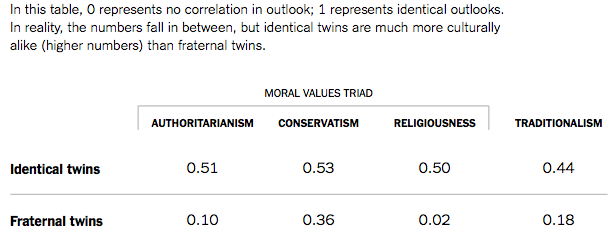
In “Obedience to Traditional Authority: A heritable factor underlying authoritarianism, conservatism and religiousness,” published by the journal Personality and Individual Differences in 2013, three psychologists write that “authoritarianism, religiousness and conservatism,” which they call the “traditional moral values triad,” are “substantially influenced by genetic factors.” According to the authors — Steven Ludeke of Colgate, Thomas J. Bouchard of the University of Minnesota, and Wendy Johnson of the University of Edinburgh — all three traits are reflections of “a single, underlying tendency,” previously described in one word by Bouchard in a 2006 paper as “traditionalism.”

This somewhat acts as a confirmation of Jonathan Haidt’s notions of the values that predominate in conservatives and liberals. And here’s the data from sets of fraternal and biological twins:

Screen Shot 2014-07-10 at 12.11.34 PM

The religiousness differential is particularly stark, followed sharply by authoritarianism. And Edsall is right to note this may help explain why, in a polity riven by core cultural questions, the ability to compromise, or even understand the other side, is in short supply. When it comes to economic questions, the divide is much less stark. There is, in other words, nothing the matter with Kansas. Kansans’ social and cultural value system outweighs in intensity and durability any economic arguments – and it’s our genes in part that facilitates that. Edsall’s conclusion?

Perhaps the most important rationale for research into the heritability of temperamental and personality traits as they apply to political decision making is that such research can enhance our understanding of the larger framework within which public discourse and debate shape key outcomes.

Why are we afraid of genetic research? To reject or demonize it, especially when exceptional advances in related fields are occurring at an accelerating rate, is to resort to a know-nothing defense. A clear majority of those involved in the study of genetics, neuroscience and evolutionary biology are acutely aware of the tarnished research that produced racist, sexist and xenophobic results in the past. But as the probability of a repetition of abuses like these diminishes, restrictions on intellectual freedom, even if they consist only of psychological barriers, will prove counterproductive. We need every tool available to increase our understanding of our systems of self-governance and of how we came to be the political animals that we are.

And we have nothing to be afraid of but the truth.

Quote For The Day

“No single explanation exists for why the War for the Greater Middle East began and why it persists. But religion figures as a central element. Secularized American elites either cannot grasp or are unwilling to accept this. So they contrive alternative explanations such as “terrorism,” a justification that impedes understanding. Our leaders can proclaim their high regard for Islam until they are blue in the face. They can insist over and over that we are not at war with Islam. Their claims will fall on deaf ears through much of the Greater Middle East.

Whatever Washington’s intentions, we are engaged in a religious war. That is, the ongoing war has an ineradicable religious dimension. That’s the way a few hundred million Muslims see it and their seeing it in those terms makes it so. The beginning of wisdom is found not in denying that the war is about religion but in acknowledging that war cannot provide an antidote to the fix we have foolishly gotten ourselves into.

Does the Islamic world pose something of a problem for the United States? You bet, in all sorts of ways. But after more than three decades of trying, it’s pretty clear that the application of military power is unlikely to provide a solution. The solution, if there is one, will be found by looking beyond the military realm — which just might be the biggest lesson our experience with the War for the Greater Middle East ought to teach,” – Andrew Bacevich, speaking truth to power.

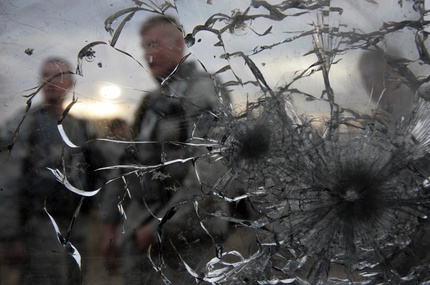
(Photo: Seen through splintered bullet-proof glass, US soldiers from 2-12 Infantry Battalion examine their damaged Humvee after an Improvised Explosive Device (IED) detonated on the vehicle, following a patrol in the predominantly Sunni al-Dora neighborhood of southern Baghdad 19 March 2007. By David Furst/AFP/Getty Images.)

Why More Americans Don’t Follow Politics

Causes Of Stress

Maybe it’s because political news stresses them out:

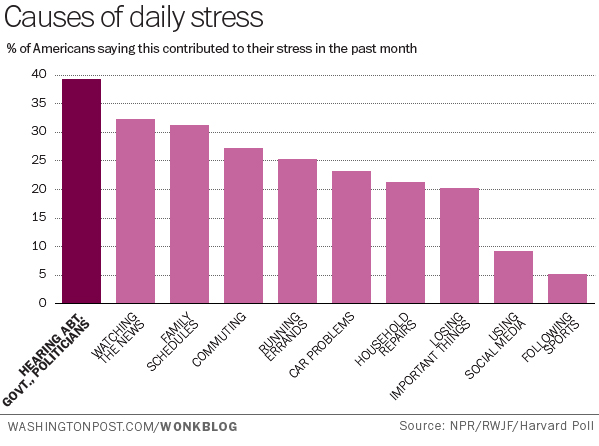
The Robert Wood Johnson Foundation just released a wide-ranging survey on the prevalence and causes of stress in the U.S. Overall, 86 percent of Americans say they’ve been stressed out in the past month, with 26 percent saying they’ve experienced a great deal of stress. When it comes to major stressful life events, health-related issues top the list: More than 4 in 10 respondents who said they experienced a major stressful event in the past year cited health concerns as the primary stressor. But the survey also asked about smaller, daily stressors — the little exasperations that can add up to a miserable day. And here something surprising emerges: Americans cited “hearing about what the government or politicians are doing” as the most frequent daily stressor on their lives, and at a substantially higher rate than the usual annoyances like commuting, chores and general schedule-juggling.

I get it. In a polarized, emotionally fraught polity, the news is almost always stressing you out. The digital media revolution has also meant countless new outlets trying to get market share by revving up one side or the other. For my part, absorbing all the news every day, and being in the arena of opinion from dawn to dusk, week after week, I can only say I am utterly unsurprised. There’s a reason David Brooks just writes chin-strokers and sociology these days: you try being him at the NYT. My response is to try and compartmentalize it so I don’t get completely stressed out, or upset, or just exhausted by the noise. You want to know why I insist on getting to Ptown every summer and not leaving? It’s the yin to the yang of the arena. Without it, I’ve only got the hubby, the hounds, and Angry Birds.

Meanwhile, Drum wants more details from the study:

[B]oy howdy, does this beg for a follow-up. I really, really want to know what news sources cause the most stress. Is it listening to NPR? Watching Fox News? Getting your daily Limbaugh fix? Reading Kevin Drum’s blog? Perhaps the mere act of making you think about this is, at this very moment, making you red in the face. Then again, maybe not. I want to know more. Who’s most stressed out by the news? Liberals? Conservatives? Everyone? And what outlets cause the most stress? Obviously my money is on the Drudge/Fox/Limbaugh axis, but maybe I’d be surprised.