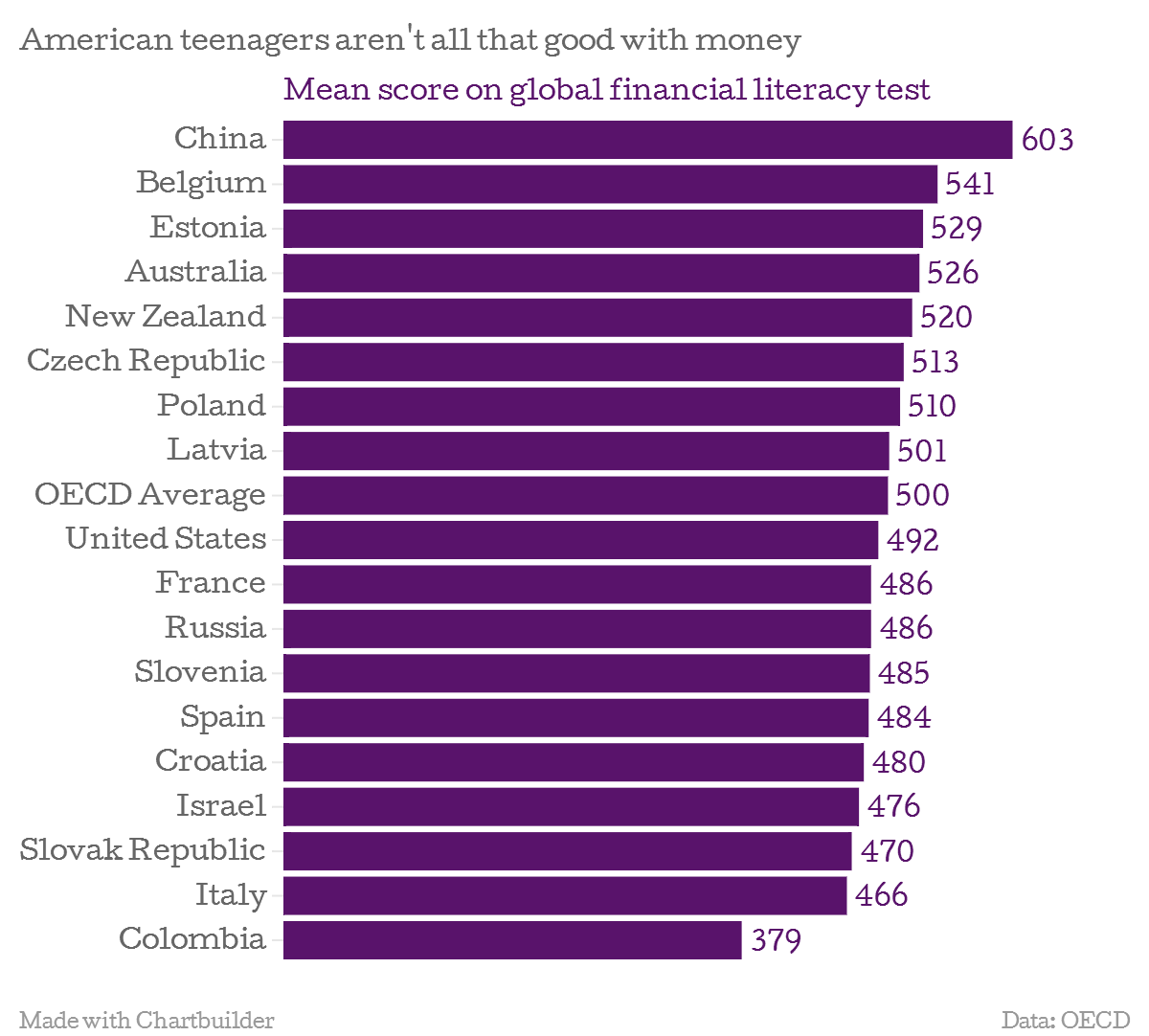
American Teens And Common Cents

American-teenagers-aren-t-all-that-good-with-money-Mean-score-on-global-financial-literacy-test_chartbuilder

Roberto Ferdman charts the findings of a new report on financial literacy:

A comprehensive study carried out by the OECD (pdf) has unearthed yet another lagging indicator for the American education system. The study, which examined the results of a financial literacy test that quizzed some 30,000 students in 18 countries around the globe, found that 15-year-olds in the U.S. aren’t all that good with money. In fact, they’re pretty mediocre with it. America’s youth are, according to the results, “not statistically significantly different from the OECD average.”

Laura Shin notes that the top-scoring kids came from Shanghai:

There, students scored 603 points on an assessment run by the Programme For International Student Assessment (PISA) by the Organization for Economic Cooperation and Development (OECD). The average was 500, and the United States’ mean was 492. That put it slightly below the average of the the 13 OECD countries and economies assessed; among all 18 countries and economies included, the U.S. ranked between 8 and 12. The other countries and economies whose students, in addition to Shanghai’s, scored above the OECD average were Australia, the Flemish Community of Belgium, the Czech Republic, Estonia, New Zealand and Poland.

Emily Richmond isn’t surprised by the results:

The ranking of U.S. students in the new assessment is consistent with the nation’s stagnant performance on the most recent PISA for math and reading—two skills that track closely with financial literacy. And it’s in keeping with prior findings. In a 2008 national survey by the JumpStart Coalition for Personal Financial Literacy, high school seniors gave correct responses to less than half – 48.3 per cent – of the questions on the basics of finance.

Allie Bidwell breaks down the findings further:

[M]ore than 1 in 6 American students – 17.8 percent – did not reach the baseline level of proficiency, meaning they could not correctly answer a “level two” question. At best, those students could determine the difference between needs and wants, make simple spending decisions and apply basic numerical operations, according to the report. Conversely, about 1 in 10 American students scored as a top performer, meaning they were able to answer the most difficult “level five” questions on the exam that focused on analyzing complex financial products and demonstrating an understanding of topics such as income-tax brackets and the benefits of different types of investments.

Presumably it’s harder for teens to develop financial literacy when they can’t find a job.

Cartel Coyotes

Caitlin Dickson connects the current border crisis to the Mexican drug cartels, who have taken over the business of smuggling migrants into the US:

Under the cartel-run migration model, migrants typically make arrangements to cross from their hometowns and are told to find their own way to a certain point where they will meet the coyote. The city of Altar, for example, about 112 miles from Nogales in the Mexican state of Sonora, is a popular launching point for border crossers, and as such, it has become a center of immigration commerce. Here, smugglers often tell migrants to wait for days before they cross, during which time they are nickel-and-dimed into buying stealth desert-crossing gear—camouflage backpacks, black water bottles, and carpet booties—from vendors who set up shop around town.

For those coming from Central America, just getting to a meeting place like Altar often means riding buses or atop freight trains from southern Mexico where they may be subjected to robbery, beatings, and getting thrown off the train by cartel lackeys. Those who make it will continue to encounter crippling fees at practically every leg of their journey to the border. Refusal or inability to pay may result in migrants being forced to carry backpacks filled with marijuana, getting kidnapped in order to extort money from their families, or being murdered on the spot.

The cartels are also partly responsible for the gang violence driving these children out of Central America in the first place. Ongoing Dish coverage of the migrant refugee crisis here.

Flexible Work

Ned Resnikoff defends his coverage of yoga instructors’ labor concerns:

Nobody asks why a story about, say, school teachers or truck drivers counts as news. But for whatever reason, yoga instructors don’t count.First International Yoga Championship-Ghosh Cup Semifinals

That seems a little odd to me. It’s a skilled service profession, typically requiring some form of accreditation. People do get paid, albeit not very much, for rendering the services in question. So what makes it not-work? To flip the question around, why are stories about yoga instructors not considered to be labor stories?

I can think of a couple possible reasons. One is the widely held perception that yoga instructors are pursuing a hobby, despite the money involved. Another related reason is the casual, precarious nature of the work, which differentiates it from a full-time, salaried position. And a third, less charitable explanation, has to do with the gender breakdown of yoga instructors. Most of them are women, and feminized labor is often dismissed as not being “real” work.

Another reason yoga instructors may not register as suffering workers is that yoga is seen as something largely by and for rich white people. As Rosalie Murphy demonstrates, the stereotype isn’t entirely unfounded. On the racial component:

A 2009 study in the Journal of Religion and Health found that 63 percent of African Americans and 50 percent of Hispanic Americans pray to improve their health. Only 17 and 12 percent, respectively, reported relying on an alternative spiritual practice like meditation or yoga to stay healthy, and almost everyone in that group also prays. In contrast, twice as many white Americans identify with alternative spiritual practices and don’t pray at all.

“It’s easier for someone who’s not committed to anything to do yoga,” [researcher Amy] Champ said. “Ethnicity is connected to spiritual practice. Culturally, African-Americans and other ethnic Americans have their own [spiritual culture]. To get buy-in from those communities is pretty heavy lifting.”

And on the cost:

[O]ften, yoga is a privilege of the upper class. An average one-hour yoga class in Los Angeles costs $17. Most require students to bring their own equipment. A mat costs around $20; lululemon yoga pants, $82.

(Photo: Noriko Moser, of Pasadena, California, competes in the semifinal round of the 2003 International Yoga Championship-Ghosh Cup July 12, 2003 in Los Angeles, California. By David McNew/Getty Images.)

Get Moving, Already

Physical inactivity is the main reason we’re getting pudgier:

Researchers crunching data from the massive National Health and Nutrition Examination Survey (NHANES) have found that American obesity (as in the epidemic) might not have much to do with calories at all. In fact, over the past 20 years, calorie consumption mainly stayed flat, while daily physical activity went through the floor. We’re gaining weight because we don’t move as much as we used to, according to the investigators.

Specifically, the percentage of women reporting no daily physical activity jumped from 19.1 percent in 1994 to 51.7 percent in 2010, while the same for men jumped from 11.4 percent to 43.7 percent during the same period. The average body mass index spiked for both groups.

The Best Of The Dish Today

Eight-year-old Palestinian boy killed in an Israeli attack

In a rather weird post yesterday, Jeffrey Toobin argued bravely that it’s a shame that there is a squabble over who gets credit for the extraordinary success of the marriage equality movement. Well: duh. I couldn’t agree more. It’s unseemly and ungracious and ugly. And that’s why you can scour the web for examples of Mary Bonauto or Evan Wolfson or Robbie Kaplan or Dan Foley or me ever claiming that we, and we alone, “changed the world”. It’s a grotesque thing for anyone to claim in such a broad and long and multi-faceted movement.

But Ted Olson, David Boies and Chad Griffin have all claimed as such through the Becker book, the Prop 8 HBO documentary, and the Olson-Boies book. And that‘s why there’s been a fight. They did something no one had ever dreamed of doing before. And that’s why the near-universal response in the gay community to the books has been criticism and derision. It’s certainly not because we begrudge newcomers to the movement, or straight people, as Toobin also bizarrely implies. The very first lawyer who filed a successful marriage equality suit in Hawaii was straight, Dan Foley. I welcomed Olson and Boies with open arms and backed their lawsuit, despite its risks of backfiring. I’ve welcomed every convert to the cause for twenty-five years.

The issue is not between laborers and newcomers; it’s between laborers and a tiny number of newcomers who declared themselves indispensable saviors of a movement that had previously been allegedly “languishing in obscurity” – and then launched on a lucrative publicity tour to cement their place in history (something also that no one had ever done before). So no, Jeffrey, the correct historical analogy of Ted Olson is not to white freedom-riders in the South. They didn’t turn around and claim exclusive credit for the work of African Americans and then bill them over $6 million.

And no, Jeffrey, it isn’t just about the first paragraph. The framing of this lawsuit as “the legal battle to bring marriage equality to the nation” was the central message of the book, which is why Toobin used that exact phrase in his now-embarrassing blurb. It was neither of those things, as Toobin must now know. And as for the first paragraph, you know who doesn’t regret or retract a word of it, even when given several opportunities to do so? Jo Becker. There’s only so much the media establishment can do to keep a lie alive. And I guess Jeffrey just did his part.

Today, I took a long view of Obama’s long game – and didn’t buy the current chattering class consensus that he’s a failed president. We noted more good news for Obamacare; and continued awful news for Palestinians enduring the latest air assault on Gaza. Plus: feminism tackles circumcision; neocons know nothing (again!); a montage of soccer’s high drama in real life; and a mash-note from me to the Millennial generation.

The most popular post of the day was Meep Meep Watch; runner up: Never Listen To A Neocon Again.

Many of today’s posts were updated with your emails – read them all here.  You can always leave your unfiltered comments at our Facebook page and @sullydish. 19 more readers became subscribers today. You can join them here – and get access to all the readons and Deep Dish, including my new podcast with Matthew Vines  – for a little as $1.99 month.

See you in the morning.

(Photo: The body of eight-year-old Palestinian boy Abdul Rahman Khattab who was killed when an Israeli missile struck his home, is brought to al-Aqsa hospital morgue in Deir al-Balah, in the central Gaza Strip, on July 10, 2014. At least 86 Palestinians, mostly civilians, have been killed and hundreds injured in a major Israeli air offensive against the Gaza Strip that began late Monday night, according to reports by the Palestinian Health Ministry. By Ashraf Amra/Anadolu Agency/Getty Images.)

Face Of The Day

Chimp Attack Victim Lobbies On Capitol Hill To Ban Trade Of Primates As Pets

Charla Nash, the victim of a mauling by a pet chimp in Connecticut in 2009 and who underwent a face transplant, speaks at a press conference on Capitol Hill on July 10, 2014. Nash joined members of Congress in advocating for changes in federal law banning the interstate trade of primates. By Win McNamee/Getty Images. To get a better sense of how remarkable her surgeries have been, watch her famous Oprah interview here.

A Twentieth Century St. Paul

Ian Thomson details the just-translated Pier Paolo Pasolini screenplay, St. Paul, which the Italian filmmaker, who was killed before he could make the film, intended to be a sequel to his The Gospel According to Matthew. The plot involves the post-Damascus disciple coming to America to preach the message of Jesus:

St Paul champions those who have been disinherited by capitalism and the “scourge of money”. Pasolini believed that the consumerist “miracle” of 1960s Italy had undermined the semi-rural peasant values of l’Italietta (Italy’s little homelands). In the director’s retelling of the Bible, Paul stands as a bulwark against the “corruption” brought to Italy by Coca-Cola, chewing gum, jeans and other trappings of American-style consumerism.

Nevertheless, as the former Saul, a Pharisee and persecutor of Christians, Paul was an ambivalent figure for Pasolini.

After his conversion on the road to Damascus in 33AD, he took his mission round the world and became the founding father of the Christian Church in Rome, with its hierarchy of prelates and pontiffs. So, in some measure, he lay behind the Catholic Church that Pasolini had come to know in 1960s Rome, with its Mafia-infiltrated Christian Democracy party and its pursuit of power and political favour. In the screenplay, Paul is by turns arrogant and slyly watchful of his mission.

The saint’s story is updated, cleverly, to the 20th century. Cohorts of SS and French military collaborationists in Vichy France stand in for the Pharisees. With a fanatic’s heart, Paul oversees the killing and mass deportation of Christians. The action then fast-forwards to 1960s New York, where the post-Damascus Paul is preaching to Greenwich Village “beats”, “hippies”, “blacks” and other outcasts from conformist America (“I appeal to you, brothers . . .”). His attempts to overturn capitalist values in Lyndon Johnson-era America are met with hostility by FBI operatives and White House flunkies. In the end he is murdered on the same hotel balcony where Martin Luther King was assassinated in 1968. Pasolini’s approximation of the apostle of black liberation to the apostle of orthodox Christianity just about works.

The Price-Cut On Medicare

Medicare Costs

Sarah Kliff is impressed by the above chart:

This simple, four-line chart is amazing news for the federal budget. It shows that the government is expected to spend about $50 billion less paying for the Medicare program this year than it had expected to just four years ago. What this chart shows is how much the Congressional Budget Office expects we’ll need to pay for each and every Medicare beneficiary. And over the past four years, the forecasting agency has consistently downgraded the price of covering one senior’s health care costs.

Saving $1,000 per patient adds up quickly in a program that covers about 50 million people. More precisely, it adds up to about $50 billion in savings this year. The reduction in expected costs grows to $2,369 in 2019. With an expected 60 million seniors enrolled in Medicare that year, it would work out to more than $120 billion shaved off the total cost of the program.

Drum expects Medicare costs to continue declining:

There are two reasons for this. First, the growth rate of medical costs in general has been declining steadily for the past 30 years, and this has now been going on long enough that it’s highly unlikely to be a statistical blip. After a surge in the 80s and 90s, we really are returning to the growth rates that were common earlier in the century, and obviously this will affect Medicare.

Second, Obamacare really will have an impact. Not everything in it will work, but it includes a lot of different cost-cutting measures and some of them will turn out to be pretty effective. And who knows? If Republicans ever stop pouting over Obamacare, we might even be able to experiment with different kinds of cost reductions.

Tricia Neuman and Juliette Cubanskigo go into more detail on the factors at play:

In addition to scheduled reductions in Medicare’s more formulaic payment rates, providers may be tightening their belts and looking to deliver care more efficiently in response to financial incentives included in the ACA, and it is possible that these changes are having a bigger effect than expected.  For example, CMS recently reported that hospital readmission rates dropped by 130,000 between January 2012 and August 2013.  It is also possible that hospitals and other providers are using data and other analytic tools more successfully to track utilization and spending and to reduce excess costs.  Another more straightforward factor is that several expensive and popular brand-name drugs have gone off patent in recent years, which has helped to keep Medicare drug spending in check.

Whatever the causes may be, the slowdown in spending is good news for Medicare, the federal budget and for beneficiaries—at least for now, and as long as it does not adversely affect access to or quality of care.

A Serious Plan To Fight Climate Change

A new report outlines what the world would need to do to head off severe global warming:

Given what we know about the sensitivity of the climate to added greenhouse gases, it’s possible to calculate how much more carbon dioxide we can admit while still having a reasonable chance of staying within the two degree Celsius envelope. What’s striking about these calculations is how many large changes we’ll have to make in order to get there. According to Jeffrey Sachs of Columbia University’s Earth Institute, the per-capita emissions would have to drop from five tons annually (where they are now) to 1.6 tons by 2050.

To accomplish this, Sachs says that all nations will have to undergo a process he calls “deep decarbonization,” which is part of the title of a report he’s helped organize and deliver to the UN [earlier this week]. Pathways to Deep Decarbonization, prepared by researchers in 15 different countries, looks into what’s needed to achieve sufficient cuts in our carbon emissions. The report finds that current government pledges aren’t sufficient, and the technology we need to succeed may exist, but most of it hasn’t been proven to scale sufficiently.

Plumer looks at what Sachs’ plan would mean for the US:

The United States eventually gets 30 percent of its electricity from nuclear power and 40 percent of its electricity from renewable sources like hydro, wind, and solar by 2050. Electric vehicles would handle about 75 percent of all trips. Large trucks would get switched over to natural gas. The coal plants that remained would all capture their carbon-dioxide emissions and bury them underground. Every single building would adopt LEDs for lighting.

David Unger reads through the report’s recommendations:

The biggest need: research and early-stage development. The world underinvests in clean-energy research, development, and demonstration by roughly $70 billion a year, according to the Center for Clean Energy Innovation, a Washington-based organization that designs and advocates for clean-energy policy. That amounts to only 13 percent of what the world spends on global fossil-fuel subsidies, according to CCEI, and 27.5 percent of what it invests in deploying clean-energy technologies.

“The main lesson in history is that targeted R&D works,” says Sachs, who says clean energy needs a large public-private effort along the lines of the Manhattan Project or the push to put a man on the moon. “The remarkable fact is that we have not invested [enough] in an issue that is of existential importance to the planet.”

Chart Of The Day

Immigrants

Casselman debunks common misconceptions about the origins of America’s immigrants:

The immigration debate, now as then, focuses primarily on illegal immigration from Latin America. Yet most new immigrants aren’t Latinos. Most Latinos aren’t immigrants. And, based on the best available evidence, there are fewer undocumented immigrants in the U.S. today than there were in 2007. … The immigration debate gets one thing right: The foreign-born population is growing. In 2012, according to data from the Census Bureau, there were more than 40 million people living in the U.S. who weren’t born here, up 31 percent since 20001; the native-born population grew just 9 percent over that time. The foreign-born now represent 13 percent of the population, near a historical high. The drivers of that growth, however, have changed significantly in recent years.

Furthermore, the Latinos who have already arrived are rapidly assimilating:

Political commentary often treats the issues of immigration and Hispanic ethnicity as two sides of the same coin. But U.S. Latinos are looking more and more like other Americans. Nearly 68 percent of U.S. Hispanics speak English fluently, up from 59 percent in 2000; more than a quarter report speaking only English at home. Latino high school graduates are now more likely than whites to enroll in college, although they are still less likely to graduate. Latinos are becoming less likely to be Catholic and choosing to have smaller families, and they more closely resemble the population at large on social issues such as abortion and gay rights. Nearly half of all Hispanics and about two-thirds of native-born Hispanics consider themselves to be “a typical American.”