Neither A Boy Nor A Girl

Charlotte Greenfield examines the medical profession’s response to intersex children:

During the 1990s, intersex adults who had received surgery as infants came forward speaking about their sense of mutilation. At the same time, an experiment from Johns Hopkins University that claimed to prove young children could safely be assigned any gender with surgical “reinforcement” was revealed to be a failure. The study had been initiated in 1967 by psychologist John Money, who claimed to have successfully given a boy female anatomy and had the child live as a girl. The child, whose penis was burnt off in a circumcision accident, was castrated and operated on to look female at the age of 22 months – eight months before the age at which Money claimed gender became fixed.

Until the 1950s, intersex children had largely been left alone, but Money’s experiment provided support for early surgical intervention. However, one of Money’s rival researchers tracked down his study’s subject and, in 1997, showed that the child had never been happy as a girl and had converted back to living as man, sending shockwaves through the medical profession. Nevertheless, the surgeries continue.

Unquestionable Right, Unbearable Stunt

Last week, after Target asked customers not to bring guns into its stores, Waldman commented that “just as there’s a culture of guns, and cultures where guns are plentiful, there are also tens of millions of Americans for whom an absence of guns is a cultural value”:

Despite what some extreme gun advocates believe, no right is unlimited, whether it’s your right to own a gun or your right to practice your religion or your right to freedom of speech. But beyond the legal limits, there are also the limits we all respect in order to have a society where we can get along despite our differences. My neighbor has a First Amendment right to write pornographic “Hunger Games” fan fiction, but if he hands his manuscripts to my kids he’s just being a creepy dirtbag, First Amendment or not. And depending on the laws of your state, you may have a legal right to take your rifle down to the Piggly Wiggly. But that doesn’t mean that doing so doesn’t make you a jerk.

Barton Hinkle is sort of on the same page. Though staunchly pro-gun rights, he argues that the antics of the open carry movement are bad for the cause:

Gun-rights advocates who delight in making suburban mothers nervous are practicing libertarian brutalism. They resemble those abortion-rights supporters who think it’s funny to wear a shirt that says, “Why did the fetus cross the road? Because they moved the dumpster.” Feeling put-upon, they have an urge to lash out at the other side, to rub the other side’s nose in the dirt and teach it a lesson. But lashing out rarely achieves much. Often such brutalism does nothing but generate resentment. Having a given right means never having to show consideration for how others feel about it, if you don’t want to. But advocates for individual rights should want to. We make a more persuasive case for liberty when we show such consideration. If, as one of the Carytown gun-toters put it, they wish to raise awareness about “responsible gun ownership,” then behaving responsibly would be a good place to start.

Update from a reader, one of several skeptical of Hinkle’s quote:

You quote Barton Hinkle as saying at reason.com that those who flaunt open-carry are like “those abortion-rights supporters who think it’s funny to wear a shirt that says, ‘Why did the fetus cross the road? Because they moved the dumpster.'” That didn’t pass the smell test for me – sounded sort of like “welfare queen driving a Cadillac” apocrypha. A Google search on that phrase doesn’t bring up anything except standard-issue “dead-baby” jokes (not using “fetus”), and certainly no T-shirts. What is Hinkle’s source for this? Because I can’t imagine anyone buying or wearing such a shirt, and I was surprised you quoted it unquestioningly. I’d comment at reason.com, but that’s predictably turned into a 2nd Amendment slugfest.

Tinker, Tailor, Soldier, Scandal

Germany is investigating another suspected spy in Berlin:

[Yesterday] German police raided the Berlin-area apartment and office of a man suspected of spying for the US, the second case in less than a week. The investigation is ongoing, but German authorities are taking it “very seriously,” a spokesperson told reporters. Last week, a German intelligence officer was arrested for working as a double agent and feeding documents back to Washington. The 31-year-old intelligence officer, which The Daily Beast has dubbed “Herr Wannabe,” apparently volunteered to work for the CIA. He got caught when he tried to spy for Russia as well.

All this comes, of course, after revelations that the US had been tapping German chancellor Angela Merkel’s cellphone since 2002. Germany tried to use this embarrassing fact to negotiate a non-spying agreement similar to the ones the US has with the UK, Canada, and other countries. However, the US has resisted out of fear that more countries will want the same thing.

Today, the German government asked our top CIA official there to leave the country. Morrissey is somewhat surprised at this reaction:

One has to assume that the Germans are not so blinded by outrage here as the public stances might suggest, as they know well how the intelligence game is played.

The French have been stealing industrial secrets for years, even though the two nations work much more closely together on the EU project than the US and Germany do in other areas. When these details about business-as-usual get made embarrassingly public, it forces everyone to make a public show of the outrage. Removing a key link in the partnership through the mechanism of a diplomatic expulsion, though, goes a bit farther than contrived outrage. That’s a step one would expect to see between two antagonists, or two loosely-affiliated nations, not between close partners like the US and Germany.

Kirchick defends our espionage activities in Germany, which he calls “a less than trustworthy ally.” In particular, he highlights the country’s ties to Russia and Iran:

German outrage at American spying would also be easier to swallow if it weren’t so hypocritical. According to former NSA intelligence and computer systems analyst Ira Winkler, the BND has penetrated the SWIFT financial messaging network, passing on the information to German businesses. In his book Spies Among Us, he writes of “the apparent willingness of German businesses to funnel sensitive information and technology to nations that are hostile to the United States,” including Iran. Germany remains one of the Islamic Republic’s largest trading partners.

American espionage in Germany—home of the Hamburg Cell, the circle of 9/11 hijackers who hung out in the port city, unmolested, for years—is aimed at protecting the national security of both America and its allies, Germany foremost among them. And while the BND cooperates extensively with America’s intelligence services, it also has worked toward giving a leg-up to German businesses, an unwritten no-no in the intelligence world.

But the latest news doesn’t much trouble Mataconis:

Understandably, there will be some degree of a diplomatic price to pay from these latest spying allegations. Allies spying on allies is, as I said, one of those things that everyone does to some degree but which is never spoken of publicly. At the same time, though, it strikes me that we shouldn’t really be all that embarrassed about what’s been revealed here, except to the extent that we got caught and the President apparently spoke to the Chancellor without being aware of what had happened earlier that week. There are good reasons to keep an eye on what’s going on in Germany and, indeed, some of those reasons ultimately benefit the national security of Germany as well as the United States. Furthermore, foreign espionage does not raise the same civil liberties issues that the N.S.A.’s domestic programs do so it’s best not to conflate the two. Foreign intelligence is sometimes an unpleasant business, but that doesn’t mean it isn’t necessary and in this case it seems like its necessary.

Mental Health Break

One reason many Americans can’t take the World Cup too seriously:

Update from a reader:

I appreciated today’s MHB because I think Neymar is the perfect example. Here is Neymar and his various dives. Here is Neymar and his real injury. When a player is acting, he rolls around on the ground and makes a spectacle of himself. When he is truly hurt, he lies still and tries to minimize the pain.

But another reader points to a video compilation “from the American sport with just as much flopping as soccer”:

Readers Hate Sponsored Content

That’s the good news as the journalism industry morphs into a branch of public relations. A new study has followed up on Tony Haile’s evidence that no one reads the damn stuff anyway. Its findings?

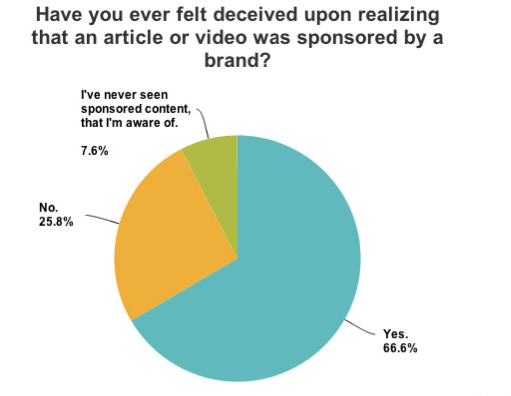
Two-thirds of readers have felt deceived upon realizing that an article or video was sponsored by a brand.
54 percent of readers don’t trust sponsored content.
59 percent of readers believe a news site loses credibility if it runs articles sponsored by a brand.
As education level increases, so does mistrust of sponsored content.

So I’m not alone among the consumers of journalism; I’m just almost alone in being a journalist who is publicly prepared to call this ethical swamp what it is. When asked if they would prefer old-fashioned, honest banner ads rather than this morphing of advertising, journalism and PR, the answer is overwhelming: by almost 2 -1 readers preferred traditional advertising.

But the core legal and political question is whether there is active deception going on, in violation of FCC rules. On that level, today’s media machers have some ‘splaining to do:

Screen Shot 2014-07-10 at 12.43.39 PM

When an industry is engaged in the wholesale deception of its consumers, the public interest is involved. At the very least, it seems to me, we should have Congressional hearings on whether this level of deception can be defended under the law.

Update from a reader:

“But the core legal and political question is whether there is active deception going on, in violation of FCC rules. On that level, today’s media machers have some ‘splaining to do”

Not so fast! The FCC, which regulates radio, TV, and common carriers, does not involve itself with online advertising. Those of us in the Radio/TV industry are familiar with the “sponsorship identification rule,” which requires that advertisers and their related content be identified in those media. There were some serious fines levied recently for this ($44,000 to a Chicago radio station for 11 instances of playing a “news” show that didn’t identify that the content was sponsored, and not actual news). Historically, the practice of payola led to these regulations, to prevent disc jockeys from accepting money to play records and thereby popularize them – a deceptive form of advertising.

Dissent Of The Day, Ctd

A reader quotes an earlier one:

Perhaps we should apply that same formula to heterosexuals. Who needs another human being when there’s God? In fact, it’s pretty obvious that any relationship OTHER than one’s relationship with God is inferior, a distraction from our one and only necessary relationship. Right?

Although I don’t think he sincerely believed it, my evangelical, heterosexual father expressed precisely the theological stance this reader posits sarcastically: Marriage was provided by God as a moral option for humans too weak in the flesh to commit fully to a relationship with God. Of course this in no way supports an argument that heterosexual marriage is fine and homosexual isn’t, but it does display a fascinating worldview. There is a higher morality that humans are invited, but not expected, to achieve.

The evangelical reader who started the thread follows up:

I’m very grateful for your posting of my earlier comments on this topic! I don’t want to fill up your inbox and use too much of your team’s time. But I get the impression that you don’t get too much evangelical input. This email is sent in reaction to your reader in Dissent of the Day, Ctd.

Your reader is absolutely right that the evangelical church cannot talk with credibility about same-sex marriage without a coherent theology of singleness and heterosexual marriage.  Western society seems to treat single people as though they are living a kind of maimed half-life, robbed of ultimate fulfilment and human wholeness (and devaluing aromantic friendship, as you pointed out recently). It’s unsurprising that opposition to same-sex marriage attracts such ire in this context.

The Biblical viewpoint is very different (even if, sadly, that isn’t always what we see in churches). According to the Apostle Paul, singleness (for whatever reason) is a gift, neither superior not inferior to marriage. Indeed, he insists that marriage has tremendous dangers:

the spouse may become an idol, competing with God for attention (1 Corinthians 7:32-35). If a prospective marriage is going to stop the couple from giving “undivided devotion to the Lord”, they shouldn’t get married. Christian marriage is for those who will glorify God better together. It is, emphatically, not to fill some sort of gap in our hearts/ we should be looking to Christ to fill that gap. As Vaughan says, the fulfilment of our relational longings is found in knowing the God who made us: the evangelical position would be inexcusable were it not for this fact.

Every Christian – male or female, gay or straight, married or single – in reality already has a bridegroom. In Hosea 2, God declares his intentions regarding his rebellious people:

Therefore, behold, I will allure her, and bring her into the wilderness, and speak tenderly to her… I will betroth you to me forever. I will betroth you to me in righteousness and in justice, in unfailing love and in mercy. I will betroth you to me in faithfulness. And you shall know the LORD.

And let’s not forget that the word “know” here is the same verb used when Adam “knew” Eve; intimacy with God is total intimacy in every dimension. From the Biblical perspective, earthly marriage is just a shadow of this heavenly union, when Christ will become “one flesh” with his church (Ephesians 5:25-33).  I was foolish to describe God giving himself to us “in return”, as though this were some kind of transaction; I meant that walking more closely with God is always worth it (not just theologically, but emotionally and experientially) because one is walking more closely with God. Whenever we disobey his commands, we are defrauding ourselves of our joy, precisely because we have taken our eyes off God.

Another responds to that reader’s first email:

The “dissent of the day” reflects why all too many Americans, especially young Americans, are moving further and further away from evangelical and fundamentalist churches.  Once, as a very young, enthusiastic (and often naively egotistical) evangelical several decades ago now, I used a “Christian cliche” in a college class, the metaphor from the Revelation about “the blood of the lamb.” Some astute “non-believer” (to me) asked me if I meant literal lamb’s blood.  I had a difficult time explaining what the metaphor even meant, let alone why I was using it, because I was conditioned to use it within “the tribe,” the evangelicals with whom I had associated.

These types of Christians, in their attempt to explain their theology of sex do themselves no favor by wrapping their fear of their own bodes and the world around them with such a high view of God that God ends up being so ultimate, so necessary to our existence that anything short of “Him and Him alone” means a failed life.  How demeaning is that to our full humanity, one shared even by God Himself, to those of us who hold to the incarnation?  How much this clap-trap sounds like the same old tired God who claims to give us free will but only if we willingly deny that free will for him, a God who sounds more like a kidnapper, holding us hostage and saying we have the freedom to leave but He will kill us if we do?  What kind of freedom is that?

I don’t think too many of those in the American evangelical camp can quite grasp the disdain all too many have to them in this culture because no matter how hard they try, sincerity comes across as sanctimony.

Never Listen To A Neocon Again

This embed is invalid

Every now and again, it’s worth remembering that they pretend to know everything but, in fact, know nothing about the Middle East, and have been proven wrong and wrong and wrong again on the subject. Their primary characteristic, of course, is never conceding a single error of judgment or denying responsibility for disasters in plain sight. So here’s a plethora of Dick Morris Award nominees from just last year about the now successfully completed withdrawal and destruction of Syria’s WMDs in the height of the civil war there. Drum roll please. First up – who else? – Krauthammer last September:

This is a clearly a way to get Obama off the hook politically. The chances of these weapons being eliminated from Syria are less than of the Chicago Cubs winning the World Series this year, and they are now mathematically eliminated.

Utterly wrong – and something he won’t ever cop to. Let’s go to Max Boot next:

If the U.S. is not seen as willing to strike Syria, what incentive does Assad have to comply with the terms of any disarmament deal? The most likely scenario is that Assad will agree to something in principle and then fudge on the implementation, knowing that Washington will have lost interest by that point.

Next up: a Kagan (little Freddy this time)! Notice the faux expertise and specificity of the bullshit:

Removing the weapons would require ground forces in large numbers. It appears that Assad keeps his chemical weapons at a variety of sites around the country, which would make it necessary to insert many strike forces simultaneously. Each strike force would need to be able to overcome the guard forces at each facility very quickly and then hold it against regime counterattacks. The strike forces would have to be accompanied by specialists in rendering chemical weapons safe enough to be transported, and those specialists would need to be supported and guarded…

The U.S. military has indicated that such an option could require tens of thousands of troops, and this quick sketch bears out that calculation. Since no one in this debate is advocating sending a large ground force into Syria, we have effectively dismissed the option of seizing the weapons or destroying them and thereby entered the realm of high-risk options.

Look: we all make mistakes. Plenty of other observers said it would be impossible as well (David Kay among them, with egg now all over his face). But when you have been wrong so consistently about so much, and have never copped to it, let alone reflected upon it, you should surely be a little circumspect in these instant, faux-expert opinions. And if you are a booker on cable news or an editor at an op-ed page, are you really going to keep giving these idiots a platform to be wrong yet again? Or are you going to grow some and care just a little about the truth?

Things Are Looking Up For Obamacare

Obamacare Impact

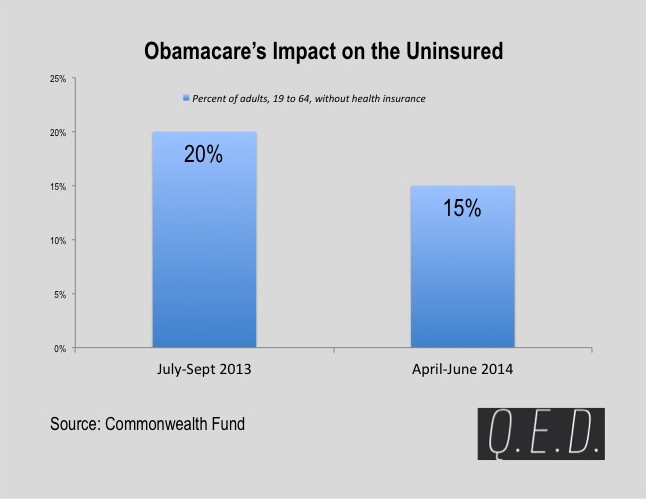
Cohn comments on the new Commonwealth Fund report I highlighted earlier today:

The Congressional Budget Office predicted that, one year into full implementation, Obamacare would reduce the number of Americans without insurance by twelve million. That included the young adults who got insurance before 2014, by signing onto their parents’ plans. There’s been some controversy over exactly how many more young people are insured because of that new option, but the best estimates I’ve seen place the number somewhere between 1 and 2.5 million. Add that number to the 9.5 million from the Commonwealth survey, and you’re close or equal to the CBO projections.

Of course, the Commonwealth survey has a hefty margin of error and the CBO projections, revised to take account of the early technological problems on Obamacare websites, were never that scientific. But the figures seem to be in the same ballpark. That’s what matters.

Douthat isn’t ready to declare Obamacare a success:

[I]f the Commonwealth figure is right we’re probably looking at between 10 and 11 million newly-insured overall for 2014 (I’m relying on “best estimates” for the number of young adults that are slightly lower than Cohn’s), which is lower than the 12 million the C.B.O. projected in April, which is lower than the 13 million it projected after the website problems, which is lower than the 14 million it projected after the Supreme Court decision on Medicaid, which is lower … you get the idea.

All of which means that this new estimate, while useful, doesn’t really bring us any closer to knowing whether Obamacare enrollment will ultimately end up where its advocates hoped — making up ground lost during the disastrous roll-out over the next couple of years, and hitting 25-30 million newly insured by 2017 or so — or whether its current shortfalls will persist and it will end up many millions below that target.

Sanger-Katz focuses on how “people who got the new coverage were generally happy with the product”:

Overall, 73 percent of people who bought health plans and 87 percent of those who signed up for Medicaid said they were somewhat or very satisfied with their new health insurance. Seventy-four percent of newly insured Republicans liked their plans. Even 77 percent of people who had insurance before — including members of the much-publicized group whose plans got canceled last year — were happy with their new coverage.

Kliff points to other details:

About four in ten Obamacare enrollees reported having signed up for Obamacare say they chose a narrow network plan, with lower premiums — but also fewer doctors and hospitals. This explains why just over one third (37 percent) say that all of the doctors they wanted were part of their insurance plan’s network. It’s possible that number could be an underestimate, as 39 percent said they weren’t sure which doctors were and weren’t included.

At the same time, subscribers who did see a doctor generally reported being able to schedule appointments pretty quickly. Most were able to get an appointment within two weeks.

On a less happy note, Flavelle finds that blacks are faring relatively poorly under Obamacare:

The uninsurance rate for whites fell to 12 percent from 16 percent; for Latinos, it plummeted, to 23 percent from 36 percent. For respondents who reported their race as “mixed” or “other,” the share without insurance was cut almost in half, to 11 percent from 20 percent. The exception to that trend was blacks. When the Commonwealth Fund conducted a survey from July to September last year, 21 percent of blacks reported being uninsured. This year, in a similar survey conducted from April to June, that level was effectively unchanged, at 20 percent.

Why?

A big part of the explanation, without question, is that a disproportionate share of blacks live in states that have so far refused federal money to expand Medicaid. Sixty-two percent of black respondents fall into that category, compared with just 39 percent of Latinos.

Ask Me Anything: In Praise Of The Millennials

The difference between them and my generation is stark, and I couldn’t be happier about it:

For more on that generation, check out our Letters From Millennial Voters, a thread in which you younger readers describe your political beliefs and how they were shaped. My previous answers in this video series are here.