The Trouble With ENDA After Hobby Lobby

Jim Burroway has the best and most concise argument I’ve yet read on this. Money quote:

Because ENDA contains an explicit LGBT-only religious exemption, the Supreme Court could, in following the Hobby Lobby precedent, look at that exemption in ENDA and conclude that Congress had effectively expanded the RFRA to cover a whole host of LGBT-rights regulations that have come about since the demise of Section 3 of the Defense of Marriage Act, including health care, hospital visitations, spousal benefits, and so forth. The possibilities for unintended consequences are enormous… The concern here is that the Obama administration may lift the language of the religious exemption clause from ENDA and graft it into his executive order, and thereby effectively eviscerate the order’s effectiveness for large numbers of LGBT people.

Book Club: Montaigne As Your Mentor

Many readers are getting psyched about our latest Book Club selection, Sarah Bakewell’s How to Live: Or A Life of Montaigne in One Question and Twenty Attempts at an Answer. My full intro to the book selection is here. Buy the book through this link to support the Dish. One reader:

Just a note to say that I am delighted that your third book club discussion will be bookclub-beagle-trabout Montaigne. If you haven’t read it, Mark Lillia’s very positive review of Bakewell is worth checking out. She misses Montaigne’s implied critique of Christianity, he argues. And M’s worldview leaves no space for transcendence, or our inescapable attraction to it.

To me, Montaigne cures us of that desire, though only temporarily. In that sense he is a proto-liberal: a skeptic, of course, and a thinker who put stability in politics before truth. I’ve been a lurker until now, but I look forward to a discussion about Montaigne on the Dish. How the ethos Montaigne recommends is challenged today by religion and by unworldly politics would be a great focus. And also the parallels and differences between The Essays and blogging.

That’s exactly why I chose this. It’s not just about life; it’s about politics, ideology, and fanaticism. Montaigne’s disposition is what we lack so much today – and need to reclaim. Another reader exclaims:

Woo Hoo! Montaigne next!

Why did I pick up How To Live last year at my public library? Probably because I saw it mentioned on the Dish or on Maria 513f2INPtgLPopova’s website. I renewed it several times so I could take it with me on vacation … to France. I greatly enjoyed the format, mixing Montaigne’s biography with Sarah Bakewell’s commentary. And I learned so much about Montaigne’s life, his essays and 16th century French history to boot.

I live in the USA, but I am originally from the Bordeaux area of France, and I go home pretty much every year to visit family. So last summer, my one objective was to visit Montaigne’s estate, as it is less than an hour’s drive from my parents’ house. It felt like a pilgrimage. Walking up the stairs of the tower, standing in Montaigne’s library, looking up to decipher the inscriptions on the ceiling. Better than a trip to Lourdes!

I also used several sections of How To Live when I taught a survey of French literature to my Advanced French class this past school year.  And the book is once again on my coffee table, so I can reread it this summer (along with my digital copy of Les Essais). So a big thank you (or should I say “mille mercis”!) to you, Andrew and the Dish, for introducing me to this wonderful book and for making me want to rediscover Montaigne’s essays. I am looking forward to reading what other book club participants will think about it.

Another nerds out even more:

You recommend the Frame translation of the essays, and I understand that translation is widely regarded as the most faithful in English. But I wonder if you’re aware that the New York Review of Books just a few months ago published selections from the 1603 Florio translation.

It’s titled Shakespeare’s Montaigne because Florio’s was apparently the translation Shakespeare read and was inspired by. Nothing against the Frame translation, but reading Florio’s translation has been for me like discovering the masterful poetry of the KJV bible after only reading the bland NIV.

Some groveling fan mail sentiment incoming: Founding member here and I’ve been reading you – pretty much every post – since late 2007. I’ve only written in once or twice, and you published the view from my window several years ago. Pardon the morbidity, but I often measure how strongly a feel about the people in my life by how I would feel if I lost them. When I think about how it would affect me if you were to die or stop writing, well, only the loss of a handful of immediate family members would be more devastating. I follow the output of other public figures as closely – a few songwriters and novelists –  and feel I know them through their work. But I guess there is less artifice, more of your unfiltered self in what you do. The only other writer that even comes close in that respect is, in fact, Montaigne. So it doesn’t surprise me that you view him as a major influence.

Again, I really look forward to the July book club discussions.

Another primes the discussion further:

Not sure if you caught this on PBS several years ago, but they did a cool series on philosophers and the idea of happiness, and this was the portion they did on Montaigne:

https://www.youtube.com/watch?v=BOjDttEtfGI

The Post-Peace Process Era

Considering the political situation in Israel/Palestine and the total collapse of the negotiations into self-parody, Greg Djerejian believes we are beyond any chance of a peace process, unless the Obama administration is willing to finally stand up to our client:

The ‘peace process’ has become a phrase now almost of ribald derision in many quarters, a moniker for seemingly endless cycles of aimless discussion mired in its own rituals, positions, talking points, coteries of drafters and scriveners that come and go, like the seasons. And beyond this, the conventional wisdom has developed into a burgeoning sense that—with everything else afoot in MENA—does Israeli-Palestinian peace really even matter all that much? Deep down, however, true friends of Israel realize it very much does. … What is needed is a convincing leader of a great power (hello, Barack) to tell his client—politely but firmly—that its many untold billions upon billions of aid come with a small price, meaning, a modicum of respect for its patron.

Here instead, we are being played for fools, negotiating with ourselves for the privilege of trying to help a client who pays us too little heed back. Even the hapless Palestinians ‘waiting for Godot’ in Ramallah could not tolerate this theater of transparent chicanery this go around. A ‘process’ like this is indeed a mockery. What is required is an end to the tyranny of such incremental process obsession, instead tabling firmly before the counterparties what everyone knows are the broad parameters of a deal, and exerting real pressure (including suspension of material components of financial and military aid) until people get serious about inking the real deal[.]

Judis is even more pessimistic, doubting that even mighty Washington can salvage the situation at this point:

The United States can influence Israeli politics. It can threaten to withhold economic or military assistance. The Eisenhower and George H.W. Bush administrations were able to use these kind of threats to force concessions. But the Obama administration appears completely unwilling to undertake this kind of diplomacy toward Israel. Obama and Kerry know that if they tried to withhold aid, they would face an immense uproar on Capitol Hill. J Street has acquired some clout among liberal Democrats, but what support AIPAC and the other groups that back Netanyahu have lost among Democrats, they have more than made up among Republicans.

And if Obama and Kerry wanted to restart negotiations, they would also have a problem with the Palestinian side. Abbas has been a receptive negotiating partner – he made significant concessions during the talks with the Israelis, including agreeing to an Israeli army presence in the Jordan Valley for up to five years – but he is increasingly hampered by old age and illness. As a result of the negotiation’s failure, and the cooperation of the Palestinian Authority’s security force with the Israelis, Abbas has also become increasingly unpopular. One Fatah official estimated his support among Palestinians as ten percent. But he has no replacement in sight.

After the current wave of violence dies down, Keating predicts a return to the unsustainable, but not yet critical, status quo:

Both the withdrawal plans pushed by the international community and the annexation moves favored by the Israeli hard right seem fairly unattractive compared with muddling through with the current state of affairs, which again, for most Israelis, hasn’t been all that bad. Of course, the events of the last few days have been demonstrations that this status quo was extremely fragile and, in the long run, probably not sustainable. But when Israel winds down its strikes on Gaza and the rockets stop flying, as they likely will soon, it may once again become very easy to forget the knife’s edge the country is sitting on. Meanwhile, the settlements will continue to grow, even more radical groups in Gaza may eclipse Hamas if it’s decimated in the ongoing assault, the influence of moderates on both sides will diminish, and the prospects for any sort of workable resolution to the conflict will likely continue to recede.

Shmuel Rosen outlines what Israel hopes to achieve in the ongoing bombardment of Gaza. He sees history repeating itself:

Israel’s goals are not at all mysterious. Israel is long past its era of hopeful thinking about its neighbors. It is well aware that Gaza isn’t going anywhere, and neither is Hamas. So what does it hope to achieve? It wants Hamas to be militarily weaker. It definitely wants Hamas to have a smaller number of rockets, and if a ground operation is launched in the coming days, the mission of many of the forces will be to target the piles of ammunition that are stored, well hidden among Gaza’s crowded civilian population.

Israel wants Hamas to be less cocky. But Israel isn’t likely to set the bar higher than that. It isn’t likely to want Hamas completely gone. Not even if the price for it to stay is having a round of mild violence every now and then. Because Hamas, illogical and violent as it is, is the only force that even wants to rule that miserable area. It is currently the only force preventing Gaza from turning totally chaotic. And chaos, as recent Middle East developments keep teaching us, is worse than even despotism.

So I’ll see you in approximately two years for this same column again.

Putin’s Splendid Little War

The Ukrainian government drove pro-Russian separatists out of Slovyansk this weekend and is now vowing to retake the major industrial city of Donetsk. David Patrikarakos reports that the fighters of the “Donetsk People’s Republic” are getting ready to make their last stand:

On July 7, separatists started work protecting the city from attack. They blew up three bridges on key roads leading to Donetsk to slow the advances of the Ukrainian army. (This also damaged the railway lines.) Two other bridges on roads from Slovyansk to Donetsk were also destroyed. The rebels are insulating the city as they get ready to hunker down and prepare for an extended battle.

A siege or stalemate looks like the most likely option.

Poroshenko is determined to recover the east, but shelling Ukraine’s most important industrial city would be disastrous both for the economy and for any hope of reconciling in the future. Meanwhile, the separatists can defend their positions, but the chances of making gains are now unlikely in the extreme. The only real chance now for the rebels to fight back would be if their allies in Moscow accepted separatists’ demands for direct military assistance. But this is equally unlikely, and even the otherwise confident rebels know it.

In fact, Moscow appears to have abandoned the rebels entirely. Ioffe passes along reports that Russia has even closed its border to them:

Not only are they not letting men and materiel into Ukraine from Russia, but they’re also blocking men and materiel from flowing in the opposite direction. That is, the very men that Moscow has riled up to the extent that they have taken up arms and are ready to die in order to get the region out of Ukraine and into Russia are not welcome to seek refuge in Russia. (Not even, it seems, the ones originally from Russia.) A group of 300 fleeing rebels reportedly even came under fire by the Russians as they tried to escape into Russia.

The Russians haven’t confirmed or denied these Ukrainian reports, but it would not be out of step with Russian military history: The Red Army was notorious for its use of so-called barrier troops that were stationed behind active combat troops to prevent retreat. They became especially notorious in World War II when, drowning in the meatgrinder of the German advance, ill-equipped and poorly trained Soviet soldiers (many of them volunteers) were shot for retreating.

But Simon Shuster questions whether Putin can back off from Ukraine without paying a hefty political price:

The rebels were not the only ones to see this as a sign of duplicity. Russian nationalists have begun to turn on him as well, posting diatribes and even music videos that seek to goad Putin into war, juxtaposing his pledges to “defend the Russian world” with images of bombed-out villages and Russian corpses in Ukraine. “We gave them hope,” Alexander Dugin, one of the leading nationalist ideologues in Russia, said during a television appearance last week. “When we said we’re a united Russian civilization, this didn’t just come from a few patriotic forces. It came from the President!” And it will not be easy for Putin to back away from those promises. A nationwide poll taken at the end of June suggested that 40% of Russians supported military intervention in Ukraine, up from 31% only a month earlier.

Drum sees the Russian strongman cutting his losses:

That Putin. He’s quite the guy, isn’t he? It appears that he eventually figured out that Ukraine wasn’t going to fall neatly into his lap, and the cost of fomenting an all-out war there was simply too great. It turned out that Ukrainians themselves didn’t support secession; Western powers were clearly willing to ramp up sanctions if things got too nasty; and the payoff for victory was too small even if he had succeeded. So now he’s had to swallow a new, more pro-Western Ukraine—the very thing that started this whole affair—along with the prospect of renewed anti-Russian enmity from practically every country on his border. But he got Crimea out of the deal. Maybe that made it worth it.

Well, maybe it did. David Silbey still believes Moscow’s meddling in Ukraine was “a pretty deft piece of great power maneuvering”:

Russia has neatly acquired the Crimea, stirred up enough trouble in Ukraine that Western governments have largely stopped talking about that annexation, and all without committing any substantial forces or getting pulled into a Ukrainian civil war. Ukraine is more pro-west, now, sure, but it’s weakened by the loss of the Crimea and the political chaos. Russia’s other neighbors are suspicious of Putin, but, realistically, they’re also aware of their own vulnerability, and are likely to believe (as with the invasion of Georgia) that the west will reconcile with the Russians after a decent interval. What are the statute of limitations for territorial annexation?

Will Feminism End Circumcision?

There’s a long, engaging and fascinating piece in Tablet on the growing movement among American Jews to abjure male genital mutilation in favor of a less draconian way of bringing a Jewish infant boy into the traditions and community of his family and ancestors. The variations – which do not involve permanently cutting the genitals – are called brit shalom and brit atifah. I found out in the article that even a small minority of Israelis are now leaving their infant boys unmutilated – up to “4.8 percent of Israeli boys weren’t circumcised, for reasons including parents’ objection to disfiguring the body — the reason cited by actress Alicia Silverstone — and not wanting to cause the baby pain.” But what intrigued me was the idea that women and feminism may have played a part in Jewish moves away from the ritual. The analogue in female genital mutilation has played a part, according to one reformer:

Consider the anatomy of the penis. If you deprive the penis of its covering, it externalizes what should be an internal organ. Some people are uncomfortable comparing circumcision to female genital cutting, but removing the external labia, while it may be more complicated, is not entirely dissimilar to removing the foreskin; you’ve changed mucosal tissue into non-mucosal tissue. If you know this, it’s hard to defend the practice.

The fact that Maimonides himself defended circumcision as a way to tame excessive lust by blunting male sexual pleasure only adds to the parallels. And then this observation about the rise of female rabbis:

Wechterman enumerated some of the reasons people choose not to do brit milah: “One of the biggest impetuses is the growth of the natural childbirth movement; parents are questioning a whole bunch of previously held conceptions, for good reasons. And I think the impact of feminism can’t be understated. A core predicate of contemporary feminism is the notion of bodily integrity and physical self-determination.” … The resistance to opting out of brit milah, she thinks, has manifold reasons. But one of them is that the deciders have always been men who are circumcised. “Men who are circumcised can’t imagine not doing it, just as men who aren’t circumcised can’t imagine doing it,” she pointed out. “But with significant numbers of women rabbis, things are changing.”

May the change continue.

Meep Meep Watch

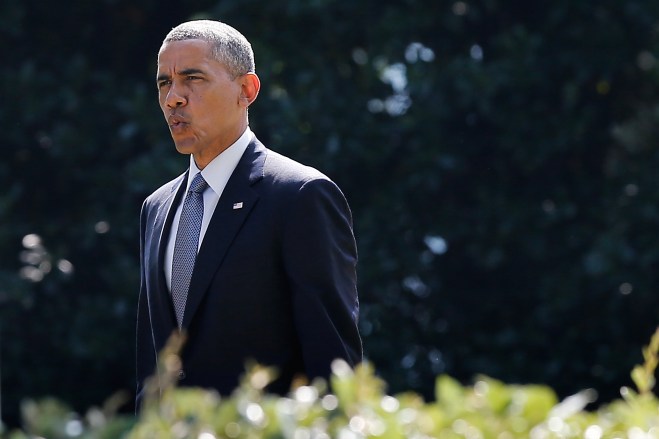
President Obama Departs White House En Route To Colorado

I’m sure my Republican readers will wince at that headline – or mock it. The news narrative of the summer is the floundering of the president in any number of ginned-up stories: he “lost” the Middle East (as if that’s a bad thing); he’s created a crisis in illegal immigration (even though the bulk of the blame goes to a Bush-era law); he’s responsible for total gridlock (as if Ted Cruz did not exist); he’s been snookered by Putin; he’s been humiliated by Netanyahu; he’s the “worst president since World War II”, and on and on.

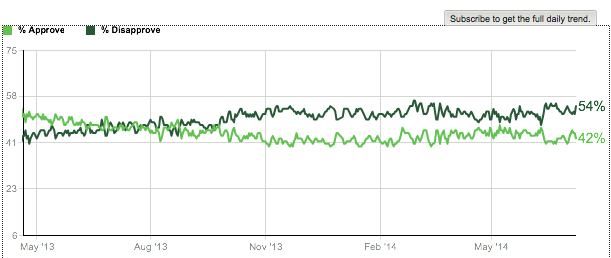
But let’s revisit last fall when Obama was in his first second term swoon. At that point, with the implosion of healthcare.gov, the very survival of the ACA, his signature domestic achievement, was in serious doubt. In the wake of Obama’s sudden bait-and-switch in Syria, when he threatened a strike and then accepted a Putin-brokered deal with Assad on WMDs, his foreign policy skills were about to get systematically downgraded by the American public. The economy was still sluggish, with no guarantee of a robust revival. Here’s Gallup’s picture of the president’s stark reversal of polling fortune, almost rectified before Iraq exploded a month or so ago:

Screen Shot 2014-07-10 at 10.04.06 AM

In April of last year, his approval ratings were exactly the inverse of what they are today. And with every passing day in his second term, his ability to leverage his power attenuates.

But let’s return to last year’s crises. Less than a year after the ACA was regarded as near-dead, the implementation has exceeded most expectations. Today’s Commonwealth Fund report tallies the results:

The uninsured rate for people ages 19 to 64 declined from 20 percent in the July-to-September 2013 period to 15 percent in the April-to-June 2014 period. An estimated 9.5 million fewer adults were uninsured. Young men and women drove a large part of the decline: the uninsured rate for 19-to-34-year-olds declined from 28 percent to 18 percent, with an estimated 5.7 million fewer young adults uninsured. By June, 60 percent of adults with new coverage through the marketplaces or Medicaid reported they had visited a doctor or hospital or filled a prescription; of these, 62 percent said they could not have accessed or afforded this care previously.

And the rate of increase in per capita healthcare costs has moderated substantially since the Bush administration. Perspective is everything, of course, and politically, the ACA is still (on balance) a loser, especially among the older, whiter Medicare recipients who are over-represented in mid-term elections. But still: isn’t this by the measure of last fall a pretty stunning comeback? And the purist “repeal!” chorus has dimmed to a faint version of replace or fix.

So turn your gaze to Syria, where the entire foreign policy establishment moaned in concert at Obama’s fecklessness last September. We were all told that it was unbelievably naive to think that Assad would ever fully cooperate and relinquish his stockpile of WMDs as a reward for not getting bombed. It was a pipe-dream to think Putin was serious about being constructive as well. Well: a couple weeks back, the last shipment of WMDs was removed from the country, with very limited use in the intervening period, and is now undergoing destruction. I don’t know of any similar achievement in non-proliferation since Libya’s renunciation of WMDs under Bush. No, we didn’t resolve the sectarian civil war in Syria/Iraq, but we did remove by far the biggest threat to the West and to the world in the middle of it. Why is that not regarded as an epic triumph of American diplomacy, backed by the threat of force?

Now look at the economy where Obama has been stymied by the GOP for a very long time – both federally and in the states where local government austerity put an unprecedented drag on the recovery. Well: again, we have an unemployment rate back to where it was before the Great Recession hit. If the momentum continues, we could have an unemployment rate below 6 percent before too long. It’s taken for ever – but the hit was deep and the debt overhang large. And speaking of debt, we also have this data to chew on:

usgs_line.php

No, there hasn’t been any progress in reducing our long-term debt or our unfunded liabilities in entitlements. But when the GOP refuses to countenance any new revenues, I can’t blame the president. And to have reduced a budget deficit from 10 percent of GDP to just over 2 percent in the wake of a massive recession is something a Republican president would be bragging incessantly about.

There’s still a lot in play. The critical negotiations with Iran remain as tricky as ever – but that we have a chance of controlling Iran’s nuclear program without war is already a remarkable fact. Again: a function of skilled, relentless diplomacy backed by serious sanctions. The menace of Putin has not gone away – even though a very good case can be made that in that head-to-head, Putin is now licking his wounds a little, after Ukraine has signed that trade deal with the EU, and Ukraine’s military is regrouping. Immigration reform is in limbo. But I’d argue that on the wider political plain, Obama has been winning the strategic war with the GOP. The last twelve months have been an unmitigated disaster for Republican outreach to Hispanics; the Republicans have hurt themselves with many more women on the question of contraception, than they have helped themselves with orthodox Christians; the Palin impeachment chorus is poison to the middle of the country; and the Democrats have a clear and female front-runner against a divided and small-bore GOP bench in 2016. If Clinton were to win, it would be as decisive a strategic advance as when George H W Bush cemented Reagan’s legacy.

I’m applying the criteria that Obama has applied to himself. Is his long game bearing fruit? So far, it seems to me, the question answers itself.

(Photo: U.S. President Barack Obama departs the White House July 8, 2014 in Washington, DC. Obama was scheduled to travel to Denver, Colorado. By Win McNamee/Getty Images.)

Will Utah Be The Big One?

Another marriage equality case is headed for the Supreme Court:

In June, the 10th Circuit Court of Appeals ruled that Utah’s ban on same-sex couples’ marriages is unconstitutional. Wednesday is the deadline for the state to ask the full appeals court to rehear that case, a process called an “en banc” rehearing, and Attorney General Sean Reyes’s office announced it will not do so. The attorney general’s office will, however, take the case directly to the Supreme Court, asking the justices to hear the appeal. The case, if taken by the justices, would present a second opportunity in recent years for the justices to declare that all state bans like the Utah one are unconstitutional, leading to nationwide marriage equality.

The court doesn’t have to take the case, of course, but Denniston explains why they might choose to:

With the case going to the Justices via such a petition, the Court will have complete discretion whether to review the Tenth Circuit ruling, or pass it up.  Utah officials are almost certain to argue that the Court should take up the issue promptly based on the argument that there is now a conflict among federal appeals courts on the constitutionality of such bans.

The Eighth Circuit upheld such a ban, but that was in 2006, seven years before the Supreme Court’s Windsor decision — a ruling that many judges have said changed the legal landscape for review of those state laws.  In the Windsor decision, which involved only a federal law, the Court indicated that it was not taking a position at that time on the validity of state laws forbidding same-sex marriages.

But there is no such conflict between courts regarding this particular case, so the justices might prefer to hold off:

While most observers expect the high court to take up the issue of marriage equality within the next few years, the Associated Press notes that the court has a history of declining to consider cases without divergent rulings from lower courts. In the Kitchen case, a federal trial judge and the 10th Circuit both ruled that the state’s ban on same-sex marriage is unconstitutional. If the Supreme Court declines Utah’s request to hear the case, those lower rulings will stand, definitively declaring Utah’s marriage law unconstitutional and striking down the voter-approved law.

Some legal experts, however, doubt the court will turn it down:

“I think the Court will take the case. Since [U.S. v.] Windsor, all of the lower courts that have ruled have struck down laws prohibiting same sex marriages,” said Erwin Chemerinsky, the Dean of the University of California, Irvine School of Law. “Perhaps without a split in the lower courts, the Supreme Court will wait. My prediction, though, is that the Court knows the issue needs to be resolved and will take it.” And if the Court does hear the case, all eyes will be on Justice Anthony Kennedy, not simply because he’s the traditional swing vote, but because he has written all three decisions in Supreme Court history that advanced gay rights. “I also predict that the five justices in the majority in Windsor will be the majority to declare unconstitutional laws that deny marriage equality to gays and lesbians,” Chemerinsky said.

Also yesterday, Alito denied without comment a county clerk’s plea to stop same-sex marriages in Pennsylvania. “That appears to remove the last potential legal barrier to Pennsylvania becoming the nineteenth state in which same-sex marriages are permitted,” Denniston adds in an update. And, in other good news, a judge struck down Colorado’s marriage equality ban yesterday, though the decision is stayed pending appeal. The speed of all this is simply staggering.

Who Killed The RomCom? Ctd

Megan Garber has her own theory about why the genre is struggling:

[T]he truth is that romantic comedies are, as works of art and pieces of culture, terrible. They are usually some ungodly, unsexy combination of: stale, trite, silly, and formulaic. They are often offensively anti-feminist. The generous reading of all this is that recent films and their creators became victims, essentially, of the innovator’s dilemma: They got too good at obeying their own, once-successful formulas – and failed to see beyond them.

The less generous reading is that film executives and creators failed to see the culture changing around them. The rom-com industrial complex – the cultural institution charged with capturing romance as a kind of ritual – failed to recognize the evolution of romance itself.

Meanwhile, a reader who writes about box-office trends offers some context, while another offers a few recommendations:

Romantic comedies aren’t weak because the male 18-24 audience dominates the box office. Indeed, the headline over the last year has been the collapse of that group among US moviegoers. Moviegoing is skewing older and a bit more female.

The need to capture a worldwide audience is one reason many genres don’t get fuller attention, but romcoms can be made relatively inexpensively, and several female-oriented films over the last few months have been considerable successes. Remember that there’s a lag of around two years between when films are greenlit and when they hit the screen. So romcoms might come back in the US. Yes, many American comedies don’t translate internationally, but a Pretty Woman would likely be just as big today as it was in 1990 (much bigger, with inflation).

Update from a reader:

I adore the movies and go as often as I can (but not to the multiplexes, which seem to be increasingly dumbed down). I prefer smaller indy films, and there are excellent indy rom coms which are neither trite nor anti-feminist. In the last month I’ve seen two excellent indy rom coms…. The Lunchbox and In a World Where…

The Lunchbox refutes the lie that romcoms cannot bridge cultures. It’s is an Indian film about a uniquely Indian system but which spoke beautifully and intelligently to longing in an unfulfilled life. I, a working American mother, related very much to the young Indian housewife at the center of the story, and her neighbor reminded me a great deal of my Puerto Rican mother-in-law. And all without innuendo about sex. The closest this film came to nudity was the heroine removing her jewelry in the evening.

In a World Where…, written, directed, starring and produced by Lake Bell, includes many romcom cliches including mistaken identity, the overlooked love interest, etc., but as a humorous side plot in this tale of a woman fighting to make it in a male-dominated industry.

If the big studios only took the time and effort to make movies that were not so dumbed down in the way they have every movie Kate Hudson and Jennifer Anniston ever starred in, maybe they could draw me back to the multiplex.

Good News For Gay Parents

A major Australian study has found that the children of same-sex couples are better off than most:

Researchers from the University of Melbourne surveyed 315 same-sex parents with a total of 500 children. About 80 percent of the children have female parents, while 18 percent have male parents. The children raised by same-sex partners scored an average of 6 percent higher than the general population on measures of general health and family cohesion. They were equivalent to those from the general population on measures of temperament and mood, behavior, mental health and self-esteem.

Researcher Simon Crouch posits that “the structure of same-sex parent families, particularly in relation to work and home duties, plays an important part in how well families get along”:

Same-sex parents, for instance, are more likely to share child care and work responsibilities more equitably than heterosexual-parent families. It is liberating for parents to take on roles that suit their skills rather than defaulting to gender stereotypes, where mum is the primary care giver and dad the primary breadwinner. Our research suggests that abandoning such gender stereotypes might be beneficial to child health.

But stigmatization remains a concern:

According to the study, about two-thirds of children with same-sex parents experienced some form of stigma because of their parents’ sexual orientation. Despite these kids’ higher marks in physical health and social well-being, the stigma associated with their family structure was linked to lower scores on a number of scales. Crouch said stigmas ranged from subtle issues such as sending letters home from school addressed to a “Mr.” and “Mrs.” to more harmful problems such as bullying at school. The greater the stigma a same-sex family faces, the greater the impact on a child’s social and emotional well-being, Crouch said.

Mark Joseph Stern argues that stigma isn’t a gay-parenting problem; it’s an anti-gay-parenting problem:

A study last year by researchers at University of Nebraska-Lincoln and University of Pretoria in South Africa took a deeper dive into the effect of stigma on gay families, finding that:

The children were not upset that their parents are gay. In fact, most of them embraced it. The negativity that children with gay parents experience is rarely the result of having gay parents. Instead, it’s the cultural stigma that causes all the problems. Any concerns they had were the result of how they would be treated in the public sphere. Research constantly shows that children with gay parents are normal, healthy, well-adjusted people. It’s the social scrutiny and stigmatization that children have to negotiate and contend with.

As that quote suggests, the study only confirmed what previous research had borne out: Gay parents don’t disadvantage their children – but conservatives’ smear campaigns against gay parents do.

German Lopez notes some caveats in the study:

The findings are based on reports from the parents who agreed to the survey, which could skew the results. The survey also focused on Australian same-sex parents, so there may be social and cultural factors at play that wouldn’t apply perfectly to America’s gay and lesbian parents. And the study doesn’t compare same-sex parents directly with opposite-sex parents; it instead compares same-sex parents and their children to the general population.

Update from a reader:

German Lopez’s caveat goes further than you may suspect. While it’s true beyond doubt that the study shows that same-sex parenting doesn’t hurt, and that’s important to get on the record, the data can’t say anything useful about whether or not it’s better. For that, you’d need to compare same-sex adoptive parents to opposite-sex adoptive parents, not same-sex parents to the general population.

It comes down to basic experiment design. You want to remove as many confounding factors as possible. Adoptive parents spend a lot of time and money on the process, have gone through a vetting process, and manifestly WANT to be parents. The general population contains a lot of willing parents, to be sure – but it also contains a lot of accidental parents, people with “buyers’ remorse”, and few of them went through any vetting process more discriminating than the mother’s choice of partner.

An interesting result, but more study is needed.