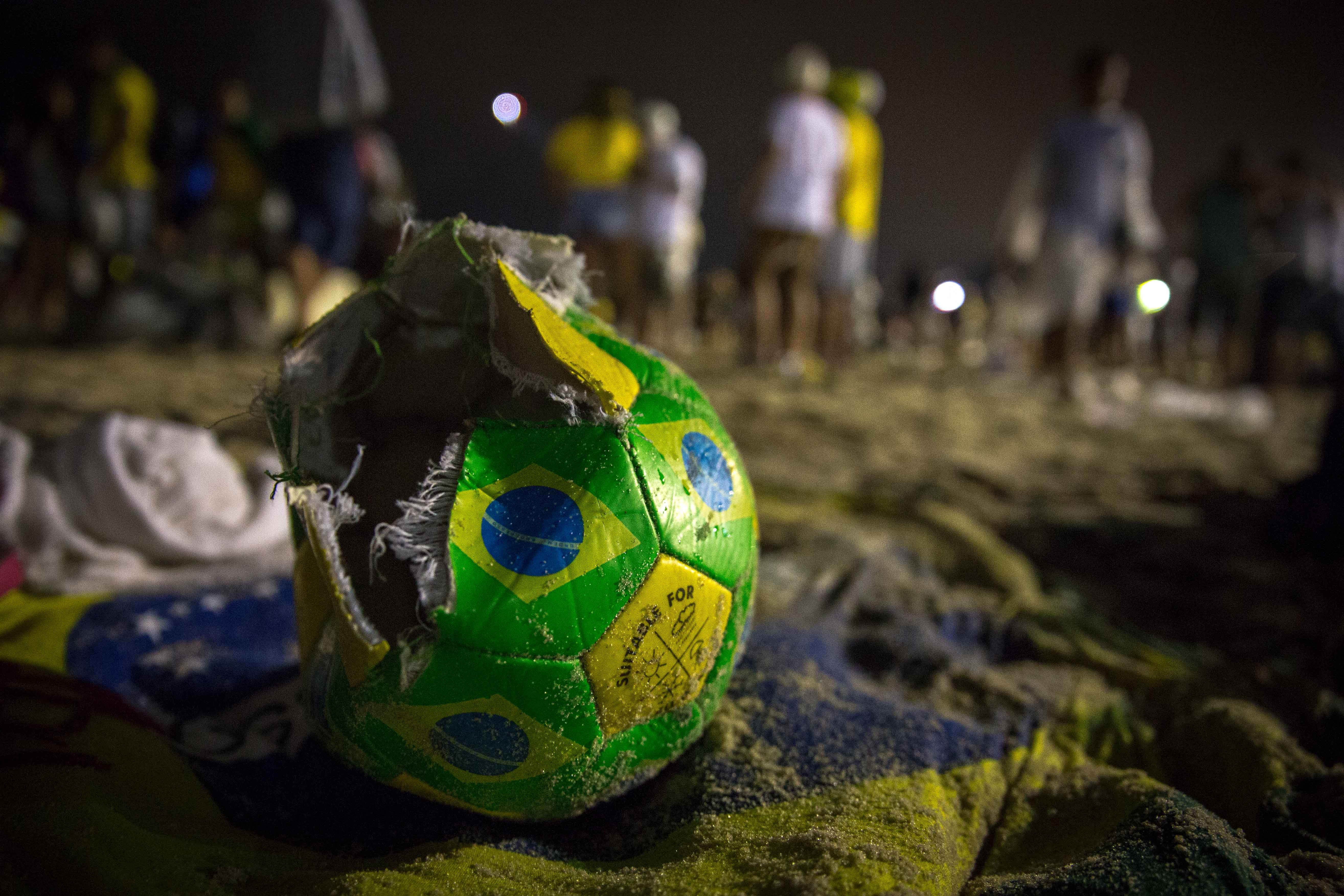
Brazil Goes Bust

2014 FIFA World Cup Brazil

Nate Silver calls Brazil’s utter humiliation in yesterday’s 7-1 loss to Germany the “most shocking result in World Cup history.” Michael Goodman wonders if it will lead to unrest:

The immediate question is whether Brazil’s exit will serve as a flashpoint for an immediate revival of the previous protests, or in an even uglier scenario, like riots. The overwhelming police presence makes this unlikely, at least for now. It may not be pretty, it may not be humanitarian, it may not even be legal — but it has been brutally efficient. When the teams and the tourists and the cameras leave again, that’s a different story. There’s every reason to believe the lead-up to Rio 2016 will be similar to what Brazil experienced before the World Cup unless, of course, the government has a super-secret plan to boost the economy, increase employment, and more aggressively address persistent inequality.

Both Brazil the country and Brazil the team are likely in for a turbulent few years. Had the team won the World Cup, they might have avoided that fate with a confirmed soccer philosophy and break from social unrest. But the honeymoon wouldn’t have lasted very long. For Brazil, the problems run a good deal deeper than just losing a soccer match.

Keating eyes the country’s upcoming elections:

If Brazil had won the tournament, it could have changed the political significance of the entire event. If the country had made a dignified exit in the late rounds, it probably wouldn’t have had that much of an impact either way. But a defeat this humiliating is going to remind a lot of voters of why they were upset about the World Cup in the first place. Anti-Dilma chants were reportedly already being heard at the stadium today.

As Francisco Fonseca, a political scientist at Sao Paulo’s Getulio Vargas Foundation, told the L.A. Times on June 28, “if there were some kind of catastrophe, or chaos, that embarrassed Brazil in front of the world, that would clearly have negative consequences for the government in the election.”

Jesse Singal provides a psychoanalysis of the crushed Brazilian fan:

The problem is that soccer dominance is an important part of Brazil’s sports identity, and this loss cut to the core of it. As Eric Simons, author of The Secret Lives of Sports Fans, explained in an email, “If you’re Brazilian, your identity is based on self-concept that you’re always the best soccer team in the world, and you know that everyone else knows it, so you’re proud.” So the pain of losing isn’t, in this case, that of an underdog happy to be there, and for the Brazilians to lose in this manner is to collide violently against all sorts of national expectations and self-conceptions.

“What happens when your pride, self-concept, and identity are suddenly obliterated in front of the entire world?” said Simons. “I don’t know. I don’t know if anyone does; this is, in sports, something of an unprecedented self-esteem catastrophe. Has anyone that good, with that much expectation, [ever] lost that badly before, with so many people watching?” The answer to that question may be no, which would mean we’re in somewhat uncharted sports-trauma territory.

Update from a reader:

While there were some rumblings of riots yesterday, I think Brazilians deserve a little more credit. The idea of conflating a historically bad result in a crucial World Cup game with the protests about the country’s economic and management issues undermines the voters’ intelligence. Given the looming inflation, underwhelming GDP, exorbitant taxation, and horrible mismanagement of taxpayer money, Ms. Rousseff will have a hard reelection campaign regardless of how well Brazil performed in the World Cup. What we witnessed yesterday was the triumph of planning, discipline, and hard work over the notion that the home team was predestined to win. Germany gave Brazil a master class yesterday; it is up to Brazil now to learn from this lesson, both on and off the field.

Now if Argentina beats Brazil soundly on the consolation match on Saturday, all bets are off …

(Photo by Steffen Stubager/Anadolu Agency/Getty Images)
The Spread Of Reefer Sanity

Well, not to everyone of course:

But Waldman won’t be surprised “if within a decade we saw legal pot in half the states”:

Any state considering its own legal cannabis regime will be watching [Colorado and Washington] closely, to figure out where the potholes are and how to avoid them. But (depending on how things go in Washington) it’s going to be very difficult for legalization opponents to argue that the two states have suffered outright disaster, particularly the kind of disaster the anti-drug forces warned about. So when new states join the debate, the discussion may well focus more on specifics, like how products should be labeled and how an existing medical marijuana system should be integrated with a new recreational commerce system. That kind of debate assumes that the problems are solvable if you fashion your policies with enough care.

In 2016, we could see anywhere from a half-dozen to a dozen initiatives on the ballot in various (mostly liberal) states legalizing cannabis in one way or another. The most important of these is California, with its population of 38 million and an already permissive attitude toward marijuana. This is a debate that’s only going to accelerate in the next few years, and if the anti-legalization advocates don’t find a way to cast off their old habit of arguing with frying eggs and apocalyptic warnings that don’t come true, they’ll find themselves increasingly marginalized.

This Is A Refugee Crisis, Ctd

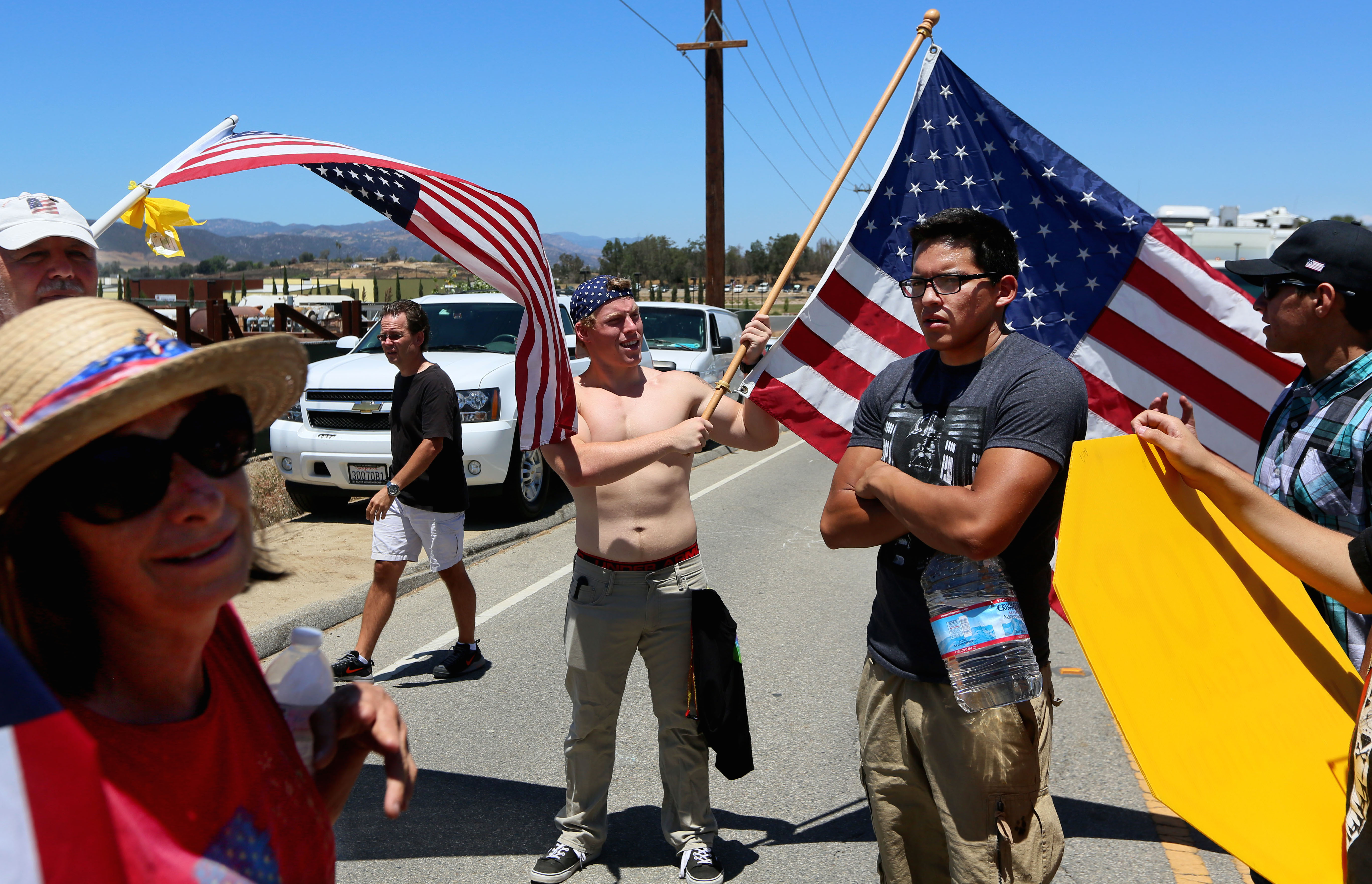
Protests Continue in Murrieta Against Processing of Undocumented Immigrants

Yesterday, Obama requested $3.7 billion from Congress to address the border crisis. The bulk of the funds ($1.8 billion) will go to HHS to better care for the tens of thousands of unaccompanied Central American children who have arrived in recent months, and another $1.1 billion to Immigration and Customs Enforcment to detain, prosecute, and deport undocumented families. But the plan is already catching heat from both sides:

By sending the request to Congress, Republicans, who are outraged over Obama’s immigration policies, will now have an opportunity to express their fury in must-sign legislation, possibly attaching policy riders or demanding budget cuts elsewhere. “The Appropriations Committee and other Members, including the working group on the border crisis led by Rep. Kay Granger, will review the White House proposal,” Michael Steel, a spokesman for House Speaker John Boehner, said in a statement. “The Speaker still supports deploying the National Guard to provide humanitarian support in the affected areas—which this proposal does not address.” And liberals are organizing to block the White House efforts to rewrite laws to make the deportation of child migrants from Central America less cumbersome.

And so you see that the GOP is so consumed with scoring political points against the president that they are prepared to allow what they have spent so long denouncing as outrageous. We have long known this. The animating spirit of the GOP these days is revenge – not advancing conservative policy options, not addressing an immigration crisis they have been hyperventilating about for weeks and months: just finding an occasion to stick it to the imposter president. Allahpundit therefore theorizes about what nefarious scheme Obamnesty is really up to:

The Orwellian irony there is that amnesty fans are pounding the table about due process for minors caught entering the U.S. illegally when, in many cases, those same minors won’t end up availing themselves of the process that’s due. The point isn’t to make sure they get a hearing before being deported, it’s to create a pretext that allows them to remain in the U.S. for the time being so that they can quietly disappear into the population while supposedly waiting for their hearing.

“Due process” is, in other words, being used as a tool to abet the breakdown in process, facilitating illegal immigration. And the chief executive is happy to let that go on, at least for now. Instead of pursuing summary deportation, he’s going to ask Congress for $3.8 billion in extra resources, nearly double his initial amount, to “process” all the new cases. Even though, as we all understand, many of them will end up going unprocessed, by design.

But from the left, the criticism is that Obama is being too tough on the children, many of whom likely qualify as refugees. Josh Voorhees, for instance, argues against Obama’s theory that expediting deportations will deter more kids from making the trip across the border:

Obama says that if parents knew for certain that their children would be sent home almost as soon as they arrived on U.S. soil, then they’d decide against sending their kids trekking across the Mexican desert in the first place. The president is betting that these families are choosing to have the children come—for reasons ranging from better jobs to reuniting with family—and not because they believe they have no other choice. And that’s where the president’s wrong, according to the plan’s critics.

“These parents and kids say that they understand how horrible the trips will be—that they might be robbed of their money or sexually abused, that they’ll be hungry and might die,” says Karen Tumlin, the managing attorney at the National Immigration Law Center. “And even after these kids get apprehended, they say they’d do it all again because of the violence and conditions in their home countries.” She and her fellow advocates argue that a parent who’s willing to pay to send her child with a “coyote” to the United States has already decided that doing anything—no matter how great the risk or low the odds—is better than doing nothing.

And William Finnegan fears that this approach will end up overlooking legitimate asylum claims:

The most disturbing part of the Administration’s response to the crisis at the border has been a suggestion by the President that, in order to fast-track deportations of young people from Central America, he might seek changes to a 2008 law meant to protect the rights and the welfare of trafficked children. Yes, there are a great many children, and the political optics are terrible for Obama. And yes, many of the newly arrived children will probably end up being deported. But others may have a valid claim to asylum—they come, after all, from some of the most violent societies in the world. All of them have a right to counsel and to a fair hearing. It’s called due process.

In any case, Waldman reminds us that this problem is largely outside of American control:

The trouble we’re having now is really two problems coming together: an increase in the number of children from Central America making this journey, and a system that doesn’t have the resources to handle them once they get here. A number of conditions are combining to create the former: desperate poverty and violence in the three countries most of these kids are coming from (Guatemala, El Salvador, and Honduras), false rumors that children who come today will get to stay under the administration’s Deferred Action For Childhood Arrivals policy (which actually only applies to people who came to the US before June 2007), and the more accurate belief that if you make it to the US you might get to stay anyway, at least for a while until your deportation hearing. … [I]n the long run, the chief driver of undocumented immigration is out of our control. The reason we aren’t faced with hundreds of thousands of Canadians sneaking over our northern border is that life in Canada is quite pleasant. People come from the south because the difficult and dangerous prospect of making it to America and then trying to build a life once you get here seems less frightening than staying where they are. And there’s only so much we can do about that

Offering an alternative solution, the Bloomberg editors argue that “to stem the flow of migrants, the U.S. must establish — and help to pay for — deterrence programs in Central American nations”:

One pilot program in Guatemala, for example, gives children repatriated from the U.S. a safe place to stay and provides education and job training. Beefed-up services at U.S. embassies and consulates could also help. Senators Charles Schumer and John McCain, a Democrat and a Republican, have suggested requiring claims for refugee status to be made at U.S. embassies in Central America rather than on U.S. soil. The White House has called for only $300 million for international programs. (The 2008 law under which the administration is operating specifically called for programs to assist in reintegrating and resettling victims of trafficking.) The more children can find services and hope in their own countries, the fewer will be tempted to make the dangerous trek north.

(Photo: Miguel Hernandez (R), an immigrant rights activist, stands among anti-immigration activists outside of the U.S. Border Patrol Murrieta Station on July 7, 2014 in Murrieta, California. Immigration protesters have staged rallies in front of the station for about a week in response to a wave of undocumented immigrant children caught along the U.S.-Mexico border in Texas and transported to the Murrieta facility while awaiting deportation proceedings. By Sandy Huffaker/Getty Images)

A Monumental Tragedy In Iraq

Christopher Dickey reports on the threat the jihadist insurgents pose to the country’s antiquities:

Indeed, museum curators and staff were no better prepared than any other part of the Iraqi government. They could have learned from al-Baghdadi’s operations in neighboring Syria that a major source of revenue for his insurgency has been the sale of looted antiquities on the black market. As reported in The Guardian, a windfall of intelligence just before Mosul fell revealed that al-Baghdadi had accumulated a $2 billion war chest, in part by selling off ancient artifacts from captured Syrian sites. But the Iraqi officials concerned with antiquities said the Iraqi intelligence officers privy to that information have not shared it with them.

So the risk now—the virtual certainty, in fact—is that irreplaceable history will be annihilated or sold into the netherworld of corrupt and cynical collectors. And it was plain when I met with [Iraqi National Museum Director Qais Hussein] Rashid and his colleagues that they are desperate to stop it, but have neither the strategy nor the resources to do so.

One Reason Why Buzzfeed Is An Embarrassment To Journalism

It runs articles by third parties attacking other newspapers’ integrity – yes integrity –  for money.  Update from a reader:

I think that BuzzFeed article is especially problematic because it’s actually just impossible to tell (likely purposefully impossible) exactly what a “Community Brand Publisher” is.

When you go to the site, the article disclaimer says: “This post was created by a Community Brand Publisher, which means it is not sponsored and has not been vetted or endorsed by BuzzFeed’s editorial staff.” While the “not sponsored” is likely meant to be read “not sponsored … by BuzzFeed’s editorial staff”, it could also be taken to mean that the article is not “sponsored content.” That reading would suggest that BuzzFeed had not been paid to run it, though it seems that they have. This is further confused by their use of the term “Community Brand Publisher”… the BuzzFeed “Community” is open to anyone and makes no mention of any payment, but I can’t determine what exactly a “Community Brand Publisher” is. Searching the term on Buzzfeed gives no results, and searching on Google seems to return a bunch of posts by these “Community Brand Publishers”, rather than any real definition of what that means.

It seems like Buzzfeed (through the use of the word “Community” and the lack of explanation of what that means) is trying to confuse their readers as much as possible while covering their asses (being able to say “well look, we clearly noted that it was a Community Brand Publisher, not someone from the Community”). An embarrassment to journalism indeed.

Write Wingers

Adam Bellow’s cover-story in National Review (paywalled) urges conservatives to re-engage with popular culture, especially by embracing the novel as a medium to fight the culture war and bring right-wing ideas into the mainstream. Dreher cheers:

[A]rt and culture should not be approached from an instrumental point of view. This is why, for example, so much contemporary Christian filmmaking is so bad: it’s designed to culminate in an altar call. It’s about sending a message, not telling a story. I’m personally aware of a conservative donor and investor who poured millions into an independent film because he thought it was wholesome, and would improve the character of its viewers. I watched the movie in a private screening, and it was terrible. A total waste of money. My sense was that the investor had no idea what he was paying for, and in fact he wouldn’t have paid for a film that was anything other than moralistic propaganda. That model is not what conservative artists and writers want or need.

Alyssa offers some advice to writers who want to heed Bellow’s call. “Popular fiction,” she notes, “has a long tradition of packaging conservative ideas about everything from sexual mores to foreign policy in page-turning plots,” but pop novelists like Tom Clancy, John Grisham, and Tom Wolfe haven’t always done a great job with it:

Neither Clancy nor Grisham are particularly adept at character development or psychological writing. Instead, they hook us with plot, which is the primary vehicle for their ideas. This is an approach that works well if the stakes for a story are external, whether Jack Ryan is foiling a terrorist plotor Mitch McDeere is bringing down a mob-controlled law firm. Something different is required when a novel is trying to get at more internal issues of morals and ethics.

In 2004, when Tom Wolfe published “I Am Charlotte Simmons,” his novel about an elite university and the contemporary students who fail to live up to its reputation, he obviously intended to pen a scathing look at what would come to be known as hookup culture. But the book is marred by Wolfe’s failure to create a fully compelling internal life for his titular fallen freshwoman. Charlotte reads like a 73-year-old’s fantasy of how an 18-year-old woman thinks, which is, of course, precisely what she is. “I Am Charlotte Simmons” should be a strong reminder of the value of empathy and nuance when writing characters who do not share your life experiences–particularly when you want to criticize their morals.

But Waldman is skeptical of Bellow’s vision, questioning whether the contemporary American right is even all that interested in influencing mainstream culture:

The problem is that conservatives love their politicized media bubble. It’s so nurturing and warm and supportive. Unfortunately, it also produces all kinds of pathological beliefs and behaviors, from the Benghazi obsession, to the insistence that climate change is a giant hoax, to the “unskewed” polls proving that Mitt Romney would trounce Barack Obama in 2012.

If Bellow can find a conservative writer who’s also the next great American novelist, more power to him. But he’ll start at a disadvantage, because artists are just more likely to be liberal. As a group, liberals tend to be more open to new experience and tolerant of ambiguity—traits that might lead one to be more creative—while conservatives tend to be more conscientious, but also more rigid. That’s why artists of all types have always been more likely to be liberals—challenging tradition, exploring new ways of seeing—and always will be. There are plenty of exceptions, of course, and maybe Bellow can help create a community of writers that produces work that would make both William Faulkner and Milton Friedman weep with gratitude. But it sure won’t be easy.

The Root Of The STEM Problem

STEM

Lumping science, technology, engineering, and math together obscures more than it clarifies, according to Danielle Kurtzleben:

[I]t’s not necessarily that there aren’t enough science and math scholars out there; it’s that there aren’t enough people out there with the particular skills the job market needs right now. Spending four years doing biology experiments is no guarantee for a job, and indeed might not go as far as a couple semesters of statistics or computer science.

The issue in part is that STEM is in many ways too broad a classification to describe the complicated job market right now.  A May 2014 report from the Government Accountability Office found that employment and wage outcomes could vary widely between healthcare STEM jobs, so-called “core STEM” jobs, and other STEM jobs. “STEM makes no sense as a category. What you have is science and engineering, and then you have this IT labor force,” says Hal Salzman, a professor of planning and public policy at Rutgers University.

(Chart from the GAO’s “Science, Technology, Engineering, and Mathematics Education: Assessing the Relationship between Education and the Workforce,” May 2014)

Is It ADHD Or Trauma?

Rebecca Ruiz observes that “inattentive, hyperactive, and impulsive behavior may in fact mirror the effects of adversity, and many pediatricians, psychiatrists, and psychologists don’t know how – or don’t have the time – to tell the difference”:

[Dr. Nicole] Brown was completing her residency at Johns Hopkins Hospital in Baltimore, when she realized that many of her low-income patients had been diagnosed with attention deficit/hyperactivity disorder (ADHD). These children lived in households and neighborhoods where violence and relentless stress prevailed. Their parents found them hard to manage and teachers described them as disruptive or inattentive. Brown knew these behaviors as classic symptoms of ADHD, a brain disorder characterized by impulsivity, hyperactivity, and an inability to focus.

When Brown looked closely, though, she saw something else: trauma. Hyper-vigilance and dissociation, for example, could be mistaken for inattention. Impulsivity might be brought on by a stress response in overdrive. “Despite our best efforts in referring them to behavioral therapy and starting them on stimulants, it was hard to get the symptoms under control,” she said of treating her patients according to guidelines for ADHD. “I began hypothesizing that perhaps a lot of what we were seeing was more externalizing behavior as a result of family dysfunction or other traumatic experience.”

Previous Dish on ADHD here and here.

The Bias Against Black Dogs, Ctd

A reader writes:

It really is true that it is more work to appreciate the features of a black dog.  For instance, in this photo of my dog, you can barely see his eyes:

10176247_10152351667344189_1085738088_n

Or his body. Or his feet.

Another can relate:

I volunteered at a shelter and noticed this problem too. I adopted a black-haired, medium-sized, young adult, mixed-breed dog who turned out to be essentially perfect. I find that with a decent camera and some experience, experimentation, and digital editing, one can make great photos of black-haired dogs. Here’s one I took of my dog, which I think proves the point:

Kitchen Portrait-2

Another reader:

We recently adopted a rather large black dog. Sonny is beautiful, but there are problems.

First, Sonny is impossible to see at night. That means he sometimes gets stuck at the back door, begging to be allowed back in the house. And sometimes, in the middle of the night, I get tripped up on my way to the bathroom.

Second, having a black dog muddies my standing as a yellow dog Democrat. In years past, when asked about my politics, I just pointed to my pooch. Can’t do that now.

Another has a suggestion for photo-taking:

As you can see, black dogs can be photographed wonderfully, and tools like Instagram help:

unnamed-insta

Another has more tips:

First, there’s the Black Dog Project if you want to see some great photographs of black dogs. The photographer, Fred Levy, photographs them against dark backgrounds to highlight the difficulties they face in being adopted.

Secondly, there’s a few things that you can do when taking photographs of black dogs to make them turn out better. This is really good for shelter workers, but also just for regular dog owners who want better photos of their pooches. Black dogs can seem scary and ominous, but if you play with the dog for a few minutes and get it into a light pant, they start to look like they are smiling, and their eyes come alive. The dog goes from scary to friendly in an instant. Washing them and giving their coat a good brush will help them shine and create really nice highlights that also make them turn out less like a dark blob in a photo.

Finally, I’d be remiss to not include a photo of my own black pup:

puptraits

Another has a different recommendation:

The best barbecue joint I have ever been to in my life is in Urbana, Illinois, home of the University of Illinois, called Black Dog Smoke and Ale House. It proudly displays several signs about this exact issue of adoption, donates to the Humane Society of Champaign (a no-kill shelter), and the owners have their own adopted black dogs. And their food is out of this world. If you ever find yourself lost in the cornfields of Illinois, worth the time.

More readers share their pup pics:

I knew about the bias against black cats in shelters, but I didn’t realize it extended to dogs. He is hard to spot in the laundry basket, though:

IMG_0943 (1)

Another:

It breaks my heart to think that people might be biased against dogs based simply on the color of their coats.  Makes about as much sense as being biased against people based on the color of their skin.  Not saying that the effect isn’t real, just that it’s stupid.

My evidence?  Take a look at these two adorable mutts that rule over our house: Chloe on the left and Chip on the right:

chip

Never a better pair of “pound puppies” to be found!

Another:

I couldn’t help but write you after reading your post today on the bias against black dogs; it’s an issue I think about daily.  I have two dogs, both rescues; one is a beagle/border collie mix (mainly white with charcoal markings), and the other is a black lab/doberman/german shepherd mix.  Every evening, weather permitting, I take them on a long walk throughout the neighborhood, and whenever anyone stops to talk, or pet the dogs, the white beagle mix is “the little one,” and Moxie is “the black one.”  I find it fascinating.  The only exception to this is small children; teens, adults, and the elderly all toe the invisible “little/black” line.

Both of my dogs are extremely friendly, well-Moxiebehaved on walks, and love to meet new people. I absolutely understand why strangers would be apprehensive of my larger dog, as she is about 125 pounds, but no one, not ever, in four years of walks, has called her “the big one.” My neighborhood is fairly diverse, but regardless of the ethnicity of the person we meet, she is always the Black Dog.  It makes me a little sad, not just because it happens, but because it is apparently such a widespread bias.

Interestingly, the colors/sizes split along gender lines, too.  Both of my dogs are female, but strangers always assume the mostly white dog is a girl, and the black dog is a boy (even though she sports a hot pink collar and matching leash).

Like all proud dog owners, I can’t resist talking about my dog without forcing you to look at sending at least one picture along.  Look at that face!

I can’t close without telling you how much I enjoy The Dish, and how meaningful it is to me in my daily life.  I’m a founding member, and I can say without a doubt that my membership is one of the most rewarding purchases I’ve made, and I plan on renewing into perpetuity. Thanks again!

One more:

Our black dog is Chaucer, born in Oxfordshire, who has traveled with us through 10 countries on our (USAF) military career. We are now in S. Korea for another year on assignment. He has flown over the Atlantic and Pacific and is a love. Koreans are afraid of large dogs and people have been known to run screaming when they see us on our walks. The younger folks stop and ask if they can have their picture taken with him. As you can see, he is very photogenic; please, please, PLEASE add my gorgeous boy to your black dog thread. You will make him very happy!

20080413-DSC_2091

Floral And Faunal Fragrances

Richard Conniff ponders the role of scent in the natural world:

We are by no means the only species trying to smell like something (anything) other than ourselves. The caterpillar of South Africa’s Zulu Blue butterfly, for instance, mimics the chemical scent that the ants use to recognize their own brood. So the gullible ants carry the caterpillar into their nest, and don’t seem to notice when it proceeds to devour the very ant brood it has been mimicking.

Orchids are also wicked olfactory deceivers. They need to attract wasps, bees and other insects to spread their pollen. So some orchid species have evolved the shape and coloration of specific female insects – and also release chemicals that duplicate the come-hither perfume of the females they mimic. (It’s interspecies cross-dressing – and, wait, do I hear a Broadway musical?) The duped males respond at first with clumsy groping and then quickly proceed to copulation, sometimes to the point of ejaculation. It gets more interesting: Some male wasps actually seem to prefer the scent of make-believe females. They will break away from a real female to have sex with a flower.