ISIS’s “Mission Accomplished” Moment, Ctd

Keating notices that their declaration of a caliphate isn’t rallying many other jihadists around its flag:

So far, there hasn’t exactly been a rush of other jihadi groups pledging allegiance to [Abu Bakr al-] Baghdadi. A number of Islamist groups in Syria, including al-Qaida’s official branch there, al-Nusra, have denounced the announcement. The caliphate has gotten a few pledges of support from groups in Egypt and Libya as well as a factions of the Pakistani Taliban and al-Qaida in the Arabian Peninsula. But we’ve yet to hear from senior leaders like AQAP’s Nasir al-Wuhayshi or al-Qaida in the Islamic Maghreb under Abu Musab Abdel Wadoud. All in all, considering the power-play ISIS just mounted, it hasn’t gotten a particularly impressive show of support from the international movement it purports to now lead. As terrorism analyst J.M. Berger put it, “it’s starting to look like that time ISIS threw a caliphate party and nobody came.”

Richard Bulliet doesn’t expect the title of “caliph” to do much for Baghdadi either:

[T]he success or failure of an ISIL caliphate will have little to do with the history of either the title or the office. None of the OIC states will recognize Baghdadi’s grandiose proclamation, and without such recognition, it will remain meaningless.

ISIL may well continue to enjoy military success against the feeble and embattled Syrian and Iraqi regimes, and that success may well draw in recruits. But the benefit to ISIL of a claim to the medieval caliphate of Baghdad is nil. In fact, it already draws more ridicule than support. Yusef al-Qaradawi, a spiritual guide to the Muslim Brotherhood in Egypt, declared that ISIL’s declaration is void under sharia and has dangerous consequences for the Sunnis in Iraq and for the revolt in Syria.”

There is an outside chance that ISIL’s Islamic State could become a regional polity with some degree of staying power, like the Sokoto Caliphate. But if that does happen, it will be due almost entirely to the fortunes of war rather than the fallacious founding of a caliphate.

Meanwhile, Robert Ford sees potential to peel other Sunni groups away from the Islamic State’s coalition:

In a reversal of their thinking after 2003, many Sunni Arabs also now call for a Sunni Arab region modeled off the Kurdistan Regional Government that they so bitterly opposed 10 years ago, during the drafting of the present Iraqi constitution. The present constitution would allow a Sunni Arab regional government with its own security forces and a wide margin of self-rule. They are surely also thinking about the share of Iraq’s big oil revenues from southern and northeastern Iraq that would go to their region, which would be centered in western Iraq. This suggests that there is space to negotiate with at least some of the Sunni Arabs. These figures would likely be willing to stop the fight against Baghdad in return for a reformed central government and an agreed path to decide if and where to establish another regional government in Iraq.

Nevertheless, Paul Miller contends that “the Middle East is now a more favorable operating environment for jihadist groups than ever before”:

Today there is no serious ideological rival left to Islamist politics in most Middle Eastern countries. Nationalist and Marxist politicians discredited themselves with decades of corruption, mismanagement, and autocracy that left the region nearly worst in the world for human development. The groups gaining ground in the political ferment of the last few years tend to espouse variations of Islamism — of the peaceful sort, where possible, as in Tunisia (the Ennahda Party) and Egypt (the Muslim Brotherhood has publicly foresworn violence since the 1960s), but of the violent sort elsewhere.

[T]here is now a wide swath of territory across Iraq and Syria that is essentially safe haven for jihadist militants. This is probably the greatest strategic setback to the United States in its long war against jihadists since al Qaeda declared war on the United States in 1996. That a menagerie of like-minded jihadist militant groups are alive and well and capturing territory suggests the irrelevance of former Defense Secretary Leon Panetta’s claim in 2011 that al Qaeda was nearing “strategic defeat.” The fate of al Qaeda is simply one small piece of a much larger problem. The situation is all the worse today because jihadist groups can now exploit the international border between Iraq and Syria to their advantage. In a move familiar to anyone watching the Afghan and Pakistani Taliban, terrorists plan, train, and hide on one side of the border, unmolested by the local government because they only carry out operations on the other side.


The Big Picture On Immigration

Charles Kenny argues that immigration reform isn’t really dead, at least not in the long run. He’s talking not just in the US, but Europe as well:

Politically, there’s little question that immigration is currently seen as a losing issue. … The average citizen in both the U.S. and Europe, however, appears to be far calmer about immigration than the heat and light of recent events would suggest. Though there has been an uptick in popular concern about levels of migration in Europe and (to a lesser extent) the U.S., that rise should be seen in the context of a longer-term trend away from nativism. According to World Values Survey data, the proportion of Germans who think that “when jobs are scarce, employers should give priority to people of this country over immigrants” has fallen from 56 percent in the late 1990s to 41 percent more recently. Over the same period in Spain, the proportion fell from 70 percent to 53 percent, and in the U.S., 59 percent to 50 percent.

The U.K. is the only country out of eight European countries and the U.S. surveyed by the German Marshall Fund where the majority of respondents thought there were too many immigrants in the country in 2013. Compare that with 41 percent in the U.S. and only 24 percent in Germany. In the U.S., more than two-thirds view immigration as a good thing for the country.

But Reihan feels that Kenny’s column “obscures more than it reveals”:

What Kenny does not mention is that when asked if there were “a lot but not too many” immigrants in the country, 39 percent of Americans, 55 percent of Germans, and 28 percent of Britons answered in the affirmative. One obvious possibility that Kenny neglects is that Germans might be reluctant to tell a pollster that there are “too many” immigrants residing in their country while Americans and Britons, who presumably don’t have the same anxieties about national chauvinism, are somewhat more inclined to do so. While Kenny cites the fact that only 24 percent of Germans will forthrightly say that there are too many immigrants in the country, he neglects to mention that 43 percent of Italians and 43 percent of the French say the same. The Swedes, like the Germans, are outliers in that only 23 percent report that there are too many immigrants in the country, yet Sweden is home to large numbers of migrants from neighboring countries like Finland (12.5 percent of all foreigners residing in Sweden), Denmark (6.8), and Norway (6) as well as countries like Iraq (9.3). A finer-grained question might ask respondents if there were “too many” immigrants from affluent market democracies or from the developing world. …

Instead of admonishing politicians on both sides of the Atlantic to consider the math, Kenny should keep in mind that the math favors immigration policies that raise the average skill level over those that lower it. Lo and behold, it turns out that societies that select immigrants on the basis of skill are also less hostile to immigration.

A Progressive Constitution?

EJ Dionne’s latest column outlines how liberals might embrace constitutionalism:

For too long, progressives have allowed conservatives to monopolize claims of fealty to our unifying national document. In fact, those who would battle rising economic inequalities to create a robust middle class should insist that it’s they who are most loyal to the Constitution’s core purpose. Broadly shared well-being is essential to the framers’ promise that “We the people” will be the stewards of our government.

Kilgore comments:

[W]hile I offer best wishes to those who wish to argue for “constitutional progressivism,” I do think it’s important for progressives to raise an occasional objection to the general idolatry of the Founders and their work before competing for the allegiance of their acolytes. Yes, the basic constitutional framework has held up relatively well, and probably better than the Founders themselves had any reason to anticipate. But it still required a bloody civil war and significant amendment (not to mention judicial interpretation) to function effectively at all.

Jonathan Bernstein agrees:

The Constitution is no more a formula for social democracy (or whatever liberals want) than it is for a libertarian paradise. To the extent that it works (and it works extraordinarily well), then it’s appropriate to praise those who wrote it. But that’s all. We should use the Constitution with eyes wide open, aware of its problems and limitations.

Jack Balkin wants liberals to stop framing “the debate on terms set by movement conservatives in the 1980s”:

It was conservatives, and not liberals, who insisted on drawing a clear distinction between originalism and the work of the Warren and early Burger courts. Liberals had been quite happy to draw on adoption history to explain how and why enduring constitutional commitments should be applied to present-day circumstances. As Frank Cross has pointed out in his article Originalism: The Forgotten Years, the trend of increasing citations to the founders in Supreme Court opinions begins with the Warren Court. And the great avatar of the living Constitution, Franklin Roosevelt, explained and defended his constitutional commitments in terms of fidelity to the constitutional text and to the founders’  vision.

If you start by accepting that the difference between conservative and liberal visions of the Constitution is that one attempts to be faithful to the text and to the founders’ vision and the other does not, well, that’s just not a very helpful way for liberals to talk, either to themselves, or to the general public.  And of course, that’s precisely why modern movement conservatives sought to frame the choice in that way.

Ramesh chimes in:

The Constitution is in many ways a conservative document, and originalism a conservative methodology. Those aren’t points that can be proven in a blogpost, of course; suffice it to say that if that’s right, then conservatives should not be embarrassed that insisting on the original understanding of the document will tend to serve conservative ends and subvert progressive ones.

Dionne wants of course to press a progressive reading of the document—and because it deliberately leaves so many matters unsettled, some of the space the Constitution creates can be filled by progressive initiatives. But progressivism does not seem to me as good a fit with the constitutional structure, which is why so many progressives over the years have expressed impatience with that structure.

Meme Of The Day

Zack Danger Brown wins the Internet today with this Kickstarter:

Potato Salad

John Herrman lets us in on the joke:

As of writing, a Kickstarter campaign for “just making potato salad” has raised $37,115. Every few seconds that number climbs higher, and each uptick is greeted with cheers. It’s a self-perpetuating humor machine, and it is horribly efficient. There is no joke, at least not anymore; whatever joke there was has become an adaptive, joke-like arrangement of circumstances. It is a perfect device, compatible with all known theories of humor and therefore with none of them.

Michael Thomas explains how this is possible:

[W]hile Kickstarter once vetted all projects, they can now move forward without approval, though the company can still shut down a project page at any time.

There were also rules against projects that essentially funded a person’s lifestyle, with a food-related exception. As this project’s popularity increases, more and more media outlets are chiming in on its relative worth. Polygon is fully supportive of the endeavour, with writer Ben Kuchera calling the project “original, goofy and satirical” while adding that people are always willing to spend a bit of money on novelty. On the other end of the spectrum, the AV Club‘s Katie Rife calls this project “the fall of the ironic empire” and that people shouldn’t give Brown any more of their money.

Brian Barrett sees the project as needling Kickstarter:

Good things have come out of Kickstarter. But, especially with these new rules in place, they’re far outnumbered by terrible no good impossible projects, pipe dreams wrapped in windmills, renders not worth the pixels they’re produced with. Potato salad guy, though? Openly satirical. You give money to Danger because you’re in on the joke, not being made into one. At this point it’s safest to think of Kickstarter as performance art. And potato salad right now is the best show in town.

The copycats are popping up already:

At least a dozen Kickstarter campaigns have launched in the past 24 hours attempting to capitalize on the newfound attention surrounding potato salad. (Yes, writing that sentence made me question my choices in life.)

One user put up a campaign, called “I’m also making potato salad,” and has raised $1 out of its $9 goal. Another has raised $10 out of his $50 goal to make Japanese potato salad. Some found more success by changing things up a bit. Sidney Shapiro of Sudbury, Ontario, launched a campaign to fund making chicken soup and has already raised 74 Canadian dollars, beating his goal of $10. “Lets prove its better than potato salad!,” Shapiro wrote on the campaign’s page.

Are Americans Done Defending Israel?

Michael Cohen posits that unwavering support for Israel won’t be a shibboleth of American Jews (or Democrats) for much longer, as the two countries’ interests continue to diverge:

For Republicans, unquestioning backing for the Jewish state is a reflection of the strong support among conservative American evangelical Christians for Israel — rather than a political move to steal away votes from American Jews, who continue to uniformly sway Democratic. But even among American Jews, new cracks are visible. Support for Israel’s policies vis-à-vis the Palestinians is exceedingly low; fewer than half of American Jews see Israel as sincere in its desire to make peace. Among younger, secular Jews, support for Israel as an essential element of their Jewish identity is far less than that among older and religious Jews. It’s a reflection of the growing and pervasive generational divide in the community …

As Israel becomes more nationalistic, more religious, and more defensive in its attitudes toward the occupation, it is hard to see an increasingly secular, liberal, American Jewish community responding with unqualified backing. And for national Democrats, the need to be seen as a steadfast ally of Israel may no longer be so politically important.

Well maybe not if you’re Bill DeBlasio. Koplow is also skeptical:

First, while Obama and Bibi have long been and likely always will be at odds, this duo only has two more years to go, and that means that the relationship can be reset in a heartbeat.

The low point of the George H.W. Bush and Yitzhak Shamir pairing was followed by the apex brought about by Bill Clinton and Yitzhak Rabin, so I am reluctant to predict any longterm trends based on the two men currently in office. If Hillary Clinton or Joe Biden end up winning the White House in 2016, their track records and both public and private comments indicate that the relationship with Israel will improve irrespective of what happens with settlements and the peace process, and that goes double for any Republican not named Rand Paul. …

Second, while it is absolutely true that support for Israeli policies among younger American Jews seems to be on the decline, the jury is out as to whether that support will increase as younger American Jews get older, and more saliently there is a question as to whether support for Israeli policies directly overlaps with support for Israel more generally. Furthermore, none of this may matter anyway if support for Israel among the general public remains strong, or if within the Democratic Party there is a gap between grassroots progressives and elite policymakers and opinion leaders.

I think Koplow is wrong with his “in a heartbeat” comment. What has emerged these past few years has been an Israeli government openly contemptuous of the US president and US interests. And that contempt springs from the clout that the settler movement – and the Greater Israel dream – has on the Israeli polity. This is not, in other words, about two individuals’ chemistry or lack of it. It’s about a structural shift in Israel and America.

Israel is increasingly a religious society, defined by a hostility to Islam, and a loathing of Arabs almost as intense as many Arabs’ loathing for Israelis. America is a country increasingly dedicated to religious pluralism, and yearning for a way out of the Middle East after Iraq. The Cold War paradigm that welded the two countries is over; the 9/11 paradigm that aligned identity and interest is also in decline.

My hope is obviously for a two-state solution and the abolition of as many settlements as possible in return for serious security guarantees for the Israelis. But more, my hope is that America and Israel can begin to have a normal relationship of two countries with differing agendas and priorities but some broadly shared democratic values. And I think the best way to reach that end is to dismantle all aid to Israel along with Egypt. You can’t have a healthy functioning relationship with a dependent. Especially when the dependent doesn’t need the money at all.

Boehner Pulls A Bachmann, Ctd

Beutler connects the Speaker’s promised lawsuit against Obama to the immigration debacle:

Boehner will either include the [Deferred Action for Childhood Arrivals] program among his list of the president’s supposedly illegal executive actions, and thus cement his party’s standing as one that represents the reactionary anti-immigrant minority in the country; or he’ll leave DACA out, giving tacit consent to the program and infuriating the anti-immigrant faction of his own conference.

And he may have just tipped his hand toward the anti-immigrant bunch. In a Sunday CNN.com op-ed, Boehner subtly alluded to his underlying thinking by making clear that his pursuit of legal action is a last resortthe end of a concerted legislative effort to rein Obama in, specifically with respect to his immigration policies. “I don’t take the House legal action against the President lightly,” Boehner wrote. “We’ve passed legislation to address this problem (twice), but Senate Democrats, characteristically, have ignored it.” Boehner didn’t name the two bills in the article. But his staff confirms that they are the ENFORCE the Law Act and the Faithful Execution of the Law Act, both of which were drafted with an eye toward reversing DACA.

If that turns out to be true, Drum finds Boehner’s choice of battleground odd:

If you’d asked me, I would have said that Boehner’s best bet for the first couple of lawsuits would be Obama’s unilateral extension of both the employer mandate and the individual mandate in Obamacare. Politically it’s a winner because it’s Obamacare, and the tea party hates Obamacare. Legally, it’s a winner because Boehner has a pretty good case that Obama overstepped his authority.

But if Beutler is right, he may instead be targeting DACA, the so-called mini-DREAM Act. This is peculiar.

True, the tea party hates it, so it has that going for it. However, it was a very popular action with the rest of the country. It was also, needless to say, very popular with Hispanics, a demographic group that Republicans covet. And legally, this puts Boehner on tricky ground too. Presidents have pretty broad authority to decide federal law-enforcement and prosecutorial priorities, so Obama will be able to make a pretty good case for himself. It’s not a slam-dunk case, and it’s certainly possible he could lose. But he sure seems to be on more solid ground than with the Obamacare mandate delays.

Meanwhile, Erick Erickson isn’t down with the whole suing the president thing:

I realize John Boehner and the House Republicans may lack the testicular fortitude to fight President Obama, but I would kindly ask that he save the taxpayers further money on a political stunt solely designed to incite Republican voters who might otherwise stay home given the establishment’s bungling of Mississippi and abandonment of their constitutionally derived powers. John Boehner’s lawsuit is nothing more than political theater and a further Republican waste of taxpayer dollars. If the Republican leaders in the House are too chicken to use their constitutional powers to rein in the President, they should just call it a day and go home.

Jay Newton-Small calls out Republicans for wanting Obama to be both more and less powerful, citing the Keystone pipeline, trade, most foreign policy issues and the border crisis as matters the GOP wants the president to “do more” about. In a follow-up post, Beutler considers why Boehner is willing to go ahead with this lawsuit even if rump rabble-rousers like Erickson are against it:

The irony is that this time around, Boehner’s attempt to run an end around of his own on Republican activists isn’t entirely about avoiding a political mistake like the October government shutdown. Maybe he’ll get laughed out of court for lack of standing. But if he gets heard and wins, his victoryeven a partial one; even one decided at the end of or after Obama’s presidencywould be binding on the next president, too. And should she be a Democrat, the precedent would hang over her head like the sword of Damocles. A constant reminder that a Republican majority in either the House or the Senate would have an entirely new ability to limit her ability to govern in absence of legislative compromise.

That would be a pretty big legacy for Boehner. But first he has some decisions to make.

The Conversion Of Evangelicals On Marriage

Evangelicals

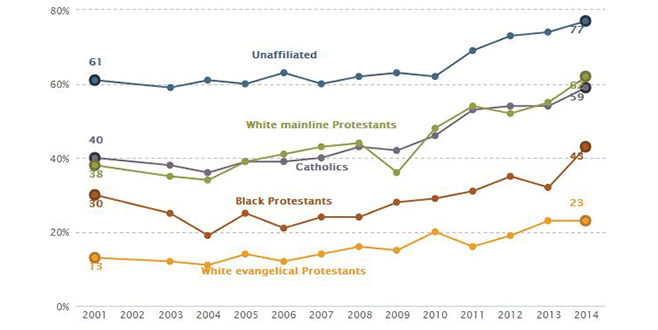
Though they lag behind other denominations, evangelicals are steadily becoming more supportive of marriage equality:

Over the past decade, evangelical support for gay marriage has more than doubled, according to polling by the nonpartisan Public Religion Research Institute. About a quarter of evangelicals now support same-sex unions, the institute has found, with an equal number occupying what researchers at Baylor University last year called the “messy middle” of those who oppose gay marriage on moral grounds but no longer support efforts to outlaw it. The shift is especially visible among young evangelicals under age 35, a near majority of whom now support same-sex marriage. And gay student organizations have recently formed at Christian colleges across the country, including flagship evangelical campuses such as Wheaton College in Illinois and Baylor in Texas.

Even some of the most prominent evangelicals—megachurch pastors, seminary professors and bestselling authors—have publicly announced their support for gay marriage in recent months. Other leaders who remain opposed to gay unions have lowered their profiles on the issue. After endorsing a gay marriage ban passed in California in 2008, Rev. Rick Warren, pastor of one of the country’s biggest megachurches, said in 2009 that he had apologized to all “all my gay friends” and that fighting gay marriage was “very low” on his list of priorities. Just last month, the Presbyterian Church, a Protestant denomination with a significant, though declining, minority of evangelicals, voted to allow ministers to perform same-sex weddings in states where they are legal.

What can this mean, I wonder? I’d like to think that arguments like Matthew Vines’ about how the Bible verses related to homosexuality have been misinterpreted are behind it. And for any major shift to occur, I think those arguments will have to gain adherents. But what we have here, I’d say, is a shifting understanding of what homosexuality is, as a result of huge social and cultural changes.

For the longest time, evangelical Christians associated gay people solely with deviant sex – and the fledgling gay community, understandably entranced with sexual liberation, did little to dissuade them. But as the culture has shifted to see gay people as actual human beings whose lives encompass so much more than sex, and as gay couples have movingly expressed their desire to commit to one another, and as gay citizens continue to volunteer in the armed services with distinction and honor, the very idea of homosexuality that informed most evangelical conversations on the topic has changed. Even those within the evangelical or traditional Catholic orbits – like the dedicated gay celibates who call themselves B-Siders – have shifted away from shame or self-loathing toward something different:

The B siders I spoke with were quick to offer critiques of homophobia within Christian communities, which surprised me, considering that they’d organized their lives around adhering to their rules. Ron Belgau, who co-founded the Spiritual Friendship blog to address the question of how celibate LGBT people can find intimacy and connection within Christian communities, summed up their frustrations by saying: “Most of [the Roman Catholic Church’s] thinking is no you can’t have sex; no you can’t go into the priesthood—they shut various doors, but there’s a need to talk about, OK, no we can’t have sex but what can we do? How can we serve the church?” Eve Tushnet, another B sider I spoke with, is writing a book to address this same conundrum. For her, the most important issue is not rule-following but “the question of how do you lead a good, fruitful life within a Catholic tradition [and] increase the tenderness and beauty in the world?”

I’m not sure celibacy is a viable long-term argument for countless gay Christians who, by virtue of their very humanity, yearn for intimacy, companionship, love and sex. But openly gay celibate people within the churches really does change the tone and content of the debate. Again, it is the collapse of the closet that galvanized this, and will continue to. The reason I’m not completely optimistic is because – Matthew’s remarkable arguments aside – the evangelical fixation on a ludicrously literal adherence to Biblical text means that they really will, at some point, have to acknowledge either that they’ve been reading the Bible wrong, or that their absolute prohibition on gay love and family, whatever the human impact, is unalterable. I suspect that many will continue to choose the latter. It would require too wrenching a shift in their own identity to embrace the identity and humanity of all their fellow citizens.

Face Of The Day

ISRAEL-GERMANY-HOLOCAUST-US-HISTORY-NAZI

At the archives of the Yad Vashem Holocaust memorial museum, the front page of the original issue of the Nazi family magazine “Sonnie ins Haus” (Sunshine in the House) shows baby Hessy Taft as the ideal German Aryan baby, part of the Nazi propaganda developed by Joseph Goebbels. The magazine cover was recently donated by Taft to the museum as part of the “Gathering the Fragments” campaign. Hessy Taft (nee Levinson) was born in Berlin in 1934 to Jewish parents Jacob and Polin Levinson, who were originally from Latvia but later immigrated to Germany. By Gali Tibbon/AFP/Getty Images.