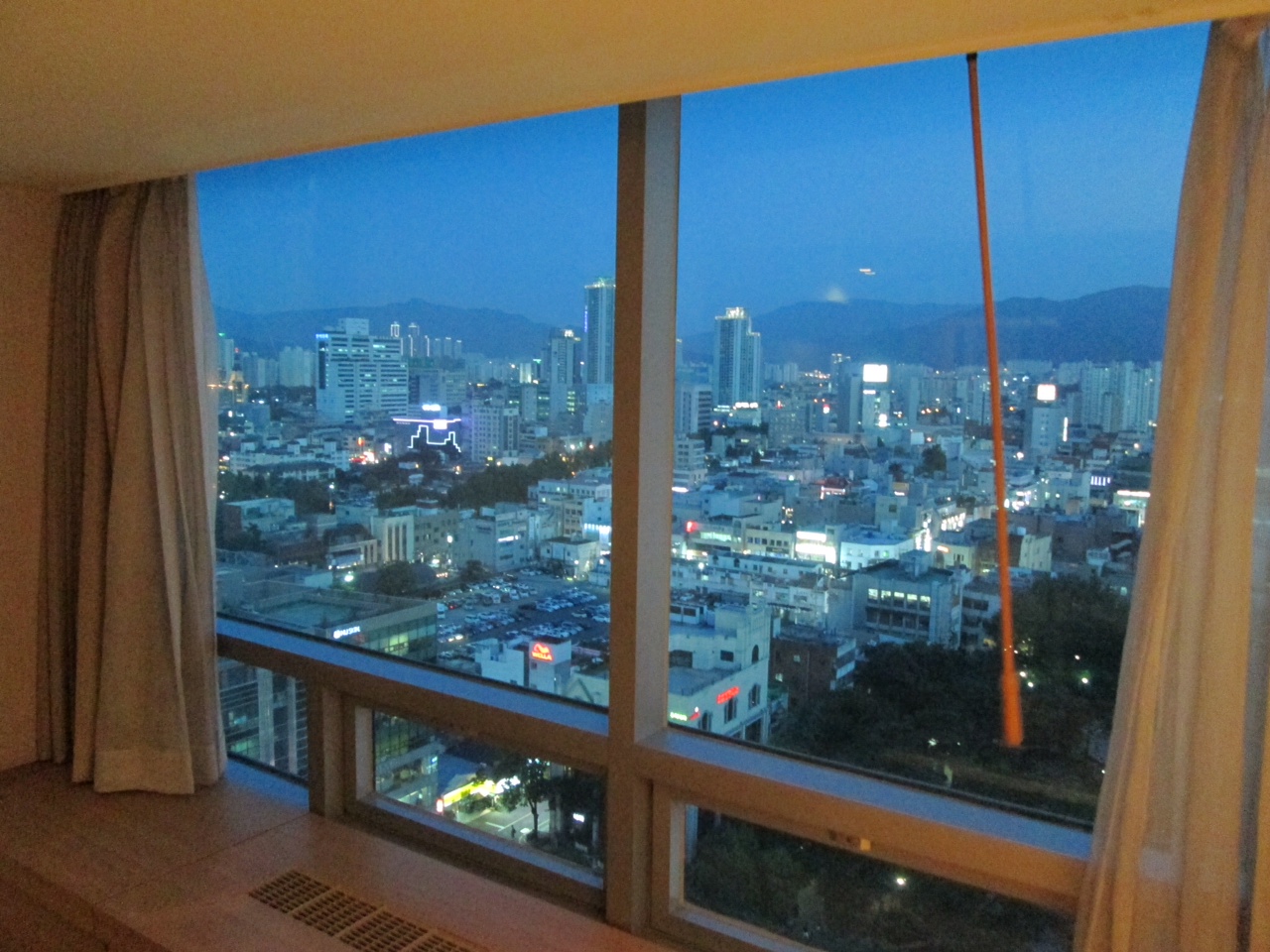
Daegu, South Korea, 11.02 pm
Daegu, South Korea, 11.02 pm
Melissa Dahl relays the findings of a new paper showing how “narcissists watch more online pornography, and the more internet porn people watched, the more narcissistic they tended to be”:
The researchers, from the University of Houston–Clear Lake, tested narcissism levels on the participants, most of whom were heterosexual women between 18 and 61 years of age, using a standard 40-item questionnaire. They found that the higher respondents scored on the narcissism scale, the more likely they were to say they’d ever watched pornography; this held true even when excluding answers from men, who in this study and previous ones cop to watching more porn. And among the people who watched porn, higher narcissism was correlated with more hours watching internet porn.
Past research has shown that the more control narcissists have over sex, the more gratifying the experience tends to be, the researchers note — and this could help explain the narcissism-porn connection. “The use of internet pornography offers this control,” write the study authors, in that the online-porn viewer is able to click around until he or she finds exactly their idealized sexual imagery.
When Ted Peckham arrived in Depression-era New York as “a foppish Midwestern arriviste,” he saw dollar signs in the would-be female patrons of “the Stork Club and the Mirador, the Cotton Club and the Savoy.” His Guide Escort Service set up wealthy ladies with men who would “hold coats but never hands” for a night in exchange for some cash:
The illusion of male dominance, however, needed to be maintained. If women were to pay the men directly—and, worse, pay their own checks—the role reversal would turn off both the clients and the escorts. So women would fill two envelopes with cash, one the escort’s fee and the other her budget for the evening, and her date then used her money to pay waiters and bartenders, reasserting his superficial control of the evening.
In January, 1938, an anonymous “girl reporter” for the Hartford Courant sampled the service, reporting that her rather gloomy escort, “Mr. Smith,” was in it for the money, and considered it unglamorous hard work. By handling the money on dates, he kept some control, although only over how much his date drank. The women held the real power, and had to be kept happy. “After three complaints an escort is dropped,” he explains. “Women complain because they don’t draw a Clark Gable for $10.”
But men still controlled the city’s night life and its social codes—men like the columnist Lucius Beebe, the “orchidaceous oracle of café society,” and, less subtly, the bouncers and gangsters guarding the doors at the Stork Club and the Rainbow Room. Single women, especially in multiples, especially of uncertain age, were unwelcome. Even when they were guests at an upscale hotel, women alone could not freely visit all the public rooms. Peckham saw college graduates with no cash to take women out and women with cash but no men to take them, and the solution was simple: he would “bring these two desolate and palpitating groups together.”
In this midst of musing on what it feels like to be sixty, the British writer and critic A.A. Gill gets real about sex:
I’ve been making a list of the sex that I’m now too old to consider. I will probably never have sex again on a jiggling sofa with her parents asleep upstairs. Or in a skip. Or in the back of a stationary 2CV or the front of a moving Alfa Romeo.
I won’t do bondage, sadomasochism or erotic yoga or miss them. Neither will I partake in role play. I am too old to be a pirate, a policeman, a Viking or the Milk Tray Man (they don’t know who the Milk Tray Man was either).
And I realise with a sudden shock that I’m probably too old to sleep with anyone for the first time. The thought of having to go through the whole seduction, will they, won’t they, can I, can’t I, is far more terrifying than it is exciting.
Sex definitely changes. It is less athletic, more romantic, more intense, more a special event. Not because it’s rare, but because it’s finite. There is a point in your life when you stop counting up and start counting back. It’s not the laps run, it’s the laps that are left.
“Who owns the story, the person who lives it or the person who writes it?” asks Roxana Robinson, who ventures an answer (NYT):
When Leo Tolstoy wrote “Anna Karenina,” he was drawing on a local real-life tragedy: a young woman, jilted by her lover, threw herself under a train in despair. But he also drew on something more personal: His married sister had an adulterous affair and an illegitimate child. She was abandoned by her lover, who left her to marry another woman. She grew desperate and suicidal and wrote anguished letters to her brother. Did Tolstoy have the right to tell her story? He changed it to suit his literary needs, and used her desperation for his own purposes. But what were those purposes?
I don’t think Tolstoy was exploiting his sister, quite the reverse. I think he was voicing his own pain and desperation. He was driven, not by a narcissistic urge for literary gain, but by deep empathy for his sister. His response was not, “I can use this,” but “I can’t bear this.” Writing was a way to relieve his own pain. This was a deeply compassionate response. … A great writer like Tolstoy will feel a character’s life as his own; he’ll enter fully into that consciousness, and his responses will reverberate through his work. A great writer will use a narrative because she finds it moving, or compelling, troubling or heartbreaking or exhilarating. What drives her is empathy, not voyeurism.
The director’s new short The Nest is NSFW from the first frame:
Aisha Harris sums up the appeal of the intensely creepy film:
In the film, shot in a single long take in what looks like a very bleak storage basement, a woman (Evelyne Brochu) goes through a consultation with a doctor (voiced by Cronenberg) in hopes of having a rather unusual mastectomy.
The two discuss her reason for wanting surgery, with the camera focused upon her almost the entire time. There are no peeling, mangled, or deformed body parts here, but the woman’s vivid, visceral description of her supposed condition combined with the mundane, relaxed tone of Cronenberg’s interaction with her might creep some viewers out nearly as much as some of the goriest moments in The Fly.
Scott Beggs praises Brochu’s acting:
It’s constructed as an unflinching POV shot of the young woman, resting entirely on and proving wholly the powerful presence of Evelyne Brochu (who some will recognize from Orphan Black). Simply put, this is a dull film without her intensity and calm insanity (similar to another of Cronenberg’s modern shorts). She sells a delusion to the point that we’re left questioning whether her garage-set surgical consult is actually the right course of action for a human wasp’s nest.
Or maybe the doctor … is a mad opportunist taking advantage of mental illness. Or maybe a dozen other things. We’re left pondering a lot of possibilities, but it seems clear that no matter the reality, what’s going to happen next will be terrible.
Daniel Mendelsohn recalls how reading the author for the first time transformed his ideas of love and writing:
Discovering Proust was a real shock—it was the shock of recognition. I was twenty, and going through a rough patch in my love life. It gave me a shock that, I believe, is felt by every gay person reading Proust for the first time—the unsatisfied desires and the frustration I harbored had not only been felt by someone else but, even more extraordinarily, they were the subject of a great book. When I read Swann’s Way, it wasn’t the description of homosexual desire that touched me—because it’s practically absent in that volume—but something much more general, the description of unreciprocated desire, and above all, the astounding revelation that desire can’t endure its own satisfaction. We see that exemplified in Swann in Love. When Swann succeeds in physically possessing Odette, when she ceases to escape him, his desire for her vanishes. For me … that was a revelation as well as a recognition.
And then I had another kind of shock. Thanks to Proust, I found a certain consolation in thinking that all artistic creation is a substitute for frustration and disappointment—that art feeds on our failures. Back then, I remember thinking to myself, I can’t get what I want anyway, I may as well become a writer!
Tony Zhou pieces together a primer on how Martin Scorsese, famous for his use of music in films, applies silence to equally great effect:
Back in 2008, Roger Ebert highlighted Scorsese’s use of rock music in his book on the director:
Of all directors of his generation and younger, he may make the best use of rock music in his films. His first film was scored with rock records, he was a supervising editor on Woodstock, he has done documentaries on The Band and Bob Dylan, and was working in late 2007 on a Rolling Stones concert tour. He uses period music for New York, New York or The Aviator, and he evokes a time period with Dean Martin (who he once planned to make a film about), but you sense that he edits with rock in mind; it is worth remembering that he met his longest-serving collaborator, the great editor Thelma Schoonmaker, on Who’s That Knocking, and worked on Woodstock with her. Michael Wadleigh, one of the cinematographers on Knocking, became the director of Woodstock. I remember sitting next to them on the floor of a New York loft and watching takes of that film while they were both vibrating like fans at a concert.
(Hat tip: kottke)

You have until noon on Tuesday to guess it. City and/or state first, then country. Please put the location in the subject heading, along with any description within the email. If no one guesses the exact location, proximity counts. Be sure to email entries to contest@andrewsullivan.com. Winner gets a free The View From Your Window book or two free gift subscriptions to the Dish. Have at it.
 The Dish