Happy Paralysis?

Taffy Brodesser-Akner reviews research by cosmetic dermatologist Eric Finzi, who investigates Botox as a treatment for depression:

[I]n 2003, Finzi launched a small pilot study. He treated several subjects suffering from moderate to severe depression with Botox, paralyzing the muscles in their brows that create expressions of sadness, anger, and fear. The results were astonishing. Nine out of 10 patients reported a complete remission of their depression. … [I]n May 2014, in the Journal of Psychiatric Research, Finzi published the results of a second, much larger study, this one double-blind and randomized, with the results co-authored with Dr. Norman Rosenthal, a professor of psychiatry at Georgetown Medical School. (The project was also funded by Finzi’s clinic.) The study found a 47 percent reduction in scores on the Montgomery-Åsberg Depression Rating Scale among those injected with Botox. The members of the control group, who were injected with saline, exhibited a 20.6 percent reduction.

Brodesser-Akner decided to undergo the treatment herself, with mixed results:

As the weirdness subsided, I realized I wouldn’t characterize myself as less emotional with the Botox. I had the same emotions I’d always had; I just didn’t care about them. And then I wondered what this meant.

We are our feelings, after all. The rest is just blood and tissue. I felt diminished by feeling less deeply, and that, to me, was the most compelling result. We think that the opposite of depression is elation, but that isn’t exactly correct. Happy people don’t walk around ecstatic the way depressed people walk around sad. No, the opposite of depression is the absence of depression—and I suppose, in those terms, the Botox worked. I did experience an absence of depression. But Botox also took away other feelings, the ones we need to make us whole: joy, jealousy, frustration, triumph. Feeling leap-in-the-air excited—that was gone, too.

Surveying Finzi’s research back in March, psychiatrist Richard A. Friedman considered (NYT) its broader implications:

Whether Botox will prove to be an effective and useful antidepressant is as yet unclear. If it does prove effective, however, it will raise the intriguing epidemiological question of whether in administering Botox to vast numbers of people for cosmetic reasons, we might have serendipitously treated or prevented depression in a large number of them.
Puff Gov

Former New Mexico governor Gary Johnson is dabbling in the marijuana industry, joining Cannabis Sativa Inc. as CEO and president:

Johnson said he hoped to expand Cannabis Sativa into a major marijuana business and intends to work out of New Mexico to help develop products that are legal in states like Colorado and Washington. “I generally believe this is changing the planet for the better,” said Johnson, who will be paid $1 a year and receive equity in the company. “It also is a bet on the future … We think we have the creme de la creme of marijuana products.”

Johnson, who owned a construction company that helped build Intel Corp.’s Rio Rancho, New Mexico, plant before entering politics, said the company will make marijuana-based oils aimed at helping children with epilepsy. The two-term governor also said it will make cough drop-like products for recreational use.

Emma Roller learns that “while marijuana may be his passion, Johnson has also been vocal about rekindling his presidential ambitions”:

“I hope to be able to run in 2016,” he said in a Reddit Q&A session in April. Johnson said he would run as a libertarian again, because that way he “would have the least amount of explaining to do.” While a 2016 Johnson candidacy is low-hanging fruit for pundits’ jokes, he does have a following akin to Ron Paul circa 2008. And while recreational marijuana is a long ways off from becoming a (legal) reality outside of Colorado and Washington, states are becoming more progressive with their views of medical marijuana. Even some of the most conservative states in the country have begun legalizing cannabis oil to treat children with severe epilepsy.

Paid To Sit Around?

When Aaron Gilbreath, a writer, couldn’t find a steady day job, he turned to house-sitting:

What you might call an invisible economy of house sitters exists across the country. Untold numbers roam our city streets, leaving their familiar bedrooms to stand sentinel over strangers’ homes while using them as getaways, weigh stations and de facto offices. As one 2006 AARP Magazine article describes house-sitting: “Imagine staying in some of the loveliest locations on earth—and all you have to do is feed the cats.” Websites like HouseCarers.com and Luxury House Sitting have emerged to connect homeowners with sitters, yet as Airbnb thrives and CouchSurfing.org gains millions of members worldwide, house-sitting goes relatively unnoticed as an industry. This is partly because it’s a cash economy, partly because it, depending on the client, bears such close resemblance to what you call “crashing at your friend’s place.” Don’t be fooled. The arrangement may be casually intimate, but it is business. Imagine what would happen if the house got robbed because the sitter failed to lock the back door. …

House-sitting provides a way to earn supplemental, tax-free income, as well as the additional benefit of enjoying a higher standard of living in a nicer house and neighborhood than part-timers’ income can often afford—a welcome balm to one’s imperfect work life.

Face Of The Day

birds

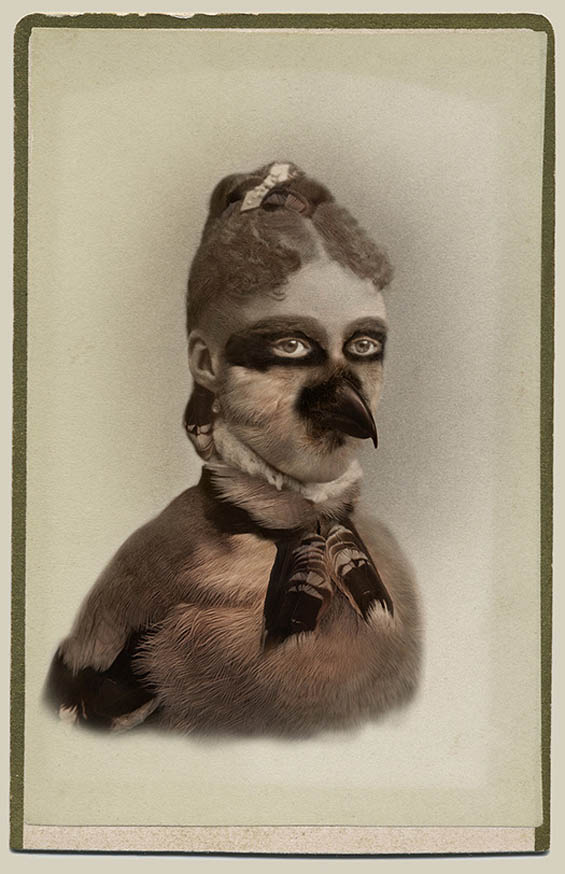
Sara Barnes’s work creates “strange portraits of birds that are superimposed onto anonymous nineteenth century cartes-de-visite (small, business card sized) photographs”:

The nineteenth century was the United States’ colonial era when there was unprecedented expansion, exploration, and an interest in science and art. Family photo albums and commemorating memories were something new, as photography became increasingly common. The collection of cartes-de-visites were like trading cards, and the urge to collect didn’t stop there. People had cabinets of curiosities that included things like taxidermied birds, an interest that lead to the extinction of the passenger pigeon. Angelucci explains in a statement about the work, writing, “Made by combining photographs of endangered or extinct North American birds with anonymous nineteenth century cartes-de-visite portraits—they portray creatures about to become ghosts.”

See more of her work here.

Mammoth Losses

Satao, a fifty-year-old elephant among the largest in Africa, recently died at the hands of poachers. Elizabeth Kolbert considers the grim picture for the creatures:

Satao was an exceptional elephant; his story is not. Africa, after years of progress in protecting its wildlife, is again in crisis mode. In 2011 alone, an estimated twenty-five thousand African elephants were killed for their ivory; this comes to almost seventy a day, or nearly three an hour. Since then, an additional forty-five thousand African elephants—about ten per cent of the total population—have been slaughtered. …

[A]s disturbing as the recent carnage is, the long-term view is, if anything, worse. Elephants and rhinos are among the last survivors of a once rich bestiary of giants. Australia was home to thirteen-foot-long marsupials. North America had mammoths and mastodons, South America glyptodonts and enormous sloths, Madagascar massive elephant birds and giant lemurs. Before people arrived on the scene, these megafauna were protected by their size; afterward their size became a liability.

The giant beasts couldn’t reproduce fast enough to make up for the losses to human hunting, and so, one after another, they vanished. In this sense, what’s happening today in Africa is just the final act of a long-running tragedy.

Mike Chase, an American conservation biologist, is currently conducting an aerial census of Africa’s elephants. He started work on the project in February, when, he told the Huffington Post, he hoped to “leave people inspired and motivated with some good news.” But the opposite has happened. At a reserve in Ethiopia, where his team had expected to find three hundred elephants, they counted just thirty-six. Now, Chase said, “I feel as though the only good I’m doing is recording the extinction of one of the most magnificent animals that ever walked the earth.”

Previous Dish on poaching here, here, here, and here.

Lingua Anglica

English is a world leader in “loanwords”:

It’s a common experience for English speakers abroad: suddenly recognizing a familiar word in a newspaper, or on a billboard, or in a fragment of conversation. Since World War II, English has become by far the leading exporter of “loanwords,” as they’re known, including nearly universal terms like “OK,” “Internet,” and “hamburger.” The extent to which a language loans words is a measure of its prestige, said Martin Haspelmath, a linguist at the Max Planck Institute. English, clearly, is now on top. …

Linguistic loans can appear in a number of forms: Some float on the surface of a language, while others are more integrated. Because English and Japanese have very different sound systems, for instance, Japan often adapts words in ways that make them nearly unrecognizable to English-speakers. Über-Japanese media franchise Pokémon actually takes its name from English (“pocket monster”). Japan’s “puroresu” is another abbreviated compound, from “professional wrestling”; similarly, the extra syllables required to pronounce English consonants have given rise to “purasuchikku” (“plastic”) and “furai” (“fry”). Then there are loans where a word stays intact but the meaning shifts. A “smoking” is French for a tuxedo, and a “dressman” is a German male model. Chinese people say they want to “high” when they want to have a (non-drug-related) good time.

A Poem For Independence Day

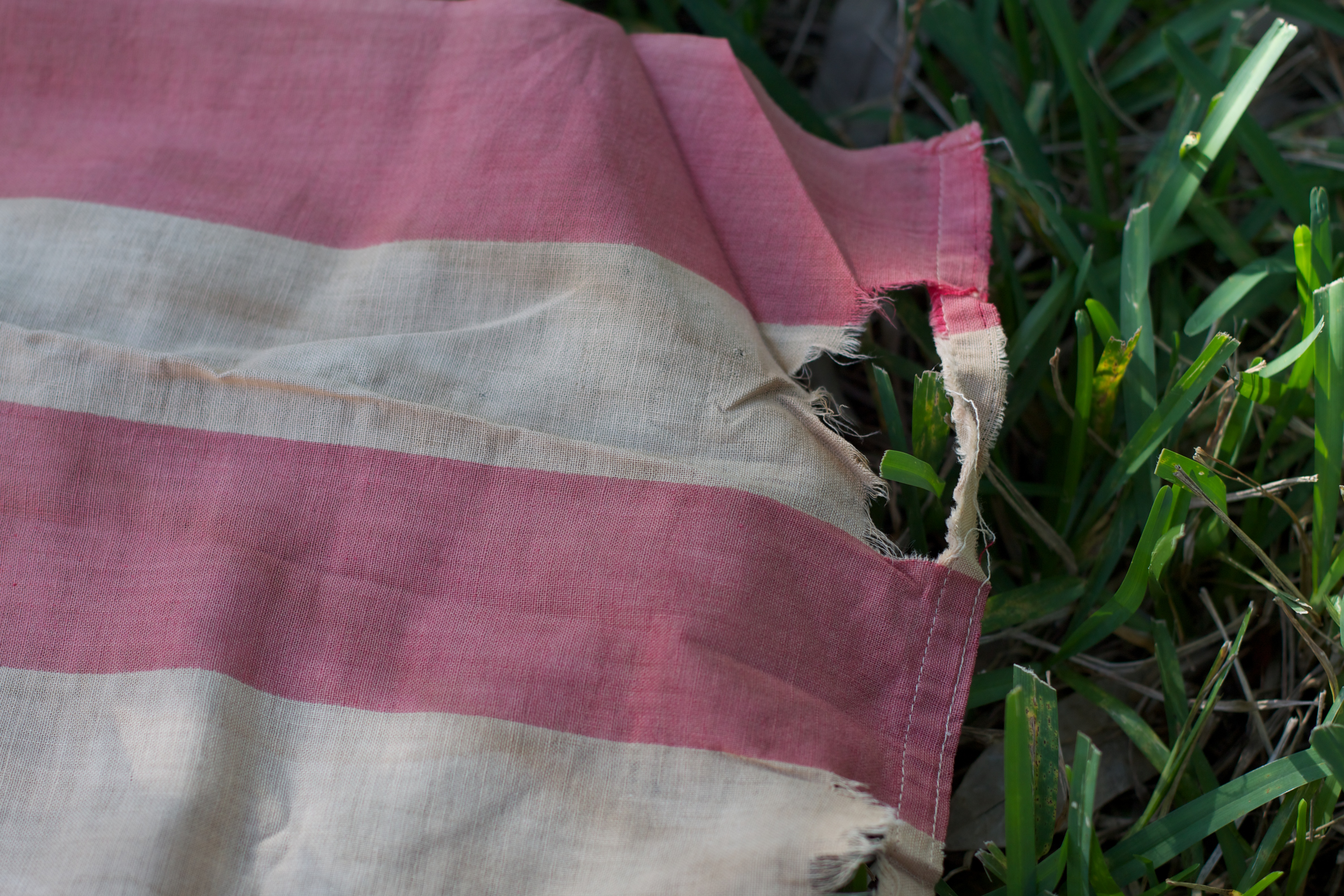
Tattered Flag

Dish poetry editor Alice Quinn writes:

The jacket copy of the recent and brilliant edition of Frank O’Hara’s Selected Poems, edited and introduced by Mark Ford, describes O’Hara as “one of the most original and influential American poets of the twentieth century,” which is gloriously on the mark. He was also one of the most expansive and beloved personalities of his day and the spiritual anchor of what came to be known as The New York School of Poets, including in its first wave, Kenneth Koch, James Schuyler, Barbara Guest, and John Ashbery, who reigns now and has for decades as one of the most original and influential poets of our time.

Gottfried Benn (1886-1956), to whom O’Hara’s poem is addressed, was a German poet and critic, also a physician, whose early verse and poetic dramas were, according to the Columbia Encyclopedia, “strongly expressionistic and even nihilistic” and his later poems and his autobiography, Doppelleben (double life) reflective of “his ambivalent though ultimately negative reactions to the National Socialist era.”

“To Gottfried Benn” by Frank O’Hara:

Poetry is not instruments
that work at times
then walk out on you
laugh at you old
get drunk on you young
poetry’s part of your self

like the passion of a nation
at war it moves quickly
provoked to defense or aggression
unreasoning power
an instinct for self-declaration

like nations its faults are absorbed
in the heat of sides and angles
combatting the void of rounds
a solid of imperfect placement
nations get worse and worse

but not wrongly revealed
in the universal light of tragedy

(From The Collected Poems of Frank O’Hara by Frank O’Hara © 1971 by Maureen Granville-Smith, Administratrix of the Estate of Frank O’Hara. Used by permission of Alfred A. Knopf, an imprint of the Knopf Doubleday Publishing Group, a division of Random House LLC. All rights reserved. Photo by Alan Levine)

Pass On The Pyrotechnics?

Sarah Miller wonders if celebrating the sound of munitions exploding is really the best way to mark our independence:

Most Americans are very, very lucky to have escaped any homefront experience with war. So there’s perhaps something arrogant about being like, “Whoo! Let’s make lots of sounds that sound like war!” To say nothing of fireworks’ considerable expense, or the fact that they aren’t great for the air, or that they tax fire departments who need to be at the ready for other more important things, especially since wildfires are increasing and intensifying with climate change.

I’m not against fun, and I’m not always against maybe-not-environmentally-friendly fun. Meaning: I don’t blame people for loving giant trucks and speedboats and ATVs. I own a Toyota Yaris that is so light you could punt it like a football, but if money were no object and cars burned dried albizzia flowers instead of fuel, I would drive a Ford F150. But we don’t live in a world where driving a giant car means nothing, or where loud, scary, artillery-like noises mean nothing. Now I’m not saying “Fireworks are bad, ban them!” or “Let’s make the Fourth a day to weave God’s Eyes together!” (Though if someone brings beer, I’m in.) But it’s worth imagining a world without them. And if you don’t believe me, ask the nearest Irish Setter.

Meanwhile, Steven Overly stresses that fireworks injuries are on the rise:

The number of fireworks-related injuries soared to their highest level in more than a decade last year, according to a U.S. Consumer Product Safety Commission report released last week. An estimated 11,400 injuries were reported during 2013, a staggering 31 percent climb compared to 8,700 injuries reported the year before.  … As one might expect, a majority of the fireworks-related injuries last year occurred in the month surrounding Independence Day. CPSC conducted an in-depth study of the 7,400 injuries reported between June 21, 2013, and July 21, 2013. Here’s what they found:

  • Men were more likely to be injured than women, 57 percent to 43 percent.
  • Roughly half of the injured were 25 or younger. Children under 4 accounted for 14 percent of the injuries.
  • Which fireworks caused the most injuries? Sparklers accounted for 2,300 of the 7,400 injuries reported during the in-depth study. The flickering wands burn at roughly 2,000 degrees, Adler noted, and often wind up in the hands of children.
  • Hands and fingers were the body parts most likely to be burned or otherwise injured, accounting for 36 percent of injuries during the month-long study. They were followed by the head and face (22 percent), eye (16 percent) and leg (14 percent).
  • approximately 3 percent were admitted to the hospital. The remaining 2 percent of victims left the hospital without being seen, according to the report.

The First Fireworks

dish_fireworks

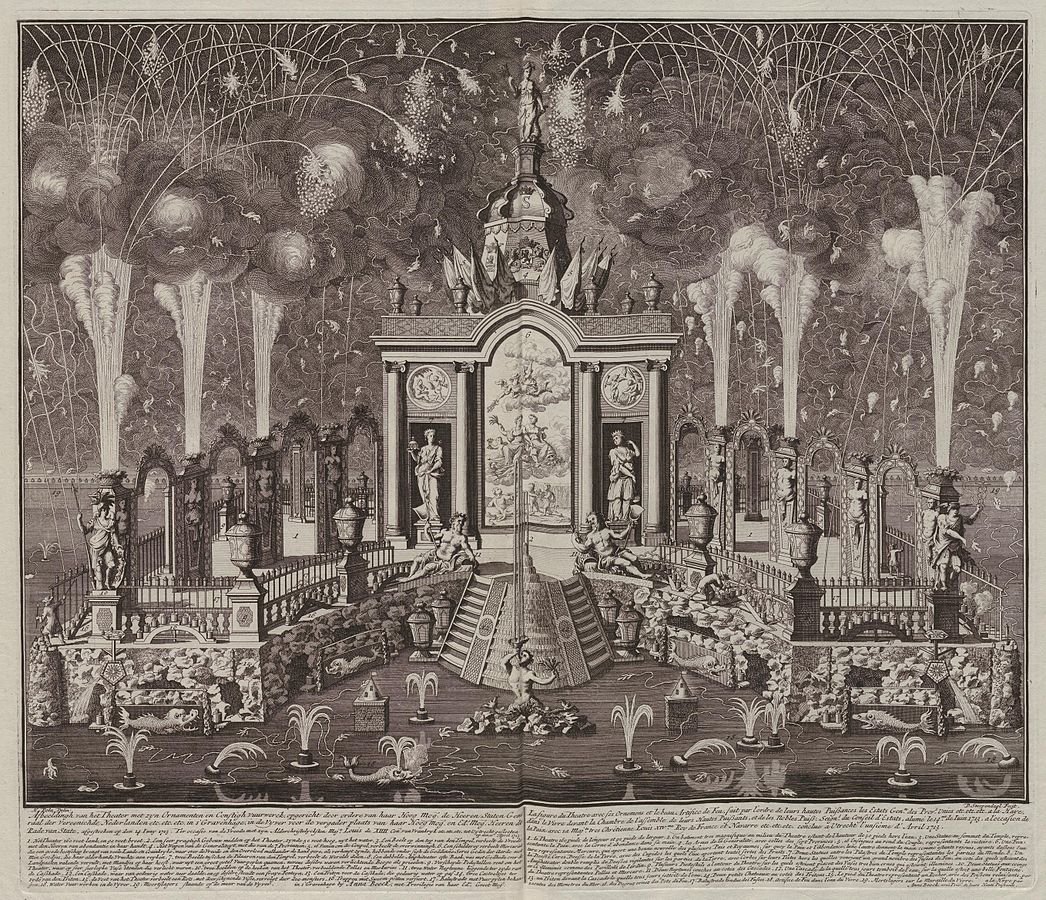
Simon Werrett looks back at the history of pyrotechnics, noting that prints like the one above were markers not so much of fun and games but of court power in 16th-18th-century Europe:

[D]isplays … typically featured symbolic or allegorical decorations and scenery which were intended to present a more specific message to audiences. The figure of a lion might represent a powerful king, or the slaying of a dragon might signal the conquest of the king’s enemies. As such, it was important to states to make sure that everyone understood the message of fireworks, and so artists were commissioned to engrave large prints of displays for distribution to relevant audiences. Fireworks prints became something of a genre in their own right, and were made by artists across Europe for several hundred years. …

Images were typically large, printed on paper, or sometimes silk, and distributed either at the display or as gifts to diplomats and other courts subsequently. Prints were not intended to capture the reality of a performance, like a photograph, but to serve as well-ordered representations of official events. Fireworks prints acted as a front-stage, sanitizing the messiness of the real event to leave only an idealized account. In fact many fireworks failed – displays often witnessed accidents, sometimes quite horrible, and there were frequently mistakes.

(Image: fireworks at The Hague, June 14, 1713 on the occasion of the “Peace of Utrecht,” via Wikimedia Commons)