The Crimes We Don’t Hear About

America would be considered a much more violent place if we took into account crimes that occur in prison:

Each year, the federal government releases two major snapshots of crime in America: The Uniform Crime Reports, written by the FBI, and the National Crime Victimization Survey, compiled by the Bureau of Justice Statistics. … According to both, America has become significantly safer over the past two decades, with today’s violent crime rate nearly half of what it was at the start of the 1990s. Neither report, however, takes into account what happens inside U.S. prisons, where countless crimes go unreported and the relatively few that are recorded end up largely ignored.

If we had a clearer sense of what happens behind bars, we’d likely see that we are reducing our violent crime rate, at least in part, with a statistical sleight of hand—by redefining what crime is and shifting where it happens. “The violence is still there,” says Lovisa Stannow, the executive director of Just Detention International, a human rights organization dedicated to ending sexual abuse and violence in prisons and jails. “It’s just been moved from our communities to our jails and prisons where it’s much more hidden.”

The Pursuit Of Heresy

Reviewing Matthew Stewart’s Nature’s God: The Heretical Origins of the American Republic, Wendy Smith unpacks his argument that the “principles that inspired the American Revolution … belong to an intellectual tradition dating to ancient Greece and reviled by every variety of Christian”:

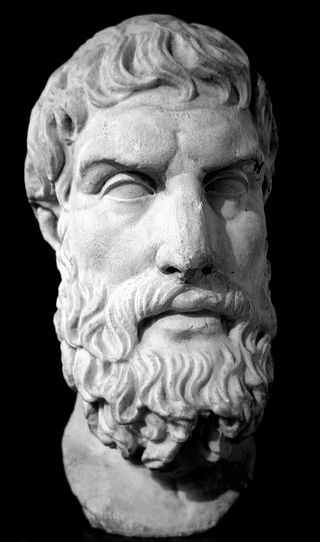
320px-Epicurus_bust2Rooted in the philosophy of Epicurus, who saw happiness as the highest good, this tradition flowered in the 17th century to produce wide-ranging inquiries into the nature of God, humanity, religion and society that got Benedict de Spinoza labeled “the atheist Jew.” Meanwhile, the more circumspect John Locke (careful to mask his iconoclasm with boilerplate declarations of conventional piety) ended up praised by historians as “the single greatest intellectual influence on America’s revolutionaries.”

Yet Spinoza the radical, no less than Locke the moderate, shaped an agnostic world view that shook America loose from Britain. Stewart pays particular attention to two fire-breathers — Ethan Allen, surprise conqueror of Ft. Ticonderoga, and Thomas Young, instigator of the Boston Tea Party — as the most outspoken proponents of a heterodox creed shared by (at minimum) Thomas Jefferson, Benjamin Franklin and George Washington. Contemporaries called them deists when not calling them infidels or atheists, and Stewart devotes considerable care to explaining that Deism, the philosophical engine of the Revolution, is not the Christianity Lite some 21st century conservatives have proclaimed it.

“America’s revolutionary deists,” Stewart writes, “saw themselves as — and they were — participants in an international movement that drew on most of the same literary sources across the civilized world.” His detailed explication of those sources ranges from Epicurus and his Roman popularizer, Lucretius, through early modern Italian freethinkers Giordano Bruno and Lucilio Vanini (both executed at the stake for their apostasy) to the diverse array of English and French intellectuals reacting to Spinoza and Locke.

In an interview, Stewart explains his use of the word “heretical” in the book’s subtitle:

Many of America’s leading revolutionaries were identified in their own time – with good reason – as “infidels.” Even more interesting is that the earlier philosophers upon whom America’s revolutionaries drew for inspiration were widely and correctly pegged as heretics, too. A surprising number were burned at the stake. I should add that they were heretics with respect to not just one but a variety of religious traditions.

Which brings up the second, more theoretical point I want to make in my subtitle. When I say “heretical” I don’t necessarily mean lacking in all religion. Heretics generally come out of religious traditions and remain committed to one form of radical religion or another. What they oppose is the common, mainstream, or orthodox religion. And what they oppose within that common religion, or so I argue, is a set of common conceptions about the nature of morality, the mind, knowledge, justice, and so forth – conceptions that, though not religious in themselves, serve to make the common religion credible. At least since the time of Socrates, the business of radical philosophy has been to challenge and oppose this common religious consciousness. Now, to get to the point: this radical, heretical philosophy was decisive in the creation of the world’s first large-scale secular republic.

(Image: A bust of Epicurus on display in the British Museum, London, via Wikimedia Commons)

What Else Was Happening in 1776?

Reviewing Claudio Saunt’s West of the Revolution: An Uncommon History of 1776, Eric Herschthal points out that, when asked about that momentous year, “few of us would think to mention the Russian fur trade with China in the Siberian town of Kyakhta; the founding of San Francisco; or the birth of the Lakota Nation in the Great Plains.” But, he says, these lesser-known developments bear “as much weight on the United States of today as what the Founders were doing in Philadelphia”:

Saunt contends that if it were not for Russia’s lucrative fur trade, the Spanish would have had little reason to colonize much of the West Coast and the Southwest. In the late eighteenth century, the Spanish became alarmed at the increasing Russian demand for sea otter and fox furs bought from natives on the Aleutian Islands, just off the coast of Alaska. To prevent their further expansion into North America, the Spanish pushed north from Mexico into California, establishing San Francisco in 1776.

Saunt’s retelling of the founding era reflects the changes in America he sees today.  We are increasingly aware of climate change, infectious diseases, and globalization, which makes us “perhaps better than ever prepared to understand and relate to the experiences of eighteenth century North America.” Disease is everywhere in Saunt’s account, and so are the nefarious effects of global trade on the environment and local populations. Skeptics might think that West of the Revolution, then, is mere politics masquerading as history. But all history writing is informed by the present, regardless of whether the historian is aware of it, admits it or not. Saunt is simply stating what most historians know implicitly.

Another Slip Down The Slope For Contraception?

SCOTUS is getting another dose of controversy this week (NYT):

In a decision that drew an unusually fierce dissent from the three female justices, the Supreme Court sided Thursday with religiously affiliated nonprofit groups in a clash between religious freedom and women’s rights. The decision temporarily exempts a Christian college [Wheaton] from part of the regulations that provide contraception coverage under the Affordable Care Act.

Koppelman gets to the heart of the matter:

The Obama administration had accommodated nonprofit religious organizations, colleges, and hospitals on the condition that they fill out a form indicating their objection and send that form to their insurance company or administrator, which must then provide the medical services free of charge. Hobby Lobby required that the same accommodation be extended to religious for-profit employers. Some of the nonprofit organizations, including Wheaton College, objected that filing the form made them complicit in the provision of the contraceptives. The Court agreed, holding that the college need only file a letter with the federal government stating its objections.

That would create a byzantine set of regulations, according to Sotomayor:

[T]he Court does not even require the religious nonprofit to identify its third-party adminis­trator, and it neglects to explain how HHS is to identify that entity. Of course, HHS is aware of Wheaton’s third ­party administrator in this case. But what about other cases? Does the Court intend for HHS to rely on the filing of lawsuits by every entity claiming an exemption, such that the identity of the third-party administrator will emerge in the pleadings or in discovery? Is HHS to under­take the daunting—if not impossible—task of creating a database that tracks every employer’s insurer or third­ party administrator nationwide?

Waldman is also worried about the floodgates opening:

On its surface, this case appears to be a rather dull dispute about paperwork. But it actually gets to a much more fundamental question about what kinds of demands for special privileges people and organizations can make of the government on the basis of their religious beliefs. …

[T]here is seemingly no length this Court says the government shouldn’t go to accommodate this particular religious belief.  A company or a university doesn’t want to follow the law? Well, we have to respect that — they can just sign a form stating their objection. Oh, they don’t want to sign the form? Well never mind, they don’t have to do that either.

Morrissey tells everyone to chill:

[T]he issuance of a temporary injunction is not a decision, as Sotomayor well knows. Sotomayor herself issued a temporary injunction to stop enforcement of the mandate on the Little Sisters of the Poor, which caused an eruption of hysteria and Know-Nothing anti-Catholic bigotry at the beginning of the year — a foreshadowing of what we saw this week, actually. A stay is just a pause that allows the courts to consider the issue at hand before enforcement does serious damage to the plaintiff, based on a reasonably good chance for the petitioner to win the case but not a decision on the merits. The court signaled that they want a closer look at the accommodation, not yet that it’s not acceptable.

Dreher’s take:

This is good news, as far as I’m concerned. As a general rule, I hold an expansive definition of religious liberty. As a technical matter, I think that Whelan is right, and that there’s nothing in Hobby Lobby that contradicts the subsequent Court order. Still, I can understand why the three dissenting justices feel sandbagged. Justice Alito, in the majority opinion, held up the HHS carve-out for religious non-profits as an alternative HHS might have offered for-profit companies, but did not. Now the Hobby Lobby majority, joined by Justice Breyer, rejects even that possibility.

But not definitively, and that’s why I think there’s less here than meets the eye. Again, the injunction is temporary, and is no doubt pending the full Court hearing the Little Sisters case, which will decide whether or not the government’s carve-out for religious non-profits is a reasonable and sufficient accommodation of religion.

But Drum worries that the Wheaton injunction is just another step of many more:

For the last few days, there’s been a broad argument about whether the Hobby Lobby ruling was a narrow one—as Alito himself insisted it was—or was merely an opening volley that opened the door to much broader rulings in the future. After Tuesday’s follow-up order—which expanded the original ruling to cover all contraceptives, not just those that the plaintiffs considered abortifacients—and today’s order—which rejected a compromise that the original ruling praised—it sure seems like this argument has been settled. This is just the opening volley. We can expect much more aggressive follow-ups from this court in the future.

America Gone Rogue

Robert Tsai surveys a history of re-declarations of American independence after 1776, from the Republic of Indian Stream to the New Afrikan movement:

dish_okconstitution[T]here are drawbacks to Americans’ maverick streak. The notion that a group of citizens can claim to speak on behalf of all or most Americans isdestabilizing—as is the idea that sometimes the best way to improve on our political system is to start from scratch. But the revolutionary spirit can also be constructive, and in some cases separatists’ ideas have ultimately helped reshape American law, even if their actual independence efforts failed. When leaders of the major native American tribes living in Indian Territory met and wrote a constitution for their planned State of Sequoyah in 1905, they captured inhabitants’ grievances so perfectly that their plan subsequently became the model for Oklahoma’s constitution. The Indian-led independence movement spurred the creation of lasting government institutions and revitalized local politics.

If there is one lesson to be learned this Fourth of July, it is that the story of America is not that of a single revolution, but of a powerful revolutionary impulse that can never be quashed. The triumph of the Founders’ achievement isn’t that it happened once, and ended: It’s that it led to a system that has survived, even fostered, 230 years of challenges to its authority. For the rest of the world, the American legacy has not been the substance of the Constitution, which has so often been rejected, but rather the model of revolutionary action that it provides. To see history this way is also to understand that the law is not given or inalterable, but rather shaped by human hands—or, more accurately, a hand grasping a pen.

(Image of Oklahoma statehood bill, as originally introduced to the House in 1906, via the National Archives)

Quote For Independence Day

“These communities, by their representatives in old Independence Hall, said to the whole world of men: ‘We hold these truths to be self evident: that all men are created equal; that they are endowed by their Creator with certain unalienable rights; that among these are life, liberty and the pursuit of happiness.’ This was their majestic interpretation of the economy of the Universe. This was their lofty, and wise, and noble understanding of the justice of the Creator to His creatures. Yes, gentlemen, to all His creatures, to the whole great family of man.

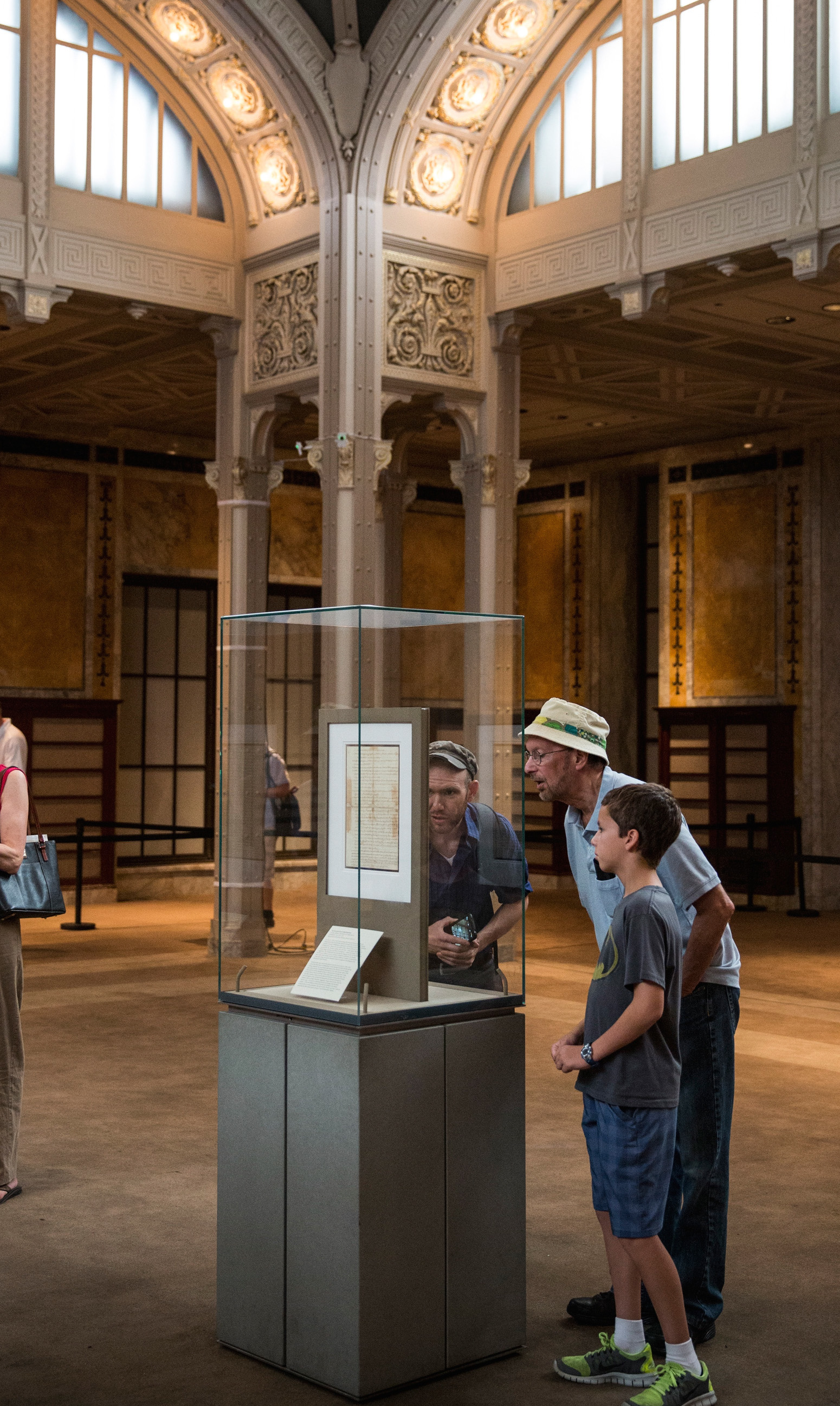
In their enlightened belief, nothing stamped with the Divine image and likeness was sent into the world to be trodden on, and degraded, and imbruted by its fellows. They grasped not only the whole race of man then living, but they reached forward and seized upon the farthest posterity. They erected a beacon to guide their children and their children’s children, and the countless myriads who should inhabit the earth in other ages. Wise statesmen as they were, they knew the tendency of New York Public Library Displays Copy Of The Declaration Of Independenceprosperity to breed tyrants, and so they established these great self-evident truths, that when in the distant future some man, some faction, some interest, should set up the doctrine that none but rich men, or none but white men, were entitled to life, liberty and the pursuit of happiness, their posterity might look up again to the Declaration of Independence and take courage to renew the battle which their fathers began—so that truth, and justice, and mercy, and all the humane and Christian virtues might not be extinguished from the land; so that no man would hereafter dare to limit and circumscribe the great principles on which the temple of liberty was being built.
Now, my countrymen, if you have been taught doctrines conflicting with the great landmarks of the Declaration of Independence; if you have listened to suggestions which would take away from its grandeur, and mutilate the fair symmetry of its proportions; if you have been inclined to believe that all men are not created equal in those inalienable rights enumerated by our chart of liberty, let me entreat you to come back. Return to the fountain whose waters spring close by the blood of the Revolution. Think nothing of me—take no thought for the political fate of any man whomsoever—but come back to the truths that are in the Declaration of Independence.

You may do anything with me you choose, if you will but heed these sacred principles. You may not only defeat me for the Senate, but you may take me and put me to death. While pretending no indifference to earthly honors, I do claim to be actuated in this contest by something higher than an anxiety for office. I charge you to drop every paltry and insignificant thought for any man’s success. It is nothing; I am nothing; Judge Douglas is nothing. But do not destroy that immortal emblem of Humanity, the Declaration of American Independence,” – Abraham Lincoln, speech at Lewistown, Illinois, August 17, 1858.

(Photo: People look at a copy of The Declaration Of Independence, on display at the New York Public Library on July 1, 2014. The copy, which was written by Thomas Jefferson, will be on display through July 3. By Andrew Burton/Getty Images)
Taking The Pledge

Mark Oppenheimer finds “national pledges of any kind … idolatrous,” but admits that as a kid, he “was kind of thrilled I had the Pledge of Allegiance in school, if only to rebel against”:

In sixth grade, when I was last in public school, I had to recite the Pledge every morning. And I decided for a time—a couple weeks maybe? a month?—that I would stand for the Pledge, but when we got to “with liberty and justice for all,” I would say, “with liberty and justice for some.” … There was another reason, besides the opportunity to test my Constitutional liberties and defy a teacher, that I liked saying the Pledge: It was something I did with my classmates. It was a ritual that all of us—the class was about a third white, a third black, and a third Puerto Rican, and overwhelmingly poor—performed every day. It was a common text, the one poem, if you will, that we all had memorized. It did not function as ideology. I now think that it rarely does.

In fact, I think of the Pledge of Allegiance mainly as part of two of the great pageants of American life: free, public schooling and spectator sports. Two institutions that tend to bring people together, across lines that otherwise divide them. Two institutions that make our country a bit more of a community. “The Star-Spangled Banner” is like that too, and the fact that millions of us are a bit sketchy on the words yet it never seems to matter proves the point that the words should not, indeed cannot, be taken literally. That doesn’t mean we shouldn’t be stirred to stand and sing that song—or recite that pledge—together.