Where’s All The Plastic Going?

Bottlenose dolphin (Tursiops truncatus) swimming in oil slick, black plastic bag is along belly Curacao, Netherlands Antilles

The ocean should be a lot more plasticky than it actually is:

For a decade or more, scientists have assumed our seas carry millions of tons of plastic, much of which should be floating in open water, forming vast midocean “gyres” – islands of man-made mess such as the Great Pacific Garbage Patch. But according to a new study, something more worrying is happening to 99 percent of the ocean’s plastic: it’s disappearing.

The study outlines the findings of scientists who trawled the waters around five large ocean gyres in 2010 and 2011. The data they obtained put them far short of the expected amount of plastic in the ocean — rather than millions of tons, the global load of ocean plastic was calculated at 40,000 tons at most.

So what happened?

Though it’s possible that sunlight is eroding it into nothingness, or that tiny pieces are washing back ashore, researchers are skeptical. What’s probably happening, scientists theorize, is that tiny fish are eating it. The most likely plastic-snackers are lanternfish and other small “mesopelagic” species, meaning those that live in the middle swath of the ocean, swimming to the surface at night to feed. These are far and away the most populous fishes in the sea. …

We don’t have a good sense of what swallowing plastic does to these fish, or even whether they’re able to excrete or throw up their plastic meals. That’s worrisome, since the toxic chemicals in plastic might permeate their tissue – bad for mesopelagic fish, but also potentially bad for humans. Pellets in the 0.5-5-millimeter range are also commonly found in the bellies of the predators who eat these smaller fish, according to the study. Those include tunamackerel and other sushi-menu faves.

For the larger chunks of plastic, drones could help:

[G]etting to the scale needed to map the world’s ocean garbage will require a gigantic remote-controlled swarm of nautical drones. Ultimately the idea is to deploy thousands of swarming, meter-long sailboats equipped with sensors and dragging nets behind them to scoop up the garbage.

Protei’s shape-shifting robotic hull is the project’s breakthrough technology, and the design is open source for anyone to use. The hull bends and curves like a snake in order to control the boat’s trajectory through the water. Touted as unsinkable, self-righting, and hurricane-ready, the drone uses wind power, and the latest prototype can tow a payload of under five pounds, the group claims. The vessel would use a custom plastic sensor to locate the trash; the sensor is able to measure “slices” of pollution at various depths.

Recent Dish on plasticky sedimentary rocks here.

(Photo: A bottlenose dolphin (Tursiops truncatus) swims in oil slick alongside a black plastic bag off the shore of Curacao, Netherlands Antilles. By Wild Horizons/UIG via Getty Images)

We The Profligate People

Libby Nelson considers the failings of personal finance education:

Just 17 states require personal finance courses for students, and only six test students on what they’ve learned. But those classes don’t seem to make much difference anyway: students who took a semester-long class in personal finance fared below average on the Jump$tart survey. There is no evidence that the classes actually made students worse at managing money, the group wrote in its report. But it certainly didn’t make them any better.

Academic research backs up that conclusion. A 2008 study from two Harvard Business School professors studied the relationship between education and saving and investing behavior. They found state-required financial literacy education had no effect on graduates’ saving behavior later in life. The money spent on financial literacy education, they concluded, produced little in return.

McArdle chides Americans for spending so much and saving so little:

[W]hat we have is people spending more than they have to on the big basics. The average car loan, for example, is more than $25,000, and for people with the worst credit ratings, it’s actually higher: almost $30,000. This is not because you have to spend $27,000 to get yourself from Point A to Point B. It’s because people are pouring a big fraction of their income into driving something “nice.”

By the same token, raising your kids in a modestly sized home is not physically impossible. But we’ve come to regard as deep deprivation anything less than one bathroom and one bedroom per person. Cash-strapped people mention giving up vacations as if doing so were as great a sacrifice as giving up food or heat.

Why Clinton Needs Female Challengers

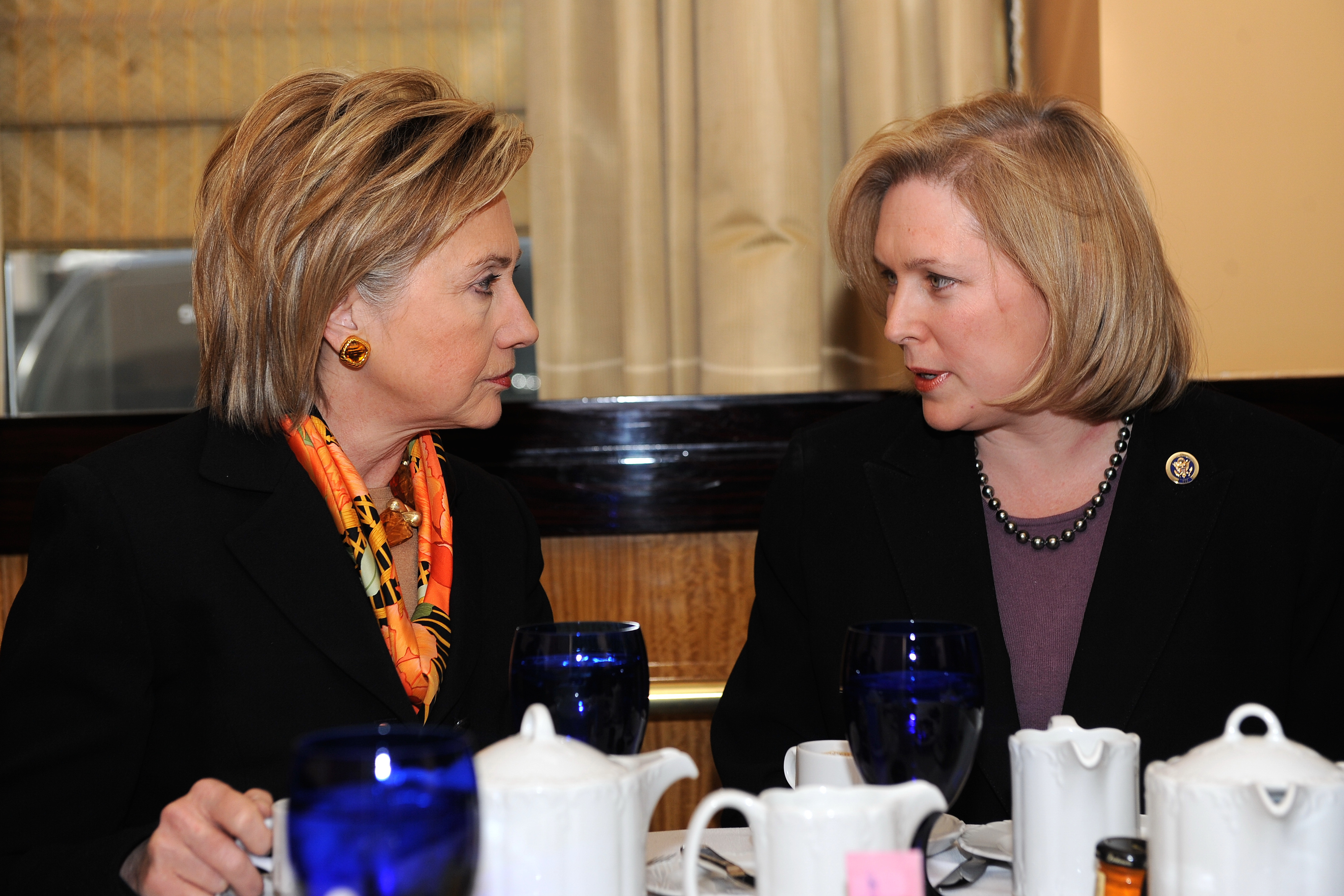
Secretary of State Hillary Clinton has lunch wtih her replac

Rebecca Traister makes a compelling case:

The last thing any woman in politics needs is the appearance of having won only because her would-be opponents gave her a pass. This perhaps goes double for Clinton, whose years in the spotlight have demonstrated again and again that she is at her most appealing when she is fighting and scrappy, and at her most loathed when she is self-assuredly coasting. Clinton and her party require arresting, attention-drawing competition. She needs to be duking it out, and not just with a bunch of white guys. How many people are salivating at the thought of a Martin O’Malley candidacy? 19? 20?

A predictable primary is a boring primary, and a boring primary leads to a disinterested Democratic Party—a major hindrance going into a general election.

Part of what hooked voters in the mesmerizing 2008 race was the thrum of newness, the frisson of history-making every time a woman and a black man stood on a debate stage together. And while we could reproduce that thrill in a variety of ways—there is, after all, a shameful abundance of racial, ethnic, religious, and gendered history to be made before presidential politics become remotely inclusive—one of the most realistic, ready-to-roll scenarios of 2016 is the one in which multiple women show up to debate each other.

But there’s more at stake here than the health of the party in one presidential election. Viewing women as adversaries—ideologically and also within their own parties—is an urgent next step in helping the nation adjust to the idea that female politicians are just like, you know, regular politicians. That means we have to swiftly abandon the processional model, in which one diligent woman takes her hard-earned turn, while the next waits patiently in the wings. …

When a single avatar stands in for womankind, womankind projects onto that avatar its own varied ideas and priorities and standards. Clinton suffered from this last time, metaphysically unable to satisfy a million divergent hopes. She couldn’t be progressive enough, authentic enough, strong enough, stoic enough, or well-dressed enough for everyone. That’s part of why it’s dangerous for one woman to mean so much to so many.

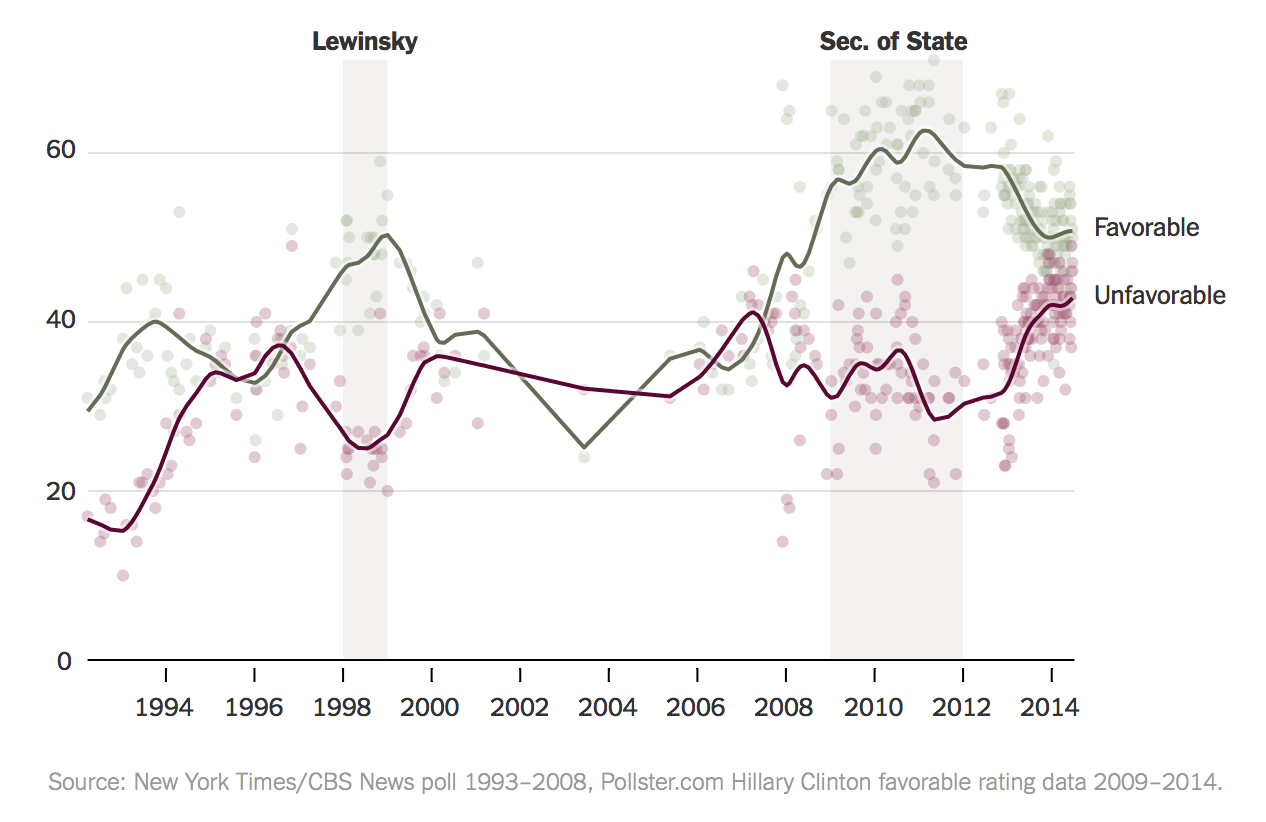
Meanwhile, Nyhan checks in on Clinton’s approval numbers:

[Her] artificially inflated poll numbers have made her seem like an especially strong presidential candidate, but the Clinton bubble is quickly coming to an end. …

Screen Shot 2014-07-03 at 5.21.23 AM

[W]e tend to overrate the importance of candidate image, which is largely a function of the flow of partisan messages. When opposition elites withhold criticism during, say, a presidential honeymoon or a foreign policy crisis, politicians can seem unstoppable, but when normal politics resume, their images — and their poll numbers — quickly return to earth. The same will be true for Ms. Clinton.

(Photo: Secretary of State Hillary Clinton has lunch with her replacement in the Senate, Kirsten Gillibrand, at Oscars Restaurant in New York City on January 25, 2009. By Enid Alvarez/NY Daily News Archive via Getty Images)

The Latest, Pathetic Pandering By Rand Paul

In the wake of Israel’s vengeful and disproportionate response to the murders of the three teenagers, Paul took the opportunity to burnish his neocon cred with an op-ed at NRO defending Israel’s actions and calling for a cutoff of aid to the Palestinian Authority. It’s a miserable, asinine piece of boilerplate designed, quite patently, to pander to the Adelson crowd. (The commenters, by the way, suggest that there is actually a robust debate on this among conservatives that is never allowed to be aired at NRO or the Weekly Standard.) Chait gets to the point:

“Israel has shown remarkable restraint,” Paul argues. “It possesses a military with clear superiority over that of its Palestinian neighbors, yet it does not respond to threat after threat, provocation after provocation, with the type of force that would decisively end their conflict.” What kind of force would “decisively end their conflict”? Killing every single Palestinian man, woman, and child?

His op-ed proceeds to demand the cutoff of aid — which is opposed by AIPAC, for the obvious reason that it would create even more dysfunction and empower terrorists. Paul’s bill does boast the support of the extreme right-wing group Zionist Organization of America. Paul’s gambit here is obviously to win over Republican hawks justifiably concerned he shares his father’s kook foreign-policy ideology. His remedy is to embrace a different kind of kookery.

And what happened to his previous call for ending foreign aid to Israel as well? Poof! Kilgore blasts Paul’s naked opportunism:

Paul, of course, has been engaged in a intensive process of overcoming his and his father’s reputation as “anti-Israeli” for favoring a cutoff of U.S. aid to Israel. So there is probably no act Israel could commit that won’t be aggressively praised by the peace-loving senator (in an impressive display of hypocrisy, he’s calling his bill for a termination of U.S. aid to the PA the “Stand With Israel Act.”) But blasting the administration for exercising actual diplomatic care over an explosive situation crosses the line from opportunism to cynical demagoguery.

Larison is disappointed that Paul’s willingness to buck GOP hawks on issues like Iraq doesn’t seem to extend to Israel:

On most things related to Israel, Sen. Paul is always too defensive, too eager to say what he thinks most Republicans want to hear, and too worried about being judged wanting in his support for the client state. Like his unnecessary security guarantee to Israel last year, this latest push to cut off funds to the Palestinian Authority is a doomed bid to beat hard-liners at their own game.

The larger problem with this is that it helps to perpetuate an undesirable status quo in U.S.-Israel relations. At present, Israel can act in whatever way it wishes without having to fear the loss of any U.S. aid or diplomatic support, and the U.S. then naturally takes some of the blame for the behavior of its client. That enables Israel to behave in harmful and ultimately self-destructive ways, and that undermines U.S. interests in the process. This is the phenomenon that Barry Posen refers to in Restraint as “reckless driving,” which the U.S. encourages by providing uncritical and effectively unconditional support to some of its allies and clients. Sen. Paul should be trying to discourage this recklessness and reduce the U.S. role in enabling it, but at the moment he is doing just the opposite.

It might even confirm to some that, in fact, there is an effective litmus test on both the GOP and Democratic primaries that demands that all potential presidents adhere to this ruinous policy for both Israel and America – or be tainted mercilessly as anti-Semitic. I want to support Paul in many ways. But this is a sign that he has no spine at all. He’s a sad, pathetic panderer on this – and libertarians and non-interventionists need to see that writing very clearly on the wall.

Lowest Unemployment Since The Market Crashed

And it’s also lower than it was when Ronald Reagan won re-election on a “Morning In America” theme. But it’s a recovery from a far deeper recession, and one clearly inherited by Obama and not created by him. Vinik evaluates the new report:

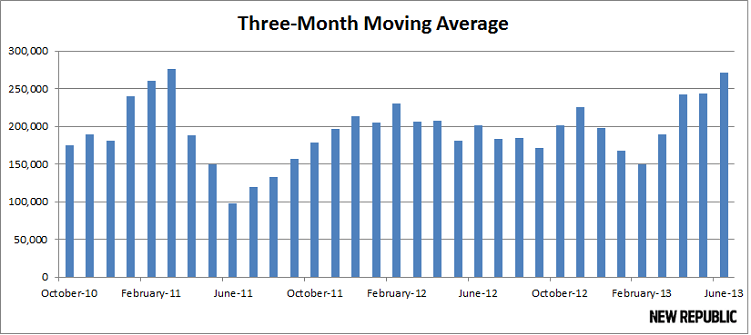
For the past few years, it was like clockwork: A disappointing summer of job growth would give way to a much stronger winter. Economists would hesitantly forecast that the economy was about to kick into second gear. Then the summer would come and the disappointing data would return.

But finally, it looks like we are ready to break that trend: The economy added 288,000 jobs in June, soundly beating economists’ expectations of 211,000, and the unemployment rate fell to 6.1 percent. You can see this pattern of strong winter and weak summerand the possible breaking of itin the three-month moving average of job numbers:

three_month_moving_average_0

That five-month streak “is the longest since the late 1990s and provides convincing evidence that the recovery has rebounded after unexpectedly shrinking during this year’s harsh winter.” Ylan Mui continues:

Perhaps most important, Gallup found that 45 percent of Americans were working full-time in June, one of the highest rates since the polling company began tracking the figure in four years ago. The government data released Thursday showed the size of the country’s workforce holding steady, albeit at a low level. Still, there is hope that the surprising slide in the size of the labor force may be ebbing, if not starting to turn around. “While few might agree that the economy has fully recovered from the Great Recession, there is no doubt that the job market is much stronger now than in prior years,” Gallup said in its report.

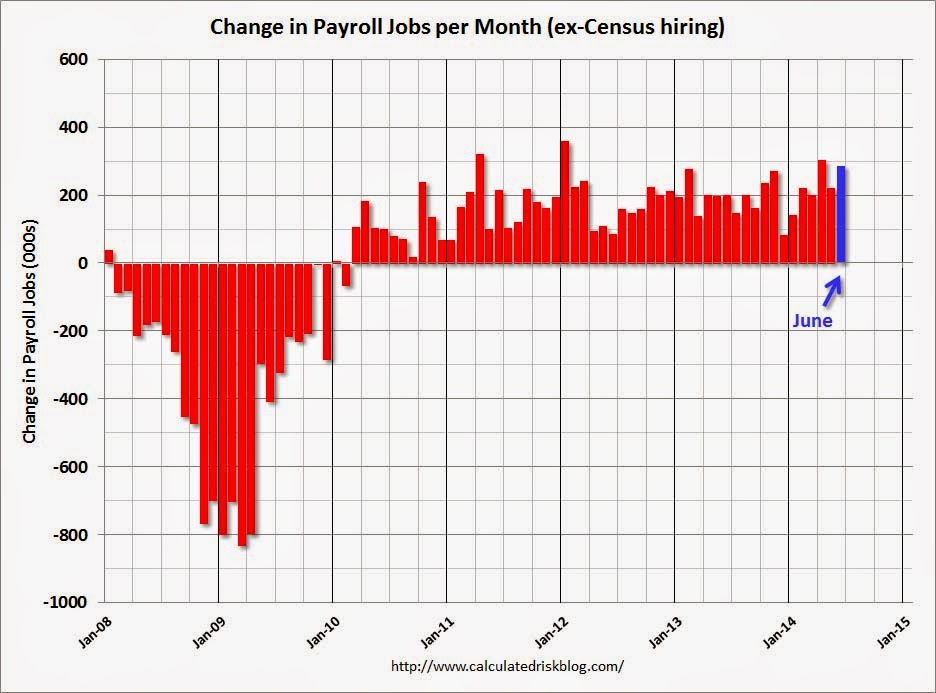
And never forget this chart:

PayrollJune2014

Not bad for the worst president since World War II.

Meanwhile, Danielle Kurtzleben declares that today “is the total solar eclipse of jobs days”:

— a rare day when both initial jobless claims and the monthly unemployment report come out simultaneously.

At the same time the government reported the economy added a strong 288,000 jobs in June, it also reported that the number of Americans who filed initial claims for unemployment insurance was at 315,000 for the week ending June 28.

That figure held relatively steady from the week before, when initial claims totaled 313,000. And though weekly initial claims data can be volatile, the smoother 4-week moving average also only shifted up by 500, to 315,000. That smoother moving average makes it easier to see trends than the raw numbers, and it shows improvement even in the first half of 2014. Since then, it has declined from nearly 350,000.

This level of claims is right around where claims were before the financial crisis hit. It is also a vast improvement over the middle of the recession, when claims were more than double where they are now.

Yglesias’ two cents:

One important data point from today’s release — “wages rose 2 percent over the past year.”

This is a bit of an ambiguous indicator. The number is high enough that people who’ve been itching for interest rate hikes can certainly point to it as a sign that economic slack is gone and it’s time to shift to tighter money. On the other hand, 2 percent year-on-year growth is hardly mind-blowing prosperity. It’s not even a hint of catchup from the years-long span of massive slack and no wage growth. Giving workers a chance at seeing some real gains requires the Fed to not have an itchy trigger finger on those rate hikes.

He also points to this encouraging tweet:

But this, from economist Justin Wolfers, could be the tweet of the day:

Jordan Weissman tries his best:

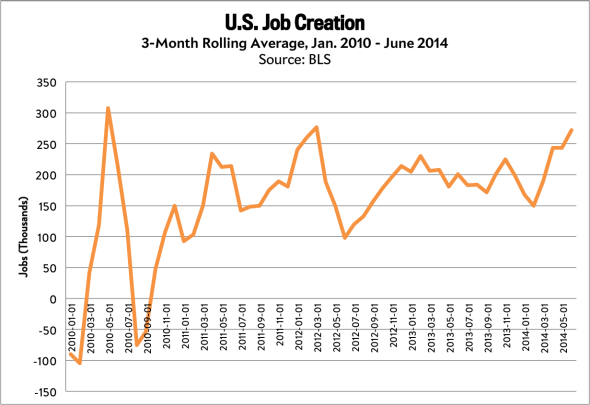
I think there’s some reason for optimism, especially given the fact that employers kept hiring while the economy retracted during the winter. Companies may finally feel good enough about the future to keep adding to their payrolls. On the other hand, as Neil Irwin points out at the Times, we’ve been here before. Below, I’ve graphed out a three-month rolling average of U.S. job creation. The labor market is almost back to the pace it hit in January 2012, after which employment growth took a nosedive.

us_job_creation_1.png.CROP.promovar-mediumlarge

It’s also possible, Irwin points out, that schools juiced this month’s numbers a bit by staying open later into the summer to make up for days lost because of the miserable winter weather. And as Wolfers notes, there’s always a margin of error of +/- 90,000 jobs on each of these reports. For now, we have some good news—but it’s too early to tell if we’re reaching a new new normal.

And Casselman notes that “as always, there are caveats” to any good report:

June’s employment gains were mostly in part-time jobs, and the number of people working part time because they couldn’t find full-time work rose by 275,000. Much of the job growth was concentrated in low-paying sectors, such as restaurants and retail, while hiring in the better-paying construction sector continued to lag. The number of people out of work six months or more fell to a five-year low, but, at least as of May, not because the long-term unemployed were actually finding jobs.

Patrick Brennan anticipates some grousing from the right:

Skeptics — see that incorrigible pessimist Arthur Brooks — will always question why exactly we’re celebrating the labor-force-participation rate merely staying steady, at the lowest rate since the 1970s, and jobs growth at a rate at which it will take years to return to employment levels, as a share of the population, that we saw before the recession.

Two points: It’s all relative, and it is notable that we are seeing stronger growth now than we have seen in years. Second, the labor-force-participation rate isn’t just being pushed down by a bad economy — it’s in a secular demographic decline. I’d like it to rise, and to be higher than it is, but in a certain sense, it’s not ridiculous to celebrate its holding steady as a victory.

Question Of The Day

A reader asks:

What are you picking for Book Club #3?  I’m super antsy … and July is here. Tell! Tell us! Tell us all! Or just respond so I may quietly read while everyone else is blowing shit up over the weekend.

Heh. Well, yes, it is July, and a major political book did not seem like the best way for me to read on the beach this summer. So I picked a book I’ve long wanted to read but never got around to – about an author who remains among my favorite non-fiction masters of all time and blogger avant la lettre: Montaigne.

The book is How to Live: Or A Life of Montaigne in One Question and Twenty Attempts at an Answer, by Sarah Bakewell.

It’s an innovative approach to biography – it’s really a series of meditations, based on Montaigne’s life and work, on some of life’s big questions. The “answers” to How To Live? come in many Montaigne-inspired recommendations: Survive Love and Loss; Question Everything; Live Temperately; Do A Good Job, But Not Too Good A Job; Give Up Control; among many others. It has an Amazon rating of 4.4 out of 5, and won the 2010 National Book Critics Circle Award for biography.

Some reviews:

“Ms. Bakewell’s new book, How to Live, is a biography, but in the form of a delightful conversation across the centuries.” —The New York Times
513f2INPtgL
“So artful is Bakewell’s account of [Montaigne] that even skeptical readers may well come to share her admiration.” —New York Times Book Review

“Extraordinary…a miracle of complex, revelatory organization, for as Bakewell moves along she provides a brilliant demonstration of the alchemy of historical viewpoint.” —Boston Globe

“Well, How to Live is a superb book, original, engaging, thorough, ambitious, and wise.” —Nick Hornby, in the November/December 2010 issue of The Believer

“In How to Live, an affectionate introduction to the author, Bakewell argues that, far from being a dusty old philosopher, Montaigne has never been more relevant—a 16th-century blogger, as she would have it—and so must be read, quite simply, ‘in order to live’…Bakewell is a wry and intelligent guide.” —The Daily Beast

I also have an ulterior motive. For me, Montaigne’s essays – first read in college – have long been a source of enthusiasm and inspiration. His constant curiosity, his openness to new ideas, his willingness to change his mind, his capacity for growth and humor, his staggering honesty, his wit and humaneness: all helped create and nurture the emergence of the modern individual in the West. Along with Shakespeare, he saw humanity in his day in its entirety, and, like Shakespeare, was somehow able to regard it with the perspective of the ages. As literature, he also pioneered the essay as a form, and the personal voice in writing in ways not seen since Augustine. If there were one powerful influence behind my approach to blogging, it would be Montaigne.

bookclub-beagle-trSo dig in – and perhaps be inspired to go to the source material as well, as long as you get Donald Frame’s still-peerless translation. Sarah has agreed to join us in a few weeks to carry on the conversation. So let’s use this book to think about that simple question: how to live? It’s an area so ripe for reader anecdotes and stories and personal journeys that it seemed perfect for a summer discussion. Buy it here – and help give the Dish some affiliate income, and get yourself a deck-chair or a hammock.

And Happy Fourth!

Health Control

Zoe Fenson emphasizes that for many women, including herself, using birth control isn’t even about contraception:

On a regular basis, I encounter women with [Polycystic Ovary Syndrome] who rely on oral contraceptives to keep their reproductive organs in check. And even beyond our experience, there are a host of medical issues, tangentially or completely unrelated to reproduction, for which birth control serves serious medical uses. I’ve known women who take birth control to limit pain from endometriosis, to stave off migraines, to address skin-scarring cases of acne.

These issues almost never come up in discussions about access to birth control, because the conversation is so dominated by sex, and by extension, pregnancy.

Even when it does come up, the debate immediately gets redirected back. Witness Sandra Fluke’s passionate defense of contraceptives on behalf of her friend, who lost an ovary to PCOS. The loudest shouters in the public discourse immediately turned the conversation to her own sexual proclivities, accused her of agitating for consequence-free sex, and the point was completely lost. I watched that spectacle play out, raged over it, and cried quietly when my rage was spent.

Caitlin Dickson adds:

One of the birth control pills’ greatest benefits to users is a reduced risk of ovarian and endometrial cancer. Studies have found that the protective effects of oral contraception against both types of cancers increase the longer a woman takes the pill and lasts for years after she stops using it.

A reader joins the conversation:

IUDs are not just birth control devices.  They are used to prevent heavy hemorrhaging due to fibroids (growths in the uterus) in perimenopausal women.  Absent these devices, the women would have to undergo hysterectomies.

This is not just about sex.  It is about an employer making decisions, based on their religious beliefs, about the health of their employees.

Crime And Collective Punishment

The three Israeli teenagers who went missing last month were found dead on Monday, leading Israel to step up its harsh crackdown on Hamas:

In the past two weeks, Israel has launched a massive security operation in the West Bank that has led to the rounding up of over 400 Palestinians suspected of being Hamas operatives. The house-to-house searches and mass arrests brought Palestinian youth out into the streets. At least five Palestinians have died after being fatally shot by Israeli soldiers in the resulting crackdown, including 15-year-old teenager Mohammed Dudeen. … At least three Palestinians in the isolated coastal strip have died as a result [of airstrikes].

The latest volley of violence:

Palestinian rockets hit two homes in Sderot but caused no injuries. Ten people were injured by the Israeli strikes. According to The New York Times, the Israeli military said they had launched airstrikes in response to earlier rocket fire, specifically targeted training sites associated with the militant group Hamas, which controls Gaza. Israel also positioned troops along the Gaza border in what it described as a defensive measure.

Here are some young racist Israelis using the occasion to march through the streets yelling “Death to Arabs!”;

Their brazenness may well have been stirred by Netanyahu’s use of the word “revenge” to describe the Jewish state’s response to the horrifying murder of three Israeli teens. MJ Rosenberg is aghast:

Prime Minister Netanyahu’s response was perhaps the most repulsive response to an event like this that I have ever seen by any national leader of a civilized country. He vows “revenge.” Revenge? Not Even George W. Bush used that term after 9/11, pledging instead to bring the people who committed the crime to justice. FDR after Pearl Harbor? The parents after Newtown?

It’s at moment like this that you realize how tenuous Israel’s commitment to Western values have become of late. Here, for example, is a tweet showing bright young things in favor of ethnic cleansing of Arabs, the obvious end-point for Greater Israel:

Many are worried about a Third Intifada in response to all this. Beauchamp:

The million-dollar question is whether this escalates militarily, especially given that the two sides were already at a tense point. Before the [Gaza] bombing, 16 rockets had been fired into Israel out of the Gaza Strip. Israel alleges that they were the first Hamas-fired rockets since 2012. Other more recent rocket fire had been from smaller groups, which Hamas arguably attempted to repress in order to avoid risking Israeli retaliation. “Either Hamas stops it,” Netanyahu said, “or we will stop it.”

Max Fisher points out:

Collective punishment is designated as a war crime by the Geneva Conventions, which regulate warfare under international law.

It’s also deeply harmful to the Israel-Palestine peace process, polarizing Palestinian political groups and civilians against Israel. It also polarizes Israelis against Palestinians. Israeli government rhetoric and actions implicitly blaming wide swathes of Palestinians for the kidnapping have coincided with incidents of Israeli mob violence against Palestinians, including what appears to be the abduction and murder of an Arab teenager. …

In any case, the Hamas political leaders based in Gaza seem unlikely to have participated in a kidnapping in the West Bank committed by rogue Hamas militants, so it’s not clear that air strikes on Hamas political leaders in Gaza are an appropriate or justified response.

And as Eli Lake observes, Saleh al-Arouri, the Hamas commander believed by Israel to be the mastermind behind the recent wave of kidnappings in the West Bank, is not even in the country:

Senior Israeli officials confirmed for The Daily Beast that al-Arouri is the Hamas leader who has encouraged, funded and coordinated a campaign to ramp up kidnappings in the West Bank and that al-Arouri now resides in Turkey. …  [I]t could further complicate relations between Ankara and Jerusalem, two former allies that have tried recently to repair a broken relationship.

Meanwhile, Amjad Iraqi laments the “selective sympathy” on both sides when it comes to the deaths of Israeli and Palestinian children:

The apathy toward the “other child’s” suffering is painful to watch, including in this latest saga. In the two to three weeks following the abduction of the three Israeli boys, at least eight Palestinians were killed during Israel’s military responses in both Gaza and the West Bank. Among them were 10-year-old Ali al-Awour, 15-year-old Mohammad Dudeen and 22-year-old Mustafa Hosni Aslan. Ali died of wounds from an Israeli missile strike in northern Gaza; Mohammad was killed by a single live bullet in the village of Dura; Mustafa was killed by live bullets in Qalandiya refugee camp during clashes with an Israeli military raid.

I write the names of those three Palestinian boys not to belittle the horrific deaths of the three Israeli boys. I write their names because, while everyone will remember Gilad, Naftali and Eyal, no one will remember Ali, Mohammad or Mustafa.

And Susan Abulhawa decries the West’s double standard:

Palestinian children are assaulted or murdered every day and barely do their lives register in western press. While Palestinian mothers are frequently blamed when Israel kills their children, accused of sending them to die or neglecting to keep them at home away from Israeli snipers, no one questions Rachel Frankel, the mother of one of the murdered settlers. She is not asked to comment on the fact that one of the missing settlers is a soldier who likely participated in the oppression of his Palestinian neighbors. No one asks why she would move her family from the United States to live in a segregated, supremacist colony established on land confiscated from the native non-Jewish owners. Certainly no one dares accuse her of therefore putting her children in harms way.

Dissent Of The Day

A reader writes:

You continue to double down on Hobby Lobby – that it is a case of limited scope that has little bearing beyond itself; that this contraception exemption is a statutory one, and not a Constitutional issue; that liberals are seriously over-reacting. Where are the liberals’ liberal values, you ask, in regards to accommodating religious rights with respect to (the new) majoritarian rule.

I sincerely respect every person’s religious rights – every PERSON’s religious rights. Think Supreme Court Rules In Favor Of Hobby Lobby In ACA Contraception Caseabout your own personal relationship with God and what that means to you. Can you honestly then state that a corporation can have sincerely-held religious beliefs? Can it go to church or receive the sacraments? Can it be a conscientious objector? Does it have a soul? Of course not. The Court already decided in Citizens United that a corporation can have free speech rights. Now it can have religious rights. What other rights that formerly inhered only in individuals can a corporation possess? Maybe the right to keep and bear arms?

You say, “A few organizations and closely-held companies want to be exempted for religious reasons.” First, you don’t know yet that it’s just a few, now that the gates are open. Secondly, as you already know, 85–90% of corporations fit the “closely-held” description, and they don’t necessarily employ just a few workers. (Hobby Lobby has 561 stores and 23,000 employees as of 2012.) I’m sorry, but once you stipulate that that many corporations can have religious rights, that is a constitutional question. And that’s how this SCOTUS works – by building on its own wrong-headed precedent. Two decisions that confer personhood on a legal entity make the third decision a lot easier.

And if this is a narrow decision by the Court, how is it that it may already be having adverse effects? Just one day later, we find out that the decision really does include all ACA-covered contraceptives, not just the four that Hobby Lobby doesn’t “believe” in. And the next day, this: The President’s pending executive order concerning LGBT discrimination and federal contractors is coming under closer scrutiny from faith leaders. How long might it be before some of these companies will want to opt out of non-discrimination against gay people because of their sincerely-held religious beliefs.

I’m grateful for this eloquent dissent – and many others. The conversation we’ve had has changed my mind on a few things, and clarified it on a few others. So here are some thoughts in response, after mulling this over some more.

The first is on the question of religious freedom. And I agree with my reader on the core point. I do not believe that even a closely held religiously informed for-profit corporation has a soul. In fact, the desire for profit is a very strange thing for a religious organization to be involved in at all. Whatever the heretical claims of the Prosperity Gospel, there is no serious Christian defense of making money as your primary purpose – and a for-profit company is, by definition, primarily about making money. I think that automatically excludes it from the religious principle. You pick either God or Mammon. Ayn Rand, for the umpteenth time, is an enemy of Christianity, not an ally.

My own view of a religious organization is one primarily devoted to religious ritual and service. Some non-profit charities would be included, but no for-profit companies would. In other words, just to be clear, I would have voted for the minority if I were a Supreme Court Justice on those grounds alone. Norm Ornstein has a great post on this principle and I share almost all his conclusions.

Equally, I think it’s fair to say that the sincerity of the religious motives behind Hobby Lobby is a little dodgy. They provided – voluntarily – the very allegedly abortifacient contraceptives in their own health insurance coverage before the ACA came into effect. How does that square with their claim to be stricken by their conscience on the question now that Obamacare is mandating it? Hobby Lobby also has investments in companies that make contraceptives. Again, their squeamishness now reeks of opportunistic politics, not sincerely held religious conviction.

I’m also struck, as I wrote yesterday, about the very Catholic-centric view of religion this ruling implies.

One wonders, as Ginsburg wrote in her dissent, if the Justices would apply these sentiments to non-Christian religions. I noted the burqa ban in France as a distant analogy, but Steve Coll goes one further and imagines a fanatical Muslim corporation asking for the equivalent rights, as in, say, exemptions from vaccines. And here is where Alito is at his weakest. His only proactive response to this is to assume that there will not be “a flood of religious objections regarding a wide variety of medical procedures and drugs, such as vaccinations and blood transfusions.” As Coll, rather drily observes: “Why not?” The religious convictions of many Muslims go far deeper than most evangelical Protestants and devout Catholics.

But here’s where I stick with my point about perspective. In the last few years, America has crossed the Rubicon of universal health insurance. In that new law, contraception coverage was, for the first time, mandated for anyone with health insurance. That strikes me as a huge gain – not just for those women who could not afford insurance before but for those women with insurance, where contraceptive coverage could be at the whim of employers. And when government mandates something, it will get always get some petitions for exemptions. We’ll see in due course – and the Dish will keep close tabs on – how big a loophole it turns out to be. But if the administration can deploy the fix used for religious organizations proper – getting insurance companies to provide the contraception and then get re-imbursed by the government (see here for the difficulties involved), then we could easily have a win-win. Everyone gets guaranteed contraception coverage and a few religious closely-held corporations can keep their hands “clean”.

And let me suggest something else about toleration of these religiously-based companies. It will hurt them in the long run. What Hobby Lobby has now announced to the world is that women who use contraception shouldn’t work there if they don’t want to live in a hostile environment, and no one should buy goods there if they object to their policy targeting women’s healthcare – and women’s alone – for discrimination. A company that behaves this way is a company that will lose customers and potential employees. The positive way to respond to this is to stop shopping there and to seek employment elsewhere. You can even boycott if you wish. Since the vast majority of women, including overwhelming majorities of Catholic women, don’t agree with the ludicrous case against contraception, it seems to me that this kind of policy will not be in the interests of any company trying to make a profit. That’s how a free society works.

One final thing: Can I respond to the emailers who say the only reason I am not too alarmed by the Hobby Lobby ruling is because I’m a man, and not a woman? I sure hope that isn’t the case. I’ve long been a libertarian type of conservative, and have long had much higher tolerance for people doing bad things in a free society than some others. So to take the very personal question of homosexuality, I have defended the right of the Boy Scouts to discriminate against gays, I have defended the right of the Saint Patrick’s Day Parade to exclude gays, I oppose hate crime laws protecting gays, and I have even theoretically opposed anti-discrimination laws in employment for gay people (and plenty others). This does not mean that I approve of any of those things – I despise them all, in fact. But in a free society, religious fanatics and bigots have rights as well. I would not have given Hobby Lobby what SCOTUS just did, but I sympathize with the principle involved, and prefer a limited government in a free society over a powerful government in a more just one. And a free society must mean religious freedom sometimes in contravention of established norms. That’s what freedom requires. And we are a stronger country for it.

(Photo by Scott Olson/Getty Images)

Sponsored Content Watch

Screen Shot 2014-07-03 at 1.38.03 AM

A reader writes:

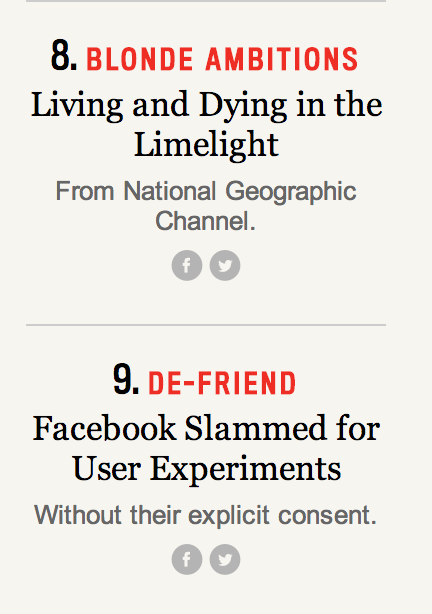
I noticed today that “partner” has invaded the Cheat Sheet at the Daily Beast. When youScreen Shot 2014-07-03 at 1.41.33 AM moved from the Atlantic to DB, I loved the Cheat Sheet as a quick-glance headline source for important news before I delved into more long reads and blogs. Today, they have the #8 spot as an ad for the National Geographic channel special on the 1990s, in addition to all the banner and sidebar ads for the same. It’s bastardizing something unique about their website and a remarkably stupid idea. Why would people who are wanting to read the headlines very quickly, waste their time with labeled “partner” ? We just keep scrolling. They keep missing the point.

Thank you for not seeking to monetize your ideas in such a crass way. I’m a proud subscriber to the Dish and hope that you can remain independent of advertising.

My favorite part of their disclosure? “This content was not necessarily written or created by the Daily Beast editorial team.” It reminds me of one surreal discussion I once had with the Beast’s ad department. I wondered why they couldn’t find an advertiser for the View From Your Window. After a bit, they came back and wondered if we could change the feature to “The View From Your Hotel Window”. There might be a sponsor for that.

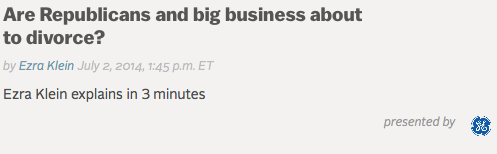
Speaking of which, how about this for irony:

Screen Shot 2014-07-03 at 10.00.44 AM

Why not just leave out the middle man and ask GE themselves?