This Is A Refugee Crisis

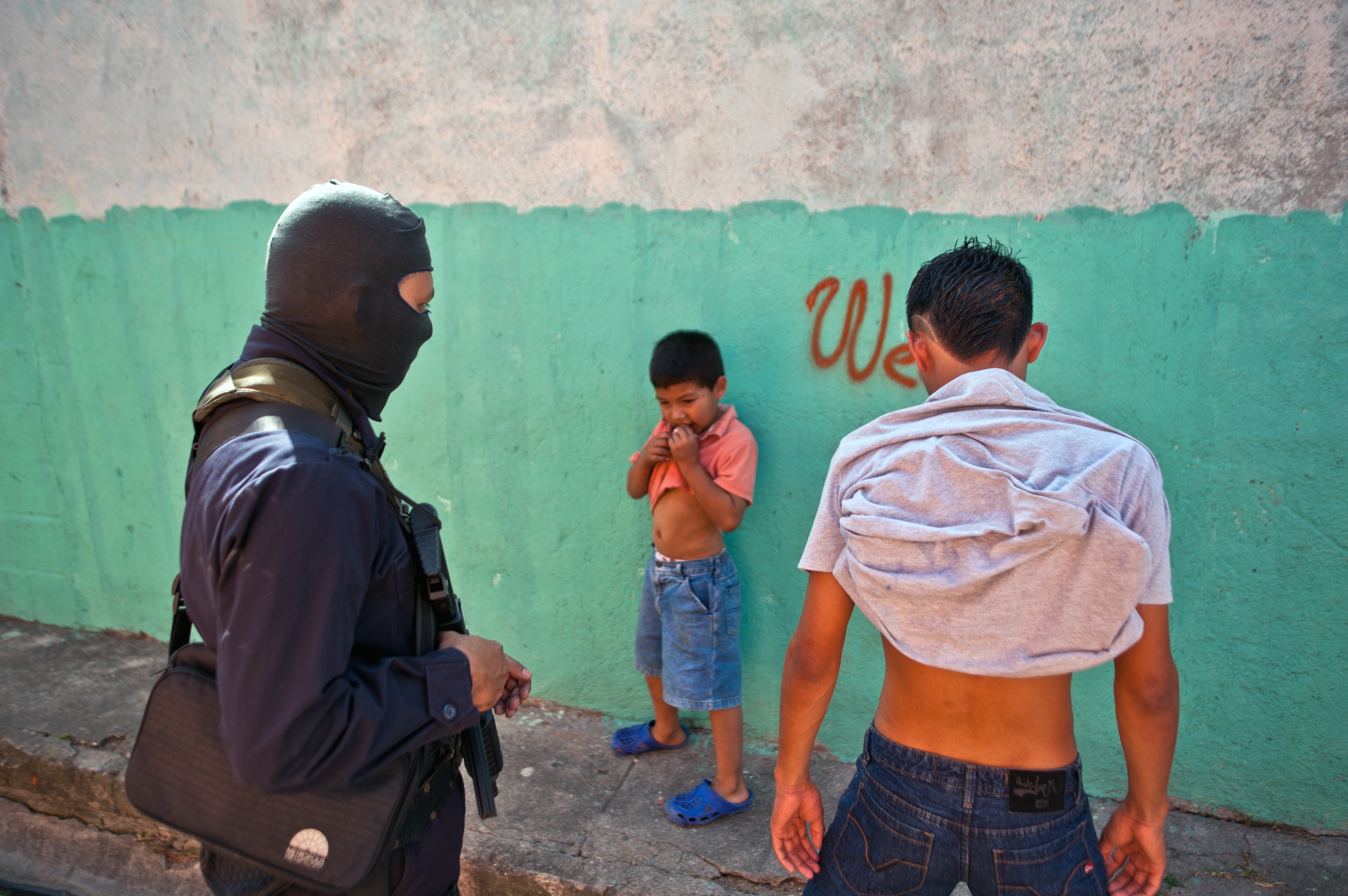
EL SALVADOR-POLICE-OPERATION

Amanda Taub illustrates how gang violence in Central America is driving thousands of unaccompanied children to seek refuge in the US:

Children are uniquely vulnerable to gang violence. The street gangs known as “maras” — M-18 and Mara Salvatrucha, or MS-13 — target kids for forced recruitment, usually in their early teenage years, but sometimes as young as kindergarten. They also forcibly recruit girls as “girlfriends,” a euphemistic term for a non-consensual relationship that involves rape by one or more gang members.

If children defy the gang’s authority by refusing its demands, the punishment is harsh: rape, kidnapping, and murder are common forms of retaliation.  Even attending school can be tremendously dangerous, because gangs often target schools as recruitment sites and children may have to pass through different gangs’ territories, or ride on gang-controlled buses, during their daily commutes.

Why now? The Economist‘s take:

El Salvador, Honduras and Guatemala have had shockingly high murder rates for years, however. The reason so many of them have decided to leave at once is a widespread rumour that Mr Obama’s administration has relaxed the barriers against children—and their mothers if the children are young enough—entering the United States.

A leaked border-agency memo based on interviews with 230 women and children apprehended in the Rio Grande Valley concluded that they had crossed the border mainly because they expected to be allowed to stay. Migrants talk of a “permiso” (permit) to stay in the United States, although this may be a misunderstanding of the American immigration procedure in which many children are put in the care of family members while waiting for deportation hearings. Some Hondurans conspiratorially say they think America is preparing for war; that’s why they are letting more youngsters in. Others blame Facebook: it is easy for relatives in the United States to show the trappings of prosperity.

Julianne Hing disputes the notion that Obama’s policies are to blame for the influx:

Republican lawmakers are having a field day casting Obama administration policy, namely DACA—a program initiated in 2012 which gave a narrow class of undocumented youth short-term work authorization and protection from deportation—as responsible for the sudden uptick of new migrants. In early June, Alabama Sen. Jeff Sessions even called Obama “personally responsible” for the influx, Think Progress reported. It’s become popular political fodder for politicians with midterm elections on the mind.

However, humanitarian groups like the United States Conference of Catholic Bishops and the Women’s Refugee Commission have noted the jump in unaccompanied minor border crossings since late 2011 (PDF), long before Obama announced DACA in June of 2012. What’s more, in interviews with hundreds of detained youth, multiple agencies and researchers have found that the vast majority have no idea about the existence of DACA, let alone the notion that they might take advantage of it for themselves.

Dara Lind accuses the administration of getting its response to the crisis backwards:

The Obama administration now believes that the government’s top priority should be swiftly returning a child to his or her home country if it’s not immediately clear that he or she deserves legal status here. That means the administration sees this as an immigration crisis — children coming to the United States because they can, for economic opportunity, family reunification, or to game the system. If that’s the case, a crackdown will deter families from sending their children, because the odds would no longer be in their favor.

It means they don’t see it as a refugee crisis — children will now be assumed not to be in danger unless they can prove otherwise. But if families are currently sending children because they’re genuinely convinced the children are in mortal danger, a crackdown won’t have as much of a deterrent effect.

(Photo: A policeman checks a man during the operation ‘safe house’ at the Maquilishuat neighborhood in San Salvador, El Salvador on January 15, 2014. Salvadorean police make ‘safe house’ operations to search for drugs and gang members in violent neighborhoods. By Jose Cabezas/AFP/Getty Images)
Getting Along, In Concert

In an interview, Andrew Bowie, a jazz-playing philosopher, claims that what we can learn about politics from the symphony has to do with practice rather than theory. He points to Daniel Barenboim and Edward Said’s East-West Divan Orchestra, along with jazz, as examples of what he means:

The Barenboim-Said Orchestra offers an example of communication between people whose political views are often totally opposed. Barenboim cites two musicians from the orchestra on opposed sides of the Arab-Israeli disputes who cannot agree at all on issues of justice and politics, but who can agree on the importance of getting the phrasing in a Beethoven symphony right. Philosophers also hardly ever agree on anything, but they have to coexist, so finding modes of communication and interaction which circumvent inevitable differences should be crucial. The point of something like music, where participation is essential, is that what happens in successful participation cannot be fully cashed out in discursive terms. Our political judgements, on the other hand, should have to be publicly cashed out, and this means we often arrive at irreconcilable conflicts, where both sides’ judgements may, of course, anyway be mistaken. …

[T]he world of music is … actually notorious for being riven by conflict – but it does also offer examples of cooperation and communication beyond everyday antagonisms in other domains. That is one of the things I love about the jazz scene, where people from wildly different backgrounds, with very different levels of experience and skill, and very different musical conceptions, can play together successfully.

Face Of The Day

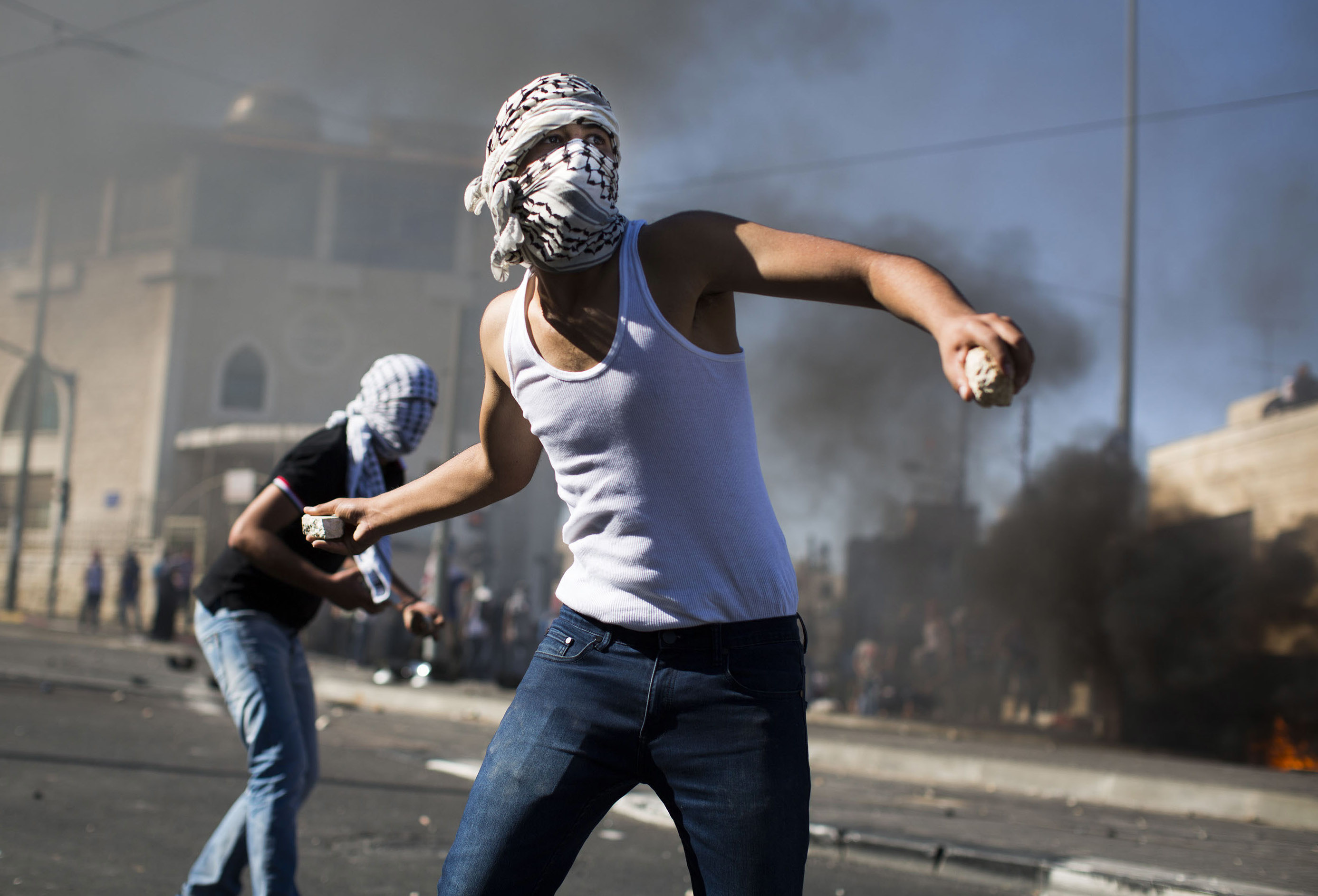
Clashes In East Jerusalem As Palestinian Teenager Reported Murdered

Palestinian youths clash with Israeli police near to the house of murdered Palestinian teenager Mohammed Abu Khdair in Jerusalem on July 2, 2014. Police found a burnt body in a forest west of Jerusalem early Wednesday morning in what appears to have been a revenge kidnapping and murder carried out by right-wing Israeli extremists after three Israeli teenage boys were found dead on Monday north of the Palestinian town Halhul, near Hebron. By Ilia Yefimovich/Getty Images.

Quote For The Day

“Stern fathers often make the mistake of believing that their children will not defend the home or the values of the family if martial discipline is not instilled. But turning the homestead into a garrison then drives the children to go AWOL. Instead, all the father has to do is make his home a place of love and, yes, comfort. Having done that, his sons will defend it from any real threat with fire in their eyes.

Ideologues prefer the idea of an ideological nation, a crusader state. Crusader states inspire great battle poetry. But a democratic republic like America needs no purpose, no mission civilisatrice. It needs no poetry. America just needs to be our home — that will require sacrifice enough,” – Michael Brendan Dougherty, taking on David Brooks.

Why Rock Stars Get Laid Like Rock Stars

Cody Delistraty examines new evidence that musical talent may be a sexually selected trait:

For over 140 years, research had not been able to verify Darwin’s theory, that is until a recent study conducted by Benjamin D. Charlton confirmed that indeed, “music is a product of sexual selection through mate choice.”

But the findings come with some nuance. Charlton and his fellow researchers at the University of Sussex found that women in the middle of their menstrual cycle – at their most fertile – tended to believe men with strong musical abilities carried better genes than men without that skill and thus preferred them as mates. For the study, 1,465 women listened to four different piano compositions of increasing levels of complexity and were asked which composer they desired most. Women who were not at a point of peak conception were generally ambivalent, not preferring a single composer over another, but those who were on days six through 14 of their respective reproductive cycles overwhelmingly preferred the composer of the most complex song.

No, ISIS Is Not Al-Qaeda, Ctd

In fact, Aaron Zelin argues, the rise of the Islamic State is pretty bad news for the leading jihadist brand:

The Islamic State hopes to put al Qaeda and its branches in the unenviable position of having to reconcile with the reality of the new caliphate, or oppose it and therefore be viewed by global jihadis as hindering the caliphate project and showing its true nature as a sectarian organization that is not working for the best interests of Muslims. That strategy, however, is a gamble: It could open the Islamic State up for an even bigger fall if it does not follow through on its promise to fight enemies on all fronts, and if it fails in governing newly captured areas. There is already insurgent and noncombatant resistance to the Islamic State’s gains in both Syria and Iraq, so the group therefore has a thin needle to thread.

Jihadists’ reactions to the Islamic State’s re-establishment of the caliphate have so far been mixed.

There are signs that al Qaeda in the Arabian Peninsula foot soldiers are excited about the alleged caliphate coming to fruition, while many within the Nusra Front are condemning it and sarcastically making fun of it, calling it a Twitter Caliphate. Maldivian jihadists in Syria under the banner of Bilad al-Sham Media have released a rebuke, arguing that the announcement strays from the true Islamic way of establishing a caliphate, and noting that it needs to have broader support. Most importantly, a number of top jihadist sheikhs, such as Hamid bin Ali and Hani al-Siba’i, have rebuked the announcement. The key Syrian Islamist rebel groups and Islamic bodies also rejected the Islamic State’s reestablishment of the caliphate.

Dettmer relays the fears of Western security agencies that al-Qaeda may try to reassert itself in the Jihadi rivalry by staging a big attack:

U.S. officials say the Obama administration is preparing to ramp up airport security and has requested Western allies do the same as concerns mount that suicide bombers are in the late stages of planning attacks on American- and European-bound commercial flights. A senior European security official told The Daily Beast there are fears as well that jihadists recently returned from fighting in Syria with al Qaeda affiliate Jabhat al-Nusra are conspiring to detonate bombs on railways and buses in major European capitals such as London and Paris.

It looks like it will be a long, difficult summer for travelers as, at a minimum, the rivalry between terror groups for top-dog status will be felt in the form of longer security lines at airports and a further proliferation of inconvenient rules about what you can carry on a plane.

And another victory for fear. Let’s just hope NSA is listening in all the right places. Previous Dish on the fraught relationship between ISIS/IS and al-Qaeda here.

Mad At The Mainland

Lily Kuo takes a look at what yesterday’s massive pro-democracy demonstration in Hong Kong was all about:

On the July 1 anniversary of Hong Kong’s handover to China, tens of thousands of students and other residents of the semi-autonomous region joined the city’s largest demonstration in a decade, demanding the right to directly elect a leader. The protests were widely followed by international media, and Hong Kong’s dissatisfaction is well-known outside the city, but observers fear they will do little to prod Beijing to allow truly open and direct elections, and could prompt a harsh crackdown by Chinese authorities. …

Last night’s sit-in is merely a trial run for a larger demonstration later this year. Organizers of a protest group called Occupy Central have vowed to bring Hong Kong’s financial district to a standstill if a proposal from authorities—due to be released before the end of this year—doesn’t include public nomination.

William Pesek details the underlying causes of the widespread discontent:

Since July 2012, Leung Chun-ying has stood aside as China clamped down on Hong Kong’s media, tried to make the city less transparent and moved to impose patriotic education on students. His predecessor, Donald Tsang, spent seven years looking the other way, while Tung Chee Hwa, the city’s first leader, enriched a whole class of tycoons, including Asia’s richest man, Li Ka-Shing. When you look at the quality of Beijing’s picks, it beggars belief that the Communist Party can’t see why Hong Kongers want greater democracy. …

For all its wealth, Hong Kong is a potential powder keg. About 1.3 million of its 7.2 million people, or one in five, live under the poverty line. Its Gini coefficient, a measure of income inequality, rose to 0.537 in 2011 from 0.525 a decade earlier, and now is 12th highest in the world. And given the surge in property prices during Leung’s tenure, coming mostly from public servants in Beijing, it’s safe to assume the gap has widened more since then.

Fear And Loathing In The Middle East

Refugees Fleeing ISIS Offensive Pour Into Kurdistan

New survey data reveal that worries about Islamic extremism are on the rise:

Concerns have increased significantly over the last two years in Jordan and Turkey, both of which share a border with Syria. Roughly six-in-ten Jordanians (62%) are concerned about extremism in their country, up 13 percentage points since 2012. Just half of Turks hold this view, but this is up 18 percentage points from two years ago. More than eight-in-ten Israelis (84%) express worries about Islamic extremism, although this view is more common among Israeli Jews (87%) than among Israeli Arabs (66%).

Meanwhile, al-Qaeda is broadly despised, Nigerians hate Boko Haram, and Pakistanis can’t stand the Taliban. Groups like Hezbollah and Hamas are also seeing their popularity decline notably:

More than half in the Palestinian territories (53%) have an unfavorable view of Hamas, with only about a third (35%) expressing positive views. Negative views are higher in the Hamas-led Gaza Strip (63%), up from 54% in 2013. In the Fatah-led West Bank, 47% have an unfavorable opinion of Hamas. Opinions of Hamas have been deteriorating in the Palestinian territories since it took control of the Gaza Strip in 2007. Then, 62% of Palestinians had a favorable view of the extremist group, while a third had negative views. Now, only about a third have positive opinions and more than half view Hamas negatively.

(Photo: Iraqis who have fled recent fighting in the cities of Mosul and Tal Afar try to enter a temporary displacement camp in Khazair, Iraq but are blocked by Kurdish soldiers on July 2, 2014. The families, many with small and sick children, have no shelter and little water and food. The displacement camp at Khazair is now home to an estimated 1,500 internally displaced persons (IDPs) with the number rising daily. Tens of thousands of people have fled Iraq’s second largest city of Mosul after it was overrun by ISIS militants. Many have been temporarily housed at various IDP camps around the region including the area close to Erbil, as they hope to enter the safety of the nearby Kurdish region. By Spencer Platt/Getty Images.)

Too Many Angry Young Men?

Two economists suggest that China would be a more peaceful place if it had more women:

[Jane] Golley and [Rod] Tyers are building off existing research, which confirms that China’s crime rate has doubled over the last 20 years and that incidents of social unrest have risen from about 40,000 in 2001 to over 90,000 in 2009.  China’s imbalanced sex ratio is likely a leading cause: A 2008 study by the Institute for the Study of Labor found that a 1 percent increase in the sex ratio leads to a 5 percent increase in the crime rate. And regions with the most male-biased sex ratios also have more gambling, alcohol and drug abuse, prostitution, rape, bride abduction, and human trafficking. Using demographic and economic projections, Golley and Tyers concluded that gender “re-balancing” could bring about a reduction in crime and a rise in productivity.

Perhaps aware that this all still has a simplistic ring, Golley and Tyers cite anthropological studies which show that in societies with surplus men, males have a greater tendency to engage in non-productive and risky “wife-seeking” behavior. And this theory isn’t new: In the 2004 book, Bare Branches: The Security Implications of Asia’s Surplus Male Population, Andrea den Boer and Valerie Hudson showed that high male sex ratios can also lead to more authoritarian forms of government as authorities try to crack down on crime.

Previous Dish on China’s “bare branches” here and here, and on its one-child policy here, here, and here.