German Lopez illustrates the racial breakdown for recreational drugs – always a helpful reminder:
White and black people report using drugs at similar rates, according to the latest data from the Substance Abuse and Mental Health Services Administration. There’s some variance from drug to drug: White people report more often using cocaine, heroin, and hallucinogens, while black people report more marijuana and crack cocaine use. These statistics underline why critics decry the war on drugs as racist. Although black people are much more likely to be sent to jail for drug possession, they’re not more likely to use drugs.
A final step the administration could take would be to enhance access to contraception by making all forms of oral contraception available over-the-counter without a prescription (and not just “Plan B”). While this would not make contraception “free” it would reduce the cost, and help alleviate some of the non-monetary obstacles women face. As Adrianna McIntyre notes, cost is hardly the only (or even the largest) obstacle working women face when it comes to obtaining contraception. Making oral contraception available OTC might not help the 3-4 percent of women who use IUDs, but it would nonetheless expand access to contraception as a practical matter, particularly for the working poor. It also has the support of some prominent conservatives and would largely eliminate the cultural conflict engendered by the mandate.
Philosophically, it’s consistent with limited government principles. It removes unnecessary government regulations and increases choice. It doesn’t impose new burdens on businesses or religious institutions, nor does it require an increase in government health care spending.
And politically, it would also be beneficial to Republicans. It would make it a lot more difficult for Democrats to portray the GOP as being only interested in obstructing Democrats rather than supporting their own ideas, and harder to accuse Republicans of being broadly against access to birth control. Instead, it would allow Republicans to go on offense, and show that Democrats are the ones who want to play politics with birth control.
Ben Domenech, another conservative, runs through the counterarguments:
There are a number of objections to [OTC birth control], but I find them to largely amount to unconvincing paternalism.
The chief argument advanced is that standard oral contraceptives mess with hormones and have all sorts of side effects. This is, of course, true! But: dangerous side effects are rampant within all sorts of other over the counter drugs. Women can think for themselves and make decisions with their doctor and pharmacist about what drugs they want to take – and the evidence shows they are good at self-screening. In fact, it would actually increase the ability to mitigate and respond to unanticipated side effects, since changing tracks will no longer require a doctor’s visit and getting a new prescription. Assuming that women won’t or can’t take responsibility for themselves to consult with a doctor unless required to by arbitrary government policy is absurd.
Allahpundit spotlights one of the idea’s most vocal supporters:
Bobby Jindal, who’s wooing religious conservatives ahead of 2016, has been pushing [the OTC pill] since 2012. … Congress could, as Jindal suggests, even adjust Health Savings Accounts so that they include OTC medicines, which would further reduce the financial burden. And politically, it would complicate the Democrats’ dopey “war on women” messaging by decoupling the contraception debate from the debate over abortion. How do you push a “Republicans don’t believe in reproductive freedom” message if GOPers like Jindal want to make the pill OTC?
In the United States, the proposal to sell oral contraceptives over the counter has been endorsed by the premier body of relevant experts, the American Congress of Obstetricians and Gynecologists. Ultimately, though, the decision will be made by the FDA.
So why the holdup? Elizabeth Nolan Brown has a must-read:
“Doctors regularly hold women’s birth control prescriptions hostage, forcing them to come in for exams,” wrote Stephanie Mencimer in a Mother Jones piece about her own doctor doing so. Dr. [Jeffrey] Singer described as it doctors extorting pay for a “permission slip” to get the same medication over and over again. Feminist blogger Amanda Marcotte says doctors use “the pill as bait” to make sure women come in once a year. Both doctors and public health officials publicly worry that women won’t receive annual cervical cancer and sexually transmitted infection (STI) screenings without such coercion. How much of this concern is motivated by profit, how much by paternalism, is hard to say. …
It’s not just some doctors and medical groups who want to keep things status quo. Pharmaceutical companies also gain from it. OTC sales “would drive down the prices substantially,” says Singer. Drugmakers can get higher prices from insurance companies than they could in a competitive contraceptive market. … Yet the pharmaceutical industry is the only entity with standing to challenge the prescription status of current birth control pills. In order to initiate the switch from prescription to nonprescription, a drug maker must approach the FDA.
I’m a broken record on this, but I have less respect for HRC, the country’s largest gay rights lobby, than I do for AIPAC. AIPAC may weaken the US, but at least it gets shit done. HRC? Not so much. Case in point – at New York’s Gay Pride Parade, they apparently couldn’t even muster a real contingent for the march, according to mischievous eye-witnesses, recruiting a bunch of 20-somethings from an ad agency – McCann:
Numbering perhaps 30, they were outdone by the delegations of many smaller community groups as well as their fellow corporate sponsors. Walmart’s envoys stretched a block and a half; MasterCard’s crowd was loud and proud … But it seems that HRC, the largest — and richest — LGBT-rights group in the country, could not be bothered to field a team for the largest LGBT-pride parade in the country. Nor did the earnest, well-meaning boys and girls who marched in their stead have much of an idea why they were there. Some clearly thought we and our banner were part of their group. One wasn’t sure what “HRC” stands for, though most gamely chanted “H! R! C!” — corporate cheerleaders shilling for our premier civil-rights organization right down the lavender line. And no one was sure if there were any HRC staffers among them; if there were, I couldn’t find any.
Based on his personal experience, Alexander Zaitchhik fears that off-label use of ADHD drugs is a “public health disaster”:
Around 2009, I noticed more friends and acquaintances getting scripts. These people would never in a million years be caught facedown in a caterpillar of street meth, but here they were singing in the rain about Adderall – Kate Miller’s “medicine.” More than one of these people asked me, “Why are you paying $20 a pill?” They suggested doing what they did: take an online quiz, find a friendly [Attention Deficit Disorder Association]-approved doctor who “gets it,” and get sorted in a doctor’s office.
I never considered it. A cheap and limitless supply of pharma-grade amphetamine, signed off by a friendly medical professional, struck me as an incredibly unwise pursuit. That’s how you become a heavy or daily user. The road to tweakdom is paved with Duane Reed co-pay receipts. I’ve since been proved right, sadly, by watching speed hurt people I care about. …
For those who have never taken speed, it’s difficult to convey the seriousness of a public health disaster – and the depths of its underlying corruption – that results in healthy college students taking 90 daily milligrams of amphetamine salts under blasé doctor’s orders. At 90 milligrams a day, the question is not if the person will eventually experience some form of speed psychosis, but what grade and when.
Randyn Charles Bartholomew summarizes the case against π – and for tau, otherwise known as 2π:
The crux of the argument is that pi is a ratio comparing a circle’s circumference with its diameter, which is not a quantity mathematicians generally care about. In fact, almost every mathematical equation about circles is written in terms of r for radius. Tau is precisely the number that connects a circumference to that quantity.
But usage of pi extends far beyond the geometry of circles. Critical mathematical applications such as Fourier transforms, Riemann zeta functions, Gaussian distributions, roots of unity, integrating over polar coordinates and pretty much anything involving trigonometry employs pi. And throughout these diverse mathematical areas the constant π is preceded by the number 2 more often than not. Tauists (yes, they call themselves tauists) have compiled exhaustively long lists of equations—both common and esoteric, in both mathematics and physics—with 2π holding a central place. If 2π is the perennial theme, the almost magically recurring number across myriad branches of mathematics, shouldn’t that be the fundamental constant we name and celebrate?
Lily Kuo surveys China’s booming amusement-park industry:
In all there are already more than 2,000 theme parks in China already, according to estimates by Chinese tourism experts, compared to just over 400 in the United States, with another 64 due to launch in the next six years. It’s no wonder global entertainment firms from Six Flags to Disney, which is building a Disneyland in Shanghai, are clamoring to enter the Chinese market: More than 108 million people visited theme parks in China last year, up 6 percent from 2012, and Chinese theme park groups like Oct Parks China, Fantawild Group, and Haichang Group, have entered global rankings [pdf] in terms of attendance.
(Photo of Guangzhou’s Chimelong Paradise by Flickr user davecobb)
Psychologist Gerd Gigerenzer defends the practice, arguing that we “need statistical thinking for a world where we can calculate the risk, but in a world of uncertainty, we need more.” How ignoring the importance of instincts and gut feelings hurts business practices:
Gut feelings are tools for an uncertain world. They’re not caprice. They are not a sixth sense or God’s voice. They are based on lots of experience, an unconscious form of intelligence.
I’ve worked with large companies and asked decision makers how often they base an important professional decision on that gut feeling. In the companies I’ve worked with, which are large international companies, about 50% of all decisions are at the end a gut decision. But the same managers would never admit this in public. There’s fear of being made responsible if something goes wrong, so they have developed a few strategies to deal with this fear. One is to find reasons after the fact. A top manager may have a gut feeling, but then he asks an employee to find facts the next two weeks, and thereafter the decision is presented as a fact-based, big-data-based decision. That’s a waste of time, intelligence, and money.
The more expensive version is to hire a consulting company, which will provide a 200-page document to justify the gut feeling. And then there is the most expensive version, namely defensive decision making. Here, a manager feels he should go with option A, but if something goes wrong, he can’t explain it, so that’s not good. So he recommends option B, something of a secondary or third-class choice. Defensive decision-making hurts the company and protects the decision maker. In the studies I’ve done with large companies, it happens in about a third to half of all important decisions. You can imagine how much these companies lose.
In a review of The Barnes Foundation’s exhibit The World Is an Apple: The Still Lifes of Paul Cézanne, Morgan Meis considers why the painter’s still lifes provoked outrage in the late 19th century and why they endure as “so peculiar, so specifically Cézanne-ish” today:
Cézanne liked his painting surfaces rough with paint. He generally did not varnish or glaze his paintings. He also didn’t care much for “correct” perspective. Look, for instance, at The Kitchen Table (1888-90). The left corner of the table doesn’t even match up with the right corner. And the floor of the kitchen doesn’t recede properly into space. Cézanne didn’t care. He wanted the painting to look this way. He wanted you to feel – when looking at the painting – slightly off-kilter, like the canvas can’t quite hold what is inside it and the kitchen might spill forward out of its frame.
Cézanne also liked to blur lines and boundaries within his paintings.
InApples and Cakes (1873-77), there is a green object, probably an apple, at the back of a white dish of fruit. The apple is the exact color as the wall behind the table. So, it looks as if the wall, in the background, has simply bled into and become part of the bowl of fruit in the middle ground. In Still Life with Seven Apples and a Tube of Paint (1878-9), Cézanne has scraped at the apples with some sort of knife, mixing the colors and boundaries of the middle apple into the apples next to it. InStill Life with Carafe, Milk Can, Bowl, and Orange (1879-80), the carafe barely exists, since it merges into the colors and shapes of the wall behind it and the other objects nearby. Many things seem to be merging in Cézanne’s paintings. Objects merge with one another. Background and foreground merge. Space itself seems to tighten and overlap.
It is as if Cézanne painted still lifes to show that individual objects sitting on a table are not individual objects at all. Sure, an apple is just an apple. But in Cézanne’s still lifes, an apple isn’t just an apple. It is also all the other apples. And it is the table and jug and the pitcher and the wall behind the table. Every object is implicated in every other object. To look at one object you have to look at all the others. To confront one individual thing, you have to confront a whole world.
(Image: The Kitchen Table by Cézanne, 1888-90, via Wikimedia Commons)
Every robot journalist first needs to ingest a bunch of data. Data rich domains like weather were some of the first to have practical natural language generation systems. Now we’re seeing a lot of robot journalism applied to sports and finance — domains where the data can be standardized and made fairly clean. The development of sensor journalism may provide entirely new troves of data for producing automated stories. …
After data is read in by the algorithm the next step is to compute interesting or newsworthy features from the data. Basically the algorithm is trying to figure out the most critical aspects of an event, like a sports game. It has newsworthiness criteria built into its statistics. So for example, it looks for surprising statistical deviations like minimums, maximums, or outliers, big swings and changes in a value, violations of an expectation, a threshold being crossed, or a substantial change in a predictive model.
Joe Pinsker isn’t too worried about robot-written stories corroding journalism:
These automated write-ups are for now filling micro-niches, such as Little League games or fantasy football drafts, that are outside the scope of information covered by journalists working now.
As Automated Insights’ CEO Robbie Allen told Poynter, “We’re creating content where it didn’t exist before.” The AP’s move has a similar underlying goal: It said that Automated Insights’ algorithms will allow them to produce nearly 15 times as many earnings reports per quarter than when they filed them manually.
While, yes, it’s true that algorithms can cram stories about vastly different subjects into the same uncanny monotone—they can cover Little League like Major League Baseball, and World of Warcraft raids like firefights in Iraq—they’re really just another handy attempt at sifting through an onslaught of data. Automated Insights’ success goes hand-in-hand with the rise of Big Data, and it makes sense that the company’s algorithms currently do best when dealing in number-based topics like sports and stocks.
On top of that, the earnings report as a journalistic form, which is what one might worry is endangered by the introduction of newsroom algorithms, is already robotically formulaic. The way the AP has been writing these reports up until now demands that human writers act like computer programs, copy-pasting the day’s numbers into their predetermined slots.
Justin Ellis spots another service employing robo-journos:
What if you could rescue your favorite saved reads by putting them into print, with one click? That’s the idea behind PaperLater, a new service that lets users create a personalized newspaper from their favorite must-reads from around the web. It’s the latest creation from the Newspaper Club, the U.K.-based company we last wrote about then it created a “robot” newspaper for The Guardian. PaperLater is a continuation of that work; the same algorithms that automatically laid out Guardian stories will now let anyone easily throw together an edition of the web’s best reads. What’s new, and what makes the service slightly more approachable to a wider audience, is a browser button for saving stories to PaperLater — and the individualized nature of single-issue printing.
It’s that time of the month, as it were, so here’s the latest data on the Dish experiment in independent subscriber-based web journalism. But first up, let’s just say we’re chuffed to read the following statement by Scott Havens of Time Inc.:
I see many digital examples of customers paying for digital content that give me hope – the Wall Street Journal, the New York Times, the Daily Dish, Netflix – even when the consumer can possibly find it, or a replacement, elsewhere.
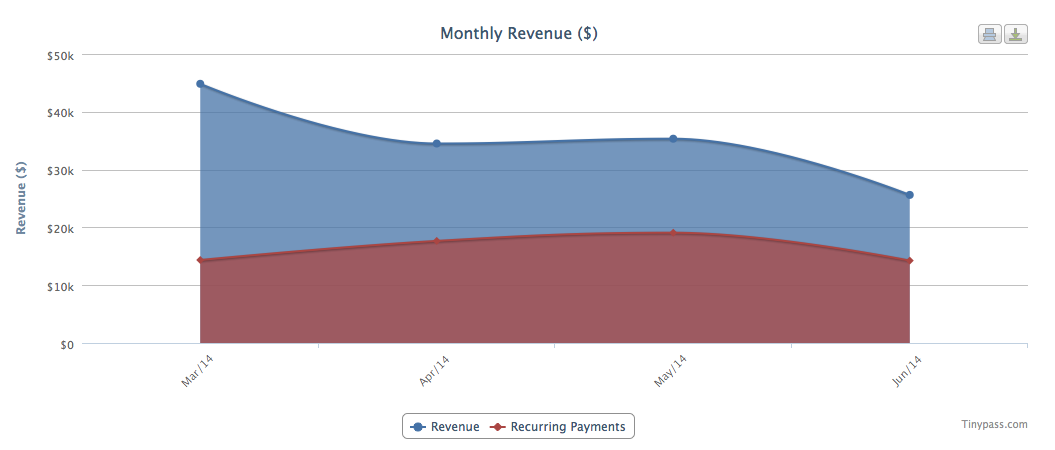
The WSJ, NYT, Netflix and little ol’ us? Well, we hoped we could be a trailblazer. And the good news is that we remain pretty stable. Traffic is marginally up from last month at 680K uniques, compared with 670K in May – but still a notch down from year one. Whether this gentle decline is a function of the news cycle or merely stabilization under the meter, we don’t know. We probably won’t until the political season heats up in the fall. As for revenue, it’s still coming in and subscriptions are now at 29,200. Here’s the data for the last few months:
We’re gliding downward in new revenue – but we did exactly the same last year in this period. And June revenue in 2014 is $26K, compared with $15K in June 2013. You can see why above: the red line is renewing income, and the blue segment is new income. Each year, with any luck, it compounds a little. Our twelve-month subscription revenue is at an all-time high of $927K. We’re beginning to prove, I think, that a subscription model can work online, and if that’s true, there’s a much brighter future for quality online journalism. Which may be why several sites are now following our lead.
So if you haven’t yet subscribed, but were meaning to, please help this experiment succeed. It’s just $1.99 a month, or $19.99 a year – and takes two minutes to sign up. We guarantee you two things: we’ll keep giving you the sharpest, independent brain food out there, and, as long as you subscribe, we will never make you sit through or be distracted by an ad, let alone corporate bullshit dressed up as an article. If that’s worth something to you, subscribe!
Today, the Hobby Lobby debate continued. I dug in to my view that accommodating some religious consciences in newly mandated contraception coverage is not the worst compromise in our culture wars. Most readers were not on the same page. I wondered if those celebrating the victory for religious freedom in America would also bemoan the ban on the niqab in France, just upheld by the European Court of Human Rights.
Many of today’s posts were updated with your emails – read them all here. You can always leave your unfiltered comments at our Facebook page and @sullydish.




 The Dish
