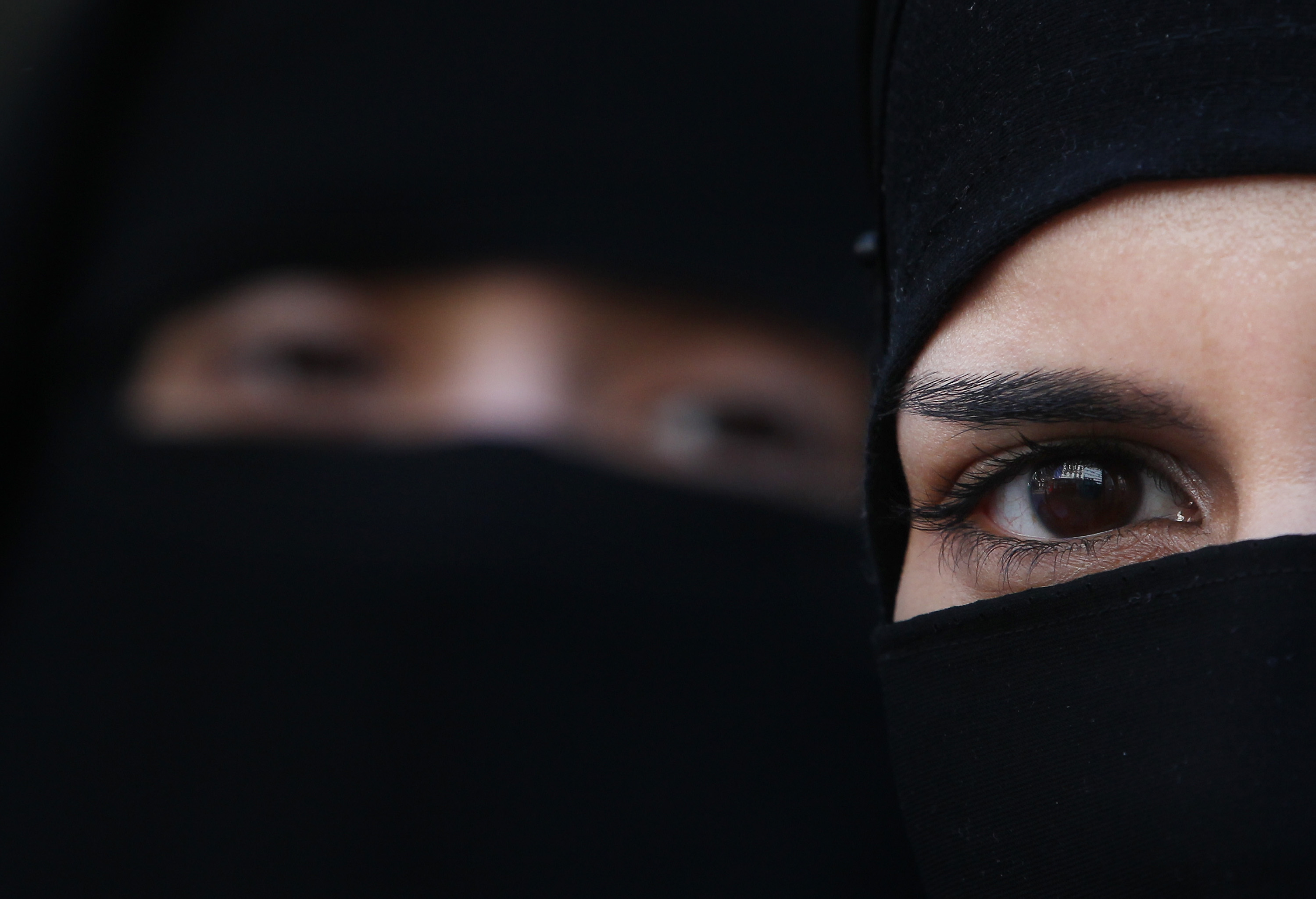
On That Religious Freedom Question …

Demonstrators Protest Over The Introduction Of A Ban On Women Covering Their Faces In France

It might be worth asking various figures on the evangelical right if they are outraged by the decision today by the European Court of Human Rights to uphold the French ban on the public wearing of the full-face veil:

At the European Court of Human Rights in Strasbourg, France, judges said the ban was a legitimate attempt to preserve the norms of France’s diverse society and did not infringe on Europe’s Convention on Human Rights. The court was ruling on a case brought by an unidentified Frenchwoman who said the law, first passed in 2010 and implemented in 2011, was discriminatory and violated her freedom of conscience.

And here’s a rather strong case that the issue is one of genuine personal conscience and conviction:

In a statement summarizing the ruling on its website, the court said the woman “is a devout Muslim and in her submissions she said that she wore the burqa and niqab in accordance with her religious faith, culture and personal convictions … The applicant also emphasized that neither her husband nor any other member of her family put pressure on her to dress in this manner. She added that she wore the niqab in public and in private, but not systematically. She was thus content not to wear the niqab in certain circumstances but wished to be able to wear it when she chose to do so. Lastly, her aim was not to annoy others but to feel at inner peace with herself,” the statement said.

For the record, I oppose the ban as an infringement on religious freedom of expression – and always have. I can see how other factors could be cited in favor of the ban – notably that the full veil hurts the possibility of “open interpersonal relationships, which, by virtue of an established consensus, formed an indispensable element of community life within the society in question.” But there are broader issues involved in Hobby Lobby as well: the government’s interest in providing affordable health insurance for the population, the health of women, the reduction in abortions, etc. And the niqab question affects directly only around 2,000 women, compared with Hobby Lobby’s theoretical impact on over half of employees in America.

So let’s hear it from America’s religious right: are you consistent about religious liberty and will do all you can to protect Muslim freedom of religious expression – or admit, you’re only about asserting your own Christian identity and no one else’s.

Somehow, I suspect few of them will be put on the spot like that. But they should be, don’t you think?

The Dish has covered this issue before – read the full thread here. Update from a reader:

This book is the best one on the French ban. It allows one to understand culturally why this ban is so French.  I just wonder about all those French feminists who are trying to save their Muslim sisters from the “horror” of the veil realize that now they have just prevented these women from being able to leave their homes.

(Photo: Two women wearing Islamic niqab veils stand outside the French Embassy during a demonstration on April 11, 2011 in London, England. France has become the first country in Europe to ban the wearing of the veil. By Peter Macdiarmid/Getty Images)

Chipping Away At Public Sector Unions

The Court’s other major ruling yesterday was Harris v. Quinn, in which a slim majority ruled that public sector unions cannot collect “fair share” fees from non-union members – in this case, Illinois home-care workers who are paid by the state – even if these non-members benefit from collective bargaining by the union:

The much-awaited decision limits, but does not reverse, the court’s well-trodden ruling from 1977, known as Abood. In that case, the court found that requiring non-union-members to pay “fair share” fees did not violate workers’ First Amendment rights, so long as those fees do not go to advancing specifically “political or ideological” ends.

The decision, written by Justice Samuel Alito, marks a loss for public sector unions, which may see their coffers and power depleted in coming years, although it’s not the worst-case scenario that many labor activists feared. The ruling stopped short of finding all “fair share” dues unconstitutional. It also does not affect all full-time public employees, but only a category called “partial public employees,” which includes a growing sector of home heath care workers.

The Dish covered the case when it was argued in January. So the Harris ruling does not overturn Abood, but rather limits its reach. Noah Feldman, however, suspects four out of five of the court’s conservatives would have liked to axe it entirely:

Abood’s value was never its imperfect logic but rather its practical wisdom in solving the problem of employees’ free riding on union efforts. In the real world, a public union could hardly function if its members could opt out. The Abood doctrine put a thumb on the scale by enabling legislation to block free riding.

Today, with public unions under intense criticism and with pension reform the order of the day in many states and municipalities, the politics look different. In dissenting, the four liberals expressed “satisfaction” that Abood hadn’t been overruled. In effect, one of the conservatives, probably Kennedy or Roberts, wasn’t prepared to provide the deciding vote against labor unions — for now. But their legal future doesn’t look rosy.

Or as Kilgore puts it:

I’d say the Court is short just one Justice of a majority willing to generally ban on First Amendment grounds “fair share dues” for non-union members who benefit from collective bargaining agreements, which would be a huge blow to the labor movement. Remember that in November of 2016.

Bazelon also fears for the future of public sector unions:

Once again, the First Amendment is turning out to be a powerful ax the court’s conservatives can pick up and wield against all kinds of laws and groups they don’t like, as I wrote last week.

Kagan is right when she says that the outcome of Harris is “at least better than it might be.” Abood stands. But when she adds that “our precedent about precedent, fairly understood and applied, makes it impossible for this Court to reverse that decision,” I’m not sure she can make it so just by saying it. Once the conservatives have teachers or firefighters or police officers before them who say they don’t want to pay their union dues, won’t they use today’s opinion as the stepping stone for toppling Abood and mandatory dues? The rules for the Supreme Court won’t change, and they work like this: Five votes turns the impossible into the possible.

But Kevin Roose’s interpretation is much less dramatic:

Pro-labor progressives will likely see Harris v. Quinn as the top of a slippery slope. … But these fears are largely unfounded for now. Today, the Court decided that teachers, firefighters, and other traditional public employees will still be covered by the collective bargaining laws that have existed since the 1970s. Public employees with unusual, state-backed working arrangements, like the 20,000 personal care workers in Illinois, may not be. The Court’s narrow ruling is an annoyance for the labor movement, but hardly a cataclysm.

Andrew Grossman is pleased that Abood is on its last legs:

The Court is right that Abood is “something of an anomaly” because it sacrifices public workers’ First Amendment rights of speech and association to avoid their “free-riding” on the dues of workers who’ve chosen to join a union, the kind of thing that rarely if ever is sufficient to overcome First Amendment objections. But Abood treated that issue as already decided by prior cases, which the Harris Court recognizes it was not–a point discussed at length in Cato’s amicus briefAbood was a serious mistake, the Harris Court concludes, because public-sector union speech on “core issues such as wages, pensions, and benefits are important political issues” and cannot be distinguished from other political speech, which is due the First Amendment’s strongest protection. A ruling along those lines would spell the end of compulsory support of public-sector unions, a major source of funds and their clout.

But Moshe Marvit accuses the court of making things up:

In Harris, the majority implied that it was not the objecting employees that were the true free-riders, but rather the union. The decision focused on the fact that hourly rates were set by Illinois law and there were significant statutory restrictions over what the union could bargain over. It highlighted the fact that the union received dues for its representation, but questioned what negotiations or grievance representation the union could deliver to employees.

In effect, this analysis places unions in a bind: any reasonable observer would conclude that the union negotiated with the state to set the terms of compensation, benefits, and other terms of employment, which are then codified into law. However, because the Supreme Court has demarcated this activity to the realm of lobbying, which is beyond the strict scope of representation, it concluded that the union is in effect collecting dues for doing little. The majority has drawn an untenable distinction and then complains that the distinction is not tenable.

And Harold Pollack dissents from the perspective of home-care consumers:

Individuals with disabilities and their families have a big stake in this, too. Theywe–require a stable and motivated group of direct care workers to perform important and difficult work. The alternative is to receive services from a disgruntled, low-wage high-turnover group of workers who are unlikely to provide competent and humane care. We consumers know first-hand why these issues are important. We know our great human debt to the men and women we trust so intimately to support people we love. …

Now that this partnership has been overturned by the Supreme Court, our state, direct care workers, and individuals with disabilities face a difficult choice. Direct caregivers can simply be hired and supervised as traditional public employees. This would deprive individuals with disabilities of the ability to select, supervise, and hire their own caregivers.  We can also shift a cumbersome management burden onto people with disabilities and their families, while depriving direct care workers of the collective bargaining mechanisms they seek. Neither option seems particularly fair or practical for anyone involved.

Pride At Home And Prejudice Abroad

Reflecting on Pride Day, Reverend Gene Robinson, the recently retired IX Episcopal Bishop of New Hampshire, insists that America has a duty to help provide safe haven for oppressed gays abroad:

The LGBT people I know are horrified at what is happening to their brothers and sisters around the world, most recently in Uganda, Nigeria, the Middle East, and Russia. We are often gripped by a sense of helplessness. After all, what can I do about such oppressive policies and actions overseas? While we may not be able to stop the repressive actions of anti-LGBT regimes, we can mobilize to care for those oppressed and threatened LGBT people who make it to the United States.

Immigration Equality, a terrific group on whose board I am proud to sit, is doing just that. It has, in fact, been a fascinating few years for that organization. For two decades, we had done our best to help bi-national couples persecuted by Bill Clinton’s Defense of Marriage Act, and HIV-positive individuals targeted by Bill Clinton’s HIV Travel Ban. But in 2008, the Bush administration finally reversed the law targeting foreigners with HIV (it functionally ended under Obama) and last year, the Windsor decision destroyed DOMA, which prevented the federal government from recognizing bi-national gay marriages.

Suddenly, we were exhilaratingly adrift. Some of us thought briefly of closing the whole thing down … until something new began to happen. Immigration Equality had always provided free legal services to those seeking asylum because of homosexuality (with a 99 percent success rate). The Obama administration gave gay refugees a much more solid standing (thanks, Hillary) … and, in the wake of the wave of anti-gay initiatives across the globe, suddenly the asylum cases took off. The numbers have quadrupled in the last few years, as governments as vicious as Jamaica’s and Russia’s and Uganda’s and Nigeria’s began to target gay people for lynching, imprisonment or indescribable harrassment. These are the best of times for gay people on the planet, and the worst times as well.

In one corner of the world, Bel Trew looks at lesbian, gay, and trans Egyptians living under Sisi:

Since the military overthrew Morsi last July, rights groups have recorded the worst state crackdown on the LGBT community since the days of Hosni Mubarak.

Back in 2001, 52 gay men were arrested on a party boat on the Nile and tried for “public depravity”. Twenty-three were sentenced to hard labour in prison. In 2004, a 17-year-old student was handed a 17-year jail sentence for posting his profile on a gay dating site.

In the last 10 months, dozens have been arrested and at least 18 homosexual and transgender people have been jailed under the country’s draconian legislation criminalizing “sexual deviance,” “debauchery” and “insulting public morals.” The prison sentences have ranged from 3 to 12 years. “We are not even sure if we have documented all the cases,” said Dalia Abdel-Hamid, from Egyptian Initiative for Personal Rights (EIPR). “We know the actual number is higher.”

Josh Scheinert glances elsewhere around the globe:

When the Indian Supreme Court recriminalized consensual sex between two adult men in December 2013 (it was de-criminalized by the Delhi High Court in 2009), it contrasted gay men with straight men with the wording “as compared to normal human beings.” … In Jamaica, the LGBTQ population is denigrated and dehumanized in popular media in ways that would shock the most impartial of observers. Last year, a transgendered teenager was murdered by a mob. In Cameroon, men are imprisoned for sending text messages to one another that say, “I love you.” Last year, a leading gay rights activist was found tortured and killed in his home.

And in Uganda, which often attracts much of the attention when it comes to global LGBTQ rights, the government just declared 38 human rights organizations illegal on the grounds that they “promote homosexuality.” This is the latest development in a country where leading LGBTQ activists are outed in the media, and where one of those outed was found murdered in his home in 2011.

John Oliver devoted a sizable chunk of his latest show to Uganda’s anti-gay pogrom and American Christianist Scott Lively‘s role in it:

Why Am I Not So Alarmed By Hobby Lobby? Ctd

Iud

Some second day thoughts. (You can read a variety of new overnight bloggy reactions to the case here.)

First off, it still seems to me that the fury over banned contraception is de trop. Of the twenty forms of contraception mandated as covered in the ACA, Hobby Lobby agreed to fund all but four of them, the ones that could, in their view, be seen as abortifacients. I think they’re pretty obviously wrong about that as a scientific matter. In which case, the best counter-argument is to make is exactly that: their religious consciences are simply empirically misinformed. But that is not the argument being proffered.

Secondly, this case is effectively an affirmation of our new, libertarian order. Ross has a great blog post on this today. For the first time, evangelical Christians are pretty much a minority on a major social question (a few forms of contraception), and they are therefore, like many minorities before them, looking to the Court to protect them. Money quote from Ross:

On other culture-war fronts — same-sex marriage, most notably — the old dynamic still sort of shows up, with judges repeatedly overturning democratically-enacted (though, in many cases, no longer majority-supported) laws that religious conservatives tended to support. But on religious liberty, the old order is increasingly reversed, with conservative believers looking to the courts rather than the vox populi for protection against moves made by the elected branches, and especially the current national executive.

Why is this not overall a good development? I remain of the view that if this precedent leads to discrimination in employment against purported sinners, then it will be a death-knell for Christianity in America. If Christianity becomes about marginalizing groups of people, it will be a betrayal of the Gospels and a sure-fire path to extinction. And the Christianists will not win with that argument, as the marriage equality experience demonstrates. But if evangelical or orthodox Catholic Christians seek merely to protect themselves from being coerced by government in overly aggressive fashion – remember that the Obama administration lost this fight because they chose the maximalist position with respect to employer-provided health insurance and did not choose another, less invasive path of providing contraception – then I think that’s a paradigm worth encouraging.

Religion is best when it does not seek to impose itself on other people.

This, indeed, is the core heresy of Christianism – a desire to impose religious rules on others who do not share the faith. But when it seeks merely to carve out a space in a secular culture where it can operate as autonomously as possible, it is imposing nothing on anyone. It is merely seeking an exemption for itself. Yes, Hobby Lobby prevents its own employees, who may not be evangelical Christians, from getting four types of contraception. But nothing in the ruling prevents other ways of providing those options that do not violate anyone’s consciences. A single-payer provision, for example, would not incur any religious freedom issues. Which means that this decision is, in essence, a libertarian one. And the more the evangelical right seeks merely to protect its own rights, rather than imposing on anyone else’s, the better.

There is, in other words, a kernel here that could unwind Christianism as a domineering force in our multi-faith and multi-cultural polity. Perhaps liberals and old-school conservatives should cheer that, instead of hyperventilating quite as much as they did yesterday.

(Photo: An Iud by BSIP/UIG Via Getty Images)

“The New Abstinence”

That’s how Maureen O’Connor describes not Googling your date:

After years of negotiating the onslaught of personal information available online, most had concluded that stalking dates online was a fool’s errand. Not everyone had Naomi’s self-control, but, like her, many defaulted to the language of chastity when discussing online date research. Googling may be “tempting,” but “resisting” is important until you are “ready.” When The Guardianasked readers whether “stalking a crush online” was a digital sin, 24 percent voted to “condemn.” In fact, amid a backlash against the personal information free-for-all, a new generation of dating start-ups has taken a minimalist approach: Tinder and Hinge have ditched the traditional profile; Twine limits access to pictures.

A Vehicle Of Freedom

Adrienne LaFrance praises the bicycle for its contribution to women’s rights:

The [1890s bicycle] craze was meaningful, especially, for women. Both Susan B. Anthony Screen Shot 2014-06-27 at 2.02.15 PMand Elizabeth Cady Stanton are credited with declaring that “woman is riding to suffrage on the bicycle,” a line that was printed and reprinted in newspapers at the turn of the century. The bicycle took “old-fashioned, slow-going notions of the gentler sex,” as The Courier (Nebraska) reported in 1895, and replaced them with “some new woman, mounted on her steed of steel.” And it gave women a new level of transportation independence that perplexed newspaper columnists across the country. …

“The woman on the wheel is altogether a novelty, and is essentially a product of the last decade of the century,” wrote The Columbian (Pennsylvania) newspaper in 1895, “she is riding to greater freedom, to a nearer equality with man, to the habit of taking care of herself, and to new views on the subject of clothes philosophy.” Yes, bicycle-riding required a shift away from the restrictive, modest fashion of the Victorian age, and ushered in a new era of exposed ankles – or at least visible bloomers – that represented such a departure from the laced up, ruffled down fashion that preceded it that bicycling women became a fascination to the (mostly male) newspaper reporters of the time.

The bicycle still serves as an inspiring symbol for female liberation; see our coverage of the 2013 Saudi film Wadjda.

(Cartoon from the June 23, 1895 issue of The [L.A.] Herald, via Chronicling America: Historic American Newspapers)

Laying Down Landmines

The US announced on Friday that it would stop producing anti-personnel mines, in a possible move toward finally joining the 15-year-old Ottawa ban treaty:

This new announcement builds on previous commitments, the White House said in a fact sheet accompanying the announcement, “to end the use of all non-detectable mines and all persistent mines, which can remain active for years after the end of a conflict.” In layman’s terms, in the past administrations have chosen to draw the line between so-called “dumb mines,” which last indefinitely, and “smart mines” that deactivate on their own. While the Clinton administration refused to sign onto the Ottawa Convention, it did decide to ban its use of “dumb mines” everywhere but on the border between North and South Korea, already destroying 3.3 million AP mines back in 1999. At present, the U.S. is estimated to have approximately 9 million self-destructing anti-personnel mines in its stockpile.

Beauchamp looks back at how our military commitment in Korea has kept us from signing the treaty thus far:

Why is Korea such a big sticking point for the US?

In very simple terms, North Korea vastly outnumbers its southern neighbor in troops. The North Korean military is almost double the size of its South Korean counterpart (roughly 1.2 million to 700,000). The massive quantity of landmines planted in the DMZ, in the US’s view, would considerably slow down any attempt by the North Korean military to rapidly overwhelm the South by dint of sheer numbers.

In the 1990s, many of those landmines were American-owned mines, not Korean. So if the US had accepted a treaty commitment to dismantle its mine stock, it would have had to dismantle weapons it believed were deterring a North Korean invasion. Today, though, South Korea technically controls all of the mines — not the US. However, joining the Ottawa Convention would prohibit any US-led forces from military cooperation with nations that use landmines during wartime. Considering that there are 30,000 US troops in South Korea, signing the treaty would severely constrain the US’s ability to work with South Korea.

The political point-scoring has, of course, already begun:

On Friday, Rep. Buck McKeon, R-Calif., chairman of the House Armed Services Committee, issued a statement calling the effort to replace landmines with new technology “an expensive solution in search of a nonexistent problem.”

“Once again, the President makes an end-run around Congress and demonstrates his willingness to place politics above the advice of our military leaders,” McKeon said. “His announcement today is perfect for a feel-good press release but bad for the security of our men and women in uniform. … McKeon said President Obama “owes our military an explanation for ignoring their advice and putting them at risk — all for a Friday morning press release.”

To Be A Christian In The “Islamic State”

Well, you may be able to imagine. Andrew Doran and Drew Bowling report on the plight of Mosul’s terrified Christians:

On June 23, the Assyrian International News Agency reported that ISIS terrorists entered the Iraqi Refugees in Erbilhome of a Christian family in Mosul and demanded that they pay the jizya (a tax on non-Muslims). According to AINA, “When the Assyrian family said they did not have the money, three ISIS members raped the mother and daughter in front of the husband and father. The husband and father was so traumatized that he committed suicide.”

Although few reports from ISIS-occupied Iraq can be corroborated, the group’s record of torture chambers, public executions, and crucifixions lends credibility to nightmarish accounts from the ground. Since the fall of Mosul, a litany of evils has replaced the liturgies of the Christians there: a young boy ripped from the arms of his parents as they ran from the ISIS advance and shot before their eyes, girls killed for not wearing the hijab.

Small wonder that since the fall of Mosul, tens of thousands of defenseless civilians have fled the ISIS onslaught, including the region’s Christians, whose presence on the Nineveh plains dates back to the earliest centuries of Christianity. Most have left their homes with nothing but the clothes on their backs.

Meanwhile, some Iraqi Christians are turning to Putin as a possible savior:

“Russia proved through history that it’s the only defender of Christians,” said Ashur Giwargis, who heads the Assyrian Patriotic Movement (APM), which for two years has energetically lobbied the Kremlin to support an independent Assyrian Christian state in northern Iraq. Until recently, the Beirut-based exile and his colleagues, who are scattered among the global Iraqi diaspora, had little to show for their efforts, but in January, as Western-Russian tensions escalated over Ukraine, Giwargis was summoned to Moscow to meet government officials. …

There are few assurances that Russia—which is already held in low regard by much of the Arab World for its stance on Syria—will further jeopardize its relations across the region by throwing its weight behind Iraq’s Christians. Nor, for that matter, does APM’s courting of Putin necessarily command serious support among many Iraqi Christians, of whom only 10-15 percent favor its pro-active approach, according to several church officials.

But the APM’s fishing for alternative patrons is illustrative of the tremendous anger many Eastern Christians feel towards the West for its perceived indifference to their plight.

(Photo: A Iraqi girl fleeing from the city of Mosul arrives at a Kuridish checkpoint. ISIS has captured major roads and town in central Iraq. June 12, 2014. By Sebastiano Tomada/Getty Images.)

Hobby Lobby Wins: Reax II

Our early roundup of blog commentary is here. My initial take on the ruling is here. Your thoughts are here and here – and we’re compiling many more. From the next wave of blog commentary, Amy Davidson seizes on several quotes from Ginsburg’s dissent and anguishes over the majority decision:

Alito sees all the substance in how put-upon the owners of corporations feel. In oral arguments, Kennedy openly worried that companies would somehow be mixed up with abortion, and one suspects that his sense that abortion is a distinctly volatile, morally charged subject was part of why he acquiesced here, and why seems to believe, against all reason, that this decision is narrow. Women’s health is treated as something troublesome—less like other kinds of health care, which a company should be asked to pay for, than as a burden for those who have to contemplate it.

Soraya Chemaly is on the same page:

Ninety-nine percent of sexually active women will use birth control at some point in their lives. The Court’s decision displays the profound depth of patriarchal norms that deny women autonomy and the right to control our own reproduction—norms that privilege people’s “religious consciences” over women’s choices about our own bodies, the welfare of our families, our financial security and our equal right to freedom from the imposition of our employers’ religious beliefs. … This religious qualifier was narrowly construed to address just this belief and not others, such as prohibitions on vaccines or transfusions. It is not a coincidence that all three female members of the Court and only one man of six dissented from this opinion.

Drum is also bummed:

This is not a ruling that upholds religious liberty. It is a ruling that specifically enshrines opposition to abortion as the most important religious liberty in America.

But McArdle doesn’t buy such sweeping statements:

Here’s a representative tweet from my feed this morning: “So let’s all deny women birth control & get closer to harass them when they’re going in for repro health services. BECAUSE FREEDOM.” Logically, this is incoherent, unless you actually believe that it is impossible to buy birth control without a side payment from your employer. (If you are under this tragic misimpression, then be of good cheer! Generic birth control pills are available from the drugstore for about $25 a month.) Otherwise, according to the reasoning of that tweet, I am being denied something every time my employer refuses to buy it for me: cars, homes, Hummel collectible figurines. …

Now, there are women out there for whom a few dollars a month is a crippling expense, but I venture to say that few of them are salaried workers getting health insurance from closely held corporations with deeply religious owners; most of them will be hourly workers on Medicaid.

Suderman counters critics of the court’s view that “corporations are people”:

The key to Alito’s ruling arguably comes down to just two words: “a person’s.” The big question isn’t whether the contraception mandate violates the religious freedoms of some faceless corporate entity entirely separate from the individuals who own that company—it’s whether the requirement would violate the free exercise of religious for the particular people who founded and now run the company. As Alito writes in his opinion, “A corporation is simply a form of organization used by human beings to achieve desired ends….When rights, whether constitutional or statutory, are extended to corporations, the purpose is to protect the rights of these people.”

Ilya Somin adds on that score:

Even the dissent by Justice Ruth Bader Ginsburg partially recognizes this, since she accepts that [the Religious Freedom Restoration Act] does apply to nonprofit religious corporations, such as those established by churches. The latter, of course, are no more natural “persons” than for-profit corporations are. In modern society, people routinely use corporations for a wide range of activities. Numerous employers, churches, schools, newspapers, charities, and other organizations use the corporate form. When they do so, their owners and employees should not have to automatically check their constitutional and statutory rights at the door.

Meanwhile, Aaron Blake notes something I mentioned last night: the court’s metric of “closely held” – defined by the IRS as companies in which five or fewer individuals own more than half the stock – affects about 90 percent of all businesses and about 50 percent of all employees. Blake then asks:

But does that mean the employers of half of all Americans will suddenly nix contraception coverage?

Of course not. According to a Kaiser Family Foundation poll, 85 percent of large employers had already offered contraception coverage before Obamacare mandated it. And while Hobby Lobby fought that mandate, so far few other large companies have joined them. … [T]here is little reason to believe that tens of millions of American women will suddenly see their contraception coverage come to an end.

And for those who do lose their coverage, Danny Vinik reminds us that “employees of closely held corporations may receive contraceptive coverage anyway”:

That coverage would likely mimic the workaround developed in 2012 by the Department of Health and Humans Services. That regulation exempted nonprofit religious institutions like hospitals and charities (churches were already exempt) from adhering to the contraceptive mandate. However, it required insurance companies to offer contraceptive coverage free of charge to those employees. This workaround, the Obama administration argued, ensured that religious institutions were not directly participating in offering contraception to their employees.

In fact, Alito essentially recommends that workaround in his ruling. Cohn takes that one step further to argue that “the obvious solution to this dilemma is to take health insurance away from employers altogether” and give it to “the government or tightly regulated insurers”:

But the people and groups who oppose government’s providing insurance directly tend to be the same people who object to the contraception mandate. That’s not a coincidence. While I don’t doubt the religious objections to birth control are sincere, I do think they are masking another belief conservatives bring to this debate: As a general rule, conservatives don’t think government should be compelling them to pay for other people’s medical expenses.

As Beutler puts it, “Ironically, and appropriately, the ruling probably prefigures a call for a greater, not smaller, government role in the health care system.” Still, any such workarounds probably won’t satisfy companies like Hobby Lobby:

To take advantage of the exemption, a closely held company owned by religiously devout individuals must file a form, specified by the government, in order to trigger the legal duty of the “middle man” to provide the coverage as a stand-in for the company or its owners. Federal government lawyers have made it clear in court, over and over again, that the “middle man” will not have any authority to step in unless the company or its owners file that government form claiming an exemption for the mandate. Some whose religions tell them to have nothing to do with some forms of birth control (often on the premise that they amount to a form of abortion) believe that even the filing of that formal declaration is itself an act of participation in the provision of those very services for people on their payroll.

And that argument is winding its way through the courts:

At least 51 nonprofit lawsuits have been filed against the administration’s policy by groups that say the accommodation still forces them to violate their religious beliefs since they have to arrange for the contraception coverage. Some of those challenges have reached the appellate court level, and just this past New Year’s Eve, Justice Sonia Sotomayor temporarily blocked the administration from enforcing the requirement against the Little Sisters of the Poor, a group of Colorado nuns.

As SCOTUSblog pointed out over the weekend, two more religious-affiliated groups on Friday asked for a similar protection from the contraception rule. “It is now nearly a certainty” that the Supreme Court will take up the nonprofit challenges to the contraception requirement next term, according to SCOTUSblog.