Can Female Candidates Save The GOP?

Maybe not:

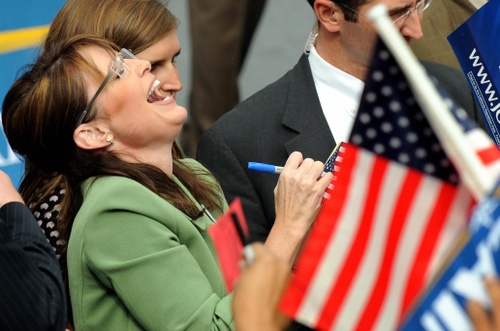
Since 1980, presidential campaigns have on average produced a 15-point gender gap. That is, the difference between Democrats’ advantage among women and Republicans’ advantage among men is generally 15 points. So, for example, Democrats win women by 8 points and Republicans win men by 7 points: 8+7=15. …

Now, using 15-17 points as the baseline gender gap, we looked at eight marquee Senate races between 2006 and 2012 in which Republican nominated a female candidate. According to exit polls and the last available pre-election polls (where exit polls were not available), the average gender gap for women in these eight races was … wait for it … about 15 points (14.5, to be exact).
John Sides isn’t so sure:

At least one piece of academic research offers a somewhat different conclusion. In a 2005 article entitled “Women for Women?,” political scientist Craig Brians examined voter behavior across 300 different House races from 1990-2002 in which female and male candidates squared off.

Brians found a modest tendency for female voters to support female candidates more than male candidates: 55 percent of women voted for the female candidate while 45 percent vote for the male candidate. Men’s votes were split 50-50.

Meanwhile, Marcotte notes the considerable challenges that female candidates of all parties candidates face:

After performing 45 interviews with experienced candidates and officeholders and holding multiple focus groups with other politicians and staff members, the [Institute for Women’s Policy Research] found that women had smaller networks than men to access for funding, faced sexist nonsense while campaigning, and had far less support on the homefront than male candidates, who can often depend on a wife who devotes herself to his career full time.

One thing the researchers did not find is that women lack ambition. “Ambition is not an issue or a deficit with these women,” Denise L. Baer and Heidi Hartmann, the study’s authors, write. “Most women self-recruited for their first office or campaign, and only one in four say others recruited them for their first office.”

Previous Dish on Project GROW, the GOP’s attempt to recruit more female candidates, here.

Why Does Academic Theology Skew Liberal?

Michael Peppard grapples with the question, offering this answer – “under the current conditions, few conservatives want to become professors”:

[A]cademic theology shares a similar model for research as the rest of the university: one must consistently produce new knowledge about the world; the process of double-blind peer review is the gold standard; notions of scientific repeatability in analysis are also applied to the “data” of theology and religion. Theology as done in the university is usually investigative, exploratory, and boundary-pushing. …

Which conservatives, then, are likely to find a calling to the academy, as it is currently organized? I would say those who are substantively conservative (e.g., have conservative topics of inquiry, scholarly conclusions, or policy prescriptions for society) can in most cases find a successful and happy spot in the academy, as Matthew Woessner’s research has found. But that substantive conservatism will probably need to be combined with a liberal temperament that continually seeks newness and a research procedure that challenges at least some authoritative traditions in ways that secular peers recognize.

Dreher nods, wondering if this explains the ideological tilt of his own profession, journalism:

I think that succeeding in journalism requires a high degree of questioning authorities and institutions, and that liberals are in general more predisposed to do that. The problem with this is that newsroom liberals are in general highly disinclined to question their own assumptions.

Should Dinner Reservations Be For Sale?

Julia Moskin mulls it over:

Who owns a restaurant reservation? Is it the restaurant, having set aside a table as a courtesy for a particular guest? Is it the guest, who made the reservation and can use it – or not – at will? Or is it the entrepreneur who pays workers to frantically redial reservation lines at the moment when prime tables are made available, snagging them under false names and marking them up for sale?

This is the crux of the restaurant industry’s current debate over selling reservations for cash, a smoldering issue being reignited by mobile apps that do just that.

Tyler Cowen defends the practice:

When restaurants don’t charge for reservations, they tend to hold back tables for regular customers, celebrities, very attractive people and the politically and socially well connected. You might be dying to go to that restaurant for a special birthday or anniversary, but you’ll simply be unable to get in. Money is ultimately a more egalitarian force than privilege, as everyone’s greenbacks are worth the same.

But Marina O’Loughlin is skeptical of its value:

The sell is the promised democratization of a notoriously exclusive system: I have experienced it first-hand, calling and being rejected under an alias, and then getting a warm welcome and prime-time table when I phone back with the name of a well-known pal. … But paying before you even glance at the menu simply provides yet another barrier to entry.

Meanwhile, restauranteur Alex Stupak thinks the issue is a no-brainer:

From my perspective the price that comes with booking the table is simply to discourage a no show. If anyone understands anything about the economics of restaurants they would know that a few tables are the difference between profit and deficit. …

Selling tickets to dinner, as some restaurants have done, and pricing based on time and other factors, are brilliant ideas, and certainly precedented in other industries. If you show up five minutes late for a flight, that plane is gone. People do show up 45 minutes late to reservations and look at us as inhospitable if the table is no longer available. Paying in advance could minimize, if not eliminate, this phenomenon. The trick for restaurateurs, is to become a brand so desirable and unique that people are willing to go down these roads to get in.

Our Dirty Dependence

Energy Use

Plumer recognizes that we’re losing the battle against climate change based on our addiction to fossil fuels:

As the world grows, it keeps using more and more energy. And fossil fuels still supply the vast majority of that energy. Oil remains the dominant source of fuel for our cars, trucks, and airplanes. And coal and natural gas are the leading sources of electricity. All told, fossil fuels made up 87 percent of the world’s energy consumption in 2013.

That ratio hasn’t changed since 1999, as the University of Colorado’s Roger Pielke Jr. points out. And Alexis Madrigal takes note that coal reached the largest share of the global energy market since 1970 last year:

Coal consumption was up 3 percent. That’s actually a decline from its 10-year average of growing 3.9 percent per year. … Even in the wealthier OECD countries, “consumption increased by 1.4 percent, with increases in the US and Japan offsetting declines in the EU.”

Do Critics Really Matter?

Donna Tartt’s novel The Goldfinch has sold over a million copies and won a Pulitzer, but it’s failed to win over many high-minded critics. (James Wood, for example: “I think that the rapture with which this novel has been received is further proof of the infantilization of our literary culture: a world in which adults go around reading Harry Potter.”) Evgenia Peretz considers the chasm between grimacing critics and the readers who made the book a bestseller:

[W]e might ask the snobs, What’s the big deal? Can’t we all just agree that it’s great she spent all this time writing a big enjoyable book and move on? No, we cannot, say the stalwarts. Francine Prose, who took on the high-school canon—Maya Angelou, Harper Lee, Ray Bradbury—in a controversial Harper’s essay, “I Know Why the Caged Bird Cannot Read,” argued that holding up weak books as examples of excellence promotes mediocrity and turns young readers off forever. With The Goldfinch she felt duty-bound in the same way. “Everyone was saying this is such a great book and the language was so amazing. I felt I had to make quite a case against it,” she says. It gave her some satisfaction, she reports, that after her Goldfinch review came out she received one e-mail telling her that the book was a masterpiece and she had missed the point, and about 200 from readers thanking her for telling them that they were not alone.

Similarly, [Paris Review editor Loris] Stein, who struggles to keep strong literary voices alive and robust, sees a book like The Goldfinch standing in the way.

“What worries me is that people who read only one or two books a year will plunk down their money for The Goldfinch, and read it, and tell themselves they like it, but deep down will be profoundly bored, because they aren’t children, and will quietly give up on the whole enterprise when, in fact, fiction—realistic fiction, old or new—is as alive and gripping as it’s ever been.”

Jason Diamond expands on Stein’s remarks:

While I ultimately agree with Stein on that point, I wonder about the people buying one or two books a year. Should the books they read next hinge on whether or not the purchase helps to prop up a power dynamic that places “literary lions” in a binary opposition against the rest of the book-buying world? Are things that dire? Does it really take one bad experience to turn them off to fiction forever? And shouldn’t it give us hope that people who are only buying one book a year might be picking up Donna Tartt instead of, say, Dan Brown?

I get that some critics don’t love The Goldfinch. Yet the fact that this one book’s popularity among readers can cause so much controversy exposes not just how little the public pays attention to what we perceive to be “highbrow” literary criticism, but also that American literature is in a really awkward place in which the reputation of a popular, Pulitzer-winning novel is at stake simply because a few critics at a handful of highbrow publications didn’t like it. If this conversation represents where we’re at, what we read, what we like, and who should help guide us toward new titles, then something is seriously amiss.

The Strategic Dumbness Of Vladimir Putin

Although it was his for the taking a year ago, Alexander Motyl believes Vladimir Putin’s ham-fisted approach to Ukraine has cost him a satellite state. I’ve been wondering who would be the first to take a few steps back and look at the costs and benefits of Putin’s treating Ukraine with such contempt and crudeness. “If you treat a bona fide country with a bona fide people with a bona fide identity as your dirty backyard,” he writes, “don’t be surprised if you slip in the mud and fall on your face.” He makes a good case:

Putin’s first major slip was during the 2004 Orange Revolution, when, stupidly, he backed Viktor Yanukovych. That disaster taught Putin nothing, and, nine years later, he made the same mistake during the Euro Revolution. How could a supposedly smart leader GERMANY-CARNIVAL-ROSE-MONDAY-STREET-PARADEback the same loser—not once, but twice? How could that same supposedly smart leader still insist that the loser remains Ukraine’s legitimate president—even after a fair and free election gave a huge mandate to Petro Poroshenko? The sad thing is that, after 15 years in power, Putin still doesn’t “get” Ukraine.

Putin’s most egregious blunder was to coerce Yanukovych into rejecting the Association Agreement with the European Union last fall. That strategic error led to the demonstrations in Kyiv, Yanukovych’s downfall, the emergence of a pro-Western, democratic Ukraine, and Russia’s transformation into a rogue state and sponsor of terrorism. That’s bad enough. Worse, Putin’s move was premised on his belief that the agreement would remove Ukraine from Russia’s sphere of influence. Sure, it would have provided Ukraine with a foothold in Europe, and, yes, it would have diminished Ukraine’s international isolation in the long run, but a Yanukovych-misruled Ukraine would have remained firmly ensconced in Russia’s backyard for a long time to come.

(Photo: Patrik Stollarz/AFP/Getty Images)

How Not To Help Women In The Workplace

The evidence on executive quotas is mixed, at best:

The most comprehensive study to date, led by Marianne Bertrand of the University of Chicago, shows that at least in the short term, they’ve had little effect beyond the obvious: placing more women on boards. In Norway, the quotas have not led to an increase in the overall number of female executives, to a decrease in the gender pay gap, to a boom in the number of young women pursuing careers in business, or to more family-friendly workplace policies.

Increasing the number of women on boards can have multiple benefits. Several studies have shown that diversity on boards improves decision-making and profits, yet women are often not considered for boards simply because they are not part of the old boys’ club. But the quotas’ limited effects show that just getting some women at the top doesn’t remove all the obstacles blocking other women from the upper echelons.

Recent Dish on female executives here.

Will Amazon Set The Mobile Market On Fire?

Christopher Mims thinks not:

The central problems with the Fire, the factors that will kill its sales as surely as they have held Windows Phone to single digit market share in North America, are these:

1. People are loath to switch from the phones they already have, and in the process abandon all the apps and media they’ve bought.

2. The North American market for smartphones–and especially the market for high-end smartphones like the Fire – is heavily saturated, which means there are hardly any new users out there who might adopt the Fire as their first phone.

3. Fire can’t access the existing pool of Android apps. It’s missing critical ones like Uber (Bezos says it’s coming) and Snapchat (no word on when it will appear).

Yglesias worries that the new Fire Phone is too high-end for its own good:

Jeff Bezos’ company has a unique opportunity to come into the smartphone space with a strategy that’s not symmetrical to what other people are doing. Amazon’s phone is first and foremost a physical extension of Amazon-the-store. That argues for a strategy built around a cheap, zero-margin phone that aims to undercut the existing market leaders.

Instead, Amazon seems to be trying to beat the market leaders by adding a bunch of snazzy 3D features to what we’ve come to expect from a high-end smartphone. They’ve even gone out of their way to slightly exceed iPhone 5S specs as far as I can tell. The only price edge Amazon is offering is one year’s worth of Prime membership for free. But this, too, seems backwards. Rather than making Prime a benefit of phone ownership, why not make a cheap phone a benefit of Prime membership?

Manjoo concurs:

For Amazon, a company whose previous devices have had innovative pricing plans that often involved selling devices at cost, the Fire phone’s uninspired price tag is a surprising disappointment. The world needed a great, cheap smartphone.

But Vauhini Vara is tickled by some of the high-end features:

[I]t can do a bunch of charming tricks that are, in fact, like something out of a futuristic “Dick Tracy.” It can change the perspective in games in response to your head movements, make images appear almost as if they were in 3-D (though it isn’t actually 3-D, as some had predicted it would be), and scroll through the content on a Web page – say, a newspaper article – when you tilt it. … People seem to be finding its phone’s newfangled features pretty cool – cool enough, maybe, to get them to switch over from the iPhones and Samsung Galaxies that, after all, haven’t offered much in the way of new whiz-bang gadgetry over the past couple of years.

And Timothy B. Lee believes Amazon made one shrewd move:

The Fire Phone includes an app called Firefly that helps users identify things they point their cameras at, from books to paintings. For some items, Firefly will present useful information, like the Wikipedia page for a famous painting. If it’s an item Amazon sells, Firefly will let you click to buy it.

This should terrify brick and mortar retailers. They have long worried about “showrooming,” the practice where customers will find a product in a physical store (like Best Buy or Home Depot) but then order it from Amazon where the price is lower. Showrooming isn’t new – journalists have been writing trend pieces about it for years. But Firefly promises to make the process effortless.

The Battle Over Iraq’s Oil, Ctd

David Unger checks up on the battle over the Baiji oil refinery, Iraq’s largest:

An Iraqi government spokesman told Reuters midday Thursday that the refinery was in their “complete control,” but other reports cite witnesses and refinery employees as saying Sunni rebels remain in command. The jihadists, led by the Islamic State of Iraq and the Levant (ISIS), likely aim long term to use revenue from fuel sales to finance terror operations across the region.

The Baiji refinery supplies motor fuel for northern Iraq and can process around 310,000 barrels a day, fed by oil fields in the autonomous Kurdistan region. It also fuels a nearby power plant that provides electricity for Baghdad, which already suffers from outages. … The flow of oil to the refinery is already off-line, according to Thamir Uqaili, an oil and gas consultant who worked in Iraq for the Iraq National Oil Co. and Iraq’s Ministry of Oil for over 40 years. If it remains damaged or off-line, it will create a shortage of products that cannot be replaced quickly, Mr. Uqaili writes via e-mail.

Frank Verrastro and Sarah Ladislaw look at what the Iraq crisis, in combination with other world events, means for world oil markets:

At present, the combination of the loss of Libyan, Nigerian, Venezuelan and Iranian oil production for various reasons, the uncertainty surrounding Russia’s gambit in Ukraine and the prospects for further reductions (seasonal maintenance, hurricanes, etc.) as we enter the second half of the year point to potentially tighter markets and higher prices (EIA’s Short term energy outlook for  June identified some 2.6 mmb/d of unplanned supply disruptions from OPEC sources and an additional 720 mmb/d of non-OPEC volumes).

Further, since Iraq was expected to contribute a large portion of near term incremental OPEC increases, sustained or enhanced violence would undoubtedly limit investment and volumes going forward.   And while Saudi Arabia still maintains over a million barrels per day of spare capacity and could offset some of the loss of larger Iraqi volumes, a complete loss of Iraqi exports would require more drastic measures – like the release of strategic stocks – in order to prevent prices from spiking.

From Steve LeVine’s viewpoint, it means a return to Saudi oil:

Until a couple of years ago, some Saudis spoke of adding yet another 2.5 million barrels a day of capacity, giving them 15 million in all. But if there ever were such plans officially, they have been shelved since the recent US shale revolution added millions of barrels a day to US production. In April, the US produced 11.2 million barrels (paywall) of oil and gas liquids a day, the most since 1970. It has been said that, four decades after the Arab oil embargoes, the US will soon become an oil exporter and no longer beholden to the Persian Gulf, and specifically Riyadh.

But a series of geopolitical disruptions including in Libya and Nigeria have canceled out those gains. And after the upheaval in Iraq analysts now believe that such disruptions will remain a factor for many years. If that is the case, Saudi Arabia’s oil will again be central to the global economy. Specifically, the world may need Riyadh to invest the billions necessary to increase its production capacity to 15 million barrels a day.

James West notes that the US is much less dependent on Iraqi oil than it was a decade ago:

But the U.S. is still tied to global oil markets, and that means what happens in Iraq can have an economic impact here. One thing every expert I spoke to agreed on is this: Even with decreasing oil imports, the U.S. is inextricably linked to world markets. That means that if the situation in Iraq continues to deteriorate, the U.S. economy may not be immune.

“The cost to the United States of a big oil shock … will be lower than they were [in the past],” [John] Duffield said. “Our main vulnerability is not so much the direct impact on oil, but the impact on the rest of the world’s economy, if there’s a big oil supply disruption.” He added that “as long as the world oil market is pretty highly integrated, the U.S. is vulnerable to an oil supply disruption in the Middle East or the Persian Gulf, regardless of the amount of oil it imports from the region.”