On what other subject is the public so grotesquely misinformed? And what does it say about the acumen of the Human Rights Campaign that its Number One legislative priority for the last 25 years (with 76 percent national support!) remains as out of sight as ever? Just keep sending them your checks, guys. In another quarter century, you might get something back for them.
I try not to, because it can come off as belittling a woman in politics, but maybe I shouldn’t care. Beinart grants absolution:
When was the last time you heard Nancy Pelosi, Sarah Palin, or Dianne Feinstein referred to primarily by her first name? When a man shares a last name with another famous pol, by contrast, he often gets the first name treatment. A certain ex-Florida governor is constantly referred to merely as “Jeb.” With his brother George W. Bush—who shared first and last names with his president-father—the press often accentuated his middle initial, as in “George W.,” “W” or even “Dubya.”
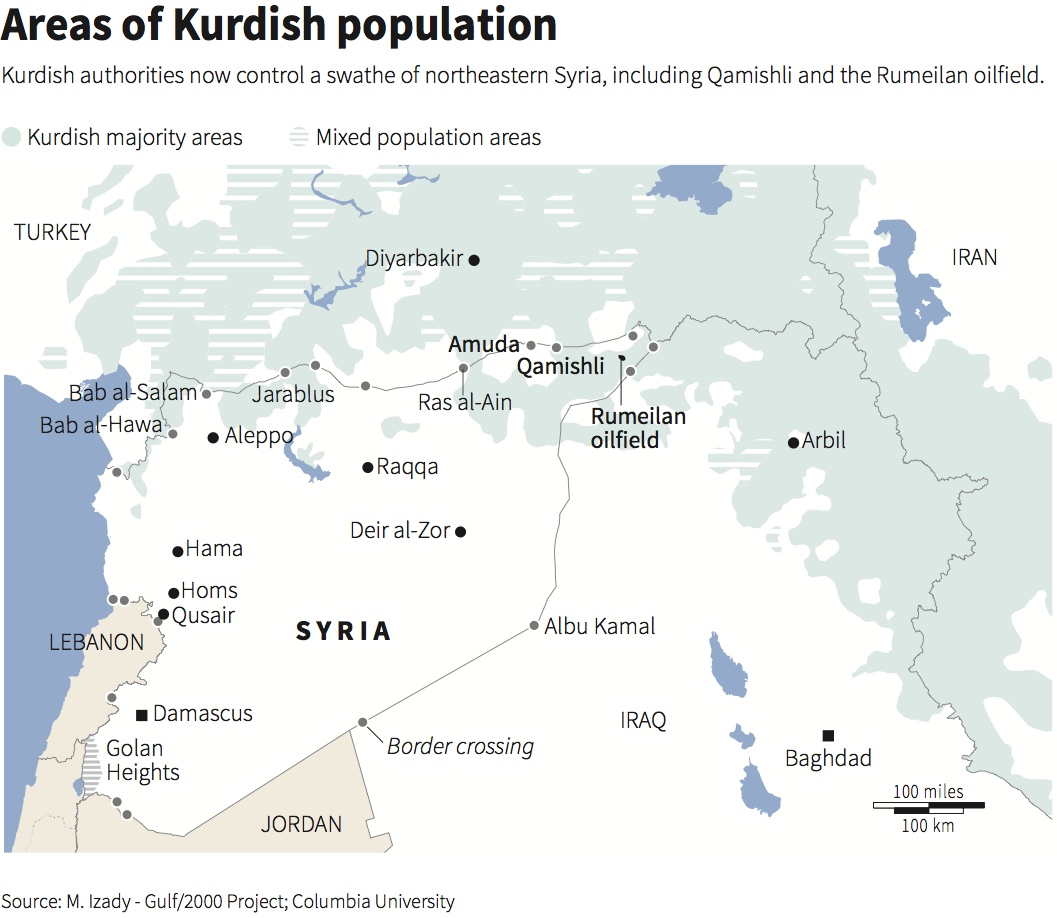
Iraqi Kurdish leaders are reportedly hinting that they’re on board with partitioning Iraq. That’s not surprising, as they’d get their own state out of such an arrangement:
Kurdistan Democratic Party figure Abdul Salam Berwari said in a phone interview with Al-Hayat, “The Kurdish political leadership sees since the 1990s that the only solution for the survival of a unified Iraq is to transform the structure of the state to reflect the population distribution of Iraqis. The basic components are the Sunnis, Shiites and Kurds, and the experience of the last 10 years supports what has always believed. … There is no solution except by establishing three regions for Iraq’s main components.” …
Pointing to the worsening differences between Erbil and Baghdad, Nechirvan [Barzani, prime minister of the Kurdistan Regional Government] told the BBC that Iraq can never return to the period before ISIS’s expansion and called on “Maliki to step down from office after the completion of the current phase,” [saying] “an independent Sunni region” is the “best solution to rule the country.”
Reporting on the Kurdish fight against ISIS in the north, Jaime Dettmer relays the peshmerga’s scorn for Maliki and his soldiers who abandoned their posts to the Jihadist advance:
Convoys of trucks carrying peshmerga, who flash thumbs-up signs when locals wave, have been scurrying along the highways of Iraqi Kurdistan strengthening positions in readiness to block jihadists and their Sunni militant allies from gaining any territory. But stopping jihadist infiltration will be no easy feat and the Kurds are relying on sympathizers among the Sunni tribes around Mosul and to the south of Kirkuk to alert them to ISIS movements.
The Kurds have no faith in the Iraqi military rallying and the confident note struck on Wednesday by beleaguered Iraqi Prime Minister Nouri al-Maliki only prompted peshmerga derision. In a televised address announcing that a fight-back had begun, he promised government forces would retake Mosul. But the Kurds don’t see al-Maliki as the man who can save Iraq: they blame his exclusionary Shiite politics for the disaster that has befallen the country. Like the Americans they want al-Maliki’s Shiite-dominated government to be replaced by one able to reach out to Sunni Muslims and start a process of reconciliation to undercut the jihadist exploitation of Sunni resentment.
Meanwhile, Marsha Cohen explores Israel’s longstanding, complicated relationship with the Kurds:
For decades, Israel has been a silent stakeholder in northern Iraq, training and arming its restive Kurds. Massimiliano Fiore, a fellow at the Department of War Studies at King’s College London, cites a CIA document found in the US Embassy in Tehran and subsequently published, which reportedly attested that the Kurds aided Israel’s military in the June 1967 (Six Day) War by launching a major offensive against the Iraqi Army. This kept Iraq from joining the other Arab armies in Israel, in return for which, “after the war, massive quantities of Soviet equipment captured from the Egyptians and Syrians were transferred to the Kurds.”
So what stake does Israel have in Kurdish fortunes today?
Less than a year ago, Lazar Berman of the Times of Israel, under the optimistic headline, “Is a Free Kurdistan, and a New Israeli Ally, Upon Us?” quoted Kurdish journalist Ayub Nuri who argued that Kurds were “deeply sympathetic to Israel and an independent Kurdistan will be beneficial to Israel.” Fast forward a year later to Neriah’s article titled, “The fall of Mosul could become the beginning of Kurdish quest for independence,” where he says nothing about the stakes for Israel. Would an increasingly independent Kurdistan continue to look to Israel as its patron?
Or will Kurdistan fully join an anti-ISIS Iraqi alliance, backed jointly, if discreetly, by Iran, with the approval of the US? Any scenario in which Iran is part of the solution, rather than the underlying problem, is a nightmare for Israel.
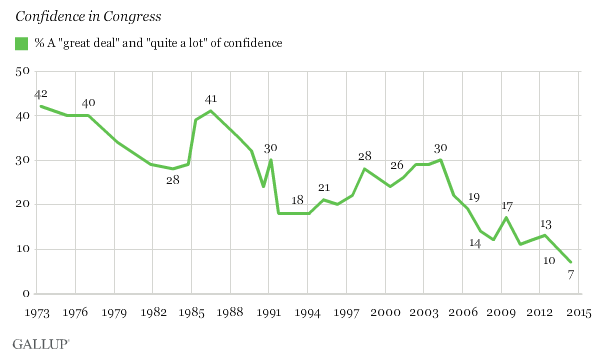
As the public’s view of Congress sinks to a near-incredible low in Gallup’s polling – not only the lowest on record, but also the lowest Gallup has recorded for any institution in the 41-year trend – House Republicans are staying the course. They just elected California Congressman Kevin McCarthy as the new majority leader yesterday, and Louisiana Congressman Steve Scalise to fill McCarthy’s former seat as whip. Ezra Klein doubts McCarthy will be much different from Eric Cantor:
They both want to cut taxes. They both voted for the Ryan budget. They both want to repeal Obamacare. And, for all the talk of Cantor’s defeat being about immigration reform, McCarthy has basically the same position on immigration reform: he’s abstractly for immigration reform, but he’s not going to bring any solution to the problem up for a vote. Which is probably as it should be. When the conservative columnist Ramesh Ponnuru dove deep into polls of tea party supporters, he was comforted by what he found. “Tea party advocates already believed the same things that regular Republicans did. They basically were regular Republicans, just, if you will, more so. The differences between the tea party and ‘establishment Republicans’ have largely concerned style and attitude rather than program and ideology.”
But Al Hunt expects immigration to be just as much a thorn in McCarthy’s side as it was for his predecessor:
McCarthy, who earlier served in the California Assembly, knows how the immigration issue has destroyed the Republican party in his home state ever since then-Governor Pete Wilson went on an anti-immigration campaign two decades ago. At every level of government in California, Democrats dominate consistently, running up big margins with the fast-growing Latino and Asian-American constituencies. But McCarthy also will lead a party in the House that has a strong nativist bloc, and may resist taking up a serious immigration effort in this Congress and perhaps the next one too.
More than a few political experts, including Boehner, believe this would be devastating for the party in national elections. McCarthy shares that view, but sensitive to his own party conference — he’ll have to be reelected to a leadership post after the November elections — he’ll be very cautious on the issue.
So does Dara Lind, who observes that McCarthy’s position on the issue is deeply unpopular:
In January, before House Republican leadership released its principles for immigration reform, McCarthy told local television station KBAK/KBFX: “In my personal belief, I think it’ll go with legal status that will allow you to work and pay taxes.” But extremely few people actually support “legal status” that doesn’t result in citizenship for the undocumented. Most Americans want unauthorized immigrants to become citizens, either immediately or eventually; most of the rest want them deported. … There’s no real middle ground.
Weigel calls both McCarthy and Scalise “safe as milk” come November, which he suspects was part of their appeal:
If you’re looking for a “conservative victory” here, look to Scalise. The fast-talking Southerner bested Rep. Peter Roskam, a deputy whip who’d been groomed for big things, and Rep. Marlin Stutzman, a sort-of Tea Party candidate who nonetheless gets farm subsidies back home in Indiana. He becomes, as some reporters quickly pointed out, the first Republican from a “red” state to take a leadership job since Barack Obama won the presidency.
But “red state” is a sort of useless term when you’re talking about congressmen. The victories of McCarthy and Scalise are good news for Republicans who want to avoid future Cantordammerung-style upsets. Why? Simple: There are three states where party primaries have been replaced by jungle primaries, followed by runoffs between the top two finishers. After John Boehner, the rest of the GOP’s leadership hails from these states.
Jonathan Bernstein cautions against reading too much into these choices:
House leadership is quite important. But it is also severely constrained by the conference’s stance on issues of public policy. On the margins, or perhaps a bit more, leadership has some ability to choose the bills it will schedule and those it will bury, and perhaps one leadership team is more able than another to get over the finish line to 218 votes. But it’s not as if the conference will automatically fall in line with whatever leadership wants. Leaders who misjudge what individual members want is the perfect recipe for coups.
So today’s elections are meaningful. Just don’t be too sure you know exactly what they mean.
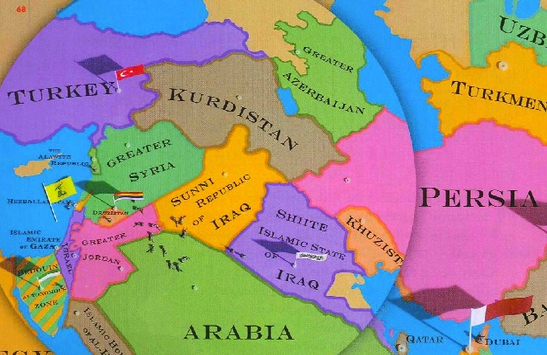
Jeffrey Goldberg – now back full time (yay!) at the Atlantic – rightly claims some prescience. In 2007, he sketched a slightly fanciful map of the future of the region and it looked like this:
His bottom line:
One of the reasons I don’t find myself overly exercised by the apparent collapse of Iraq (and one of the reasons I don’t think it would be wise for the U.S. to rush into Iraq in order to “fix” it) is that I’ve believed for a while that no glue could possibly hold the place together.
The case for Kurdistan is pretty powerful, I’d say, and there are some hints that the Turks may not be quite so hostile. British Tory Daniel Hannan wonders whether partition is such a bad idea after all:
How much disorder, horror, fear and mutiny might have been avoided had Iraq been divided along ethnographic lines in 2003 – or, better yet, in 1920. (If you don’t like the word “ethnographic”, substitute “democratic”: it amounts to the same thing.)
Any mention of partition sends some pundits scurrying to their keyboards. What about Yugoslavia, they say, or Ireland, or India, eh eh? Well, I wonder whether, in each of those cases, an agreed separation beforehand might have left us with something very like today’s borders without the intervening war. We’ll never know, obviously, but it’s worth noting that several partitions happened amicably enough, from Czechoslovakia to the West Indies Federation. More to the point, look at the consequences of non-partition. The civil wars have driven 2.1 million Iraqis and 1.4 million Syrians into exile. How much worse do things have to get before we consider an alternative?
Mordechai Kedar posits that Iraqis’ loyalties are not to “Iraq” anyway:
“The tribe always succeeds against the state,” Kedar emphasized. If one doubts this, one need not look further than the number of Iraqi soldiers that deserted Mosul. If they felt loyal to a country called Iraq, they would have staid and fought against Al Qaeda. However, their loyalties were to their tribes and clans. Why die fighting for something that they don’t believe in? “People are loyal to the tribe rather than to the state,” Kedar noted.
Aside from the tribal issues in Iraq, Kedar explained that the country is also full of religious tension, as Iraq is the home to 10 different religions. Among them are Muslims, Christians, Zoroastrians, Alawis, Druze, Bahais, etc. Kedar emphasized, “As we speak, Christians are getting killed and persecuted. Only a third of the Christians that existed in Sadamn Hussein’s Iraq are still in the country.” These tensions don’t even include the Shia-Sunni divide, which has been going on since the advent of Islam even though the Caliphate no longer exists, rendering the question of who his rightful successor should be to be almost irrelevant.
But Mansoor Moaddel collects survey data from the past decade that complicates the narrative that Iraq is hopelessly incoherent:
The Sunnis and Shia converge in defining selves as Iraqi, rather than Muslim or Arab, above all. This support rose from 22% in 2004 to 80% in 2008, and then dropped to 60% among the Sunnis. Among the Shia, it was 28% in 2004, increased to 72% in 2007, and then dropped to 62% in 2013. There is not much support for Iraqi identity among the Kurds. Among the Kurds, on the other hand, there has been a shift from predominantly Kurdish identity to religion.
Reinforcing attachment to the nation rather than to the religion of Islam in politics is the fact that both the Sunnis and Shia (1) prefer politicians who are committed to the national interests over politicians who have strong religious convictions by at least a factor of 4 to 1, and (2) consider a good government one that makes laws according to the wishes of the people over the one that implements only the sharia by at least a factor of 3 to 1.
And Jocelyne Cesari has faith in reconciliation, provided anyone is willing to try and make it happen:
In sum, the main reason for the rise of ISIS is the growing disillusion of the Iraqi Sunnis with the government of Al Malki who has marginalized Sunni in different areas of politics and public life. In other words, the main issue that fuels the influence of ISIS is not religion, even if the war is couched in religious terms, but the unbalance in the distribution of power between Shia and Sunni. Although ISIS aims to establish a Caliphate across Iraq, Syria and beyond, it is not the main goal of the Sunni population of Iraq. In fact the political violence of Sunnis in Iraq is governed primarily by tactical and strategic choices rather than by religious motivations. No doubt that communal antagonism plays a significant role but is the outcome, not the cause, of the discriminatory political mechanisms in Iraq.
Successful conflict regulation requires the recognition and accommodation of the core cause ‐ in this case effective power sharing ‐ rather than a containment of the violent symptoms of the conflict. In this case, defeating ISIS is certainly necessary but not sufficient. It is imperative for the Iraqi rulers to create the conditions for a national reconciliation between Sunni, Shia and Kurds and devise a constitutional compromise which offers each community sufficient protection which eliminates the resort to violence. It is probably easier said than done, especially in the current regional environment and the transnational ideology of ISIS. But its is where the international community, including the US, could positively influence Iraqi protagonists: all of them.
Meanwhile, Andrew Lee Butters cautions that the states that would emerge from partition might not be viable:
It’s not just the mass executions that are going to leave a bad taste. In the chain-smoking Arab world, the days are numbered for a regime whose interpretation of Islamic law is so severe that it bans cigarettes. And an ISIL regime in northern Iraq can’t exactly put oil on the international market, or get Baiji‘s barely functioning gasoline refineries and pipelines up and running at full speed. The billions of dollars in U.S.-donated war material that ISIL is now capturing from the Iraqi army can’t really be put to effective use without substantial maintenance, training and support capability that ISIL lacks.
Substantial checks also remain on the nationalist impulses of both Kurds in the north and Shias in the South. The southern city of Basra may have a ton of oil and access to the Persian Gulf, but if it broke away from the rest of Iraq with a Shia sectarian agenda, it could find itself dangerously isolated or becoming a battle ground for Iran and Saudi Arabia. The Kurdish leadership in the north has consistently shown more interest in consolidating control and the economic viability of the Kurdish region than in national independence. For all their success at boosting trade and relations with their neighbors — particularly Turkey and Iran, each of which has large Kurdish minorities with national aspirations of their own — the old rules still apply. The Kurdish Regional Government (KRG) has power, and the support of these key neighbors, as long as they are bringing stability to their part of a weak Iraqi state. They make enemies if they declare statehood.
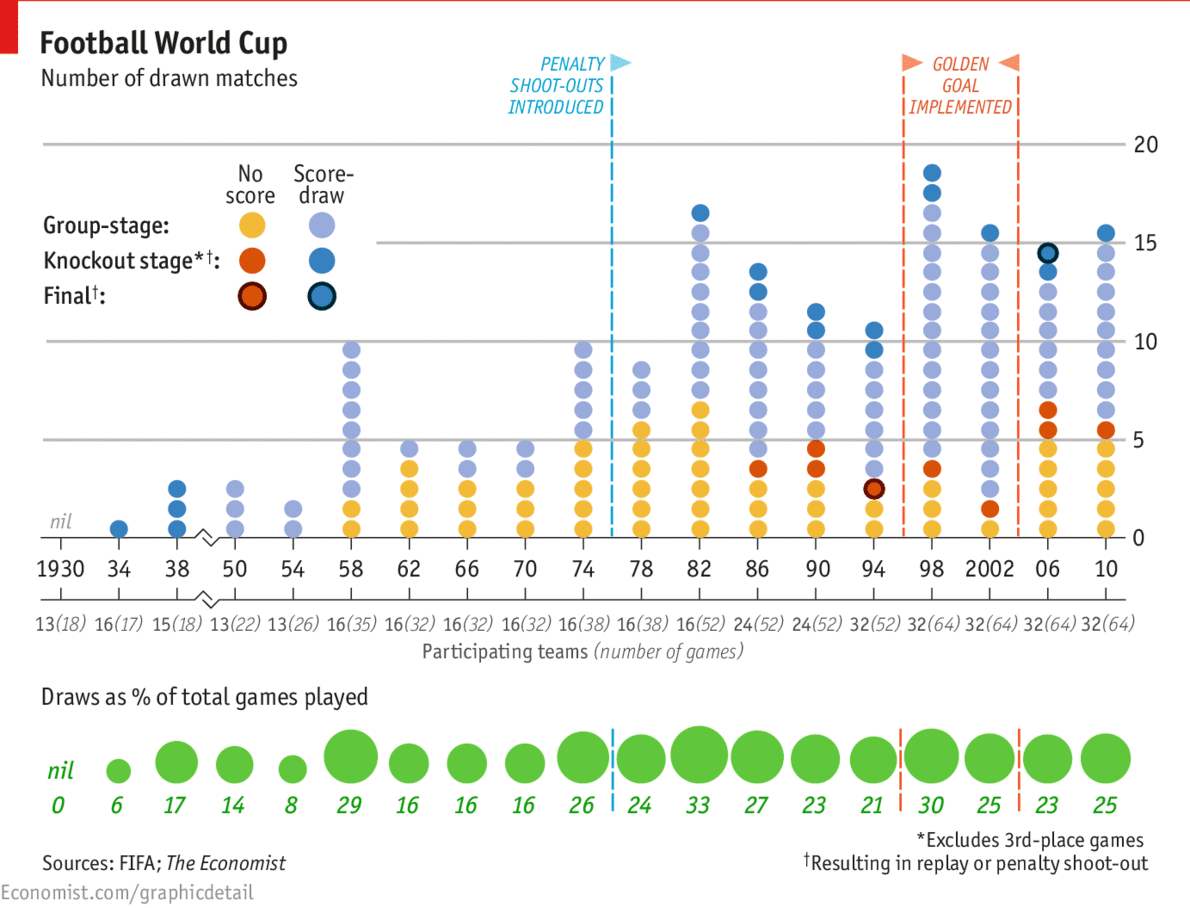
Monday’s 0-0 match between Iran and Nigeria was the first draw of the ongoing World Cup. As the above chart from The Economistillustrates, that’s pretty unusual:
The match was conspicuous in an otherwise high-scoring tournament, which so far has seen 44 goals, or 3.14 per match. It is proving to be one of the most exciting World Cups of recent times, including shock results such as the Netherlands’ 5-1 win over Spain, the reigning champions. Such excitement bucks the modern trend. Until this year, the tournament had been losing its kick. … Prior to this tournament, more matches have resulted in stalemate, often scoreless, in the last six tournaments than the previous 13 combined. Even the 1994 and 2006 cup finals ended in a draw (the former without a single goal) and had to be decided by penalty shoot-outs.
Elaine Teng notices a recent trend toward higher-scoring matches:
The scoring barrage is no fluke.
Over the past four years, with some exceptions (including a big one named Jose Mourinho), elite football has become more offensive-minded as a whole. In Europe’s top leagues, where over half of the World Cup players ply their trade, the average number of goals per match has been consistently on the rise. According to The Telegraph, the Premier League averaged 2.58 goals per game between 2006 and 2010. Since then, that number has jumped to 2.79, and the trend holds true in Spain, Germany, and Italy. Possession-based football—most famously Spain’s tiki-taka—is looking vulnerable, as the counterattacking style has reasserted itself. Many teams are now happy to let the other team have the ball, then exploit space and hit their opponents on the back foot when chances come.
I’ve always been a fan of the scoreless draw—the good kind, of course, not the Nigeria-Iran kind. This stems, in part, from being raised in the United States in the 1980s, the dark ages for footballing culture in the U.S., when one was consistently subjected to the mainstream notion that soccer was both foreign and boring. The possibility of a 0-0 final score was exhibit A for that ignorant thesis. A fan knows that this is ridiculous, of course. A fan knows that the score tells only part of the story, that a nil-nil, un empate a ceros, can have all the drama and entertainment of a 3-2 or a penalty shootout.
Watching soccer is about expectation, it’s about anxiety. Something is always happening, and unlike other sports, the scoreline is not necessarily an accurate barometer of the quality of the match, nor does the superior team always score more goals. Sometimes, no one scores, and it can be amazing. To put it another way, there are nil-nils, and then there are nil-nils.
But such low scoring is among the chief reasons David Post doubts the US will ever love soccer the way other countries do:
[S]occer has wa-a-a-y too much failure in it, and, generally speaking, Americans don’t like failure, and don’t like to dwell upon it. Soccer is all about failure — about failure and the ability (and will) to overcome it. Over and over and over again they charge down the field, knowing full well that the chances that they get the ball into the net on the attack are awfully slim; think about that the next time you watch some left back running full tilt in the 88th minute of a 0-0 game to try to get himself in position to receive the ball on the counter-attack; he knows damned well that the whole enterprise is almost surely for naught, yet on he goes (at least, if he’s good, and “determined,” and “committed” – words you hear a lot at a soccer game). Succeed a couple or three times in 90 minutes (plus extra time!) of hard work and your team’s a juggernaut. Soccer fans do more cheering for the “good effort”, the fabulously-constructed set of passes that sets up a chance that doesn’t result in anything on the scoresheet, than fans in any other sport.
Matt Steinglass identifies a big problem with the way the US conducts foreign policy, particularly in the Middle East. Namely, we always seem to be looking for an ethically sound position that often doesn’t exist:
Over and over in the wars America conducts we attempt to create political entities that meet our ideological criteria, but have no natural constituency in the countries themselves. Maliki, Karzai, Diem: we become infuriated at the leaders we install when they fail to carry out our vision of progress. We are the world’s biggest Hegelians, analysing every conflict as a clash between two opposing principles that need to be resolved, and then trying to create that synthesis.
We have the same longing in domestic politics, for that matter. If only some great moderate could bridge the gap between the two parties, and bring us all together towards the reasonable consensus! We cannot seem to understand that if there were a constituency for that middle position, someone would be occupying that space; if there is no one in that space, it is because the middle position has no constituency. We keep trying to create a third force that does not exist. We need to stop it. The forces on the ground are the forces on the ground. If we support one side, we should back that side, and if not, not. If the two sides want peace, we can help them reach peace. If they want to fight, they will.
That’s a bit of a stretch from Hegel, but I take the point. We constantly seem to forget that the supremely smart and moral choices today can become deeply problematic tomorrow. So the CIA’s coup in Iran in 1953 seemed like a good idea at the time – until you realize the astonishing cost over the long run. Funding the mujahideen in Afghanistan as a gambit against the Soviets also seemed like an inspired way to win the Cold War without risking a global nuclear clash. But there’s a straight line from that decision to September 11, 2001.
What we don’t seem to be able to grasp is that there are realities in the world we cannot change, and some of them are not going to be completely beneficial for the United States or the West. But that doesn’t mean we have to fix them or indeed can fix them. We might try as an alternative to live with them, until they sometimes resolve themselves. It seems to me, for example, as if the West’s interventions in the Middle East – often well-intentioned – have done very little but slow or scramble that region’s natural historical development. Leaving alone, while guarding our own security, may lead to occasional bad results. But constant meddling only guarantees them – in an endless, fruitless and draining cycle.
Along those line, Chase Carter makes the case against continuing to support any Syrian rebels against Bashar al-Assad:
American idealism frequently clouds the judgment of our policy makers. We want to promote democracy everywhere, and we have a seemingly nonnegotiable aversion to dictators. But sometimes there simply isn’t a better alternative—toppling a despotic regime often creates more problems than it solves.
The United States is certainly creating more problems for itself in Syria by working against Assad. Obama said the United States needs to support moderates in Syria because they are fighting terrorists “who find safe haven in the chaos,” but arming the opposition to topple Assad is only prolonging the chaotic power vacuum that allows those terrorists to thrive.
Pointing to Pew’s most recent survey of the Middle East, Bruce Stokes adds that such meddling is not well received, even among those who would like to see Assad go:
[D]espite their fear of extremism spreading and their distaste for Assad, Middle Eastern publics voice no support for aiding those attempting to oust the Assad government. People in the region have seen the results of Western intervention in Iraq. And they may not relish the idea of other Arab states acquiring a taste for interfering in the domestic affairs of their neighbors. There was little support for aid to anti-government forces battling the Damascus regime in 2013, and there is even less backing in 2014.
Roughly three-quarters of Lebanese (78 percent), Tunisians (77 percent), and Turks (73 percent) are against Western nations sending arms and military supplies to the insurgents. (Respondents were not asked to differentiate between rebel groups.) And about two-thirds of Palestinians (68 percent), Egyptians (67 percent), and Jordanians (66 percent) agree.
In a press conference yesterday, Obama announced a limited American response to the Iraq crisis, including the deployment of additional intelligence assets and a team of up to 300 military advisers to help train the country’s security forces:
The troops, drawn from US special operations forces, will assist the Iraqi military to develop and execute a counter-offensive against the Islamic State of Iraq and the Levant (Isis). Their mission is likely to spread to the selection of targets for any future air strikes, but Obama stopped short of accepting a plea from Baghdad to order US air power into the skies over Iraq immediately. Instead, Obama said the option of air strikes would be held in reserve. Any such strikes would be “targeted” and “precise”, Obama said, warning that the fate of the country “hangs in the balance”. …
Obama said the US had “significantly increased” its intelligence, surveillance and reconnaissance in areas of Iraq taken by Isis. However, his decision not to authorise immediate air strikes will disappoint the Iraqi government, which has formally requested that the US provide Iraq with the air power it lacks. The Obama administration has said military involvement by US forces would not involve combat troops, and would be contingent on the Iraqi government making a concerted effort to bridge the sectarian divides threatening the breakup of the country.
It gives the United States the kind of direct contact with Iraqi forces that allows them to judge their strengths and weaknesses, and act as a check on sectarian abuses, as well as help funnel U.S. aid to the units that will use it against ISIL and other extremist forces, rather than encourage sectarian attacks and Civil war. It keeps up the right kind of pressure on Maliki and any successor, and still helps Iraq deal with an all too real threat of extremism. With the right kind of quiet dialogue, it will also assure Jordan, Saudi Arabia, and the UAE that the United States is not giving Maliki a blank check.
What emerges from Obama’s remarks is a portrait of cold-blood realism. He thinks our invasion was reckless. He thinks we gave too many lives and spent too much money. He sees ISIS as a threat to regional stability, our oil supply, and our security from terrorism. He’s willing to use force, but only to the extent necessary to quash that threat. Beyond that, he’ll leave the restoration of Iraq to Iraqis. And if that means replacing Maliki, Obama won’t shed any tears.
He also saw Obama’s speech as a strong rebuke to the neocons:
Obama isn’t going to tolerate [the narrative that he has squandered Bush’s victory]. His view is that the neocons wrecked Iraq and that the latest crisis is just another mess he has to clean up. And he’s increasingly willing to say so, now that polls show strong public opposition to the war.
The trick is to do this without saying Americans died in vain. During the Q&A, Obama said one of his goals is “vindicating the enormous effort and sacrifice that was made by our troops in giving [Iraq] an opportunity to build a stable, inclusive society.” So he accepts some responsibility to protect the war’s gains. But he barely concealed his contempt for the decision to invade. He even implied that Iran ought to learn from our mistake: If the Iranians go into Iraq, he suggested, “they could find themselves fighting in a whole lot of places, and that’s probably not good for the Iranian economy or the Iranian people over the longer term, either.”
But Max Boot worries that Obama is treating the sovereign government of Iraq too much like, well, a sovereign government:
Sending in 300 military personnel to work with the Iraqi Security Forces will enhance American awareness of Iraqi military operations and could potentially help honest officers to resist sectarian orders from Nouri al-Maliki’s henchmen. But there is a danger in embedding U.S. forces only with the Iraqi military when it has become so heavily politicized by Shiite operatives. It is vital that the U.S. not be seen as taking a side in this sectarian conflict and that we not become an enabler of Maliki’s sectarian agenda.
For this reason it is imperative that U.S. personnel work closely not only with the Iraqi military but also with the Kurdish peshmerga and whatever anti-ISIS forces can be cobbled together among the Sunnis–call it the Son of the Sons of Iraq (as the Anbar Awakening militia was known). Moreover, it is imperative that the U.S. not forget about the “S”–Syria”–in ISIS. We need to hit ISIS on both sides of the Syria-Iraq border, which will require doing much more to train and equip the Free Syrian Army and possibly support their operations with air power.
Juan Cole believes that airstrikes, which he expects will be carried out by drones, are a mistake if their end purpose is to prop up Maliki:
To the extent that Obama is likely paving the way to US drone strikes on ISIS in Iraq, he is mysteriously failing to take his own advice. He has already admitted that the Iraq crisis is political and not military, and said that there are no military solutions. The Sunni Iraqis of Mosul, Tikrit and other towns of the west and north of the country have risen up and thrown off the government and the army of Shiite Prime Minister Nouri al-Maliki. The uprising was coordinated with ISIS, but was made up of many groups and to some extent was the spontaneous act of townspeople. Droning some ISIS commanders to death isn’t going to change the situation in Mosul, a city of 2 million that is done out with the Maliki government.
For Obama to associate himself with an attempt to crush this uprising in favor the the highly sectarian ruling Da’wa Party (Shiite ‘Call’ or ‘Mission’), which is allied with Iran is most unwise. If it had to be done, it should have been done as a covert operation and never spoken of publicly.
Daniel Byman also hopes we don’t go ahead with airstrikes:
If the Iraqi Army withers and runs when attacked, limited airstrikes will ultimately do little to push ISIS back. Air power can’t conquer territory by itself. Even in the best circumstances, airstrikes must be sustained to have a strategic effect. And strikes must work in tandem with advances on the ground, so Iraqi forces can move in and occupy any territory from which ISIS withdraws. If strikes are limited in duration, ISIS can simply lie low, camouflaging its forces among the civilian population and avoiding the offensive until the spotlight moves off Iraq, as it inevitably will. If its forces are hit in one area, it can simply reoccupy the territory when the bombing ends. The United States must be prepared to strike often and repeatedly if it is going to play a major role in pushing ISIS back. This could take months even if all goes well.
Davidson thinks that focusing on military tactics is misguided:
[T]he idea that local forces who engaged in intractable battles just need to learn how to fight properly can be a trap. Mass desertion, of the sort that led to the fall of Mosul, is a political question, not a matter of learning how to drill. Training can sometimes mean telling the Army you’re working with not to engage in abuses; the proper verb, then, might be restraining, which some have argued is America’s proper job when it comes to Iraq, and why we ought to have left a residual force there. Under this theory, we should give the Shiite-dominated Maliki government guns, and then stand by them, because if we don’t they will point the guns at the wrong people—at members of the Sunni community. How does a mission like that end?
Judis feels for Obama, noting the thorny position he’s in and that he doesn’t really have any good options:
He is suffering from political cross pressures. On the one hand, there is next to zero public support for any military intervention in Iraq or anywhere else. In an April NBC/Wall Street Journal poll, 47 percent thought the United States should become “less active” in world affairs; only 19 percent thought it should become “more active.” At the same time, when the press reports chaos overseas, and when the President’s opponents in Washington accuse him of being weak for not ending the chaos, public support for the president plummets. In this month’s NBC/Wall Street Journal poll, only 37 percent of the public approved and 57 percent disapproved of the President’s handling of foreign policy. That’s an all time low for Obama.
Charges of weakness from McCain or The Weekly Standard are often reinforced by hyped reporting meant to keep viewers from switching channels. Waiting for Obama to speak today, I heard Christiane Amanpour saying on CNN that ISIL represented a “dire and existential threat” to the United States. Then CNN’s Jake Tapper described ISIL as “approaching closer to Baghdad.” I don’t think either of these statements were true, but I think the reporters were merely trying to create drama around the President’s speech. They weren’t trying to pressure him for action, but statements like these have exactly that effect and probably led to the president advancing measures today that make it look like he is doing something to hold Iraq together, but that are unlikely, on their own, to succeed.
Amanpour has also described ISIS as a branch of al Qaeda. There seem to be few hyperboles she will not advance to promote the cause of American military intervention in the Middle East. Previous Dish on the possibility of US airstrikes here, here, and here. My own take on the CIA’s ambitions is here.
It’s in the blood, you know. Growing up, the year 1966 almost had the same resonance as 1940 in Britain. That was the year we really beat the Germans – in the World Cup, rather than the World War. The event shaped all of us – I was three at the time. And ever since, the fragile possibility of re-living that moment has always haunted the country. It still does:



 The Dish