Sexbots And Sexism

Leah Reich considers how sex robots could alter human relationships – or keep them trapped in the strictures of the past:

Perhaps the best-known work on intimate relationships with robots is by the British author, chessmaster, and CEO of Intelligent Toys Ltd, David Levy. Most of the discussion regarding the ethics of robot sex centers on his article ‘The Ethics of Robot Prostitutes’ from Robot Ethics (2011), wherein he separates types of sexbots according to their sophistication. Levy argues that as long as sexbots are artifacts, without ‘artificial consciousness,’ there are no ethical implications in having sex with them or using them for prostitution. …

But even if sexbots are not currently conscious, they do have the external markings of personhood, and we are programming them to be person-like. Indeed, we are programming them to be like a specific type of person: the type of woman who can be owned by a heterosexual man. If women are the model on which most sexbots are based, we run the risk of recreating essentialized gender roles, especially around sex. And that would be too bad, because sex technology has the potential to alleviate longstanding human problems, for both men and women. Sex tech can help us take on sexual dysfunction and profound loneliness, but if we simply create a new variety of second-class citizen, a sexual creature to be owned, we risk alienating ourselves from each other all over again.

In other high-tech sex news, Victoria Turk investigates “the DIY side of the 3D-printed sex toy revolution”:

The descriptively named ‘Dildo Generator’ lets you tweak a phallic model until it fits your preferences just so, ready to be saved and exported so the 3D file of your fantasy can be forever solidified in silicone. I reached out to Ikaros Kappler, the Berlin-based programmer behind the project, to ask why. Fittingly, the idea came to him while he was hanging out with friends, drinking beer, and listening to techno at a maker space. “It was the aim to print something more useful instead of printing small figurines to put on your windowsill,” he told me over email. He also wanted to explore the new features of HTML5. “Oh, and I love Bézier curves!” he added. Those are the curves you can make by adjusting points at either end on a computer model, always resulting in a nice smooth finish. Pretty important to dildo design, I guess.

Previous Dish on futuristic fornication here.
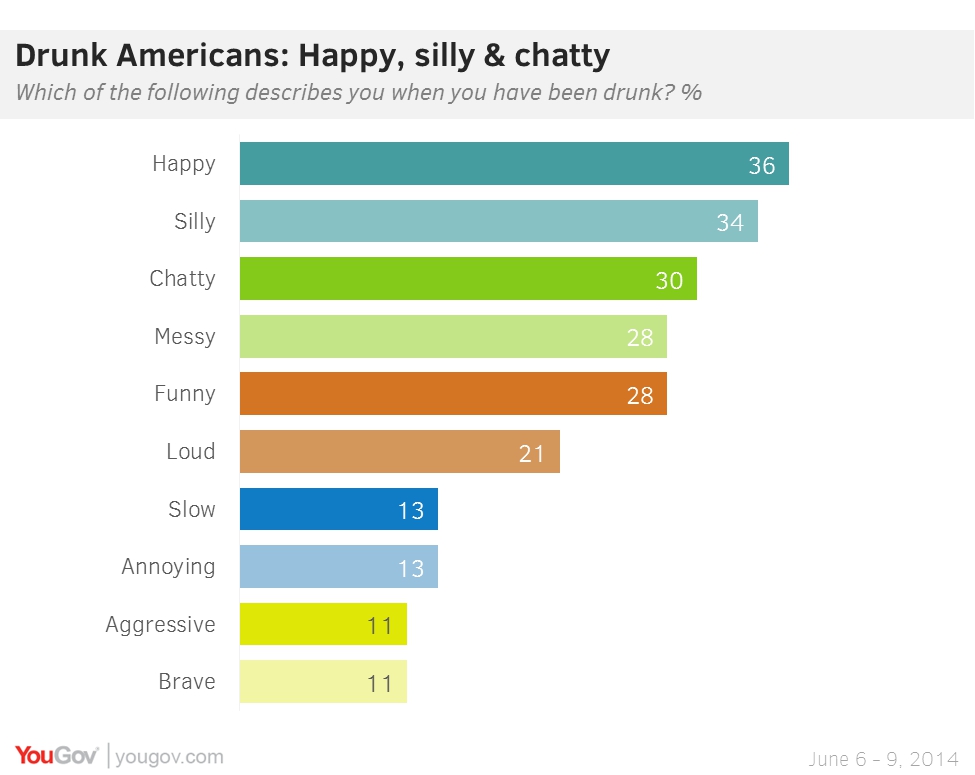
Chart Of The Day

dish_cotdsatnight

A new YouGov poll shows that Americans consider themselves fun drunks. But what about the next morning?

On the whole, most Americans have avoided double hangovers where you feel bad both due to excessive drinking and because of something stupid or mean you did the night before. 26% of Americans say that they have never been drunk, while out of the 71% who say that they have been drunk before most (42% of the entire country) haven’t had to apologize for something they’ve done the night before. Only 31% have had to apologize for the night before. 23% of Americans say that they’ve had to apologize for doing something that they were too drunk to even remember doing.

Does The World Need Another Dating App?

Allison P. Davis mulls over Wyldfire, a new app where female users double as gatekeepers:

[F]emale users can sign up freely, but any man on the app has to be invited, theoretically creating a network of only women-selected desirable, dateable, single men. “Everyone has that one friend who they think is a great-quality guy but they either don’t want to date themselves or want someone else they know to date,” says brand manager Jesse Shiffman. Founders Brian Freeman and Andrew White created the app, “designed specifically around the needs of women,” after hearing several of their female friends complain about “getting creeped on” whenever they used Tinder. … By using existing social networks to build an expanded dating pool, it simulates a more desirable, “organic” dating experience – like Hinge, but with more options. …

But here’s a problem:

How many men in your inner circle do you consider dateable that you don’t want to date yourself? I have maybe two. On a good day. Will  “female-centric” dating networks turn into a smorgasboard for dudes? They might be “safer,” but they don’t necessarily increase chances of dating success for the female user.

Amanda Hess is similarly skeptical:

As Davis notes, that type of eligible bachelor – the single, straight guy you don’t want to date, don’t want to set up with any of your friends, and yet are eager to recommend to all female strangers in your general area – may be even more elusive than the guy who actually sparks your interest.

But let’s say we all have these men in our lives: Identifying a guy as an obvious creep isn’t easy, either. The Wyldfire system operates on the assumption that men who text aggressively crude material to strangers on the internet have no female friends in real life. While it’s tempting to believe that men who type with their penises have simply never had any contact with female human beings, who really knows what lies in the dark recesses of your friend’s Tinder messages? Not you – you just hang out at parties.

Update from a reader:

I wonder how many men are going to want to participate in an app where merely being invited to it means you’ve been implicitly turned down by the person who invited you.

A Well Hung Museum, Ctd

4795419319_42df912873_z

Can a museum dedicated to all things phallic serve as a center of learning? As Julie Beck finds, the answer is … sort of:

By the time Siggi’s private collection became a museum, in 1997, he had 62 specimens. The museum now boasts 283 biological specimens, including at least one from every species of mammal found in Iceland.

And I mean every mammal. The documentary The Final Member, which comes out on DVD June 17, profiles Siggi and his museum’s quest to complete his collection by acquiring—you guessed it—a human penis. The film portrays an apparent race against time between a 95-year-old Icelandic adventurer (and, seemingly, notorious womanizer) named Pall Arason, who has promised his organ to the collection when he dies, and an American named Tom Mitchell, who so desperately wants his penis, which he calls Elmo, to be famous, that he considers cutting it off while he’s still alive, so his can be the first on display. “I’ve always thought it’d be really cool for my penis to be the first true penis celebrity,” Mitchell says in the movie. …

[T]here is a strange tension [in the museum] between the spectacle and the scientific.

The spectacle gets people in the door, but the museum’s purpose seems to be more sincere. The “About” section of its website states: “Now, thanks to The Icelandic Phallological Museum, it is finally possible for individuals to undertake serious study into the field of phallology in an organized, scientific fashion.” It’s certainly not pornographic. …

“It is very very important for me to inform people or educate people,” Hjartarson says in the film. “I think this serves and helps decrease taboos about the human body. Especially about this organ, I’m presenting here… I was a professional teacher for 37 years. I like telling people, I like informing people.”

“My father is a teacher, not only by learning, but by heart, in his soul,” Sigurdsson agrees. “There’s nothing lewd or pornographic about [what he’s doing]. It’s an educational and funny sort of way to display something that isn’t seen every day. If you take something like the penis and just treat it like any other thing, it becomes more ordinary.”

Previous Dish on the museum here.

(Photo by Flickr user JasonParis)

Wishful Drinking

dish_drinking

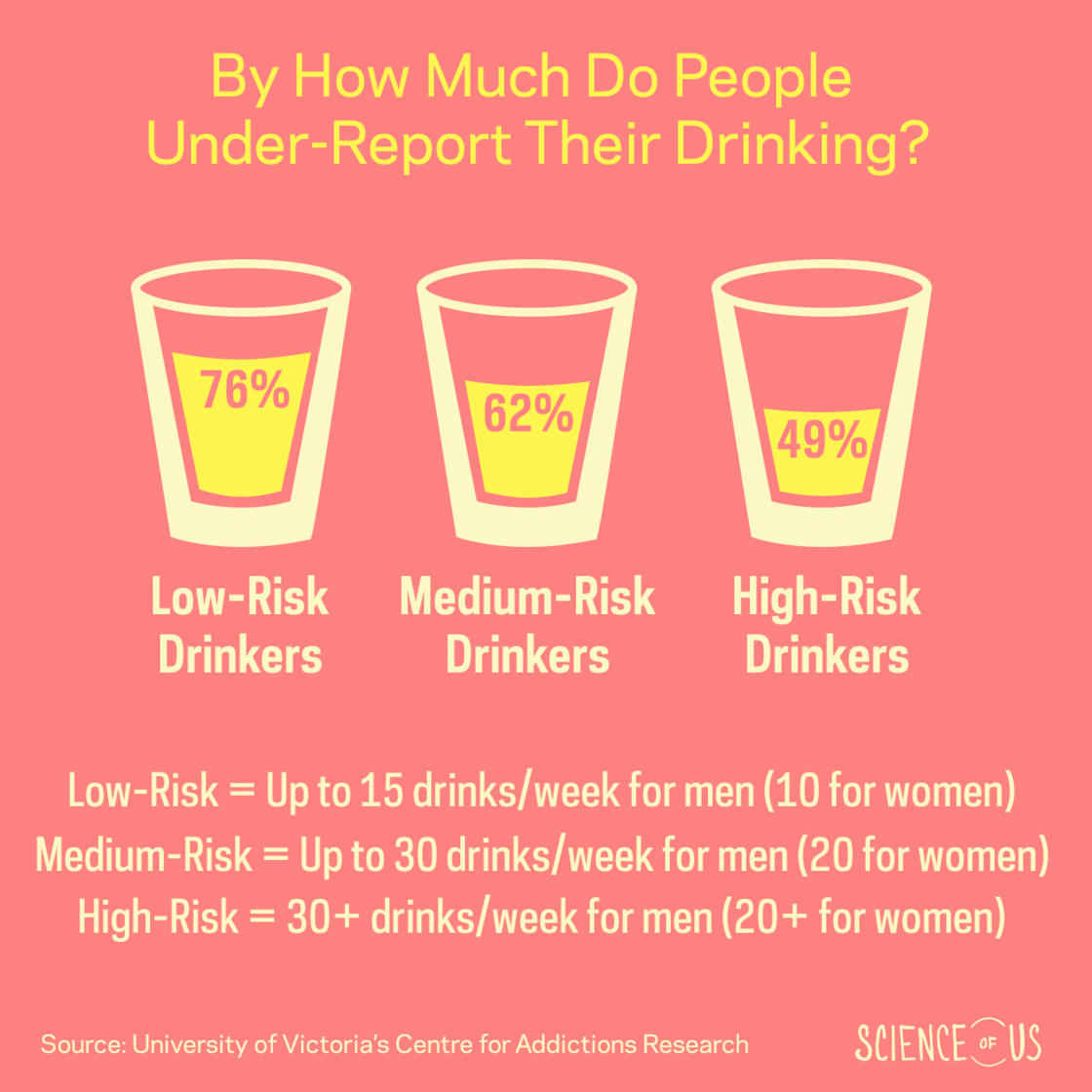
Many drinkers seriously underestimate the amount of alcohol they consume:

[R]esearchers surveyed over 40,000 people with standard alcohol survey questions about their quantity and frequency of alcohol consumption — “How many drinks have you had in the past month?” and so on. But in a smart twist, they then asked a more immediate question: “How many drinks did you have yesterday?” This method is useful for detecting under-reporting because of the improbabilities it reveals.  For example, if 50 percent of people who say they drink once a month acknowledge drinking yesterday, one can infer that this group is severely under-reporting their consumption: If they were truly once-a-month drinkers, only about 3 percent should acknowledge drinking on a particular randomly selected day of the month.

Men and women were comparably good (or bad, depending on your perspective) at accurately reporting their drinking. But as the chart above shows, a large difference emerged when types of drinkers were compared. Putatively low-risk drinkers grossly under-reported, acknowledging only about one in four of their actual drinks consumed. The heaviest drinkers actually recalled their consumption most accurately, but in absolute terms they still only reported about half of it.

Highdea Of The Day

What if the government held a billion-dollar competition to create a safe and effective designer drug? Greg Beato thinks it’s a great idea:

Pipe dream? Certainly innovation has never been a part of the federal government’s drug policy mandate. In 1986, in response to “designer drugs” intended to mimic the effects of heroin and other illegal drugs, Congress passed legislation making it illegal to produce substances that are “substantially similar,” or chemical “analogues,” to Schedule I and Schedule II drugs. …

[But] imagine if, instead of trying to thwart the entrepreneurs behind products like “Bomb Marley Jungle Juice” and “AK-47 Cherry Popper,” the [Office of National Drug Control Policy] tried to actively incentivize them, by offering a billion-dollar prize to the first manufacturer who successfully produces the kind of safely domesticated mood enhancer that Dr. Siegel envisioned 25 years ago. Under the current regulatory environment, manufacturers are only rewarded for creating substances that are different enough from existing Schedule I drugs to claim, at least temporarily, shelf space in head shops, gas stations, and cyberspace. A billion-dollar prize for a safer intoxicant would give them a tangible reason to aim much higher.

How Relevant Is Poetry?

Two weeks ago, the English broadcaster Jeremy Paxman ignited a furor by arguing that contemporary verse “connives at its own irrelevance” and needs to “raise its game a little bit, raise its sights.” One word in particular rankled poets:

Paxman suggest[ed] (not, it would appear, entirely ironically) setting up “inquisition” panels before which poets would be forced to justify their decisions, including “why they chose to write about the particular subject they wrote about, and why they chose the particular form and language, idiom, the rest of it.” This, Paxman claims, would be “a really illuminating experience for everybody.”

On Twitter, Paxman’s comments were fodder for some choice responses from poets, including Canada’s own David McGimpsey, who wrote, “Asking poets to appeal more to the common person is like asking Colonel Sanders to appeal more to chickens.” And Q&Q’s April cover subjectSina Queyras, responded, “Jeremy Paxman can kiss my obscurity.”

Adam Kirsh defends Paxman – to an extent:

What really got some poets angry was when Paxman called for an “inquisition” in which poets would be “called to account for their poetry.” The language of “inquisitions” and being “called to account” has ugly resonances – that is why the provocative Paxman used it – and it has led some poets to denounce Paxman: George Szirtes saw it as an allusion to McCarthy and Stalinism. But if we take the element of compulsion out of it, there is nothing wrong with Paxman’s suggestion. Indeed, not only is there nothing wrong with it, it’s already, as Shakespeare once said in a different context, lawful as eating. Poetry magazine publishes issues in which poets are interviewed about their poems; anthologies feature poets explaining their work; poets clamor to get the chance to talk on panels, to read their work aloud and discuss it; and the whole creative-writing industry is premised on the idea that poets learn by explaining and defending what they’ve written. …

The real problem with Paxman’s comments lies in their incoherence: He is complaining about two different things as if they were the same thing. On the one hand, he urges poets to open up, to write for the general public, to be more accessible; on the other hand, he wants poetry to be better, to be more interesting and captivating. Both are understandable demands, but it’s important to recognize that they contradict one another. The best poetry is not always accessible, and the most accessible poetry is usually not good.

The Ever-Imploding Iraq, Ctd


Maliki’s forces may have halted, or at least slowed, ISIS’s advance:

Security sources said Iraqi troops attacked an ISIL [ISIS] formation in the town of al-Mutasim, 22 km (14 miles) southeast of Samarra, driving militants out into the surrounding desert. They said army forces reasserted control over the small town of Ishaqi, also southeast of Samarra, to secure a road that links Baghdad to Samarra and the now ISIL-held cities of Tikrit and Mosul further north. Troops backed by the Shi’ite Asaib Ahl al-Haq militia also retook the town of Muqdadiya northeast of Baghdad, and ISIL was dislodged from Dhuluiya after three hours of fighting with tribesmen, local police and residents, a tribal leader said.

It was far from clear whether government forces could sustain their reported revival against ISIL, given serious weaknesses including poor morale and corruption, and the risk of Iraq sundering into hostile sectarian entities remains high. ISIL insurgents kept up their assaults on some fronts.

Where the current US thinking stands:

The biggest questions center on whether the United States will carry out air strikes, either with warplanes or unmanned drones, against militants of [ISIS], which moved swiftly to seize the northern cities of Mosul and Tikrit this week and now threaten Baghdad. Such attacks, an option the Pentagon described on Friday as “kinetic strikes”, could be launched from aircraft carriers or from the sprawling U.S. air base at Incirlik in Turkey. The carrier USS George H.W. Bush and its strike group are already “in the region,” the Pentagon said on Friday.

Last night, Clinton basically agreed with Obama’s reluctance to get re-involved with Iraq or to further support the Maliki government:

“You’d be fighting for a dysfunctional, unrepresentative, authoritarian government,” she said on Friday at George Washington University. Clinton talked at length about the unfolding crisis in Iraq, where the extremist group, the Islamic State of Iraq and Syria, has moved from Syria, taking hold of cities north of Baghdad. “There’s no reason on earth that I know of that we would ever sacrifice a single American life for that,” Clinton added.

Amen. Meanwhile, Kilgore is not liking the deja vu:

Moqutada al-Sadr and his Mahdi Army, which may be reforming; Grand Ayatollah Ali al-Sistani, who has now called Iraqis to arms to resist the ISIS breakup of the country; the Kurdish Peshmerga militia, which just seized the oil city of Kirkuk that the semi-autonomous Kurdish regional government has long coveted; the “holy sites,” which Shi’a revere but that the ISIS would just as soon destroy as “idolotrous.” And yes, among the bad returning memories is the daily hectoring from John McCain about the need for U.S. troops in Iraq forever—this time, presumably, in a more explicit and highly ironic alliance with Tehran, which many of McCain’s neocon buddies would love to see reduced to radioactive ash.

The Obama administration seems to be treating the Iraq crisis as it would an adverse breakdown in the military balance in Syria, not as some sort of implicit repudiation of the U.S. decision to shut down its part of the Iraq War. That makes sense. But it will be interesting to see how U.S. public opinion reacts to any sort of return engagement with Iraq in all its complexity. The bad memories are just too recent to have faded entirely.

To wit, Aaron Blake notes that if Obama does attack, the US public will likely respond in kind:

[A] Washington Post-ABC News poll last week found his ratings in this area sinking to a new low. Just 41 percent approved of his job on international affairs, down six points in three months and currently five points below his overall approval rating. Layered on top of Obama’s weakness on foreign affairs is the long-standing unpopularity of the war in Iraq. As of March 2013, just 38 percent said the costs of the war were worth the effort and 58 percent said they were not.

Back in Iraq, the government has instituted a social media blackout in an effort to cut down ISIS’s communication network, though as Craig Timberg notes, it’s unclear how effective that will be:

Regions beyond government control often rely on alternative sources, such as satellite links and fiber-optic lines coming from telecommunications providers in Turkey, Iran and Jordan, analysts said. Service in semiautonomous Kurdish regions, for example, appeared to be flowing without a blip.

“It kind of echoes the larger themes in Iraq, of how little the Iraqi government controls in that country,” said Doug Madory, a senior analyst with Renesys, a New Hampshire-based company that tracks Internet performance worldwide.

Read all Dish coverage of ISIS here. Mackey is live-blogging the latest developments.