Wilde For Women

As a journalist, Oscar Wilde took a special interest in women’s issues:

[I]t is revealing to see just how many of Wilde’s journalistic writings are for and about women. This activity peaks when Wilde takes over the editorship of the Lady’s World, an illustrated monthly that advertised itself as a “high-class magazine for ladies”. Famously, the first thing Wilde did when he took charge of the journal was to change its title: Lady’s World became Woman’s World – a shift that signals a different target audience and different political ambitions. The revamped journal was to provide high-quality journalism aimed at modern middle-class female readers who did not think of themselves as “ladies”. These women were keen to read about culture, education and employment, and Wilde catered for their advanced tastes. Wilde’s editorship of Woman’s World from 1887 to 1889 was a crucial step not only in his career as a journalist but in his development as a writer in a broader sense. It was the only period in his life in which Wilde received a regular salary. More importantly, though, he was now in charge of commissioning essays and reviews, which he did by recruiting an impressive array of women contributors ranging from successful novelists to graduates of the new women’s colleges in Cambridge and Oxford.

In a review of the volumes of The Complete Works of Oscar Wilde that cover the writer’s journalism, Stefano Evangelista observes that the genre proved a good training grounds for Wilde’s later literary experiments:

It is in the journalism that Wilde comes up for the first time with many of the ideas and phrases that he would reuse in critical essays such as “The Decay of Lying” or “The Critic as Artist”. The traffic between his journalism and criticism makes us realize that to draw a sharp divide between these two fields in the Victorian age is a rather arbitrary affair. It is also in the journalism that Wilde learns to play with the epigram – a literary device that he would perfect in his society comedies. He learns to cultivate an effortless style, which mixes critical acumen with silliness, balances learning with superficiality, and tempers natural donnishness by means of studied flippancy. He learns to master that characteristic blend of praise and ridicule. He learns, in other words, to establish that easy, direct contact with the audience that made him a successful dramatist in his own time and that still makes him, on the stage and in print, so appealing to many today.

Email Of The Day

[Re-posted from earlier today]

A reader writes:

I have been a subscriber since very early on. This winter I purchased a subscription for my father. He is an evangelical, as well as a thoughtful conservative. He and I have had our fair share of clashes over the years as I have moved more to the left, but we have always worked hard to hear, and be heard by each other.

dish-gift-sidebar-FDA couple months ago they moved across the country to the same area that my wife and I live. We have obviously spent a lot more time together since that move. I cannot tell you how many conversations we have that are based on something one or the other of us read on the Dish. Neither of us totally agree with you, but it gives us a good jumping off point to have healthy discussions, where both of us are fleshing out our ideas. I think over the last couple of years we are actually moving closer to the same way of thinking. I, through reading your blog, have become somewhat more conservative (small c) and I think he has moved away from the GOP and certainly from FOX news.

Anyways, thanks for thoughtful commentary and conversation starters.

To give the gift of Dish for your father or grandfather or stepfather or father-in-law or any other father on Father’s Day, click here. He, like all subscribers, will get full access to the Dish, including the thousands of words below all the readons each day, in addition to all the writings and podcasts in Deep Dish, including long conversations with Hitch, Dan Savage, and Iraq vet Mikey Piro.

European Cabbies Are Uber-Angry

Traffic was worse than usual in Europe’s major cities on Wednesday, as tens of thousands of taxi and limo drivers in London, Paris, Madrid, and Berlin went on strike to protest the competition they are facing from ride-share services, particularly the astronomically valuated Uber, Alison Griswold outlines their beef:

Taxicab drivers throughout Europe are calling for their governments to crack down on Uber with tougher regulations. London has emerged as the epicenter of the demonstrations: Thousands of drivers are rankled that the city’s public transit authority, Transport for London, or TfL, has determined that the smartphone app used by Uber drivers cannot be classified as a meter because it is not installed in the vehicle. That technical distinction is everything because TfL rules state that only licensed taxis can use a meter—a privilege that comes with strict regulatory hurdles. Drivers feel that because Uber’s app determines fare based on time and distance (and the occasional price surge), it functions like a de facto meter and should be regulated accordingly.

But Richard Read argues that the protesters are missing the point, and that “the taxi industry is overdue for a shake-up” anyway:

Many cab companies still operate using a 20th century model: travelers call for service, step outside, and wait for the cab to arrive. That may be appealing to our parents and grandparents, but for folks under 40, it’s a different story. Like newspapers and record labels, the industry has resisted change for so long, it may be too late to fix it. We understand that there are millions of hard-working cab drivers around the world who find this news unsettling. But Uber isn’t booting them out of a job, it’s changing the way they work to be more in keeping with modern technology and lifestyles.

Ultimately, protests like the ones staged yesterday in Europe make for good news stories, but they do little if anything to reform the industry or boost customer satisfaction. As proof, consider this: Uber said that the protests in London alone resulted in an 850% growth in the company’s user base, as frustrated travelers tried to work around the traffic jams caused by cab drivers.

Likewise, Jim Epstein tells the cabbies they’re wasting their time – in more ways than one:

London mandates that its cabbies pass a 149-year-old exam called “The Knowledge” that requires them to master the city’s maze-like streets and know the precise location of museums, police stations, and theaters. As part of the test, they have to verbally recite detailed explanations of how best to travel from one location to another through the city’s roughly 25,000 arteries. Passing “The Knowledge” takes years of study, and most drivers fail at their first few tries. The test causes the gray matter in applicants’ brains to expand, according to one London researcher.

Perhaps the most compelling case for letting Uber thrive is that London’s brainy cabbies should devote their oversize hippocampi to contributing to fields like computer science and medical research. In an age of ubiquitous GPS devices, many of which also incorporate real-time traffic data, circling the city in a car is a profound waste of such exceptional minds. London may as well also require that cabbies master the art of saddling a horse and mending a harness.

Waters’ World

John Waters shares some of his cross-country exploits with Craig Ferguson:

Choire Sicha entertainingly dresses down the “stunt-writing industry” – books like 52 Loaves: One Man’s Relentless Pursuit of Truth, Meaning, and a Perfect Crust and Living Oprah: My One-Year Experiment to Walk the Walk of the Queen of Talk – but saves praise for John Waters’ new take on the genre:

John Waters is something of a living stunt, in the best possible way. A hero of both America and Americana, Waters has changed the culture of the country as much as any other living filmmaker—Errol Morris, Wes Anderson, or Paul Verhoeven. Having written a couple of memoirs, he now turns his gaze more strictly on himself in a strange stunt book, Carsick: John Waters Hitchhikes Across America (Farrar, Straus & Giroux, $26). After life-stuntist extraordinaire Bill Clegg sold Waters’s idea to FSG head Jonathan Galassi in a bookish velvet-mafia inside job, it took, according to the acknowledgments, two and a half years for Waters “to write and live this adventure.”

The stunt was that Waters, who is now sixty-eight, would hitchhike from his primary home in Baltimore to his San 51l19HWlbrLFrancisco residence. On May 14, 2012, he set out on that expedition. In the end, he arrived. We learn that he is far too cranky and fussy to be doing such things!
In one way, though, Waters tears a mannequin of the stunt genre apart and spits in its face. The actual hitchhiking takes up less than the second half of the book. The first 192 pages consist of two fictional accounts: first his best-case scenario, followed by his worst-case one. These are unimpeachably lewd and Watersian (and, of course, far more entertaining than the actual dreary hitchhiking odyssey). Womb raiders, escaped convicts with priapism, a stripper who shoots up Viagra in a room of truckers gone wild, an alien abduction, and rape—oh, sure, that’s the best-case scenario. The worst-case presentation involves way more pus and goiters.

I can’t wait to see him again in Provincetown this summer, gamely biking up and down Commercial Street and still throwing one of the funkiest parties in town. He may hitchhike across America, but he always ends up here.

Iran’s Soccer Politics

Suhrith Parthasarathy looks at how association football influenced the modern history of Iran:

Drawing links between sport and the larger cultural and political ethos of a nation can often be tenuous and far-fetched. But, in Iran, when soccer returned to the hub of social life in the late 1990s, it served, as David Goldblatt wrote in his book, The Ball Is Round: A Global History of Soccer, as a “rallying point for opponents of the conservative elements in the theocracy.” Tehran’s national soccer stadium, built in 1971 and which can hold more than 100,000 people, is called “Azadi,” meaning “freedom” in Farsi. But ever since the 1979 revolution, which saw the Islamisization of the nation, women were altogether prohibited from watching soccer at Azadi. The boisterous celebrations following the team’s victory in Melbourne, therefore, served as much as a means to help break such shackles as it has to entrench a new form of expressing not only joy but also political protest in the country. Next month, when Iran plays in the 2014 World Cup in Brazil, its matches will reverberate in significance well beyond the soccer pitch.

John Duerden fast forwards to today, when the sport remains just as politically significant:

Popular passion for the game is such that no leader can afford to ignore it. One of the first international figures that President Hassan Rouhani met after taking office last August was Sepp Blatter, the controversial chief of the International Federation of Association Football (FIFA), football’s international governing body, who backed Iran’s bid to host the 2019 Asian Cup.

If Rouhani hadn’t immediately grasped the power of the game, it was made abundantly clear soon enough. Just one week after his historic election inspired thousands to take to the streets, crowds of roughly equal size turned out to celebrate Iran’s qualification for the 2014 World Cup. By scoring political points in his meeting with Blatter, however, the new Iranian president was just following the example set by his predecessor. According to a diplomatic cable published by Wikileaks, Mahmoud Ahmadinejad “has staked a great deal of political capital in Iranian soccer … in an effort to capitalize on soccer’s popularity with constituents.”

Yet Iranians (NYT) don’t seem all that excited about the World Cup this year. That’s no coincidence:

It is more than the daunting competition and the controversies surrounding Team Melli that keep the Iranians from warming to the World Cup. The authorities have been working hard to nix any soccer related excitement.

Tehran’s cinemas have been told by the police that they are not allowed to show World Cup matches to a mixed audience of men and women, “out of respect for Islamic morals.” A plan to show Iran’s games on some of the large electronic billboards across the city was canceled, and on Wednesday, restaurant and coffee shop owners said they had been told by the Ministry of Islamic Guidance and Culture to refrain from decorating their establishments with the national flag or the colors of other countries.

“We want to decorate our restaurant with German flags,” said one restaurant owner who asked to be identified only by his first name, Farhad. “But even that is not allowed. Fun, people gathering in large groups, such things make the authorities nervous.”

Are Steady Jobs Obsolete?

Screen_Shot_2014-06-09_at_11.34.18_AM

Danielle Kurtzleben worries that the growth of on-demand service startups like TaskRabbit and Instacart points to “deeper, unsettling trends going on in the US economy”:

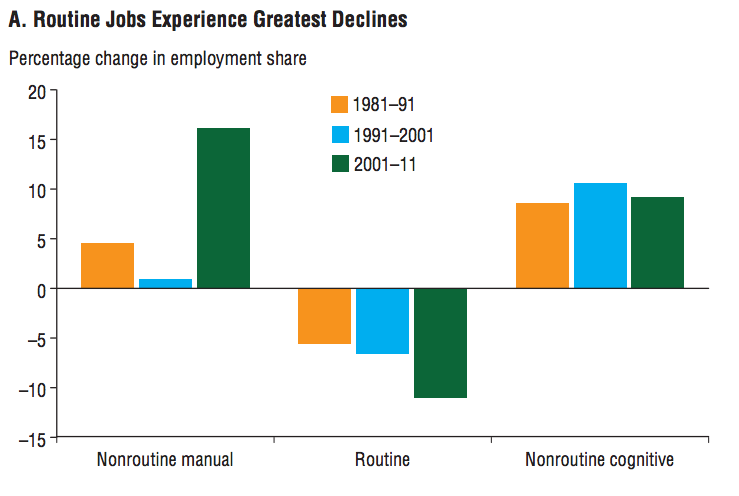
The New York Times’ Farhad Manjoo wrote in May that Instacart and services like it could “redefine how we think about the future of labor.” That sounds great in an era when technology replaces cashiers withself-check-out machines and automates assembly-line jobs out of existence. But the growth of TaskRabbit and other similar firms could mostly mean yet more job growth at the lower end of the spectrum. These low-skill jobs have made up the bulk of job growth over the last decade or so, as the Dallas Fed showed in a recent paper.

While jobs fall out of the middle, new jobs are created at the top and bottom. And those jobs at the bottom tend to be “nonroutine manual” jobs: those that require few skills and little problem-solving. Many of these errand jobs fit this bill perfectly, involving deliveries and other rote tasks. These new errand jobs can feature high pay — Instacart, Manjoo noted, can pay $30 an hour. But a major problem is finding steady work — no grocery run takes eight hours.

Iraq Needs A Political Solution

And Barbara Walter believes it’s a real possibility:

The key to preventing a long and bloody war in Iraq is to create disincentives for Sunnis to fight for complete control over the government. This may not be as hard as it sounds. True, the Sunnis’ number one goal is to regain full control over the government — but Sunnis understand that this is risky and costly. Their second best solution would be to gain a significant voice in government such that Sunnis could ensure that they will not be exploited by the demographically larger Shiite population. This will require a negotiated settlement with al-Maliki and his government that offers real power-sharing guarantees to the Sunni population. A negotiated settlement with moderate Sunnis has the added benefit of undercutting their support for more extreme elements. Studies by Walter 1997 and Harzell and Hodie 2003 have found that civil war combatants are significantly more likely to sign and implement peace settlements that include specific power-sharing guarantees.

But how do you convince al-Maliki to share power when he has shown no inclination to do so to date? As Marc Lynch wrote yesterday, al-Maliki has been urged to build a political accord for a half-decade, but has not done so. The key, I believe, is to make any aid or assistance to him contingent on good behavior. Once it is clear to al-Maliki that he and his army cannot defeat the Sunnis, it will also become clear to him that a deal is his best option.

Walter Russell Mead wonders if Maliki will instead turn towards Iran:

A major thrust of [Obama’s] speech is a political ultimatum to Maliki and his government: we will only help you if you get serious about an inclusive government and system in Iraq that offers real accommodation for the Sunnis.

This means Maliki has a choice. Iran is willing to bolster his government without any requiring any concessions to the Sunnis, having already dispatched two Revolutionary Guard units to protect Baghdad and the Shia holy cities of Karbala and Najaf. So for Maliki, do the advantages of American help offset the concessions he would have to make? If so, he’ll respond positively to Obama and the U.S. will get more deeply engaged in the contest. If not, he will turn to Iran and Iran’s involvement in Iraq will grow exponentially—and in effect the entire war in Syria and Iraq will turn into a war of Iranian expansion.

Peter Van Buren imagines a possible future:

The Kurds are the easy ones; they will keep on doing what they have been doing. They will fight back effectively and keep their oil flowing. They’ll see Baghdad’s influence only in the rear-view mirror.

The Sunnis will at least retain de facto control of western Iraq, maybe more. They are unlikely to be set up to govern in any formal way, but may create some sort of informal structure to collect taxes, enforce parts of the law and chase away as many Shias as they can. Violence will continue, sometimes hot and nasty, sometimes low-level score settling.

The Shias are the big variable. Maliki’s army seems in disarray, but if he only needs it to punish the Sunnis with violence it may prove up to that. Baghdad will not “fall.” The city is a Shia bastion now, and the militias will not give up their homes. A lot of blood may be spilled, but Baghdad will remain Shia-controlled and Maliki will remain in charge in some sort of limited way.


A Well-Oiled Warzone

ISIS_control_june_12

Plumer takes a look at a slippery dimension of the Iraq conflict:

Some basics: Iraq has the world’s fifth-largest proven oil reserves. But the country has only very recently begun churning out significant amounts of crude oil again (production dropped sharply during the 2003 US invasion and its bloody aftermath). By April 2014, Iraq was producing an estimated 3.3 million barrels per day — equal to about 4 percent of global supply. And the country was expected to keep ramping up production, with plans to produce at least 5 million barrels per day in the years to come.

Or at least that was the idea. The recent takeover of northwestern Iraq by the Islamic State of Iraq and the Levant (ISIS) has complicated those plans considerably.

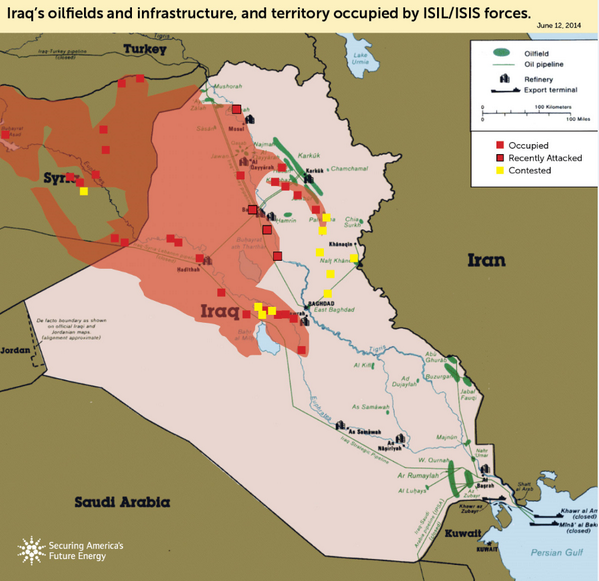
True, as the map above shows, ISIS isn’t close to any of the massive oil fields in the southern regions of Iraq, which produce 75 percent of the country’s oil. And ISIS has yet to enter the Kurdish regions in the north, another major oil-producing area. But the fighting has threatened some of Iraq’s other oil infrastructure, including a pipeline that can deliver 600,000 barrels of oil per day from Kirkuk to the Turkish port city of Ceyhan. (That pipeline had been damaged by a 2013 attack and was offline receiving repairs — that work has now been halted.)

In terms of oil as well as land, Iraq’s Kurds stand to benefit from the crisis:

The Kurds have an estimated 45 billion barrels of oil and have a long planned to be exporting 400,000 barrels a day this year, but until now dividends have been limited. Kurdistan and foreign oil companies have managed to export some of the crude, transported first by truck and then tanker, despite the Baghdad government’s declaration that all their activities are illegal. But, although a big export pipeline is now complete and millions of barrels of oil have been shipped through it to the Mediterranean port of Ceyhan, none of these volumes has been actually sold.

Tankers containing 2 million barrels of Kurdish oil are at sea awaiting buyers, who are apprehensive while Baghdad threatens to sue anyone who purchases it. The current offensive by an al-Qaeda affiliate may be the tipping point. Disciplined Kurdish forces now control not only Kurdistan but the disputed, oil-rich region of Kirkuk, which lies just to its west. The region has been autonomous since the first Gulf War in 1991, and its army has steeled itself to defend Kurdistan against Baghdad’s forces.

Previous Dish on the economic angle of the conflict here.

Responding To Student Groans, Ctd

A reader adds a personal touch to the blog debate:

What ever happened to working your way through school? I went to college form 1985 through 1994 to get my degree, going to school in the day time and working as a hospital orderly at first, then working for an engineering firm during the day and taking classes at night. I did my first year at a JuCo and the rest at a couple of state schools. Of course, I had to give up the fun campus lifestyle – no time for fraternities and parties (well, I found time for a few). But, when I graduated, I was student-debt free.

I realize that this is not the same as spending four years at at residential college or university, but that’s the breaks. Some people get to eat filet mignon and some of us have to eat hamburger. Bottom line is, maybe it took a bit more time and effort then some have to expend, my education has served me quite well in my career, and I never had the depression that must come from leaving school with the kind of debt that so many now incur.

I understand that tuition has increased, but dammit, everyone isn’t going to get to go to the Ivy League school that dream about. The state school in my town has a non-residential program that costs $8K/year, full time. Anyone should be able to deal with that.