The Neocons Get A War Chubby

Yesterday, Eli Lake breathlessly weighed Nouri al-Maliki’s request for American air strikes to assist in the battle against ISIS that his army appears unwilling to fight. Today, jonesing for more war with Jihadists, he and Tim Mak report that “if Obama changes his mind, U.S. jets could be flying over Iraq in less than a day”:

U.S. air bases, housing dozens of American fighters and bombers, are well within striking distance of Iraq. High-flying spy drones like the Global Hawk can just as easily fly over Iraq as Afghanistan or any other conflict zone in the region. The aircraft carrier U.S.S. George H.W. Bush is a few days’ sail away, in the North Arabian Sea. And it boasts dozens more fighters on board.

That’s why a number of retired high-ranking U.S. Air Force officers, including Lt. Gen. David Deptula, who served as the Air Force’s first deputy chief of staff for intelligence, say any strikes, if ordered, could begin almost immediately. “If you can provide me with the appropriate intelligence we can start doing (air strikes) within 24 hours,” he told The Daily Beast. “There are a variety of means do this, whether you are talking about long-range, high-payload aircraft or smaller aircraft. With the requisite intelligence information you can start again in 24 hours.”

Mercifully, the piece includes some warnings about the unintended consequences of deciding to “re-enter the Iraq War.” Even McCain and Butters are leery of air-strikes, which would sink the US right back into the Iraqi quicksand.

Reihan, meanwhile, has the great idea to see what the architects of the original Iraq catastrophe would have us do, because Ken Pollack and the Kagans – yes, the Kagans! – are still the “experts” we should defer to. He manages to shoe-horn in some Scowcroft while he’s at it, but never addresses the fact that Maliki and the American people were deeply opposed to the occupation continuing, that no protections were even given to US soldiers in such a scenario, and, more crucially, that if our leverage with 100,000 troops had failed to sway Maliki, why would a few hundred be salient now – especially since he has become rightly despised by his Sunni enemies?

In case anyone believed that the right had learned anything from Iraq, the editors at NRO also come out strongly in favor of re-entering the war they helped start:

Maliki needs help now, and the U.S. needs to give it to him. The Obama administration, asked about the country’s impending collapse, noted that it has sent Maliki a few hundred missiles, some rifles, and lots of ammunition. It’s possible ISIS will overextend itself, but all the ammunition in the world may not be enough for the Iraqi army, such as it is, to retake the cities ISIS controls and stamp out the insurgency.

The Iraqi government has a long list of weapons and support it needs. The U.S. ought to meet those requests, at least. The Maliki government may need U.S. advisory support — and possibly even other measures — to stop ISIS’s advance and retake the cities that have been overrun. This is anathema to the Obama administration: It much prefers handwringing to intervention. But deliberation now (not unlike in Syria) will allow the Islamists to solidify their position and amplify their influence.

The Iraqi government has a 250,000 strong army, trained and equipped by the US. But sectarianism meant that, when it came to the defense of Mosul, most of them took off their uniforms and joined the ISIS brigade.Do these delusional partisans actually believe that “advisory support” can somehow reverse this core dynamic?

George Will sums up the position of the right-wing id:

The president is in fact implementing the foreign policy he promised. It was entrenchment by one word, retreat by another. He is implementing the foreign policy that Secretary of State Hillary Clinton facilitated without expressing any qualms. He is implementing a policy that the American public has said in polls it wants right now. It wants it at least until it gets queasy by looking at the pictures they have been seeing tonight.

And one might think an alleged Tory like Will would understand the futility of trying to control an endless sectarian civil war in a country we neither understand fully or could control while occupying with 100,000 troops. But what’s conservative coherence worth when you can bash Obama so easily? In Malkin Award-worthy screed, Robert Tracinski does Will one better and proclaims that Obama wanted America to fail:

So were the Democrats right? Was Iraq a lost cause, inevitably, all along? There’s one big problem with this narrative: Iraq has fallen apart on President Obama’s watch, as a consequence of his own policy of willful neglect. I would say that this was a self-fulfilling prophecy, but that doesn’t quite seem to cover it. Instead, I would characterize this as a wish-fulfilling prophecy. If Iraq is falling to al-Qaeda, it’s because this administration deliberately chose to throw away the victory handed to them by George W. Bush. The left thought we should have lost the war in Iraq, they wanted us to lose it—and finally they’re getting the outcome they wanted.

Yes, the Iraq War was a victory. How on earth did we manage to forget that?

My first take on the debate over whether to re-intervene in Iraq is here.

Will Samarra Be An Inflection Point?

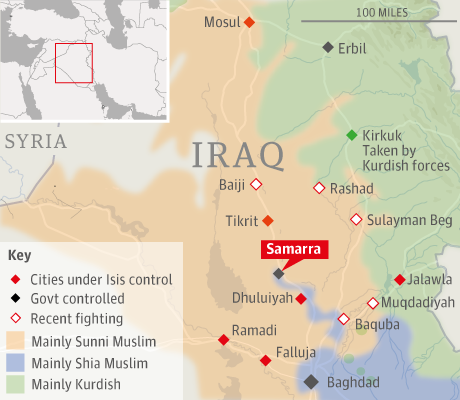
The battle for the city is on, raising both the likelihood and the stakes of an ugly sectarian conflict as Shia militias rush to defend holy shrines that they fear ISIS’s Sunni jihadists will destroy:

iraqisissamarra3Thousands of Shia fighters have rushed to the central Iraqi city of Samarra to defend two shrines that were blown up by insurgents eight years ago, triggering the sectarian war that almost destroyed the country. Convoys of fighters were seen being escorted north by Iraqi police trucks from Baghdad early on Friday and many have now reached the city where insurgents – led by the Sunni militant group the Islamic State of Iraq in the Levant (Isis) – were in control after a lightning strike south.

The volunteer Shia fighters were quickly assembled after Iraqi forces abandoned their positions in most of the area, leaving only a small number of troops to guard the Imam al-Askari shrines. Samarra is the fourth northern city to have all but fallen out of government control. The embattled prime minister, Nouri al-Maliki, appears to have drawn battle lines further south in Taiji, hoping to defend Baghdad against insurgents who have occupied the north virtually unopposed.

How ISIS behaves in Samarra might give us a clue as to its endgame:

ISIS operations around Samarra during this phase of its northern offensive will be an important indicator of its ultimate intent and its estimate of its own capabilities. If ISIS means to continue a blitzkrieg offensive toward Baghdad it will likely need to bypass Samarra to maintain momentum and conserve forces. But Samarra is extremely significant in itself.

Al-Qaeda in Iraq’s destruction of the al-Askari Shrine in 2006 ignited the sectarian civil war that had been simmering before then. Prime Minister Nouri al-Maliki will surely feel a great deal of pressure to prevent a repetition of such an event and may well attempt to concentrate forces to prevent it. Iraqi forces, militias, and Iranian proxies have long been in Samarra precisely to protect the shrine. ISIS could therefore attack the shrine for any of several reasons. It could seek to draw the ISF into a meeting engagement in hopes of defeating arriving ISF troops piecemeal. It could intend to destroy the rebuilt shrine to inflame the sectarian war even further. It could even find irresistible the prospect of fighting the actual Iranian forces and proxies thought to be in the city. Any or all of these conditions could lead to a major battle in Samarra, or the ISIS command might instead decide to bypass the shrine and continue south.

Last night, The Guardian’s live blog ran an account from one Samarra resident who seemed pretty happy to see the ISIS militants:

Everyone in Samara is happy with the fighters’ management of the city. They have proved to be professional and competent. We have water and power; there is a shortage in fuel because Maliki’s forces have cut the bridges between Samara and Baghdad. The fighters themselves did not harm or kill anyone as they swept forward. Any man who hands over his arm is safe, whatever his background. This attitude is giving a huge comfort to people here.

Four days ago, Maliki’s military dirty force raided Al-Razaq mosque in the city, brought a few locals whom they picked up from different parts in Samara and killed them in the mosque. What do you think the people feeling would be towards these military forces? We have lived enough years of injustice, revenge and tyranny and we can’t stand any more.

A Wider Sunni-Shia War?

Unrest in Kirkuk, Iraq

It’s been the most powerful narrative in the region for quite some time – exacerbated a million times by the US invasion, and then inflamed by the Arab Spring in Syria. Simon Henderson believes that the Saudis now want Iraq to host a proxy fight against Iran:

ISIS is a ruthless killing machine, taking Sunni contempt for Shiites to its logical, and bloody, extreme. The Saudi monarch may be more careful to avoid direct religious insults than many other of his brethren, but contempt for Shiites no doubt underpinned his Wikileaked comment about “cutting off the head of the snake,” meaning the clerical regime in Tehran. (Prejudice is an equal opportunity avocation in the Middle East: Iraqi government officials have been known to ask Iraqis whether they are Sunni or Shiite before deciding how to treat them.) …

There is an additional and often confusing dimension, although one that’s historically central to Saudi policy: A willingness to support radical Sunnis abroad while containing their activities at home. Hence Riyadh’s arms-length support for Osama bin Laden when he was leading jihadists in Soviet-controlled Afghanistan, and tolerance for jihadists in Chechnya, Bosnia, and Syria.

Tom Ricks tries to make sense of Iraq’s sectarian future:

It boils down to this: The Shiites act like they are a majority in Iraq, or at least the single biggest group. The Sunnis act like they are a majority in the Arab world. Both are right. The question is: Which is more important inside Iraq?

It boils down to this: The Shiites act like they are a majority in Iraq, or at least the single biggest group. The Sunnis act like they are a majority in the Arab world. Both are right. The question is: Which is more important inside Iraq? Unfortunately, the answer likely will come from Iran, in how it supports Maliki in the coming days. I don’t think the U.S. government will conduct air strikes. I don’t even know how it would be done-the big base at Balad will be a juicy target for ISIS, so you can’t use that. So B-1s out of Diego Garcia? Still hard to do and coordinate with someone on the ground.

My guess: We wind up with a de facto partition of Iraq-a Shiite south extending up to the east bank of the Tigris in Baghdad, a Sunni north and west that begins in the western side of Baghdad, and a Kurdish northeast. The Kurds have played this especially well, hanging back and letting Maliki screw up and also cutting a peace deal with the Turks so they can focus on Iraq.

Allahpundit doesn’t think other Sunni states will join the fray:

One obvious possible response [for containing ISIS] is for Jordan, Saudi Arabia, Turkey, and maybe even Egypt to send troops to Iraq to crush [them]. The jihadis are hugely outnumbered: Combined, the Iraqi army and the Kurdish peshmerga in the country top them more than 30 to one. Add multinational Sunni troops and the ratio would skyrocket. I assume it won’t happen, though, partly because the Sunnis would rather let Iran bleed some more in handling this and partly because they may be nervous about being thin on troops at home at a moment when Islamists are running wild in Iraq.

The local Islamists might seize on the security vacuum as an opportunity for mass protests or worse, which could destabilize the country. In the eternal game of Middle Eastern jihadi whack-a-mole, there are always more moles. And even if the Sunni states managed to keep order at home, what happens once they’re done with ISIS in Iraq? Do they go home, or push on into Syria to fight ISIS there — which could eventually lead to a direct confrontation between Iran, on Assad’s side, and the multinational Sunnis on the other?

I’m not going to pretend I have the expertise to know what’s ahead. But the question to me seems merely at what level of heat the Sunni-Shia war will continue. And continue. And continue. And these fights can go on for ever, especially where order and security are imperiled. Look at how long the Catholic-Protestant fight defined Europe. People were dying over it only a few decades ago in Ireland.

(Photo: Kurdish Peshmerga forces and Iraqi special forces deploy their troops outside of the oil-rich city of Kirkuk, Iraq on June 12, 2014. By Feriq Ferec/Anadolu Agency/Getty Images.)

ISIS Against The World

Workbook5

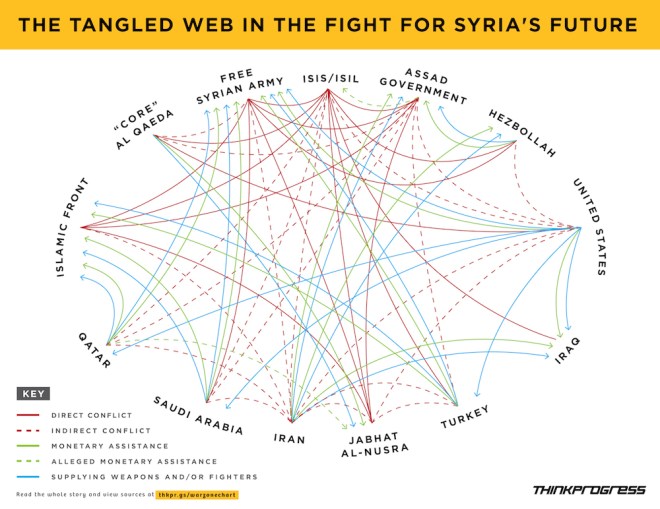
More Iraqi towns fell to “worse-than-al-Qaeda” overnight. The above chart from Hayes Brown and Adam Peck illustrates how ISIS is really at war with everybody:

ISIS is the most committed to taking on every single other actor. Their single-minded focus on creating an Islamic state in the “Greater Syria” region — which generally is considered to include Syria, Iraq, Lebanon, and parts of Jordan — has led them to completely ignore the borders drawn between the modern states that lie on the territory. As a demonstration of their commitment to the metaphor, ISIS fighters on Tuesday symbolically bulldozed a wall between Iraq and Syria.

Meanwhile, Adam Taylor presents the new rules under which citizens of Nineveh, now effectively a province of the Islamic State of Iraq and Syria, are living. These include amputations as punishment for stealing, a ban on alcohol and cigarettes, a pledge to destroy the graves and shrines that Shia Muslims revere but which Sunni fundamentalists like ISIS view as idols, and instructions to women not to leave the house except when absolutely necessary (in Islamic dress, of course).

If history is any guide, this means ISIS will lose. No Jihadist group as extreme as this has ever managed to sustain popular support for very long. Al-Qaeda collapsed in Jordan because of this – and in Iraq, the insane puritanism of the Sunni extremists actually played a part in creating the Sunni Awakening.

Douglas Ollivant considers how this state of affairs might end:

So what could be game changers?

If the United States (or, perhaps, another Western nation) were to launch airstrikes against ISIS convoys and on support bases in western Iraq (or, for that matter, eastern Syria) it could stop the insurgency in its tracks. However, such a step appears unlikely, at least on a scale that would truly shift the chessboard.

Less dramatic, but probably of greater long-term effect, would be a breakthrough in the political stalemate in Baghdad involving at least one major faction from each of the three ethno-sectarian groups (Shiite Arabs, Sunni Arabs, and Kurds). Should this crisis cause cooler heads to decide it is better to hang together than hang separately, then this may be just the crisis that Iraqi politics needed.

A third possibility, much as we might hate to admit it, would be a resurgence in the Assad government in Syria that permits it to attack ISIS bases on their side of the Iraq-Syria border, forcing ISIS to shift forces from Iraq to defend their safe havens in Syria. The Assad government might truly enjoy the opportunity to turn their rhetoric on fighting terrorism into some sort of reality.

Peter Beamount counts the opposing forces:

Estimates put the fighting strength of Isis in Syria and Iraq at around 7,000 but its numbers in Iraq appear to have been bolstered by other groups, including local Sunni militants and Ba’ath nationalists particularly in Tikrit. Despite claims that they have captured helicopters in Mosul, it seems unlikely they would be able to deploy them. Lightly armed with Toyota pickup technicals, RPGs and small arms, Isis has captured some armoured Humvees, although there are suggestions that some equipment has been sent back to Syria. While they have been able to operate easily in largely Sunni areas where they have some support from a population angry and alienated from the Shia-led government in Baghdad, the capital is a different proposition. One district alone, Sadr City, has a Shia population of some 1 million and since the sectarian war that ended in 2008, the sprawling suburbs have been divided along sectarian lines with checkpoints and barriers.

Malaki controls roughly 250,000 forces of unknown readiness and ability. And the Kurds?

Although some 35,000 Kurdish peshmerga are incorporated into the Iraqi security forces, other peshmerga remain outside with published estimates varying from 80,000 to three times that number. Two years ago a Kurdish official suggested the peshmerga numbered 190,000. Increasingly well equipped – including with 2,000 armoured vehicles and rocket artillery systems – they are regarded as motivated, well trained and experienced.

“The Syrian war,” Totten declares, “is no longer the Syrian war. It’s a regional war”:

It spilled into Lebanon at a low level some time ago. It sucked in Iran and Hezbollah some time ago. Now it is spreading with full force at blitzkrieg speed into Iraq and has even drawn in the Kurdistan Regional Government which managed to sit out the entire Iraq war. This could easily suck in Turkey, Jordan, and Israel before it’s over. Or maybe it won’t.

In the future we might see the events of the last few days as the beginning of the end of Iraq as a state, or at least the beginning of the end of Prime Minister Nouri al-Maliki, whose American-trained army has proven utterly useless. Or maybe he’ll survive in an Iranian-backed rump state. Maliki wants an American-backed rump state. … But we are not going to save Iraq and we are not going to save Syria. It’s over. That’s what the Middle East wanted, and it’s what the Middle East is going to get.

And Aryn Baker notes: “It’s not looking good for the 49 Turkish citizens taken from the country’s consulate in Mosul, or the 31 Turkish truck drivers who were also kidnapped.” But the biggest wild card remains Iran. Thomas Erdbrink (NYT) doesn’t confirm reports that the Revolutionary Guard is already fighting in Iraq, but he relays some Iranian officials’ thoughts on the situation:

Should the Islamic State of Iraq and Syria manage to consolidate its power in northern Iraq, Iran would be confronted with the fresh headache of propping up yet another weak ally, along with Syria. But there is a huge emotional difference between Iraq — the site of the defining battles of the Shiite faith and where the holiest of Shiite saints are buried — and the Syria of President Bashar al-Assad, more an ally of convenience, with only the shrine of Zeinab. “I propose we help Iraq by repeating our good experience,” said Hossein Sheikholislami, an aide to the speaker of Parliament, Ali Larijani, and an important figure in Syrian affairs. “Of course, if they ask officially for our help we can send experts to train the trainers, just as we did in Syria.”

Other analysts dismiss both the militants and the costs of intervening in Iraq. “This group is not as big and powerful as they seem,” said Mashallah Shamsolvazein, a reformist journalist and analyst of Arab affairs. “If needed, we can enter Iraq and wipe out ISIS easily, but that won’t be necessary.”

If this does become a second Iran/Iraq war, as he fears, Juan Cole remarks on how dramatically the US position has changed since the first one:

In the looming second Iran-Iraq War, the US will be de facto allied with Iran against the would-be al-Qaeda affiliate (ISIS was rejected by core al-Qaeda for viciously attacking other militant vigilante Sunni fundamentalists in turf wars in Syria). The position of the US is therefore 180 degrees away from what it was under Reagan. In fact, since ISIS is allegedly bankrolled by private Salafi businessmen in Kuwait and elsewhere in the Oil Gulf, the US is on the opposite side of all its former allies of the 1980s. In some ways, some of the alleged stagnation of US policy in the Middle East may derive from a de facto US switch to the Iranian side on most issues, at the same time that US rhetoric supports Iran’s enemies in Syria and elsewhere in the region.

It is possible that a US-Iran alliance against al-Qaeda-like groups in Iraq and Syria could clarify their budding new relationship and lead to a tectonic shift in US policy in the Middle East. One things seems clear. Without Iran, the US is unlikely to be able to roll by al-Qaeda affiliates and would-be affiliates in the Fertile Crescent, who ultimately could pose a danger to US interests.

Paul Iddon remembers the last time American and Iranian interests coincided:

Iran-U.S cooperation post-1979 isn’t at all unprecedented. In November 2001 the Iranian Qods Force then commanded by Pasdaran commander Yahya Rahim Safavi cooperated with United States Special Operations forces in the liberation from Taliban rule of the city of Herat in Afghanistan. …

Common interests between Tehran and Washington in the immediate post-9/11 period briefly trumped long-held animosities as mutual cooperation was feasible and desirable. Iran was then under the more reformist-oriented Khatami. Its president today is one who was elected on the grounds of his advocacy of more productive relations between his regime and the United States. One could argue the finer points of what such a cooperation between U.S. and Iran in Iraq now could entail but for once one thing is sure in that region, that an ISIL victory today in Iraq is detrimental to the majority of Iraqi’s, the majority of Iranians and the United States.

(Map via The Guardian)
Half-Baked Edibles

The potency of  marijuana edibles varies dramatically:

Colorado lawmakers made allowances for serious marijuana users by allowing recreational edibles to contain up to 100 milligrams of the psychoactive component THC, roughly equivalent to smoking three joints filled with a gram each of 15 percent THC cannabis.

At the same time, however, the law seemed to have pot novices in mind when it defined each serving size of edible marijuana to be just 10 milligrams of THC. So if you’re following serving directions on each edible, a 75-milligram-THC Mile High Mint bar weighing 45 grams should be consumed in 6-gram chunks, not all at once. And an 8.5-ounce bottle of one of Dixie’s 75-milligram-THC elixirs (just over half the size of a grande Starbucks coffee) should be divvied up into 7½ servings. Even if you abide by these directions, it’s hard to know exactly how much—or how little—THC you’re getting in each bite or gulp.

In March, a Denver Post investigation found that some edibles had just a fraction of the THC listed on their labels (a package of 100-milligram-THC Dr. J’s Jelly Stones contained 0.2 milligrams of THC), while others were considerably more potent than advertised (a 100-milligram-THC Mile High Mint bar boasted 146 milligrams of THC).

Steven Wishnia’s primer on edibles is also worth a read:

“In a nutshell, eaten cannabis gets metabolized by the liver, so delta-9 THC becomes 11-hydroxy-THC, which passes the blood-brain barrier more rapidly and has more of a psychedelic effect than standard THC,” says Understanding Marijuana author Mitch Earleywine, a professor of psychology at the State University of New York at Albany. “Smoked or vaporized cannabis bypasses the liver and doesn’t create the same 11-hydroxy-THC.”

Smoking marijuana gets THC into the body much faster and at higher concentrations, but it stays there much longer after eating. With smoking, as much as 50 to 60 percent of the THC in a joint can get into the blood plasma, and peak concentrations come in 5 to 10 minutes. It “very quickly crosses the blood-brain barrier,” explains Paul Armentano, deputy director of the National Organization for the Reform of Marijuana Laws. With orally administered cannabis, only 10 to 20 percent of the cannabinoids reach the blood plasma, and they do so 60 to 120 minutes later, says Dr. Mark A. Ware, an associate professor of family health at McGill University in Montreal.

Recent Dish on edibles here and here.

Their Poor, Huddled, Underage Masses

Fox News is blaming Obama for the massive influx of migrant kids into the US:

Among the policies that allegedly are creating a magnet for illegal immigrants is what’s known as Deferred Action for Childhood Arrivals. The unilateral policy in 2012 allowed some illegal immigrants who came to the U.S. as children to defer deportation — among other criteria, they must have come to the U.S. before they were 16 years old, be younger than 31 on June 15, 2012, and have been in the country since at least June 15, 2007, and have no criminal history.

The administration extended that program earlier this month, allowing the immigrants to apply for protection from deportation for another two years.

Ian Gordon’s reporting tells a very different story:

Many of the kids are coming to help a family in crushing poverty. Some are trying to join a parent who left years ago, before the recession and increased border enforcement slowed down adult immigration. Still others are leaving because of violence from family members and gangs. According to a report from the United Nations High Commissioner for Refugees, 58 percent of the 400 youth the agency interviewed “had suffered, been threatened, or feared serious harm” that might merit international protection. “This is becoming less like an immigration issue and much more like a refugee issue,” says Wendy Young, executive director of Kids in Need of Defense (KIND), a DC-based nonprofit that helps unaccompanied immigrant kids find pro bono legal services. “Because this really is a forced migration. This is not kids choosing voluntarily to leave.”

Bob Ortega hears the same thing:

Gang violence in El Salvador and in urban areas of Guatemala has escalated dramatically in recent months since a weak truce among rival gangs has evaporated, said Elizabeth G. Kennedy, a Fulbright scholar reached Monday in San Salvador, the capital of El Salvador. “Half of them are fleeing for their lives,” she said.

Kids from Mexico are returned across the border, while others are placed in one of eighty temporary shelters, sometimes at military bases, for the duration of their deportation proceedings. Caitlin Dickson parses new allegations by immigrants rights groups that U.S. Customs and Border Protection (CPB) agents have been persistently abusing migrant children under their care:

In addition to the descriptions of freezing cold, overcrowded and unsanitary holding cells, one in four children referenced by Wednesday’s complaint said they were subjected to physical abuse—sexual, beatings, and even torture-style stress positions—by CBP officials. More than half of them reported sexual harassment, death threats, and other forms of verbal abuse. More than half said they were denied medical care and about 70 percent of them say they were detained beyond the 72-hour limit—though many report that it was hard to tell what time of day it was or how many days had passed because fluorescent lights were kept on at all hours.

Over 80 percent of the kids interviewed said they were denied adequate food and water. Many say they became sick after eating the frozen or moldy food the CBP officials gave them. One child said that while he was in custody, the drinking water came from a toilet tank. Many of the children reported being shackled while transported to and from CBP facilities, and 30 percent said that, when they were finally released, money and personal belongings that had been confiscated by CBP officials were not returned to them.

Karen McVeigh adds:

Reports of such abuses have been documented for at least a decade, the groups said, but no reforms have been implemented and agents are rarely held to account. For instance, the AIC found recently that 97% of the 809 abuse complaints – 60% of which involved abuse of migrant children – filed against Border Patrol agents between January 2009 and January 2012 resulted in the classification “no action taken”.

The head of the CBP’s internal affairs unit was removed from his post on Monday. The Obama administration is working on a program offering legal aid to the migrant children.

E Unus Pluribum

Noting that more than half of our 50 states have declared English their official language, Eric C. Miller argues against English-only advocacy:

Language is an organic force, and difficult to control. The troublesome example of official French policy in Quebec offers a cautionary tale. The US is so much larger, home to hundreds of millions of people and their myriad cultural traditions. Enforcement brings other problems, too, not least ideological ones; many supporters of Official English are political conservatives, critically opposed to government intervention in the lives of citizens. If imposition is to be avoided as a rule, then federal speech codes must surely qualify. And since laws are valid only to the degree that they can be enforced, language law is bound to be tenuous at best.

If the English language were under threat, matters might be different. But any honest appraisal of the situation in the US must concede that it simply is not. At the close of his excellent 1997 essay on the subject, Robert D King said that Americans are ‘not even close to the danger point’, and that we can ‘relax and luxuriate in our linguistic richness and our traditional tolerance of language differences’. Dismissing the idea that language was a threat to unity, he concluded: ‘Benign neglect is a good policy for any country when it comes to language, and it’s a good policy for America.’

(Update: yes, as a Latin scholar I know that headline is ungrammatical in Latin. Ex Uno Plures is the right formulation. But I figured the entire pun might be lost to non-Latin-proficient readers.)

What’s So Funny?

In the world of laughter yoga, the answer is “not much”:

This weekend, Manchester will host the 3rd annual U.K. National Laughter Festival. Madan Kataria will be the keynote speaker. Kataria (colloquially known as the Guru of Giggling) is the creator of Laughter Yoga. Created in 1995, the practice is a combination of yogic breathing (pranayama), and voluntary laughter.

Purely laughter though – no jokes, humor, or comedy. The idea is that your brain doesn’t register the difference between fake and real laughter, and it produces the same endorphins regardless, resulting in enhanced well-being. Kataria claims that laughter “helps you to unwind the negative effects of stress, and also boosts your immune system.”

Worn Down By The Racism Beat

For years, Cord Jefferson made his “unofficial beat the stories, struggles, and politics of blacks in America”:

The hostility directed at writers who cover minority beats in America is solid proof that those people are doing important work. But that work can be exhausting. It’s exhausting to always be writing and thinking about a new person being racist or sexist or otherwise awful. It’s exhausting to feel compelled on a consistent basis to defend your claim to dignity. It’s exhausting to then watch those defenses drift beyond the reaches of the internet’s short memory, or to coffee tables in dentists’ offices, to be forgotten about until you link to them the next time you need to say essentially the same thing.

After a while you may want to respond to every request for a take on the day’s newest racist incident with nothing but a list of corresponding, pre-drafted truths, like a call-center script for talking to bigots. Having written thousands of words about white people who have slurred the president over the past six years, you begin to feel as if the only appropriate way to respond to new cases—the only way you can do it without losing your mind—is with a single line of text reading, “Black people are normal people deserving of the same respect afforded to anyone else, but they often aren’t given that respect due to the machinations of white supremacy.”