The Nader-Chomsky Of The Right?

Eric Cantor Holds Press Conference At Capitol One Day After Primary Defeat

That’s Ryan Lizza’s take on Brat – and he largely shares my view that this new form of Republican populism is a lot more potent than the Romney campaign’s 47 percent message. Why? Because Brat is targeting the 1 percent. Money quote:

Instead of lecturing the most vulnerable about the moral beauty of the marketplace, Brat targets the most well off. “Free markets!” he declared in Hanover, like a teacher about to reveal the essence of the lesson. “In a nutshell, what does it mean? It means no one is shown favoritism. Everyone is treated equally. Every firm, every business, and you compete fairly. And no one, if you’re big or small, is shown special attention. And we’re losing that.”

If this sounds familiar, it’s because it’s the kind of rhetoric that Ralph Nader, and even Noam Chomsky, have used for many years to pillory the government for protecting the rich and the well connected from the vagaries of the free market.

And that’s why, in my view, it is not to be under-estimated. The K Street-Wall Street nexus is a scandal; as is our absurdly complex tax code (largely devised for corporate welfare and for those with expensive tax lawyers). Put that together with a left-sounding defense of the American middle-class against millions of undocumented, low-wage immigrants, and you’re beginning to get somewhere.

Given where the country now is, I expected Obama’s likeliest successor to be to his populist left, someone able to corral anger at the one percent and Washington, someone urging radical change on behalf of the little guy. But the Clinton machine has managed to choke off that possibility – while the GOP is fast rushing into the gap.

(Photo: Mark Wilson/Getty)

The Scientific Case For AA

Keith Humphreys traces how addiction scientists came around to the idea that Alcoholics Anonymous works:

A watershed in scientist’s views of the value of AA occurred in the 1990s with Project MATCH, the largest study of alcohol dependence treatment ever undertaken.  Two well-validated professionally-developed psychotherapies were evaluated head to head against “twelve-step facilitation counselling.”  This counselling approach adapted AA ideas and goals into a 3-month long psychotherapist-delivered outpatient treatment protocol and also strongly encouraged involvement in community-based AA groups.

AA skeptics were confident that by putting AA up against the best professional psychotherapies in a highly rigorous study, Project MATCH would prove beyond doubt that the 12-steps were mumbo jumbo.  The skeptics were humbled: Twelve-step facilitation was as effective as the best psychotherapies professionals had developed.

subsequent randomized clinical trial eliminated the twelve-step counselling component and simply evaluated the effect of a brief, structured introduction to AA (as well as Narcotics Anonymous, if appropriate).  Those connected by researchers to 12-step groups had substantially lower rates of using alcohol and other drugs over time.  This proved that the groups themselves have a positive impact, even when they are not coupled with extended professionally-provided twelve-step facilitation counselling.

Previous Dish on the effectiveness of AA here, here, here, and here.

Assad The Invulnerable

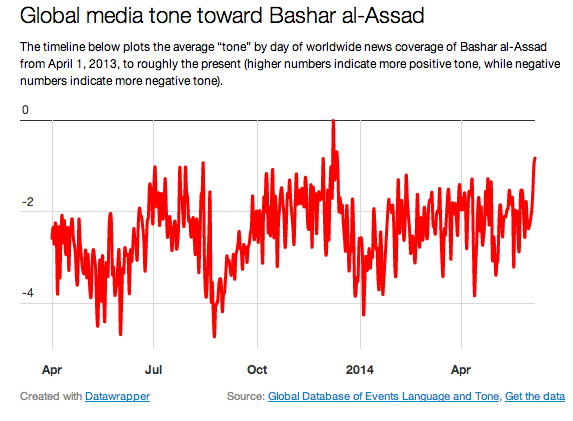
Screen-Shot-2014-06-10-at-9.18.16-AM

That’s the sense one gets from international media coverage of the Syrian dictator:

Immediately visible is the sharp negative trajectory of global media tone towards Assad in the lead-up to the August 21, 2013, Ghouta chemical weapons attack, as Assad was rapidly losing global credibility.  In the days immediately following, as the world’s headlines were captivated both by the attack itself and the continued clashes over the following days, tone towards Assad continues to become sharply more negative. However, something extraordinary begins to happen on August 28 – the tone of news coverage across the world about Assad begins to turn sharply positive, containing a high density of language regarding invulnerability.

A review of news coverage from this time period reveals a world anticipating U.S. military action in the first few days after Ghouta, with substantial reference to President Barack Obama’s “red line” policy towards chemical weapons. But as the Obama administration wavered, and it became increasingly clear that not even a symbolic missile strike would occur, the discourse around Assad began to change dramatically — from a vanquished has-been in his last days, to a resurrected and invulnerable leader. … Of course, the world’s media wasn’t applauding Assad for gassing children to death, but it’s clear that, as a group, it contextualized the lack of response to those horrific actions as an indicator of new-found impunity.

Scarcity Breeds Racism

That’s what new research suggests:

David Amodio, a psychology professor at New York University and Amy Krosch, a graduate student, performed a series of experiments that showed that their predominantly white study subjects tended to view biracial people as “more black” when they were primed with economic scarcity, and that the subjects were stingier toward darker-complexioned people overall. …

Of course, past studies have also shown that scarcity and resource competition fosters distrust between groups. The ingroup/outgroup cognitive bias theory holds that we prefer people who resemble us. But this research suggests that financial strain can cause the very definition of the “out” group to change, as well, by nudging us to view people of other races as even more dissimilar to ourselves.

Maya Rhodan elaborates:

[P]articipants were asked to identify whether select images depicted black people or white people, while researchers manipulated select economic conditions. In one study, participants were first asked to express agreement or disagreement with “zero-sum” beliefs like “When blacks make economic gains, whites lose out economically,” and then asked to identify the race of the people featured in 110 images – people whose skin color varied greatly. The study’s results showed that those with stronger “zero sum” beliefs were more likely to consider the images of mixed-face subjects as “blacker” than they actually were.

[Krosch and Amodio] found similar results when participants were asked to identify whether someone was black or white after being shown words related to scarcity like “limited” and “resource.” The remaining studies threw economics into the mix – asking subjects how they would divide $15 between people represented by two images – and not only were images of darker-skinned people deemed “blacker” than they actually were relative to the average skin color, they were allocated fewer funds.

Jesse Singal adds:

The standard caveats apply: This was a lab setting; in real life people make these sorts of decisions differently; and so on. But given previous research on race, scarcity, and bias, it’s a useful data point, and a useful reminder that scarcity has a lot of negative effects on human behavior – some of them a bit surprising.

It’s A Bird! It’s A Plane! …

It’s the first drone approved for commercial overland use!

The FAA gave BP permission to fly the UAV over Alaska yesterday. (What could possibly go wrong?) Adam Clark Estes describes the drone as “less like a hobbyist toy and more like what the military uses on the battlefield”:

In fact, AeroVironment’s Puma AE drone is one of the military’s favorite models. At nearly five feet long with a wingspan of nine feet, this is a sizable aircraft. … This makes good sense when you consider that the drone’s main duty will be patrolling BP’s oil pipelines in Alaska. AeroVironment’s five-year contract with BP also stipulates that the aircraft will do some 3D-mapping, wildlife monitoring, and the occasional search-and-rescue mission.

This is a good thing. It’s no mystery that drones can do a lot of good by taking over jobs that humans can’t or won’t do. Patrolling potentially dangerous pipelines in Alaska’s deep wilderness certainly qualifies. The location also largely skirts around the privacy issue that the FAA’sstruggled to address in its ongoing process of writing the rules that will dictate how commercial drones will operate in the United States.

Jason Koebler argues that this isn’t the breakthrough it seems to be:

In fact, AeroVironment had already been flying commercial drone missions in the area. Today, the FAA simply ever-so-slightly expanded the area in which AeroVironment can use its drone. Last July, the company became the first ever to gain FAA approval to fly the drone over the North Slope of the Arctic for oil spill monitoring and ocean surveys. That’s why you’re seeing the claim that this is the first commercial drone approved to be flown over land.

But Megan Garber argues that the launch heralds a new era of civilian UAV use:

As Transportation Secretary Anthony Foxx put it in a statement, “These surveys on Alaska’s North Slope are another important step toward broader commercial use of unmanned aircraft. The technology is quickly changing, and the opportunities are growing.”

And they’re growing because the government is fostering them. The Obama administration, The Verge points out, has considered offering a “streamlined” approval process for low-risk commercial use of drones (like farming, say, and filmmaking). It is also considering giving permissions to seven different aerial filmmaking companies that use drones in their photography. And in April, the FAA announced the certification of a site in North Dakota for testing the Draganflyer X4ES, a camera-equipped quadcopter. The site, the FAA pointed out at the time, will not only allow for the gathering of safety and maintenance data on the drones; it will also help the agency to develop rules for UAV operation.

Which is to say: The frontier is fading. In its place will be standards, regulations, and crowded skies.

The End Of Afghanistan’s War Boom

Lynne O’Donnell examines how the US drawdown is affecting the country’s feeble economy:

The international military drawdown has had an immediate impact on Afghanistan’s economic growth, with a GDP of more than 14 percent in 2012 cut to a World Bank estimate of 3.6 percent last year. According to an as yet unpublished report for NATO and the U.N., the International Security Assistance Force (ISAF) has estimated that 11.5 million people lived within a 5-km radius of at least one military base or facility that provided economic support to the local population.

Afghanistan’s military economy has depended on local services, including: construction; food, fuel, and other supplies; logistics; security; transportation and trucking. If a jeep broke down, local mechanics fixed it. If a base needed a latrine or laundry block, local carpenters built it; locals usually cleaned it, too. One analyst said that providing security for military supply convoys alone cost around $2 billion a year. The number of military bases is down from a peak of 850 in 2012 to fewer than 100 now.

The report adds that almost 90 percent of Kabul’s 4.25 million people have directly benefited from 75 ISAF and Afghan National Security Forces facilities. The capital’s febrile atmosphere is born of the shrinkage of economic activity as small businesses collapse, the construction industry winds down, and many of the wealthy prepare to leave the country.

Who Is Dave Brat?

Chuck Todd peppered him with policy questions earlier today:

Betsy Woodruff profiled him back in January:

Brat’s background should make him especially appealing to conservative organizations. He chairs the department of economics and business at Randolph-Macon College and heads its BB&T Moral Foundations of Capitalism program. The funding for the program came from John Allison, the former CEO of BB&T (a financial-services company) who now heads the Cato Institute. The two share an affinity for Ayn Rand: Allison is a major supporter of the Ayn Rand Institute, and Brat co-authored a paper titled “An Analysis of the Moral Foundations in Ayn Rand.” Brat says that while he isn’t a Randian, he has been influenced by Atlas Shrugged and appreciates Rand’s case for human freedom and free markets.

His academic background isn’t all economics, though. Brat got a business degree from Hope College in Holland, Mich., then went to Princeton seminary. Before deciding to focus on economics, he wanted to be a professor of systematic theology and cites John Calvin, Karl Barth, and Reinhold Niebuhr as influences. And he says his religious background informs his views on economics. “I’ve always found it amazing how we have the grand swath of the Judeo-Christian tradition, and we lost moral arguments on the major issue of our day,” he says, referring to fiscal-policy issues.

Beauchamp digs into Brat’s unpublished book on economics:

Brat clearly wants to bring to bear is the role of “values” in economics. Brat seems to believe that most economists are motivated by philosophy rather than science: they’re secretly utilitarians who believe that the goal of public policy is to produce the greatest good for the greatest number. He thinks this leads them to wrongly assert that their preferred policies are “scientifically” the best policies, when in reality they’re just the policies that a utilitarian would say are the best. “Economists from the beginning to the end, have engaged in normative, ethical and moral arguments which diverge greatly from the work of the ‘true’ science which they espouse,” Brat writes.

Timothy B. Lee focuses on Brat’s views of the security state:

In a recent interview with the Richmond Times-Dispatch, he argued that “The NSA’s indiscriminate collection of data on all Americans is a disturbing violation of our Fourth Amendment right to privacy.” On his website, Brat says he favors “the end of bulk phone and email data collection by the NSA.” If Brat takes Cantor’s seat, it will shift the Republican Party a bit more toward the Amash position on surveillance issues. That’s significant because Section 215 of the Patriot Act, which the government has cited to justify its phone records program, will come up for renewal next year. With more Republicans like Brat and Amash in Congress, that could be a tough sell.

John Nichols highlights Brat’s populism:

Brat’s anti-corporate rhetoric distinguished him from Cantor, and from most prominent Republicans—whether they identify with the Republican “establishment” or the Tea Party wing of a party that in recent years has been defined by its subservience to corporate interests.

Ana Marie Cox fully expects his star to fade:

Congressional seats are not made of Valyrian steel; they do not remain powerful no matter who holds them. When he leaves the House, Cantor will take much of his influence with him – probably straight to K Street, where he arguably can hold more sway over national policy as a lobbyist than he ever could as a representative from Virginia.

Brat will have to build his political capital from zero: as an economist, he probably has a better understanding than most of us about just how difficult that is. As an economist and paid follower of Ayn Rand, he will face the added difficulty of not being a very good economist.

Noah Millman, on the other hand, gives Brat the benefit of the doubt:

Scott Galupo may be right that Brat is going to be “another useless crank,” but we can always hope that he will be a useful crank, the kind who demands a wildly against-the-consensus look at this or that particular issue, as opposed to someone willing to destroy the institution if he doesn’t get his way. The House of Representatives is pretty big; there’s for those who make the sausage and room for those who want to change the recipe – even radically. We’ve just had enough of folks whose idea of changing the recipe is adding e coli.

If Brat becomes a table-pounder on immigration, or NSA spying, or corporate welfare – he may make a useful contribution to shaping the debate, even if I don’t always agree with the direction. If he refuses to vote for any budget that doesn’t repeal Obamacare – not so much.

Don’t Under-Estimate The Power Of Right-Wing Populism

Leading Conservatives Gather For Republican Leadership Conference In New Orleans

That’s my underlying take on what just happened in American politics. We live in a potentially powerfully populist moment. The economy is failing to help middle- and working-class people make headway, while the wealthiest are living higher on the hog than since the days of robber barons. Wall Street’s masters of the universe nearly wiped out the US and global economy – and there has been scarcely any accountability for their recklessness and greed and hubris. Big business favors mass, cheap immigration – which adds marginally to the woes of the working poor. All of this is grist to someone like Elizabeth Warren, but also to someone like Dave Brat or Ted Cruz.

But the main difference between a Warren and a Brat is that Warren is never going to be able to rally the Southern or Midwestern white working poor to her professorial, Massachusetts profile. A dorky populist like Brat? Much more imaginable. A gifted demagogue like Ted Cruz? I think many liberals would be surprised. And the ace card for the populist right, rather than the populist left, is immigration. If you can weld together a loathing and resentment of elites with a loathing and resentment of foreigners “invading” the country and “taking our jobs,” then you have a potent combination.

Brat also targeted K Street as well as Wall Street. So you have this dynamic, noted by John Judis:

Speaking last month before the Mechanicsville Tea Party, Brat tied Cantor to Wall Street and big business, whom he blamed partly for the financial crisis. “All the investment banks in the New York and D.C.those guys should have gone to jail. Instead of going to jail, they went on Eric’s Rolodex, and they are sending him big checks,” he said. Brat echoed these charges in a radio interview. “The crooks up on Wall Street and some of the big banksI’m pro business, I’m just talking about the crooksthey didn’t go to jail they are on Eric’s Rolodex,” he said.

Brat and local Tea Party leaders also criticized Cantor for attempting to water down the Stock Act, which banned members of Congress from profiting from insider trading. “One congressman changed the act so spouses could benefit from insider trading,” Brat charged, referring to Cantor. (Cantor drew equal fire from Democrats for attempting to undermine the bill.)

This theme also taps into a deep dissatisfaction with a gridlocked government.

The gridlock is, of course, caused by the absolutism of the opposition to anything Obama might want to do – but the GOP radicals can rely on their base and many more to forget that. Besides, it’s a political win-win. You create the gridlock, then present yourselves as the only people able to break it. And that’s the other feature of this potential movement: it’s about upsetting Washington; it’s about change in an economically depressed time. The change may be incoherent; it may be economically disastrous (brutal fiscal austerity would not exactly sustain short-term growth or employment, for example); but it’s politically powerful. If the Democrats put up Hillary Clinton – a symbol of the past, of the DC establishment, of big money and big corporations and big lobbyists – then the opening for a root-and-branch right-wing revolt is absolutely in sight.

Would it stand a chance? I wish I could say it didn’t. Is this a mere protest vote to be buried in a multiracial landslide for Clinton in 2016? Maybe. But maybe not.

(Photo: U.S. Senator Ted Cruz (R-TX) speaks during the final day of the 2014 Republican Leadership Conference on May 31, 2014 in New Orleans, Louisiana. Leaders of the Republican Party spoke at the 2014 Republican Leadership Conference which hosted 1,500 delegates from across the country. By Justin Sullivan/Getty Images.)

Mental Health Break

The self-proclaimed Bruce Lee of bartending:

Update from a reader:

I grew up watching kung-fu movies on HBO, back in the late 1970s when HBO didn’t own the rights to play much mainstream cinema. And the thing about Bruce Lee is that, beneath his theatricality, he displayed an awe-inspiring economy of motion. Lee and his imitators were all about maximum asses-kicked for minimum motion.

The bartender, on the other hand, spends the better part of three minutes on a juggling routine with no connection to drink-making at all – admittedly, a fun juggling routine – before mixing a single cocktail. And when he finally gets down to the actual, you know, bartending, his motions aren’t all that much different than if you or I mixed a martini.

So the guy isn’t the Bruce Lee of bartending. He’s the hulking, clumsy white dude wannabe whom Bruce Lee humiliates in every movie, of bartending.