Bad Behavior On The Soccer Field

It doesn’t pay off:

In the World Cup, the countries that most regularly get dealt red and yellow cards are some of the least successful to have entered the tournament.

Just looking at the number of cards given to a single team since 1970—when the current penalty system was first introduced—Argentina comes out on top with 99 yellow cards and seven reds. But Argentina is a perennial qualifier and has played 54 matches in that time. Quartz has crunched the numbers on a more telling metric: the average number of cards doled out to teams per game. The result: None of the top 20 offenders on our list has reached a World Cup final, at least since the card system began.

It looks like underdogs commit more penalties out of carelessness or desperation.

In other World Cup statistical analysis, Andrew Bertoli links participation in the World Cup to state aggression:

The results show that going to the World Cup increases aggression substantially. The countries that barely qualified experienced a large spike in aggression during the World Cup year. The difference in the aggression levels between the two groups is statistically significant and very unlikely to have been caused by chance (p<0.01). The estimated treatment effect is also much larger for (1) countries where soccer is the most popular sport and (2) non-democracies, which have a history of using sports to generate public support for their aggressive foreign policies.

The qualifiers not only took military action more often than the non-qualifiers, but the actions they took tended to be more violent.

The Economist instead focuses on World Cup politics in Brazil, the host country:

Mega-sporting events, [Brazil’s Dance with the Devil author Dave Zirin] writes, have become “neoliberal Trojan horses, preying on our love of sports to enforce a series of policies that would in any other situation be roundly rejected”. World Cup euphoria, he argues, has given the Brazilian government cover to pursue a radical agenda of austerity, privatisation and the mass eviction of slum-dwellers.

Mr Zirin’s indictment of massive sporting events certainly has merit. The Brazilian reality, however, is not as neat as he would have it. The country’s difficulties with staging global showcases long precede its supposed neoliberal turn. In 1922, when hosting an exhibition in Rio de Janeiro, the government forcibly relocated many slum-dwellers in its eagerness to present a modern face to the world. The last time Brazil hosted the World Cup, in 1950, critics objected that the money would be better spent on schools and hospitals.

Mr Zirin is too quick to find external causes for Brazil’s internal problems.

The Pain Of Painting

For Matisse, writes T.J. Clark, “painting was agitation”:

He said to more than one admirer late in life – no doubt intending to frighten, but still, I think, essentially telling the truth – that in order to begin painting at all he needed to feel the urge to strangle someone, or lance an abscess in his psyche. There ought to be a better way. ‘Paintings seem to be finished for me now’: he is writing in 1945 to his daughter Marguerite, who was recovering at the time from the horror visited on her in a Gestapo prison at Rennes. ‘I’m for decoration – there I give everything I can – I put into it all the acquisitions of my life. In pictures I can only go back over the same ground.’ …

Painting, in Matisse’s case, had always equalled Nature. Certainly confronting Nature – passing it under his fingers – had proved to be delight as much as interrogation: a rustling and smoothing of things into the skein of colour that was painting, so he believed, and that painting had to fight continually to keep in being, up front. But doing so was inseparable from the murderous urge, the mud and flies, the grimace, the exacerbation – ‘the accomplishment of an extremist in an exercise’. ‘He took in front of nature,’ as an early critic had it of Cézanne, ‘the attitude of a question mark.’

Israel’s Marriage Laws

Ariel David explains them:

There is no civil marriage. Jews can only be married in a religious ceremony, by an Orthodox rabbi under the authority of the Chief Rabbinate, the top religious authority for Jews in Israel. This means there is also no interfaith marriage between Jews and non-Jews, since Orthodox Judaism does not allow mixed unions.

Israelis who belong to other streams of Judaism, such as Reform or Conservative, must still tie the knot in front of an Orthodox rabbi in a traditional ceremony if they want their marriage to be recognized by the state.

Other religious authorities recognized by Israel, including those of Muslims and of Christian denominations, also do not perform interfaith marriages, so a Jew cannot marry a Muslim or a Christian unless one member of the couple converts to the faith of his or her partner. (Islamic law technically allows for a Muslim man to marry a Christian or a Jewish woman, as long as their children are raised Muslim, but Muslim clerics and scholars frown on the practice.)

What Tiananmen Meant To Moscow

Sergey Radchenko places the 1989 Tiananmen Square protests and ensuing massacre in geopolitical context, focusing on Soviet premier Mikhail Gorbachev’s visit to Beijing just weeks before the event:

The Soviet delegation was stunned by the scale of the protests. “This is a revolution,” concluded Gorbachev’s confidant Yevgeny Primakov, who had been a prominent advocate of rapprochement with Beijing. “Could it not be,” wondered Teimuraz Stepanov-Mamaladze, an official at the Soviet Foreign Ministry, “that we normalized relations with political dead men?”

Gorbachev himself was worried and relieved in equal measure — worried because he had found himself in the epicenter of a national upheaval, and relieved because at least it was not his nation. “Some of those present here,” he told members of his delegation on May 15, “have promoted the idea of taking the Chinese road. We saw today where this road leads. I do not want Red Square to look like Tiananmen Square.”

Jay Ulfelder considers how things could have turned out very differently both in China and in the USSR, where reactionaries in the government attempted to stop Gorbachev’s reforms with a clumsy putsch in August 1991:

That August Putsch looks a bit clowny with hindsight, but it didn’t have to fail. Likewise, the brutal suppression of China’s 1989 uprising didn’t have to happen, or to succeed when it did. In a story published this week in the New York Times, Andrew Jacobs and Chris Buckley describe the uncertainty of Chinese policy toward the uprising and the disunity of the armed forces tasked with executing it—and, eventually, the protesters in Tiananmen Square.

“At the time,” Jacobs and Buckley write, “few in the military wanted to take direct responsibility for the decision to fire on civilians. Even as troops pressed into Beijing, they were given vague, confusing instructions about what to do, and some commanders sought reassurances that they would not be required to shoot.” Seven senior commanders signed a petition calling on political leaders to withdraw the troops. Those leaders responded by disconnecting many of the special phones those commanders used to communicate with each other. When troops were finally given orders to retake the square “at any cost,” some commanders ignored them. At least one pretended that his battalion’s radio had malfunctioned.

As Erica Chenoweth and Maria Stephan show in their study of civil resistance, nonviolent uprisings are much more likely to succeed when they prompt defections by security forces. The Tiananmen uprising was crushed, but history could have slipped in many other directions. And it still can.

Who Wins In The Palestinian Reconciliation?

Earlier this week, Palestinian President Abbas finalized a deal with his Hamas rivals to form a unity government in the occupied territories. Bernard Avishai reads the agreement as a sign of how much ground Hamas has lost:

Tuesday’s reunification agreement suggests one of two things. The first is that Abbas—who is seventy-nine and concerned about his legacy after Kerry’s unsuccessful nine-month initiative to broker peace—has decided to get out in front of the mounting anger in the Palestinian street about the failure of the talks and adopt something like Hamas’s harder line. The second is that Abbas simply has beaten Hamas at its own game, forcing it to recognize his authority and to accept his nonviolent, internationalist strategy. Both conclusions may be true to some degree, though most Israelis impulsively jump to the first. Which is truer?

“Abbas has not knocked out Hamas, but he is winning on points—he has the opportunity to extend the umbrella of nonviolence to Gaza,” Mohammad Mustafa, the Deputy Prime Minister responsible for the economy, told me in Ramallah. A central player in both the old and new Palestinian governments, Mustafa, a former World Bank official, is also the head of the billion-dollar Palestine Investment Fund. “This is an agreement for real,” he went on. “Hamas’s situation has changed. The biggest factor is regional—especially Egypt. Hamas lost their alliance with Syria some time ago. But they had alternatives. Morsi”—Mohamed Morsi, the deposed Egyptian President—“made them feel comfortable. Tunisia, Turkey was a big ally, Iran was coming their way. Now there aren’t really many friends for Hamas.” He added that the fall of the Muslim Brotherhood in Egypt had “convinced Hamas that they really lost.”

But Efraim Inbar considers it a coup for the Gaza-based militants:

Despite the current “unity” discourse, the Palestinians remain as divided as before. The only true test for “unity” of a political entity is monopoly over the use of force.

As long as the military branch of Hamas remains independent, there is no unity; just evidence of the “Somalization” of Palestinian politics. Islamic Jihad also remains fiercely independent in Gaza, as well as other jihadist organizations. In fact, under the current accord, instead of the PA regaining lost Gaza, Hamas is gaining better access to the West Bank. …

In fact, it is hard to believe that Hamas will give up control over the Gaza Strip. The de facto statehood which Hamas enjoys is good business, as it allows for the extraction of taxes and fees. In addition, it serves the extremist Hamas ideology that demands building Islamist political structures and keeping alive the military and theological struggle against the unacceptable Jewish state. Hamas has made it clear that it has not mellowed one bit on this issue. It also hopes to get a better foothold in the West Bank to fortify its role in Palestinian society. Hamas seeks to emulate the road taken by Hizballah in gaining political hegemony in Lebanon while maintaining a military force independent of the central government.

But Sheera Frenkel reports that the US may have been holding back-channel talks with Hamas for months, indicating that the group has made more concessions to peace in private than it would dare to do in public:

“Our administration needed to hear from them that this unity government would move toward democratic elections, and toward a more peaceful resolution with the entire region,” said one U.S. official familiar with the talks. He spoke on condition of anonymity, as the U.S, government’s official stance is that it has not, and will not, talk to Hamas until certain preconditions are met. “It was important to have that line of communication,” the U.S. official said.

State Department deputy spokesman Marie Harf denied the talks. “These assertions are completely untrue,” Harf told BuzzFeed. “There is no such back channel. Our position on Hamas has not changed.”

Previous Dish on the unification deal here and here.

Even IUDs Are “Abortion” Now

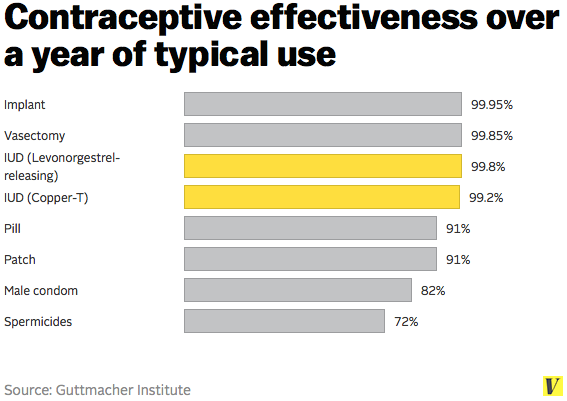
contraceptive_effectiveness

An Ohio Republican is trying to limit women’s access to long-term birth control. Elizabeth Nolan Brown ridicules his reasoning:

The first hearing for House Bill 351, sponsored by Cincinnati Republican Rep. John Becker, was held yesterday. At the hearing, Becker said insurance plans should be barred from covering IUDs because preventing the implantation of a fertilized egg—which IUDs could theoretically do, though they primarily work by preventing sperm from getting to that egg in the first place—could be considered abortion. “This is just a personal view. I’m not a medical doctor,” he added.

Sound policy reasoning there, Rep! Becker also acknowledged the wording of the bill could be interpreted to ban coverage of birth control pills, too, but he hadn’t intended it that way. He’s not a medical doctor, remember, just someone trying to play one with the weight of the state behind him. Under H.B. 351, all insurance plans in Ohio would be barred from offering abortion coverage. This isn’t a ban on “taxpayer funded abortions” we’re talking about—it’s an explicit restriction on the kinds of legal services that private insurance companies (and by extension, employers who offer health plans) can offer. Conservatives decry this sort of thing vociferously when it’s Obama making every insurance company and employer cover certain services.

German Lopez illustrates the bill’s folly with the above chart: 

The bill, in other words, attempts to stop women, particularly low-income women, from using one of the most effective, practical forms of birth control.

The only exemption in the bill is for ectopic pregnancies, which could threaten the life of the mother. Pregnancies involving rape, incest, and other life-threatening circumstances would not be exempted. Becker’s bill isn’t the first time Ohio’s Republican-controlled legislature has moved to restrict abortions. In the latest state budget, Republicans approved a slew of measures that will, among other things, allow state officials to more easily shut down abortion clinics.

Tara Culp-Ressler highlights the impact the bill would have on poor women in particular:

The unintended pregnancy rate for women living below the poverty level is more than five times as high than the rate for the women in the highest income level, largely because they struggle to access affordable birth control. Since long-lasting forms of birth control like the IUD remain effective for years without the need to take a daily pill or a monthly shot, public health experts recommend them for women who struggle with avoiding pregnancy. But IUDs are expensive, and can cost as much as $1,000 upfront. A large 2012 study focusing on low-income women in St. Louis found that when cost barriers to IUDs are removed, more women choose them and fewer women end up needing abortions.

Quote For The Day

“The thing to remember is that that cover came out when I was in college, and I was a reader of the New Republic, and I knew that that was leadwhere all the hot, young wannabe narrative journalists went. I knew that no black people worked at the New Republic. I also knew that the New Republic very much opined on quote-unquote “black issues” very often, in a fashion that struck me to be blunt and completely ill-informed and utterly ignorant. [Laughs]

If you want to know the source of some of my motivation, it’s that. It strikes you to be a young person and watch people in general speak about you as though you’re not there … Specifically I’m reacting to …  the idea of people having a conversation as though you’re not in the room, with no curiosity about who you are about your humanity. Discussing you as a problem. Disease, an infection. That’s what comes across in that cover,” – Ta-Nehisi Coates with Isaac Chotiner, TNR.

Your iPad Is Making You Fat

Jennifer Senior warns that our gadget dependency both deprives us of sleep and encourages absent-minded eating:

It’s already fairly well established that people consume more food when watching television. Recently, researchers at the University of Bristol found the same among those who eat in front of their computers, though their sample was small and the design of their study was a bit eccentric (they fed 44 subjects the same meals at lunchtime; those who ate while playing computer solitaire were apt to eat twice as many cookies 30 minutes later as those who ate far from a glowing screen). The theory, whether it’s television or a desktop: You remember eating when you’ve made a separate activity out of it; you don’t if you’re doing something else, and therefore misgauge your appetite.

Yet it’s increasingly difficult for Americans to unplug.

Last winter, The Journal of Clinical Sleep Medicine reported that nine out of ten of us use a technological device in the hour before bed. (In 60 percent of those cases, it’s the TV, but that’s in aggregate; for Americans under 30, it’s cell phones, which the researchers deemed much more disruptive.) According to a Pew study from 2010, 65 percent of Americans sleep with their cell phones on or next to their beds (for people 18–29, that number jumps 90 percent.) And in 2012, a poll by Harris Interactive found that 54 percent of Americans look at their phones while lying in bed.

None of which is to say that curtailing email and Facebook and Twitter use will make us lose ten pounds. But it cannot hurt, at the very least, and reminds us that all of our cells, be they inside our bodies or in the palms of our hands, could use a good rest.