A free and simple fitness plan:
Category: The Dish
When Your Parents Divorce Late In Life, Ctd
A few more readers chime in:
I love your blog, but your comment on this subject, sadly, missed the point. I agree that it’s never too late to seek happiness in life. I divorced after a 10-year marriage (no kids) and have discovered happiness and a life now that is more complete than I ever imagined.
I’m also an adult child of divorce. My parents split when I was in my late 20s (and while I was still married). It has had a profound impact on me. When you’re an adult child, the roles are reversed. You aren’t the “kid” who mom or dad or other family members reach out to make sure you’re ok and handling the grief of seeing your family being torn apart. You are the “adult” who becomes the shoulder for your mom and/or your dad to deal with their grief and their emotions.
They open up to you about the other in ways that make you look back and question memories of your childhood. The father I thought I knew becomes an ex-husband who “wasn’t this and wasn’t that”. The mother I thought I knew, becomes a ex-wife who “wasn’t this and wasn’t that”. People think since you’re an adult and already grown up, it’s easier for you to rationalize that relationships fail and deal with the loss.
Even though we’re adults, we’re still kids at heart. Experiencing the break-up of your family and loss of decades of established family traditions is hard too. Yet few recognize the impact this has on us kids even when we’re grown-up. We’re expected to understand. And, as a result, the loss and grief we go through are often ignored.
Another makes an interesting point:
Several readers wrote in objecting to the use of “stepmother” to refer to someone you first met as an adult. English is a flexible language. It is up to us to determine what words mean.
Reading the letters of how people think of a person who becomes attached to them as a result of the legal act of marriage, I realized that these people are discussing their “stepmothers” exactly the way I think of my two mothers-in-law (I’m widowed). Neither one was someone I had a choice in. Both were attached by marriage. One is someone I’m cordial to, but not all that close. The other is a great friend.
I just realized that these people are describing mothers who arrived by marriage. If she arrives when you’re already and adult, your dad’s new wife is really a “mother-in-law”, not a “stepmother”.
How Risky Is Going After Big Coal?
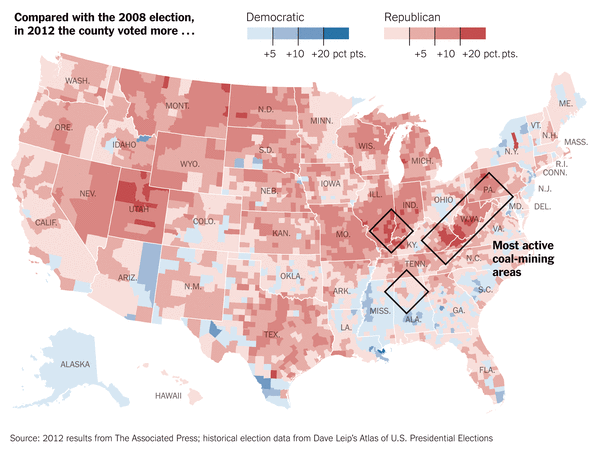
For Democrats, not very:
The war on coal hasn’t hurt the Democrats very much in presidential elections. Since 2000, when coal country and Appalachia helped cost Mr. Gore the presidency, Democrats have built an alternative path to victory with large margins in diverse, well-educated metropolitan areas, like Northern Virginia, Denver and Columbus, Ohio. Additional losses in coal country haven’t changed this because the areas don’t have enough voters to make a difference in battleground states.
And coal country has clear boundaries that limit harm to Democrats. In 2012, Mr. Obama suffered significant losses in the coal country of southwestern Virginia, losing as much as a net 30 points in traditionally Democratic Dickenson and Buchanan counties. Yet just a few miles to the east, in counties where there are no coal mines, Mr. Obama retained nearly all of his support. The same was true in southeastern Ohio.
Alec MacGillis adds:
Take Kentucky, the focus of much of the punditry, given the close race between Republican Senate leader Mitch McConnell and Democratic challenger Alison Lundergan Grimes. Coal-mining employment in the Bluegrass State has plunged by more than half in the past three decades, from 38,000 in 1983 to under 17,000 in 2012, according to the U.S. Department of Labor. (Nationally, there are 78,000 people employed in coal mining—well less than half as many as are employed in oil and gas extraction, and not much more than the number of people employed in logging.) To put that in perspective: the auto manufacturing industry in Kentucky employs three times as many people as the coal industry does today. When is the last time you heard pundits making grand predictions about how new auto-industry regulations would affect Kentucky “Car Country”?
China Gets Serious About Climate Change?
China said on Tuesday it will set an absolute cap on its CO2 emissions from 2016 just a day after the United States announced new targets for its power sector, signaling a potential breakthrough in tough U.N. climate talks.
Plumer unpacks the news:
If China ever did put a cap on its absolute carbon emissions, that would definitely mark a big policy shift. For now, China has only aimed to restrict its “carbon intensity” — the amount of carbon-dioxide it produces per unit of economic output. That means China’s overall emissions keep growing as the nation’s economy expands. A cap on emissions, by contrast, would require overall emissions to peak.
Also:
It’s not yet guaranteed that China will actually announce a cap. The man who made the announcement — He Jiankun, chairman of China’s Advisory Committee on Climate Change — is an adviser to the government, but he’s not a government official. So we’ll still have to see if this is the official Chinese government’s position. … More importantly, we don’t yet know the details of this supposed cap. What emissions will get capped? All of them? Some? How stringent will the cap be? Will it be enforceable?
Keating hopes the Chinese follow-through:
The Chinese government and official media often present the U.S. position on emissions as deeply hypocritical. China, after all, still has much lower emissions per capita than the United States, and the U.S. and Europe were able to pollute their way to prosperity in an era before concerns about global warming. Why, the argument goes, should China and other developing countries shoulder the burden for a problem largely created by the West?
This argument, paired with the American aversion to any new emissions rules that won’t also apply to China, creates a perfect feedback loop of inaction, with both countries arguing that the issue is the other side’s problem. While still very preliminary, this week’s news could be an indication that the two countries are starting to break out of the cycle and take some action on their own.
What Andrew Revkin is hearing:
I consulted with The Times’s Beijng bureau. Christopher Buckley, a reporter [based in Hong Kong] who in 2011 had covered China’s emissions plans [and similar pushes from advisers to adopt a cap] while with Reuters, spoke with He Jiankun, who told him repeatedly that he did not in any way speak for the government, or the full expert climate committee. Here’s Buckley’s translation:
It’s not the case that the Chinese government has made any decision. This is a suggestion from experts, because now they are exploring how emissions can be controlled in the 13th Five Year Plan…. This is a view of experts; that’s not saying it’s the government’s. I’m not a government official and I don’t represent the government.
Keith Johnson adds more context:
Beijing’s formal environmental goals are designed to make the economy relatively cleaner but allow overall greenhouse gas emissions to keep rising as the economy keeps growing. The latest official targets, for instance, are meant to cut carbon emissions per unit of GDP by 2015, rather than cutting carbon emissions outright. China is struggling to meet even those lower targets. Meeting these potentially more ambitious ones will be even harder.
The View From Your Window

Williamsburg, New York, 4 pm
Obama’s Global Warming Long Game
Lizza describes the president’s climate agenda as evidence of his “left conservatism”:
It’s hardly unheard of for a President to be cautious about pushing social change, and it would be more surprising if a President didn’t move in the direction of shifting public opinion. Obama and his aides like to see him as someone who plays a long game. They sometimes suggest that his movement on these issues is all part of a grand plan. More likely, Obama is what might be called a “left conservative,” a phrase that Norman Mailer briefly popularized when he ran for mayor of New York, in 1969. Obama obviously shares the outlook of the left on these cultural issues, but he’s temperamentally cautious and rarely believes that it’s worth his effort to act until his own liberal base has moved the country along with it. And, even then, he sees his job as moderating the passions of the activists.
But this interaction between Obama and an activist left that is slowly pushing the country in its direction—especially among younger Americans—is becoming the main subplot of the Obama years. While people like [environmental lawyer] James Milkey push for change at the bottom, they are increasingly finding an ally at the top.
Bouie credits Republicans for forcing the EPA’s hand. He recalls how they killed climate legislation in 2009:
It’s not that EPA action wasn’t possible, but that the administration wanted legislation and would make key concessions to get it. In the absence of a law, however, the White House was prepared to act alone. “If Republicans didn’t respond to the proposed deals,” wrote The New Yorker’s Ryan Lizza, “the White House could push them to the table by making a threat through the Environmental Protection Agency, which had recently been granted power to regulate carbon, just as it regulates many other air pollutants.”
With a little cooperation, Republicans could have won a better outcome for their priorities. They could have exempted coal from more stringent spectrum of regulations, enriched their constituencies with new subsidies and benefits, and diluted a key Democratic priority. Instead, they’ll now pay a steep substantive price for their obstruction, in the form of rules that are tougher—and more liberal—than anything that could have passed Congress.
Brentin Mock focuses on the racial justice angle of the new EPA rules:
President Obama hit on carbon pollution impacts on black and Latino kids within the first couple minutes of his talk with reporters yesterday, in a press call hosted by the American Lung Association. “The health issues that we’re talking about hit some communities particularly hard,” he said. “African-American children are twice as likely to be hospitalized for asthma, four times as likely to die from asthma. Latinos are 30 percent more likely to be hospitalized for asthma. So these proposed standards will help us meet that challenge head on.”
The fact that the EPA and Obama are holding up asthmatic kids of color as the avatar for the new carbon regime testifies to how much environmental-justice advocates have shaped this climate conversation over the past few years.
And Ben Adler previews the political battle to come:
Cleaner air, or less global warming, benefits everyone. But it benefits most people only marginally, and invisibly. So, as with many other types of industry regulation, support may be a mile wide and an inch deep. The costs, unlike the benefits, are heavily concentrated. Someone who works for a coal company, or a related industry, or in a community with a large coal presence, may see a direct threat to her livelihood and be much more motivated to call her congress member or show up at a town hall to express her intense opposition.
That’s why the coal industry will focus its efforts in the states that are most dependent on coal for their electricity, or that have it in the ground. “We’ve been seeking to educate and inform consumers through some of our grassroots activities in key coal and coal-consuming states,” says Nancy Gravatt, communications director for the National Mining Association, a trade organization for mining companies. There are 19 states across the Midwest, Appalachia, and the Rocky Mountains that get more than half of their electricity from coal. That’s where NMA will focus. And in Upper Midwestern states like Ohio, Minnesota, and Illinois, the group will argue that an increase in electricity costs would damage the manufacturing economy.
The Future Of The Gay Rights Movement Is Evangelical
I met the painfully young Matthew Vines last week, after a few near-misses over the past couple of years. The Dish has been following his work for a while now. Dan Savage gives you the basic biography:
Matthew Vines is a young gay man who grew up in Kansas. His family is Christian and very conservative. After coming out, Vines took two years off college to research and think deeply about what the bible says—and doesn’t say—about homosexuality.
Matthew doesn’t intend to go back to Harvard; indeed he has set his sights on living in Wichita, Kansas, where he is from, and building his fledgling organization, The Reformation Project, to create change within the evangelical church. But the most significant aspect of Matthew is his orthodoxy. His book, God and the Gay Christian, which I recently finished, is not an indictment of Christianity’s long and somewhat callous treatment of homosexuals; it’s an impassioned case that the Bible does not say what many have assumed it to say, once you bore down into the critical verses and chapters and try to understand them faithfully. It’s a thoroughly conservative and orthodox argument. We covered the gist extensively here and here. The video seen above is Matthew’s brand new distillation of the case into a few minutes.
But what thrilled me about the book is that it’s extremely persuasive in utterly orthodox terms. You do not have to pretend that almost all the references to same-sex sex in the Bible are not extremely negative to see more deeply that what these passages are condemning is excessive lust, sexual obsession, and sexual exploitation, rather than homosexual love, as we understand it now. More to the point, several other powerful and more fundamental Biblical passages show how the demand for enforced celibacy for gay Christians is anathema to the human flourishing that Jesus came to foster.
Some of the arguments were familiar to me, and were echoed in my own, somewhat parallel investigation into Catholicism’s natural law arguments against homosexual love. But others were genuinely new and eye-opening. If you read the book alongside James V. Brownson’s groundbreaking new work of Biblical scholarship, Bible, Gender, Sexuality, you begin to see the contours of a revolution in evangelical circles on the subject. Here’s a brief glimpse of an awakening:
What struck me about both books is a new tone. That tone is not defensive or angry, but entirely reasoned and calm. It is the tone I strove to achieve in Virtually Normal all those years ago – a tone designed merely to invite others into a dialogue beyond the polarizing culture and politics of our time. And it is a tone resting on confidence. There is no intellectual straining in Vines’ book; its arguments are simply explained and it is geared almost entirely to a readership that accepts basic evangelical notions about the Bible’s authority and divinely inspired literal truth. I’ve always had a bit of a defensive crouch about the obvious condemnation of some same-sex acts in the Bible, but because my own faith is not built on literalism or entirely on Biblical authority, I didn’t need to defang them. But Vines and Brownson do just that convincingly and then move on to the broader Christian message of the virtue of a commitment to another person, of self-giving to another in love and marriage, in ways that are finally able to include gay people in the broader evangelical community. I won’t read those passages in the Bible the same way again.
People talk about the cutting edge of gay activism, but here is another cutting edge – of gay scholarship in a zone where few openly gay people have felt emboldened to tread. These books may do to the next evangelical generation what John Boswell’s Christianity, Homosexuality and Social Tolerance did to mine. I cannot recommend it – or this fearlessly logical young spirit – highly enough.
Over The Hill
A reader gives Jonah Hill some credit:
You labeled this as “slur and apology,” but I do not see an apology here. And that’s a good thing, because what I see is something much better. Apologies have become so ubiquitous and meaningless these days, often extorted by interest groups and those seeking to benefit from phony outrage. Exactly to whom should he apologize? To whom does he “owe” an apology? The cameraman seeking the exact reaction he elicited? Others who are not involved but have inserted themselves into the story with self-righteous outrage?
What Hill said was so much better than any empty, extorted apology: it was a genuine recognition of reality and a sincere personal reaction to it. Hill owned his comments and didn’t grovel nor seek forgiveness; rather, he simply expressed that he said something that he felt bad about saying. To me, this was the perfect response. Hill owes nobody anything, and “apologies” forced under the threat of some other consequences are hardly apologies. I would much rather see someone express sincere personal reflection and disappointment.
Contrast that with Alec Baldwin’s lame apology to George Stark. Another reader suggests that the reflexive use of “faggot” or even “gay” as a slur is falling by the wayside with the current generation of kids:
As someone who basically grew up in Jonah Hill’s generation, I regrettably understand where his outburst originates. We all did it constantly in middle school and high school. “Faggot” was just the go-to insult, and “cocksucker” wasn’t far behind. But it was generational, and as offensive as their meanings, I never put connotation on them with being anti-gay.
I’m gay. And I called people this all the time, not because I had any anti-get animosity or self-hate, because I don’t, but because … it just was. I’ve had tons of friends – college and post-college – get into a fight and call someone a faggot and stop to turn to me and apologize to me. It was just a word. I think it speaks more to the percentages of millennials who support gay rights than those who learned an offensive word and fall back on it sometimes.
Update from a reader:
It’s probably worth linking to Hill’s apology on Jimmy Fallon last night. This doesn’t seem to be the scripted “I’m sorry if I offended” schtick his publicist gave him, but I’ll let folks judge for themselves.
Bassem Youssef Bows Out
A couple months ago, the comedian hailed as “Egypt’s Jon Stewart” sounded defiant:
But now, just days after former field marshal Abdel Fattah al-Sisi was elected president, Youssef has canceled his envelope-pushing satirical news show:
The cancellation of Youssef’s wildly popular show El Bernameg (“The Program”) underscored Egypt’s constriction of freedom of expression since the military removed elected President Mohamed Morsi last year. Since Morsi’s ouster, authorities put an end to the freewheeling media atmosphere that arose in the wake of the 2011 uprising. The interim government shuttered Islamist media, jailed Egyptian and foreign journalists and banned unauthorized protests. The crackdown on political opponents initially targeted thousands of Morsi’s primarily Islamist supporters, but it’s now affected many who, like Youssef, were staunch critics of Morsi.
In a news conference Monday at the downtown Cairo theater where his show used to be recorded, Youssef did not explain exactly why the show would not return to the airwaves, but suggested government pressure was to blame. “The Program doesn’t have a space,” he said. “It’s not allowed.”
Max Fisher sees a hint of irony in that Youssef supported the coup that brought Sisi to power:
It is true that Youssef, during the difficult year of Muslim Brotherhood rule in 2012 and 2013, was an important truth-teller whose jokes challenged the government’s abuses. He was briefly arrested for teasing the government on his TV show and faced real threats of serious prison time. This is the Youssef who is celebrated in the United States and elsewhere for his political satire, for challenging authoritarianism even when it put him at personal risk.
The Youssef who we do not typically see in the United States is the satirist who didn’t just challenge the Muslim Brotherhood government — but who went a step further, vilifying the regular Egyptians who supported the Islamist government, characterizing them as lesser citizens or internal enemies in a way that played into Egypt’s hate-filled political polarization, Sisi’s coup, and the disastrous consequences of both. Indeed, Youssef cheered on the military coup — as well as the bloodshed of anti-coup protesters, because unlike him they were Islamists
H.A. Hellyer also marks the show’s end:
Had Youssef been willing to make certain compromises, El-Bernameg could have gone on. He could have turned his show into one that lauded the now president-elect — certainly, that is what nearly all of the Egyptian media now does in some shape or form. He could have chosen to leave Egypt and broadcast in exile, or he could have gone to another channel — either another Arab one, or a European station.
But Youssef always made it clear that his program was an Egyptian program, and that it would be aired from Egypt on an Arab station — otherwise, it wouldn’t be aired. The last thing he wanted was to invite yet more attacks about the program being some sort of treasonous foreign entity. In discontinuing his show, Youssef and his team have sent a message: They refuse to compromise on their content to satisfy the powers that be. That is certainly unlike most of the Egyptian media — indeed, unlike media outlets the world over, including within the United States and Europe.
The Tea Party Prepares To Take Another Scalp
Late last night, Molly Ball explained what just went down in Mississippi:
Given the choice between an out-of-touch incumbent and a flawed challenger, Mississippi Republicans could not make up their collective mind. In a stunning result here Tuesday, the Republican civil war was fought to a draw. Senator Thad Cochran, a 41-year incumbent, took 48.8 percent of the vote, while state Senator Chris McDaniel, his Tea Party-aligned opponent, took 49.6 percent with more than 97 percent of precincts reporting late Tuesday. (One county had not reported its results because the election commissioner had gone to bed.) With the outstanding results unlikely to push either candidate over 50 percent, the two candidates appear headed for a runoff in three weeks’ time.
Beutler thinks the run-off won’t matter “in as much as McDaniel will be a junior Senator, who won’t vote much, if at all differently than Cochran would have”:
But it matters quite a bit as a reflection of the American right, and as a check against the growing narrative that Republicans have sloughed off their “Tea Party” problem. I’ve written skeptically of the idea that the GOP’s victories over “Tea Party” candidates this primary season are particularly meaningful. If the trick to beating “Tea Party” candidates is to nominate better-polished hardliners and throw tons of money at them, then the “Tea Party” hasn’t been beaten so much as the revanchist faction of the American right has been subsumed into the Republican party.
Weigel finds “no modern example of an incumbent senator losing the first round of a primary and winning a runoff”:
Cochran can’t bring any more Democrats into the electorate in three weeks, because Mississippi law prevents you from voting in one party’s primary and other party’s runoff.
So the Tea Party is war-whooping. FreedomWorks, which has been struggling after staff departures and weak fundraising, dispatched its president to the McDaniel victory party and sent reporters evidence of its hard work — 100,000 door knocks, 100 events, 40,000 yard signs. (You really can see the bold RETIRE COCHRAN songs all over the state.) The Tea Party Patriots Citizens Fund, a PAC that spent a half a million dollars on late ads, is currently meeting to discuss further investments.
Kilgore also doesn’t like Cochran’s chances:
[N]ow a deeply wounded Cochran faces a three-week runoff campaign in which many factors — especially turnout — favor his opponent. And with the heavy investment of groups like the Senate Conservatives Fund and the Club for Growth in Mississippi as their best prospect for a Senate RINO “scalp,” it would take a phenomenal effort by the incumbent or a big gaffe by the challenger to change the momentum in this race. When the smoke clears on June 24, Mississippi will likely join Kentucky and Georgia as states where the loss of a Republican Senate seat in November is possible, and the dissipation of GOP resources better spent elsewhere is certain. Beyond that, Republican pols everywhere would know that not even four decades of genial service and effective money-grubbing for a very poor state, or the support of virtually everyone there ever elected to a position above dogcatcher, is enough to survive the ever-rightward tide of the conservative activist “base.”
Should McDaniel become the nominee, Albert R. Hunt suggests that Democrats could win in Mississippi:
Before the primary, national Republicans admitted they were nervous over a possible McDaniel upset. They particularly feared the “Akin effect,” whereby his views would force other Republicans to either embrace or repudiate McDaniel. Still, the general feeling was McDaniel likely would squeak through in such a heavily Republican state. Actually, with a huge African-American population, Mississippi is not as red, or Republican, as it its neighbors, Alabama, Arkansas and Tennessee. In these three states, Barack Obama got less than 40 percent of the vote in the last presidential election; he got 44 percent in Mississippi.
Chait views this is wishful thinking:
[T]he most favorable polling still shows Democrats losing the seat even if McDaniel wins the nomination. As Nate Cohnshows, a majority of Mississippi is comprised of white Evangelicals who vote almost unanimously Republican in every election no matter what. So the only real question at stake is whether Mississippi’s Republican senator is a boring partisan or an entertainingly crazy one.
 The Dish