The cover story in yesterday’s NYT exposed the deplorable conditions of the laborers who built New York University’s new satellite campus in Abu Dhabi, where Bill Clinton will address the first graduating class this Sunday. Overworked, underpaid, living in squalor, with their passports confiscated, no rights or recourse to justice… gee, they sound just like other migrantworkers in the Gulf. But NYU had claimed they would do better. Joe Coscarelli sums up the university’s lame response:
A spokesperson for NYU said this was the first they’d heard about unrest among the workers and that the school is “working with our partners to have it investigated.” The executive director of campus operations for NYU Abu Dhabi added, “We’re not involved in the negotiation of the contracts that the partners are doing, just as they’re not in the negotiation of the contracts that we’re doing. We have a relationship with our partners, and so we have to trust that what they’re coming up with are the reasonable wages on their end.”
“I just don’t think that universities and museums should be working like Wal-Mart,” one NYU professor told BuzzFeed, speaking for the many critical of the long-planned expansion. “I think the opportunity for students to be in the Middle East and North Africa, you know, is wonderful. I believe in global education. But I think you also need to question the terms of production.”
That the NYU administration thinks anyone will buy the line that they just “have to trust” their contractors not to exploit workers is laughable. It’s called due diligence, and they clearly didn’t bother with it. But I’m also a bit shocked that anyone is shocked by this; as Keating points out, it is depressingly common for international institutions that do business in the Gulf to take advantage of these countries’ lack of labor protections:
When internationally renowned architect Zaha Hadid, designer of the largest of Qatar’s World Cup stadiums, was asked to respond to reports that over 382 Nepali migrant workers had died in construction related to the World Cup on top of the more than 500 Indian migrants who have died in the country in 2012, she replied, “I have nothing to do with the workers. I think that’s an issue the government—if there’s a problem—should pick up.”
Most of the large institutions setting up shop in the Gulf probably wouldn’t be quite so callous as to say that working conditions simply aren’t their problem, but it’s nonetheless the case that as the United Arab Emirates and Qatar have given free reign and enormous resources to cultural institutions like NYU, the Louvre, the Guggenheim, and FIFA, and turned themselves into architectural playgrounds for the likes of Hadid, Frank Gehry, Norman Foster, and I.M. Pei. The well-known fact that the Gulf’s construction boom depends on foreign migrant workers enticed by false promises into near-slave labor conditions has often been conveniently brushed to the side.
The administration has since apologized, but Coscarelli is not impressed:
NYU President John Sexton, the man who struck up a partnership with Abu Dhabi’s royal family, called the treatment “if true as reported, troubling and unacceptable … They are out-of-line with the labor standards we deliberately set for those constructing the ‘turn-key’ campus being built for us on Saadiyat Island and inconsistent with what we understood to be happening on the ground for those workers.” (Most worked for contractors, not the university directly.)
The apologies are all well and good on the PR front, but as one worker, waiting more than a year for his last six months of pay, told the Times, “When will the money come? If the money comes it will be O.K.” Sorry doesn’t feed a family.
NYU could have had someone on site monitoring the labor conditions that would actually try to find out what was going on rather one who papered over problems to make the client happy. It could employ these workers directly and be the responsible party for paying them. It could have constructed its own dormitories for these workers. But of course it did none of these things. NYU administrators were just following the cash. It contracted out the labor and completely forgot about it until the news reports about the exploitation came out. If NYU wants to take real responsibility, it will take on liability for these workers. Otherwise, this falls into the empty “I’m sorry we were caught” category of apology.
Congrats Pennsylvania!! Win for humanity. I can’t wait until gay marriage is so common it only makes the news in wedding announcements. — Family Stark Hoppus (@markhoppus) May 20, 2014
It's Truly Over >>> Bush-Appointed Judge Cites Scalia In Axing Pennsylania Gay Marriage Ban @TPMhttp://t.co/MzgVEo6xLI
Alice Dreger, a bioethics professor with a precocious son, reflects on how uninformed his classmates are when it comes to basic sex ed. Her core point:
How funny that we can’t bring ourselves to tell our children the most fundamental truth about sex, that most of the time we have sex, we have it for pleasure.
Praising the piece, Dan Savage shares a great anecdote from his newest book:
There’s a chapter in American Savage, which comes out in paperback next week, about how lousy sex education is in America. I point out that we don’t teach about pleasure in our sex ed programs—which run the gamut from dangerous (abstinence-only) to pathetic (“comprehensive” sex ed programs that leave out pleasure, gay sex, and obtaining consent, a.k.a. “talking people into having sex with you”).
But talking about sexual pleasure with kids is easier said than done. Even I left it out when I explained sex to my son. That omission lead to a pretty funny confrontation…
One day my then-eight-year-old son came into the kitchen and jumped up on the counter. He narrowed his eyes and gave me a strange look.
“Two men can’t make a baby,” D.J. finally said.
That’s true, I told him, two men can’t make a baby.
“Then you and daddy have sex for no reason,” he said.
Most of the sex that goes on out there—gay sex, straight sex, solo sex—is for “no reason,” or more accurately for a very good reason—for pleasure. And yet most parents, myself included, leave pleasure out of “the talk.” And if a sex-advice columnist who believes that pleasure needs to be incorporated into sex education leaves pleasure out, can you blame sex educators for ducking the issue?
An initial push to create a national database of firearm injuries in the late 1980s and early 1990s was slowed by the political fight over Centers for Disease Control and Prevention funding for gun research, according to a history of the project written by researchers who worked on it. To make the effort more politically viable, as well as more scientifically rigorous, researchers decided to collect data on all violent deaths, not just firearm deaths. And to cut costs, they decided to focus only on fatal injuries. Even that more limited effort has languished without full congressional funding – the database currently covers fewer than half of all states.
Most discussions of crime trends in America look back 20 years, to 1993, when violent crime of all kinds hit its peak. Compare 1993 to today, and the picture looks bright: The number of murders is down nearly 50 percent, and other kinds of violent crime have dropped even further. … But over the same time period, CDC estimates show that the number of Americans coming to hospitals with nonfatal, violent gun injuries has actually gone up: from an estimated 37,321 nonfatal gunshot injuries in 2002 to 55,544 in 2011. The contrast between the two estimates is hard to clear up, since each data source has serious limitations.
In his new book on race and genetics, Nicholas Wade incorrectly defines race biologically. But this is far from his worst error. Robert VerBruggen summarizes some of Wade’s main arguments:
(1) Why did the Industrial Revolution occur first in England? Wade lays out evidence, collected by the economist Gregory Clark in A Farewell to Alms, that those in England’s upper classes had been having more children than those in the lower classes — possibly affecting traits including “interpersonal violence, literacy, the propensity to save and the propensity to work,” and in turn transforming the population into one capable of immense economic output. An enormous population growth spurt starting around 1770 finally set the revolution off, and it quickly spread to other nations that were similarly situated.
(2) Wade says China had the right evolution but not the right institutions to take advantage of industry once it emerged, which is why its economy didn’t take off until it adopted economic reforms. Wade notes the examination system that was in place in China starting in 124 B.C., which he says created a sort of meritocracy that allowed the best scorers to rise in society and have the most children.
(3) Did violent tendencies evolve differently in different places? Wade notes that, among the Yanomamo of South America, men who have killed in battle have 2 1/2 times as many children as those who don’t. And he cites evidence that one gene that seems to contribute to violence — “MAO-A” — doesn’t show up evenly across populations, with one evidently violence-promoting variant being present in 5 percent of African-Americans but only 0.1 percent of Caucasians. The “gracilization” of the skull — the thinning that occurred as humans became less likely to try to bash each others’ brains in — shows a pattern too, but a very different one: It’s “most pronounced in sub-Saharan Africans and East Asians, with Europeans retaining considerable robustness.” Still another genetic variant, one related specifically to violence when drunk, has been found in Finns.
(4) Wade also digs into Jewish history, relaying theories that the religion’s emphasis on literacy — a skill with little practical value in a farming society — may have driven the less intelligent to join Christianity instead, and that European Jews’ being highly concentrated in intellectually demanding professions like moneylending may have further contributed to increased IQ.
In a review worth reading in full, H. Allen Orr declares that Wade “goes beyond reporting scientific facts or accepted theories and finds Wade championing bold ideas that fall outside any scientific consensus”:
Wade obviously appreciates the distinction between behavior that “could be” genetic and “is” genetic. The problem is that he doesn’t seem particularly interested in hard evidence or even in the prospects that relevant hard evidence could ever be obtained.
There is, however, another distinction that Wade doesn’t seem to appreciate at all. He’s right that political sensitivities shouldn’t distort scientific truth: the facts are the facts. But as [Steven] Pinker notes, this doesn’t mean that we shouldn’t be particularly careful when discussing race. History has shown that this is an especially dangerous subject, one that has resulted in enormous abuses. There is nothing unscientific about recognizing this and treading carefully.
At times, Wade’s approach seems almost the opposite. Though he issues the requisite disclaimers about the dignity and moral equality of all peoples, he’s clearly tempted, under the cover of politics-shouldn’t-distort-science, to provoke. Indeed there is a species of bravado here, as though demonstrating that he, unlike others, is tough-minded enough to face unpleasant facts. But surely there is a difference between facing facts that are unpleasant and spinning tales that are improbable.
Wade’s main thesis, and where the book goes wrong, is to insist that differences between human societies, including differences that arose in the last few centuries, are based on genetic differences—produced by natural selection— in the behavior of individuals within those societies. In other words, societal differences largely reflect their differential evolution.
For this Wade offers virtually no evidence, because there is none. We know virtually nothing about the genetic differences (if there are any) in cognition and behavior between human populations. And to explain how natural selection can effect such rapid changes, Wade posits some kind of “multiplier effect,” whereby small differences in gene frequencies can ramify up to huge societal differences. There is virtually no evidence for that, either. It is a mountain of speculation teetering on a few pebbles.
This is the problem with Wade’s book: it presents a sweeping hypothesis about the selective basis of human social differences ( a touchy subject), but gives virtually no evidence to support it. If you like stories, it’s fine; if you like science, it’s not so fine. Wade sometimes offers disclaimers, but the reader’s impression will be that he really is presenting scientific findings.
There is much I admire about Greg Clark’s (previous) book, but Wade doesn’t seem to realize Clark has hardly any evidence in support of his “genetic origins of capitalism” thesis.
Mr. Wade occasionally drops in broad, at times insulting assumptions about the behavior of particular groups without substantiating the existence of such behaviors, let alone their genetic basis. Writing about Africans’ economic condition, for example, Mr. Wade wonders whether “variations in their nature, such as their time preference, work ethic and propensity to violence, have some bearing on the economic decisions they make.”
For Mr. Wade, genetic differences help explain the failure of the United States occupations in places like Iraq and Afghanistan. “If institutions were purely cultural,” he writes, “it should be easy to transfer an institution from one society to another.” It’s hard to know how to begin to address such a puzzling statement.
Indeed it is. This paragraph from A Troublesome Inheritance also made my jaw hit the floor:
When North Korea adopts market-friendly institutions, a safe prediction is that it would in time become as prosperous as South Korea. It would be far less safe to predict that Equatorial Guinea or Haiti needs only better institutions to attain a modern economy; their peoples may not have yet had the opportunity to develop the ingrained behaviors of trust, nonviolence and thrift that a productive economy requires.
Andrew Gelman’s takedown of such nonsense is worth a read:
As a statistician and political scientist, I see naivete in Wade’s quickness to assume a genetic association for any change in social behavior. For example, he writes that declining interest rates in England from the years 1400 to 1850 “indicate that people were becoming less impulsive, more patient, and more willing to save” and attributes this to “the far-reaching genetic consequences” of rich people having more children, on average, than poor people, so that “the values of the upper middle class” were “infused into lower economic classes and throughout society.”
Similarly, he claims a genetic basis for the declining levels of everyday violence in Europe over the past 500 years and even for “a society-wide shift … toward greater sensibility and more delicate manners.” All this is possible, but it seems to me that these sorts of stories explain too much. The trouble is that any change in attitudes or behavior can be imagined to be genetic—as long as the time scale is right. For example, the United States and other countries have seen a dramatic shift in attitudes toward gay rights in the past 20 years, a change that certainly can’t be attributed to genes. Given that we can see this sort of change in attitudes so quickly (and, indeed, see large changes in behavior during such time scales; consider for example the changes in the murder rate in New York City during the past 100 years), I am skeptical of Wade’s inclination to come up with a story of genetics and selection pressure whenever a trend happens to be measured over a period of hundreds of years.
Wade often strays from his taxonomy – Caucasians sometimes stand equal alongside Africans and East Asians, while at other times “the West” is treated as separate to both the Middle East and the Indian sub-continent. Modern nation-states are frequently talked about as if ethnically homogenous, and what discussion there is of internal variation (say, class difference) is waved away as irrelevant. Quite why the Jews benefited from being kicked around Europe for hundreds of years while other persecuted ethnicities didn’t is unclear – the inevitable, unpleasant implication of this is that we can just as easily decide that the Roma are predisposed to petty crime, for example.
Never mind that there are plausible social, historical and economic analyses, with substantial evidence, that also explain the trends Wade has identified – his view is almost fatalistic in attributing everything to genes, based on nothing more than a correlation between the time it takes for the human genome to be shaped by environmental pressures and the time it takes for societies to undergo significant change. He does not pinpoint the genes he suspects cause social change – he merely deduces they must be there, because it fits the pattern.
And that’s so, so weird. Nobody – nobody – denies that there is genetic variation between distinct groups of people. This is visible in the colour of our skin, in our different heights and hair colours, in the higher rates of sickle cell disease among Africans and higher rates of obesity among Pacific Islanders.
What Wade is arguing for, though, is a definition of race that is at once dangerous and useless.
And Anthony Daniels’s review provides an alternative explanation for differing crime rates in Africa and the West:
The author tries to make out that the decline in the homicide rate in the western world is the result of genetic changes that gave survival advantage in new social circumstances to those who were less inclined to aggression and personal violence. These social circumstances not having yet developed in Africa, the homicide rate in the latter continent remains much higher than in Europe or the United States, the implication being that Africans are genetically more violent than the populations of Europe and the USA.
The author paints with far too broad a brush. Are there really no variations in the regions and countries of Africa, both in time and place? Is there really such continental uniformity? This was certainly not my experience of Africa, and I once travelled across it by public transport, such as it was.
Moreover, the statistics that the author uses are suspect. He says of the United States that its homicide rate is less than 2 per 100,000. The last time I looked the rate was 4.7 per 100,000—itself a very sharp decline of recent years. But a paper not long ago suggested that if the same resuscitation and surgical techniques were used as were used in 1960, the homicide rate in the United States would be five times higher than it is today, that is to say 23.5 per 100,000. The new techniques in surgery and resuscitation are unlikely to have reached much of Africa, where (the author says) the homicide rate is 10 per 100,000. In other words, either the statistics in Africa are unreliable—which in my opinion is very likely—or the statistics prove precisely the opposite of what the author wants to prove. Either way, his point is vitiated.
It’s banal to admit that genetics has helped shape human history. But one must balance genetic explanations with those based in history, culture, institutions, and random chance. Wade, under the guise of science, invents out of thin air theories to explain and justify current racial inequalities. He admits that history and culture play a role in the fates of nations, but he minimizes those factors and does not go looking for non-genetic explanations for regional inequalities. I do not detect any racial malice in Wade’s writing, but he appears to be suffering from the Just World Fallacy. David McRaney explained this psychological bias back in 2010. The short version:
The Misconception: People who are losing at the game of life must have done something to deserve it.
The Truth: The beneficiaries of good fortune often do nothing to earn it, and bad people often get away with their actions without consequences.
For Wade, there must be an innate reason why one population succeeds and another fails. He cannot accept that historical circumstance and pure luck are perhaps larger reasons for the current state of affairs. For example, here’s Wade downplaying the role of colonialism in keeping Africa down:
If running a productive , Western-style economy were simply a matter of culture, it should be possible for African and Middle Eastern countries to import Western institutions and business methods, just as East Asian countries have done. But this is evidently not a straightforward task. Though it was justifiable at first to blame the evils of colonialism, two generations or more have now passed since most foreign powers withdrew from Africa and the Middle East, and the strength of this explanation has to some extent faded.
Incredibly, he uses the fact that a mere two generations have passed since colonialism to argue that is should no longer be considered an adequate explanation for Africa’s continued economic problems. It would funny if it weren’t so depressing.
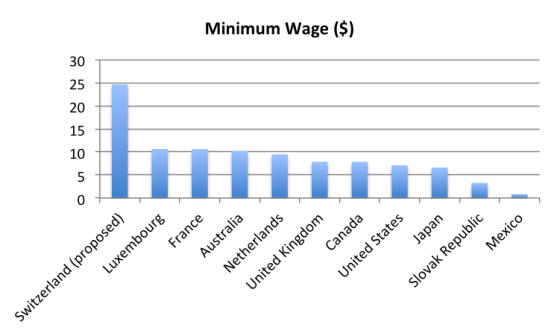
Jordan Weissmann is “kind of bummed” that Swiss voters rejected a referendum this weekend that would have enacted a minimum wage of 22 francs (about $25, or $14 adjusted for purchasing power—the highest in the world by either measure):
As I’ve written here before, one reason we should all be at least a little wary of efforts to push the minimum up to $15 in places like Seattle is that there isn’t a whole lot of historical precedent, either here in America or abroad. According to the OECD, Luxembourg currently has the world’s highest minimum wage, adjusted for purchasing power, at $10.70 per hour. With it’s enviably low 3.2 percent unemployment rate, Switzerland would have been a pretty safe place to test-run something more ambitious. After all, you’re talking about a generally high-pay country—only a tenth of Swiss workers earn less than the proposed minimum—where, even with some job losses, you’d still have a remarkably robust labor market. Alas, it’s not to be. The economics profession can only mourn.
Dan Kedmey thinks the vote helps define the limits of the minimum wage debate:
In the US, 71% of voters back President Barack Obama’s proposal for a minimum wage hike. In Germany, 81% of voters supported a similar proposal from German Chancellor Angela Merkel. But the scale of Switzerland’s proposed hike, vaulting it two times ahead of the most generous minimum wage rate in the world ($10.66 an hour, compliments of Luxembourg), clearly had Swiss voters on edge.
The referendum offers an interesting test case of where in the voters’ mind a wage hike leaves the realm of economic reality and soars into Alpine-high levels of wishful thinking. After all, if the Swiss bill became U.S. law tomorrow, it would require instant wage renegotiations for 620 occupations across the country, all of which pay less than $25 an hour on average.
Leonid Bershidsky calls Switzerland a poster child for direct democracy:
The Swiss have proved their wisdom by throwing out most crazy ideas, such as the abolition of the armed forces or price controls on books, as well as politically charged ultraconservative proposals such as ending health-insurance coverage for abortions. They are down-to-earth people who recently approved extra investment in rail infrastructure but voted down the purchase of new fighter planes. If a political party had their voting record, it would have been a reasonably liberal, moderate, centrist one.
I suspect people in most countries would vote as cautiously and reasonably as the Swiss if they knew their decisions would be immediately put into practice. Like any middlemen, politicians are hanging on to their intermediary role, talking of the populist threat and ordinary people’s lack of specialized knowledge. There is, however, nothing special about the Swiss: They are no smarter than Germans, Thais or Ukrainians, just wealthier — and wealth, according to Bonoli and Haeusermann, is not a good predictor of voting patterns. If they can vote responsibly, there is no reason why direct democracy shouldn’t work elsewhere.
Yesterday, Georgia’s Supreme Court upheld the state’s execution drug secrecy law:
In upholding the state law, the state’s Supreme Court ruled that, without confidentiality, there was “a significant risk that persons and entities necessary to the execution would become unwilling to participate.”
Georgia lawmakers passed the confidentiality measure last year amid concerns over the supply of pentobarbital, a chemical used in the injections. A number of firms, under pressure from anti-death penalty activists, have refused to supply the drug for the purposes of killing inmates.
But state law permits concealing the source of lethal injection drugs from the public, attorneys and judges in court proceedings.
Under the law Georgia just upheld, the public has no right to obtain the name of any person or company, even under seal in a legal proceeding, who manufactures or sells an execution drug. It also lets state authorities hide the identities of doctors who participate in executions—a professional ethical breach. The secrecy requirements may also be an effort to protect state officials from embarrassment; in 2010 and 2011, the state was shamed by news that it had been illegally importing expired drugs with limited potency from “Dream Pharma,” a London company operating out of the back of a run-down driving school. Georgia actually used those drugs in two executions before the Food and Drug Administration stepped in and confiscated the supply.
Meanwhile, Andrew Cohen worries about Russell Bucklew’s impending execution in Missouri:
Bucklew’s serious health problems guarantee that his execution will be far more complicated than most that have occurred recently during this season of discontent over injection procedures. That grim fact (and the botched execution last month in Oklahoma) have put pressure on officials in a state notorious lately for hiding its execution procedures from public view. And, to add to that pressure, several news organizations last week filed two First Amendment lawsuits seeking more basic information from Missouri’s executioners.
The litigation to make Missouri’s death-penalty more transparent and hold officials more accountable won’t spare Bucklew or any other death row inmates scheduled to be executed in the state anytime soon. And neither the state courts nor the 8th U.S. Circuit Court of Appeals, with primary federal jurisdiction over the state, have shown any inclination to stop recent executions or otherwise require officials to reveal more about the drugs they wish to use or how they are procured.
The Guardian has been live-blogging from Thailand, where the military declared a state of emergency and imposed martial law this morning, but claims it is not carrying out a coup:
Army chief General Prayuth Chan-ocha said the military had stepped in to restore order and build investor confidence, and warned that troops would take action against anyone who threatened security. At a press conference he said martial law would continue as long as necessary. The army offered to mediate between pro and anti government protesters after a six months of demonstrations and a stand off between the two sides. “We ask all sides to come and talk to find a way out for the country,” General Prayuth said.
Caretaker prime minister, Niwattumrong Boonsongpaisan, who had refused to protesters’ demands to step down on Monday, called for an election on 3 August. He said martial law could help the elections take place and said he was seeking talks with the generals.
Charlie Campbell calls out the army on that claim:
“The public do not need to panic but can still live their lives as normal — this is not a coup,” said an announcer Tuesday on military-run television, while soldiers took up positions at key intersections in the tourist-thronged Thai capital. However, Pavin Chachavalpongpun, associate professor at the Centre for Southeast Asian Studies at Kyoto University, says, “I think you can call this a coup … because this is about taking away power from the people, taking control of the political situation and human rights.”
Military intervention is endemic in Thailand. Since the end of absolute monarchy in 1932, the country has seen 11 successful coups, 23 military governments and nine military-dominated governments. The current coup, Pavin says, “is a move preserving the political position of the country’s elite.”
One idea is that martial law will create a face-saving exit for Suthep Thaugsuban, the leader of the anti-government protests. He has led the movement for six months now and so far failed to topple the elected government. His plan to have it replaced by an appointed government was going nowhere; there is no constitutional basis for toppling Thailand’s electoral democracy.
While Mr Suthep might welcome a break after six months of marching in the sun, this is surely not what motivated the imposition of martial law. The better bet is that martial law is something like a last ditch effort on the part of Mr Suthep’s sponsors. He had been playing the role of a front man for the old Thai establishment—representing the street-level id of the civil service, the army, the judiciary and the monarchy—and he has failed to deliver.
In this scenario, today’s move might then be a more forceful bid to dislodge the government and appoint a new one with the aim of rewriting rules of the game. The point would be to depose Thailand’s democracy and with it the chances of electing yet another government loyal to Thaksin Shinawatra, the one figure who has united democratic majorities in recent years.
Adam Pasick analyzes the situation from an economic standpoint:
Thailand has weathered many political upheavals and natural disasters, earning it the sobriquet “Teflon Thailand,” but as Quartz has reported, the nonstick surface is showing some heavy scratches: GDP fell 0.6% in the first quarter as consumer confidence and foreign investment plummeted. It’s unclear whether the declaration of martial law will exacerbate those fears, or create a stable starting point for the country to move forward.
“The imposition of martial law is not, in itself, negative for Thailand’s ratings, although clearly we are keeping the situation under close review,” said Fitch Ratings analyst Andrew Colquhoun in a note to clients. “It may even help to break Thailand out of the political deadlock of the past six months, by which the two sides have failed to agree on arrangements for new elections.”
Previous Dish on Thailand’s political crisis here, here, and here.
This speech by Charles Mills, which we’ve posted before, does an excellent job explaining the social construction of race:
Nicholas Wade’s new book on race and genetics, which takes the biological basis of race as a given, provides no consistent definition for “race.” During his debate with Wade, anthropologist Agustín Fuentes pointed out that “Wade uses cluster, population, group, race, sub-race, ethnicity in a range of ways with few concrete definitions, and occasionally interchangeably throughout the book.” In a response to Wade’s book, Fuertes explains how A Troublesome Inheritance gets race so wrong:
The originators of the computer program most often used to support the argument that humans divide into the continental genetic clusters (which Wade says are “races”) comment that their model (called structure) is not well-suited to data shaped by restricted gene flow with isolation by distance (as human genetic variation data on large scales are). They warn that if one does try to apply this model to those data, the inferred value of K (how many clusters emerge) can be rather arbitrary. For example, one article Wade cites shows not three, not five, not seven but 14 clusters, six of which are in Africa alone.
So when Wade states in chapter 5 of his book, “It might be reasonable to elevate the Indian and Middle Eastern groups to the level of major races, making seven in all,” he notices a problem: “But then, many more subpopulations could be declared races.” But he has a solution: “[T]o keep things simple, the 5-race continent based scheme seems the most practical for most purposes.”
Sure, it is practical if your purpose is to maintain the myth that black, white and Asian are really separable biological groups. But if your goal is to accurately reflect what we know about human biological variation, then no, it is a really not practical at all; in fact, it is flat-out wrong. What we know about human genetic variation does not support dividing humans into three or five or seven “races.”
Other writers who argue that race is biological aren’t as sloppy as Wade. And, even though I do not believe that defining race biologically is correct, it’s best to engage with the strongest arguments of those who disagree. For starters, here is part of a 2012 post by Jerry Coyne that defends defining human races biologically:
What are races?
In my own field of evolutionary biology, races of animals (also called “subspecies” or “ecotypes”) are morphologically distinguishable populations that live in allopatry (i.e. are geographically separated). There is no firm criterion on how much morphological difference it takes to delimit a race. Races of mice, for example, are described solely on the basis of difference in coat color, which could involve only one or two genes.
Under that criterion, are there human races?
Yes. As we all know, there are morphologically different groups of people who live in different areas, though those differences are blurring due to recent innovations in transportation that have led to more admixture between human groups.
Coyne, in the midst of a scathing review of Wade’s book, writes that “Wade’s discussion of genetically differentiated subgroups, whether or not you want to call them ‘races’—is not too bad.” H. Allen Orr, who tears Wade’s book to shreds, likewise defends a genetic definition of race:
The central fact is that genetic differences among human beings who derive from different continents are statistical. Geneticists might find that a variant of a given gene is found in 79 percent of Europeans but in only, say, 58 percent of East Asians. Only rarely do all Europeans carry a genetic variant that does not appear in all East Asians. But across our vast genomes, these statistical differences add up, and geneticists have little difficulty concluding that one person’s genome looks European and another person’s looks East Asian. To put the conclusion more technically, the genomes of various human beings fall into several reasonably well-defined clusters when analyzed statistically, and these clusters generally correspond to continent of origin. In this statistical sense, races are real.
This is what I also claimed, and of course got slammed by the race-denialists who are motivated largely by politics. To a biologist, races are simply genetically differentiated populations, and human populations are genetically differentiated. Although it’s a subjective exercise to say how many races there are, human genetic differentiation seems to cluster largely by continent, as you’d expect if that differentiation evolved in allopatry (geographic isolation).
Relatedly, Razib Khan argues that “the modern American consensus that race is a social construct is true but trivial”:
It’s true because a de facto race such as “Latinos/Hispanics” were created in the 1960s by the American government and elite for purposes of implementing public policies such as affirmative action. Obviously this is a classic case of a social construct, as the quasi-racial category is based upon social, not biological, factors (Latinos/Hispanic can explicitly be of any race, though implicitly it’s transformed into a non-white class in the United States). A group like “black Americans” ranges from people with considerably less than 50% African ancestry to more than 90% African ancestry (though almost always black Americans who are not immigrants from Africa or first generation offspring of those immigrants have some segments of European ancestry). The problem is that people move from this non-controversial point, that some racial categories are social constructs, to the assertion that all racial categories are social constructs, and that phylogenetic clustering of human populations is irrelevant or impossible. It is not irrelevant, or impossible. Human populations vary, and that variation matters. Human populations have specific historical backgrounds, and phylogenetics can capture that history through methods of inference.
I disagree with Khan calling “phylogenetic clustering of human populations” races, but Razib is far more intelligible here than Wade is in most of his book. Nevertheless, the biological definitions of race outlined above are problematic because they are not the same as the social definitions of race. There is significant overlap between the biological and social definitions but defining “race” two ways only confuses matters. In an interview, Wade offers an explanation for why he uses the term “race” as he does:
It seems that the problem might be, as you said, that there is so much historical baggage associated with the term race. Is there a way to get around that? Do we just need a different term than race to talk about these genetic differences?
I’m not sure how that will play out. The geneticists, if you read their papers, have long been using code words. They sort of dropped the term “race” about 1980 or earlier, and instead you see code words like “population” or “population structure.” Now that they’re able to define race in genetic terms they tend to use other words, like “continental groups” or “continent of origin,” which does, indeed, correspond to the everyday conception of race. When I’m writing I prefer to use the word race because that’s the word that everyone understands. It’s a word with baggage, but it’s not necessarily a malign word. It all depends on the context in which it’s used, I guess.
Wade says that “everyone understands” the word race. But what everyone understands are the social definitions of race: White, Black, Latino, Asian, Native American, Samoan, and so on. Wade dismisses geneticists who use terms like “population structure,” “population stratification,” “ancestry” and “ancestry informative markers.” But those terms are useful when discussing genetics because they allow for far more complexity and specificity than our social definitions of race do.
Obviously, skin color and the other physical characteristics society uses to categorize individuals racially are biological. But skin color and other physical traits are not the same as race. And, as Khan noted recently, one “of the ironies of traits which we use to differentiate populations, such as skin color and facial features, is that these might actually have relatively shallow time depth within a given lineage.” So prioritizing skin color above all other ancestry informative markers finds little basis is biology. In a 2012 post, Fuentes argued against a biological understanding of race for related reasons:
Even something thought to be so ubiquitous as skin color works only in a limited way as dark or light skin tells us only about a human’s amount of ancestry relative to the equator, not anything about the specific population or part of the planet they might be descended from.
There is not a single biological element unique to any of the groups we call white, black, Asian, Latino, etc. In fact, no matter how hard people try, there has never been a successful scientific way to justify any racial classification, in biology. This is not to say that humans don’t vary biologically, we do, a lot. But rather that the variation is not racially distributed.
Alfred W. Clark, a strong defender of Wade’s book, has a useful round-up of commentary on A Troublesome Inheritance. In it, he dismisses Fuentes by arguing that he is suffering from a “slightly more sophisticated version of Lewontin’s Fallacy.” What is Lewontin’s Fallacy? In a 2005 NYT article arguing that race is biological, Armand Marie Leroi explained it:
The dominance of the social construct theory can be traced to a 1972 article by Dr. Richard Lewontin, a Harvard geneticist, who wrote that most human genetic variation can be found within any given “race.” If one looked at genes rather than faces, he claimed, the difference between an African and a European would be scarcely greater than the difference between any two Europeans. A few years later he wrote that the continued popularity of race as an idea was an “indication of the power of socioeconomically based ideology over the supposed objectivity of knowledge.” Most scientists are thoughtful, liberal-minded and socially aware people. It was just what they wanted to hear.
Three decades later, it seems that Dr. Lewontin’s facts were correct, and have been abundantly confirmed by ever better techniques of detecting genetic variety. His reasoning, however, was wrong. His error was an elementary one, but such was the appeal of his argument that it was only a couple of years ago that a Cambridge University statistician, A. W. F. Edwards, put his finger on it.
The error is easily illustrated. If one were asked to judge the ancestry of 100 New Yorkers, one could look at the color of their skin. That would do much to single out the Europeans, but little to distinguish the Senegalese from the Solomon Islanders. The same is true for any other feature of our bodies. The shapes of our eyes, noses and skulls; the color of our eyes and our hair; the heaviness, height and hairiness of our bodies are all, individually, poor guides to ancestry.
But this is not true when the features are taken together. Certain skin colors tend to go with certain kinds of eyes, noses, skulls and bodies. When we glance at a stranger’s face we use those associations to infer what continent, or even what country, he or his ancestors came from – and we usually get it right. To put it more abstractly, human physical variation is correlated; and correlations contain information.
Genetic variants that aren’t written on our faces, but that can be detected only in the genome, show similar correlations. It is these correlations that Dr. Lewontin seems to have ignored. In essence, he looked at one gene at a time and failed to see races. But if many – a few hundred – variable genes are considered simultaneously, then it is very easy to do so.
But this still fails to prove that races are biological. Calling these populations “races” is a semantic rather than a scientific decision. Wikipedia provides useful context on this front:
Philosophers Jonathan Kaplan and Rasmus Winther have argued that while Edwards’s argument is correct it does not invalidate Lewontin’s original argument, because racial groups being genetically distinct on average does not mean that racial groups are the most basic biological divisions of the world’s population. Nor does it mean that races are not social constructs as is the prevailing view among anthropologists and social scientists, because the particular genetic differences that correspond to races only become salient when racial categories take on social importance. From this sociological perspective, Edwards and Lewontin are therefore both correct.[13][14][15]
Similarly, biological anthropologist Jonathan Marks agrees with Edwards that correlations between geographical areas and genetics obviously exist in human populations, but goes on to note that “What is unclear is what this has to do with ‘race’ as that term has been used through much in the twentieth century – the mere fact that we can find groups to be different and can reliably allot people to them is trivial. Again, the point of the theory of race was to discover large clusters of people that are principally homogeneous within and heterogeneous between, contrasting groups. Lewontin’s analysis shows that such groups do not exist in the human species, and Edwards’ critique does not contradict that interpretation.”[6]
Much like gun control, climate is an issue that unites Republicans by ideology but divides Democrats by geography. Even if Democrats can build a bigger Senate majority through the next few election cycles—they are positioned to add seats in 2016 even if they lose control in 2014—such gains probably won’t produce the 60 votes needed to break a filibuster against legislation to limit carbon emissions.
The Democrats’ problem is that they cannot build a big Senate majority without winning seats in states heavily dependent on coal, which would suffer the most from limits on carbon. Democrats now hold 21 of the Senate seats in the 19 states that rely on coal to produce a majority of their electricity and half of the seats in the 10 states (some overlapping) that mine the most coal. Resistance from some coal-state Democrats doomed climate legislation in 2009, even when the party controlled 60 Senate seats and then-Speaker Nancy Pelosi narrowly muscled a cap-and-trade bill through the House. Senate Democrats such as North Dakota’s Heidi Heitkamp and Indiana’s Joe Donnelly remain equally unenthusiastic today.

 The Dish