Lessons In Listening

Win Bassett, a seminarian at Yale Divinity School, looks back at what he learned as a hospital chaplain this past summer. Avoiding phrases like “everything happens for a reason” is among the lessons that mattered the most:

Instead of trafficking in speculations about why a person experiences pain or becomes ill, I found it far more helpful to ask the question “What now?”

Reynolds Price wrote that after his cancer diagnosis “the kindest thing anyone could have done for me…would have been to look me square in the eye and say this clearly, ‘Reynolds Price is dead. Who will you be now?’” I once presented this passage from Price at a conference, and a participant who had survived breast cancer told me that, years ago, she playfully added “2.0” at the end of her name.

Nevertheless, I bet she sometimes heard the wrong words at the wrong times during her recovery. We’ve all said them, and we don’t do it because we fail to understand that these responses are theologically indefensible. We utter these words because they seem to be the only things that might give momentary comfort. Because these dubious phrases have become our default expression of consolation, we need God’s help to put them aside, to remain silent until we have something truer and therefore more helpful to say. Sometimes the words never come, and silence itself is enough. With or without words, chaplains are there to offer another loving presence, sometimes the only loving presence. As the Episcopal priest and poet Spencer Reece writes in a poem about his own experience in a hospital chaplaincy, “It is correct to love even at the wrong time.”

Does Jealousy Make The World Go Round?

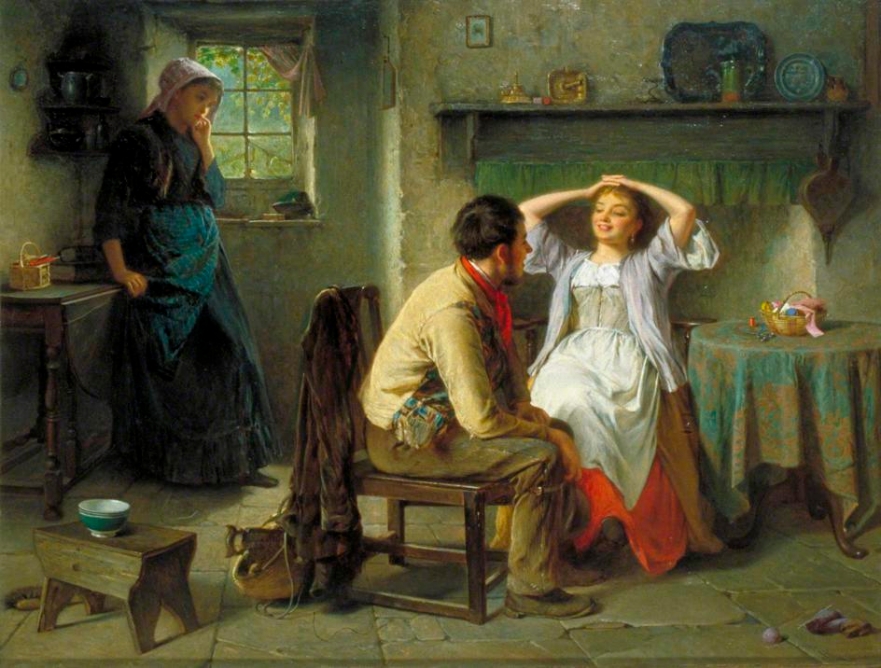
Jealousy_and_Flirtation

Peter Toohey’s new book, Jealousy, puts it at the center of our emotional lives. Musing over his arguments, Diane Johnson runs down the many ways it’s informed art, especially in the last few centuries:

Toohey tells us that beginning in the late nineteenth century, painting and literature would see an “explosion” of treatments of the subject, with obsessively jealous characters like Tolstoy’s Pozdnyshev in The Kreutzer Sonata, or, later, Dickens’s Bradley Headstone—the reader will think of dozens of instances—Emma, or la cousine Bette, or the hero of Trollope’s He Knew He Was Right, who dies of it, or Così Fan Tutte, much of Verdi, “Frankie and Johnny”—jealousy is all over the place.

In painting and sculpture there’s a whole iconography of jealousy—ears, husbands listening behind doors, cats with their big green eyes, the color yellow. As the twentieth century approaches, artists begin reaching for means to express what jealousy feels like; here he points to the paintings of Edvard Munch and of August Strindberg, the playwright, who seems to have found painting to be more directly expressive of his jealous state of mind.

Toohey examines the discoveries of late-nineteenth and early-twentieth-century psychology by Freud and his colleagues. He doesn’t mention but we might think of Freud’s friend Arthur Schnitzler’s Dream Novel, the inspiration for the Stanley Kubrick film Eyes Wide Shut, which details the psychic revenge fantasies of a husband whose jealousy in all its Freudian complexity is aroused by his wife’s erotic fantasies. One of Toohey’s more interesting findings is that a morbidly jealous person (as opposed to “normally” jealous) is especially zealous in seeking “visual evidence to confirm the truth of the way they are feeling”; Othello must see Desdemona’s handkerchief. This visual element makes film a particularly suitable medium for expressing jealousy. He suggests that stalking also arises from the visual need.

(Image: Jealousy and Flirtation by the 19th century French artist Haynes King, via Wikimedia Commons)

First Chapters, Then Verse

We’ve featured reviews of James Booth’s new biography, Philip Larkin: Life, Art, Love, over the last few months. Now, Dana Gioia notices an interesting wrinkle in the poet’s story – it was only after Larkin wrote two early novels, Jill and A Girl in Winter, that he devoted himself to verse:

As his dreams of being a great novelist expired, Larkin poured his full talent into poetry. He discarded his lofty, early models, Yeats and Auden, and studied instead the homely genius of Thomas Hardy (another novelist-turned-poet). Larkin then brought a novelistic sensibility into his verse. Emphasizing the prosaic virtues of plot, setting, character, and narrative voice—the building blocks of fiction—he crafted a new sort of lyric poem, one firmly placed in the everyday world and yet charged with evocative power. His new poems also had personality; they were simultaneously savage and yet compassionate, very depressing and very funny. His language grew commonplace without losing its musicality, and he displayed a gift for using complicated verse forms in ways that sounded utterly conversational, as in the opening lines of “Annus Mirabilis”:

Sexual intercourse began
In nineteen sixty-three
(Which was rather late for me)—
Between the end of the Chatterly ban
And the Beatles’ first LP.

The change happened during his years in Belfast (1950–1955).

Always a good poet, Larkin suddenly became a great one, producing a series of works in quick succession that were destined for the anthologies—“Lines on a Young Lady’s Photograph Album,” “I Remember, I Remember,” “For Sidney Bechet,” “Poetry of Departures,” “Toads,” and “Church Going.” Although these poems would become signature pieces of contemporary British literature, Larkin initially couldn’t find a publisher for them. After repeated rejections, the despairing poet sent his breakthrough volume, The Less Deceived, to George Hartley, a friend in Hull, who wanted to start a press. Larkin would regret the decision, but the small, unpublicized collection proved an immediate success with great reviews and steady sales. Larkin soon found himself named the central figure of “The Movement,” a celebrated group of young writers. To his own astonishment, he was famous.

“Taking The Edge Off Vulnerability”

Todd May questions what he calls “invulnerabilism,” the approach of philosophies like Buddhism, Taoism, and Stoicism that teach, in his words, that “we can, and we should, make ourselves immune to the world’s vicissitudes.” He argues instead for a particular type of engagement:

As far as I can tell, the way to think about these things has less to do with the invulnerability promoted by the official doctrines, and more to do with, one might say, using these doctrines to take the edge off of vulnerability, to allow one to experience life without becoming overwhelmed or depressed or resentful or bitter, except perhaps at the extremity of loss. There is some combination of embedding oneself in the world in a vulnerable way and not being completely undone by that vulnerability that is pointed at, if not directly endorsed, by the official doctrines.

It seems to me that Taoism, Buddhism, Stoicism, etc. work not by making one invulnerable but rather by allowing one to step back from the immediacy of the situation so that the experience of pain or suffering is seen for what it is, precisely as part of a contingent process, a process that could have yielded a very different present but just happened to yield this one. This, of course, is not the official doctrine either, especially for Stoicism, for which the unfolding of the cosmos is a rational one. (Buddhists will periodically refer to the contingency of the cosmos’ unfolding; however, the concept of nirvana bends that contingency toward something more nearly rational, or at least just.) But it does seem to me to capture their common insight that there is so much about the world that we cannot control; seeking to master it is an illusion. We must learn instead to live with the process in all its contingency, even where we hope to change it for the better.

And we must understand that for most of us suffering is inevitable. We can recognize all this and take solace from it without having to take the step of removing ourselves from the desires that lead to suffering.

Face Of The Day

Ivy-Barn-Owl-406x524

For her series Prey, Leila Jeffreys photographs the predatory birds of Australia. From an interview:

There is just so much diversity in Australian birds. Some birds of prey are typically stern and formidable, while others are shy and affectionate. … This series does have some colourful characters like Pepper, a gorgeous Southern Boobook Owl who was rescued and rehabilitated, yet continues to return to Broadwings every time she is released; a cheeky Kestrel called Bandit with a penchant for stealing tea bags; and a rescued Goshawk called Trinity, a victim of habitat destruction as a result of land clearing; plus many more.

I photographed the series with a large format Phase One camera so the detail captured is stunning and I print my artworks at human size so that they can be appreciated as equals. I think that if you stare into the eyes of a regal bird of prey you begin to feel a deeper connection and understanding of the species.

See more of her work here and here.

(Photo of “‘Ivy’, Eastern Barn Owl” by Jeffreys. Hat tip: Jobson)

A Poem For Sunday

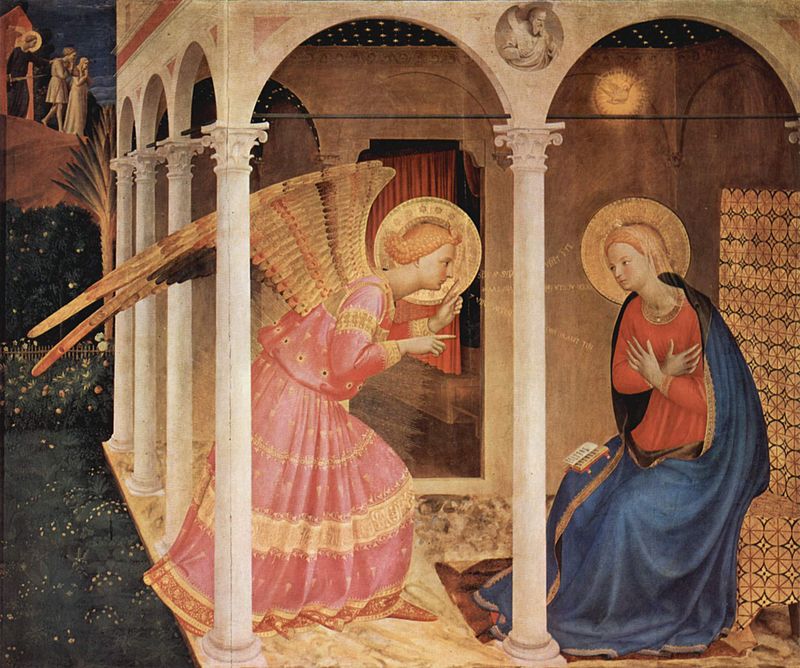
800px-Fra_Angelico_069

Dish poetry editor Alice Quinn writes:

In the appealing anthology Lifelines: New and Collected, Letters From Famous People About Their Favourite Poem, contributors range from novelists on the order of Doris Lessing and Penelope Fitzgerald to actors and scientists on the order of Rosaleen Linehan and Richard Dawkins. One choice surprising to me was made by Peter Fallon, a poet and the distinguished publisher of Gallery Books, who wrote this about his selection:

Thousands of times I’ve heard the ‘Hail Mary’ transformed into, at best, a kind of mantra, at worst, the sound of no sense. Yet the words are lovely in their pure praise of a woman, a mother—maybe all women—and the phrase which has always delighted me, that is ‘the fruit of thy womb,’ for an offspring, a welcomed child, has again and again been submerged in the interminable decades of a million galloping rosaries. …Perhaps it’s the editor in me which would propose to alter the order of the first section of the piece so that it ends ‘Blessed is Jesus, the fruit of thy womb,’ to recover its special emphasis.

The text of the Hail Mary:

Hail Mary, full of grace,
The Lord is with thee.
Blessed art thou amongst women
and blessed is the fruit of thy womb, Jesus.
Holy Mary, mother of God,
pray for us sinners,
now and at the hour of our death, Amen.

(“The Annunciation” by Fra Angelico, circa 1434, via Wikimedia Commons)

Quote For The Day

“Shall we say that Montaigne has spoken wisely, and given the right and permanent expression of the human mind, on the conduct of life?

We are natural believers. Truth, or the connection between cause and effect, alone interests us. We are persuaded that a thread runs through all things: all worlds are strung on it, as beads; and men, and events, and life, come to us only because of that thread: they pass and repass only that we may know the direction and continuity of that line. A book or statement which goes to show that there is no line, but random and chaos, a calamity out of nothing, a prosperity and no account of it, a hero born from a fool, a fool from a hero,- dispirits us. Seen or unseen, we believe the tie exists. Talent makes counterfeit ties; genius finds the real ones.

We hearken to the man of science, because we anticipate the sequence in natural phenomena which he uncovers. We love whatever affirms, connects, preserves; and dislike what scatters or pulls down. One man appears whose nature is to all men’s eyes conserving and constructive; his presence supposes a well-ordered society, agriculture, trade, large institutions and empire. If these did not exist, they would begin to exist through his endeavors. Therefore he cheers and comforts men, who feel all this in him very readily. The nonconformist and the rebel say all manner of unanswerable things against the existing republic, but discover to our sense no plan of house or state of their own. Therefore, though the town and state and way of living, which our counsellor contemplated, might be a very modest or musty prosperity, yet men rightly go for him, and reject the reformer so long as he comes only with axe and crowbar.

But though we are natural conservers and causationists, and reject a sour, dumpish unbelief, the skeptical class, which Montaigne represents, have reason, and every man, at some time, belongs to it. Every superior mind will pass through this domain of equilibration – I should rather say, will know how to avail himself of the checks and balances in nature, as a natural weapon against the exaggeration and formalism of bigots and blockheads.

Skepticism is the attitude assumed by the student in relation to the particulars which society adores, but which he sees to be reverend only in their tendency and spirit. The ground occupied by the skeptic is the vestibule of the temple. Society does not like to have any breath of question blown on the existing order. But the interrogation of custom at all points is an inevitable stage in the growth of every superior mind, and is the evidence of its perception of the flowing power which remains itself in all changes,” – Ralph Waldo Emerson, “Montaigne; or, the Skeptic,” in Representative Men.