What’s Rove’s Game?

Yesterday, Karl Rove defended his recent comments that suggested Hillary Clinton could have brain damage:

Chotiner expects the attack to backfire:

Rove has always been overrated as a strategist. (If the Florida recount had gone the other way, Bush’s decision to campaign in New Jersey and California in the week before the 2000 election would have gone down as one of the great blunders in campaign history.) But, as with Rand Paul’s comments about Monica Lewinsky, Republicans seem completely confused as to how to run against Hillary Clinton. The two times Clinton has been most popular or politically robust were during the Lewinsky mess and parts of the 2008 campaign, when she came to be seen as a victim of media sexism. Perhaps Rove is so Machiavellian that for some reason he wants Clinton to win in 2016, thus ensuring…who knows what? Either that or his comments are simply dumb as well as nasty.

Beinart isn’t so sure:

Why does Rove allegedly smear his opponents this way? Because it works.

Consider the Clinton “brain damage” story. Right now, the press is slamming Rove for his vicious, outlandish comments. But they’re also talking about Clinton’s health problems as secretary of state, disrupting the story she wants to tell about her time in Foggy Bottom in her forthcoming memoir.

Assuming she runs for president, the press will investigate Clinton’s medical history and age no matter what Rove says. But he’s now planted questions—about the December 2012 blood clot that forced her into the hospital, and about her mental condition as she ages—that will lurk in journalists’ minds as they do that reporting. If she has a moment of Rick Perry-like forgetfulness sometime between now and the fall of 2016, Rove’s comments make it more likely that voters will wonder whether she’s still with it mentally.

Kleiman makes related points:

My high-school biology textbook told me that the paramecium is the lowest form of animal life. Obviously, the author of that textbook had never encountered Karl Rove. He knows how to play the media like a violin, half-saying things he can later deny, getting a story each time that plants a nasty suspicion about an opponent, and reporters don’t know how to resist.

Waldman weighs in:

Here’s one way to understand Rove’s comments: They might be a way of testing how allegations about Clinton’s health — or about anything else — play out in the press. Will the news media pick them up and run with them? How far can Republicans go in making unsubstantiated charges? What kind of blowback will there be, and would it outweigh the benefits to Republicans of making Clinton answer uncomfortable questions? After all, while Rove may not be quite the political genius many believe, he doesn’t make statements like that without a reason.

Cillizza adds:

Rove is not exactly the ideal messenger to carry the “Is Hillary healthy enough to be president?” argument. “Having Karl Rove lead the charge will only solidify Democratic support behind Hillary, and risks alienating independents who think personal attacks are out-of-bounds,” said one Democratic consultant granted anonymity to speak candidly about the political impact from Rove’s comments.

In the end, Clinton’s health and age will only be an issue if there is a re-occurrence (or some new occurrence) of a medical problem that suggests she may not be able to carry out the duties of the office. If Clinton is actively moving around the country — speaking, raising money and, eventually, campaigning — without incident, the age and health questions will likely disappear.
Adapting To Global Warming

Noah Millman argues that although “a rise in sea levels and an increased incidence of extreme weather are the easiest parts of climate change to understand, they aren’t actually the most important.” He makes some reasonable points:

Human beings adapt pretty readily to flooding. We know how to build sea walls, and ecologically-sophisticated systems of flood control. In the extreme, we know how to move – we are a highly mobile species.

It’s less clear how well we’d adapt to wholesale changes in the ecology attendant on changes in CO2 levels. An increase in the acidity of the oceans, for example, could significantly disrupt the marine food chain (what’s left of it after over-fishing). A wide variety of land-based species are also sensitive to changes in the climate; global changes could have an unpredictable global impact on overall biodiversity. The earth, of course, will adapt just fine; the terrestrial climate has seen some pretty huge swings over geological timescales, and the diversity of life has recovered from multiple mass-extinctions. Human beings, though, have only been around for a million or so years (much less depending on how picky you are about what counts as “human”), and large-scale civilization is only a few thousand years old. We have no idea how well that civilization would adapt to widespread ecological disruption.

Moreover, there is a synergy between efforts to reduce the impact of human activity on the environment and efforts to repair or adapt to the consequences of that activity. The slower the rate of CO2 and methane emissions, the slower these changes will progress; in effect, we’d be buying time to adapt.

Working The Land

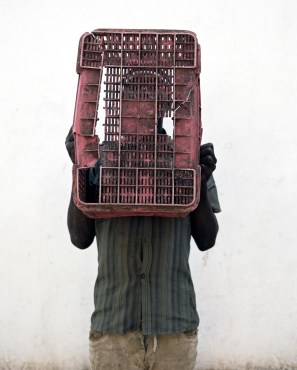
Jackie Nickerson‘s Terrain series depicts African farmers obscured by their crops and working materials. Sean O’Toole explains the work:

Formally, Terrain presents a synthesis of two ways of seeing and describing the daily grind EOK0011N_21.tifof commercial farming. The book juxtaposes portrait studies of farm workers, many pictured at the site of their labour, either harvesting or gathering industrial crops such as tobacco, maize or banana, alongside descriptive landscape studies, typically of open fields and enclosed sites of cultivation. The sequencing of these photographs is however more important than the genre they belong to: Terrain makes no distinction between ethnicity and geography; it erases very real linguistic, cultural, economic and political differences. It is a risky strategy. Although sometimes overstated for effect, there is a common-held perception in the global north of Africa as a vast undifferentiated space.
Nickerson, who is nominally an outsider on the continent, is well aware of this bias. She accepts as given that the circumstances of a Malawian farmworker, for example, differ substantially from workers in Kenya, South Africa, Zambia or Zimbabwe, all countries pictured in Terrain. Nickerson has observed these differences first-hand – principally on month-long excursions to specific farms for this project, although it bears noting that Nickerson lived on a farm in Zimbabwe for five years in the late 1990s, an experience that sharpened her understanding of the daily nuances and political complexities of farm labour. But Terrain is not an evidentiary record of what distinguishes here from there, him from her, this from that.

See more of Nickerson’s work here.

(Image © Jackie Nickerson. Courtesy the artist and Jack Shainman Gallery, NY)

American Decline Is Real

With regard to height:

For centuries, Americans were the NBA players of the world. We were two inches taller than the Red Coats we squared off against in the American Revolution. In 1850, Americans had about two and a half inches on people from every European country. But our stature plateaued after World War II, and since then, other countries shot past us. White Americans have grown a bit taller since the early 1980s, but African Americans haven’t.

And the tallest in the world?

[T]he Dutch are the tallest, at an average of six feet for men and five-foot-seven for women. They’ve come a long way: In 1848, a quarter of Dutch men were rejected from military service because they didn’t meet the five-foot-two height limit. “Today, fewer than one in 1,000 is that short,” the Associated Press noted in 2006.  (The tallest people on record, though, are apparently the people of the Dinaric Alps, in the former Yugoslavia, where adolescent males are, on average, six-foot-one monoliths.)

The Danes, Norwegians, and Germans stack up right under the Dutch. American men and women, meanwhile, measure just 5’9″ and 5’4″, respectively, barely edging out the Southern Europeans.

The Stigma Against Stoned Driving

Stoned Driving

It should be stronger than it is:

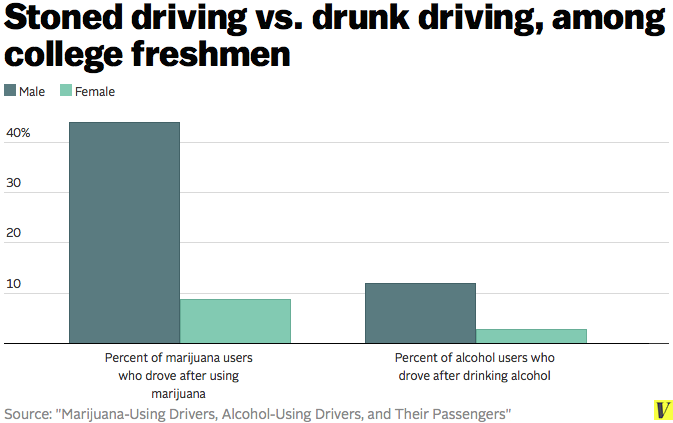
Researchers suggest that college students in general perceive stoned driving to be safe. The popular misconception is that, while alcohol demonstrably slows someone’s reflexes, marijuana makes drivers more anxious and, therefore, more attentive to possible mistakes on the road. But the research shows that, while marijuana doesn’t affect everyone in the same way, it does impair a person’s ability to drive at some level.

Ethics In The Superbrain Era

Alexis Madrigal explores the drugs and technologies we are already using to augment our brain power, and the Institute for the Future’s proposal for a “Magna Cortica” to lay out some ethical principles of cognitive enhancement:

Back in 2008, 20 percent of scientists reported using brain-enhancing drugs. And I spoke with dozens of readers who had complex regimens, including, for example, a researcher at the MIT-affiliated Whitehead Institute for Biomedical Research. “We aren’t the teen clubbers popping uppers to get through a hard day running a cash register after binge drinking,” the researcher told me. “We are responsible humans.” Responsible humans trying to get an edge in incredibly competitive and cognitively demanding fields. Then there is transcranial brain stimulation, which is already being practiced by dedicated DIYers because of tantalizing results like this, despite limited clinical evidence about its efficacy.

And part of Google Glass’s divisiveness stems from its prospective ability to enhance one’s social awareness or provide contextual help in conversations; the company Social Radar has already released an app for Glass that shows social network information for people who are in the same location as you are. A regular app called MindMeld listens to conference calls and provides helpful links based on what the software hears you talking about. Both are one more step to integrating digital information directly into how we think as prosthetic knowledge.

Burning Out The Candle At Both Ends

Noting that only 30 percent of American workers say they are engaged with their jobs, Krystal D’Costa wants us to start taking the problem of burnout seriously:

Burnout is a work-related disorder that results from prolonged experiences of stress, which can stem from work overload, role ambiguity, a lack of autonomy, and low social support. It’s characterized by a lengthy list of symptoms including exhaustion, disinterest, boredom, heightened irritability, feeling unappreciated, loss of concentration and feelings of detachment. And if allowed to fester, burnout can result in depression, substance abuse, and make you more susceptible to illnesses overall. …

Search for “burnout” and the majority of the news results you’ll found are Canadian or based in the EU. The scarce recognition of burnout in the United States is noticeable and what exists reads like the same general piece over and over again.

We’re dancing around the topic despite the potentially serious impact of burnout because there is also be a degree of stigma in the assignment, particularly in a market where jobs are still somewhat difficult to come by and employees may feel pressure to perform (or appear as if they are). Burnout suggests you don’t fit with the company—that you can’t cut it. It implies that you’re not a prime candidate.

Denial, which is a huge factor in the progression of burnout, is also at work on a larger social level: we acknowledge the problem with general self-help articles, but place the burden of diagnosis and treatment largely on the individual with suggested tips for identifying and managing symptoms. This overlooks the ways in which organizational and social structures can create a setting for burnout.

Collateral Damage From The Culture Wars

Three years after Texas’s Republican legislature gutted the state’s family planning budget, Erica Hellerstein sheds some light on how these cuts have affected the state’s Hispanic community:

Reeling from accusations of a “war on women,” Republican state senators last year proposed adding $100 million for women’s health services back into the state’s primary-care program. But advocates say it’s too little, too late. “It’s hard to put back together a system that’s been dismantled,” said Sarah Wheat, vice president for community affairs for Planned Parenthood of Greater Texas.

The cuts have had a disproportionate impact on the million-plus residents living in the overwhelmingly Latino, notoriously impoverished Rio Grande Valley. Nine of the valley’s 32 state-funded family planning clinics have shut down, while others reduced services and raised fees, according to a joint report from the Center for Reproductive Rights and National Latina Institute for Reproductive Health. Before the cuts, basic reproductive services like Pap tests, breast exams, contraceptive services and counseling, and STI testing, were available at clinics for little to no cost. But the shutdowns have ushered in a new era for Texas women: higher costs, fewer services. Between 2010 and 2012, the number of women in the valley getting family-planning services at clinics funded by the Texas Department of State Health Services plummeted by 72 percent, according to the NLIRH report.

Our Precarious Power

Hugh Byrd and Steve Matthewman warn that electrical blackouts are “becoming increasingly common” across the globe and “will only get more frequent and severe”:

Electricity systems are complex, high-tech assemblages in which small failures can interact in unanticipated and often incomprehensible ways. The North American grid, for example, is blackoutarguably the world’s largest machine, but is highly fragmented. It crosses borders and regulatory zones and has no single owner or manager. Over 3,100 utility companies are on it.

Other continent-scale grids have similar weaknesses. The vulnerability of such systems is demonstrated by the Italian blackout of 2003. The event began when a falling tree broke a power line in Switzerland; when a second tree took out another Swiss power line, connectors towards Italy tripped and several Italian power plants failed as a result. Virtually the whole country was left without power. It says something when a nation can be brought to a halt by two trees falling outside its borders. …

Resource depletion is already having an effect on countries that rely on fossil fuels such as coal for electricity generation. Countries with significant renewable resources are not immune, either. Weather is not predictable and is likely to become less so, courtesy of climate change: in the past decade shortages of rain for hydro dams has led to blackouts in Kenya, India, Tanzania and Venezuela. Deregulation and privatization have created further weaknesses in supply as there is no incentive to maintain or improve the grid. Almost three-quarters of US transmission lines and power transformers are more than 25 years old and the average age of power plants there is 30 years.

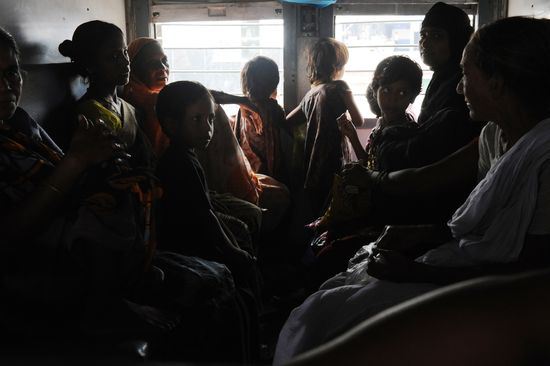
(Photo: Indian women and children wait inside a darkened train carriage at a railway station in New Delhi on July 31, 2012. A massive power failure hit India for the second day running as three regional power grids collapsed. By Roberto Schmidt/AFP/Getty Images. Dish coverage of the blackouts here.)

Coming Out Twice

In a report on BYU’s gay community, Emily Shire observes that “coming out of the closet is often a two-part process for LGBT Mormons”:

The first is admitting you “suffer” from same-sex attraction. During this stage, “People often are very warm,” says Cary. “That’s the norm. They say ‘We’ll help you through this.’”

The second is actually accepting being LGBT. “I had to come out a second time. ‘No, Mom and Dad, I’m actually gay and date boys and will hopefully marry one some day,’” recalls Cary. “That was a much harder coming out. The first often serves as a buffer to the second.”

It’s not just that BYU treats homosexuality as a temporary condition. Sam (not his real name), who is currently a student at BYU, says he’s bothered that the Honor Code reduces LGBT students to their sexual behavior. “It is simplistic to view homosexuality that way, to say that I’m only gay when I’m committing a homosexual act,” he tells me. “I breathe gay. I‘m never not gay. But apparently, when I do something sexual, BYU draws the line. I’m more than my sexual urges.”