Book Club: Ask Bart Ehrman Anything II

Below is the second installment of Ehrman’s responses to Dish reader questions (the first part is here):

What do you make of the evangelical response to your book, How God Became Jesus?

For a somewhat fuller response, see my blog post. Here I can say that the five evangelical Christians who responded are all good scholars. The purpose of their book was to engage my historical claims at a number of points. Some of the responses I found to be interesting. I ehrman_bart_12_020didn’t actually find any of them convincing, and on the whole I have to say that I was disappointed by the book. What I had hoped was that the book would provide a different historical narrative from the one that I laid out in How Jesus Became God. The respondents regularly accuse me of engaging in “bad” history, but they don’t themselves engage in any historical reconstruction at all. So how is one supposed to compare their views with mine?

The book really is little more than an attack on this point or the other in my discussion. I would love to see how they can imagine that their thesis, that God became Jesus, can be established on historical grounds, rather than theological or religious grounds . My view is that it is impossible for historians to demonstrate what God has done: that’s the province of theologians. If what they want to do is present a theological perspective that differs from my historical one, I have absolutely no problem at all with that. What I object to is their decision to embrace a theological perspective and claim that it is history.

What if anything might change your mind and cause you to again become a believer?

Hmmm … Good question!

I guess a revelation from the Almighty would do it! I’m actually, personally, prone more to belief than disbelief, and would prefer, at the end of the day, to be a believer. Maybe one day I’ll become one again, even though at this stage of my life, I doubt it. For it to happen, realistically, I would need to come to a more comprehensive, synthetic understanding of how this world makes sense if there is a God who is in some sense (any sense) active in it. For me, right now, that simply doesn’t seem to be the case. So many innocent people suffer unspeakable agony and horrific deaths each and every minute, hour, and day – ravaged by starvation, drought, epidemics, earthquakes, hurricanes, tsunamis, not to mention war and violence. I simply do not see the hand of God in any of this. I do know what the “answers” are that people give – I used to give them myself, all the time. I just can’t believe them anymore. Maybe at some point that won’t matter to me, although I do side more with Ivan in the Brothers Karamazov on this one, as I explain in my book God’s Problem….

Which religions, if any, deal better with the problem of evil and suffering than Christianity?

I’m not sure any of them deal with it in a way that I find intellectually satisfying, although since I wrote my book God’s Problem I’ve had a lot of people tell me that they have found Buddhism to be much better on just this issue.

Given your thesis that Jesus was not buried in a tomb, based on the evidence that the Romans would not have allowed it, what do you make of the archaeological evidence of crucifixion victims in tombs?

Great question! Unfortunately, we have only one piece of archaeological evidence to go on and it simply doesn’t tell us what we would like to know. In 1968 the remains of a crucified man, named Yehohanan, were discovered in Israel. His skeleton – ankle pierced with an iron stake from crucifixion – was decently buried in an ossuary. This shows, it is argued, that it is conceivable that something similar happened with Jesus. I would agree that this makes it conceivable. Unfortunately, as I have also pointed out, we do not have even the slightest bit of evidence to tell us what happened in Yehohanan’s case, and so we have no way of knowing if it is analogous to the case of Jesus.

Why was an exception made in Yehohanon’s case to place his body in a common tomb? Was his family well-connected? Was he an aristocrat? Was he crucified on the birthday of an emperor (Philo says that such persons were allowed burial)? Was he crucified for insurgency against the state (like Jesus) or for a lower crime (it makes a big difference!). Moreover – was he placed in a tomb the very day he was crucified? We have no way to know. Was his body left to decompose and be eaten by scavengers (the usual punishment) before being entombed? We don’t know. In other words, precisely what we would need to know in order to know if Yehohanan’s case was similar to that of Jesus we don’t know.

What we do know is that there is no evidence that Jesus was executed on the birthday of an emperor; he was not an influential person with high connections (he was not even known in Jerusalem before he appeared the week before); he did not have powerful family members who could intercede on his behalf; his own followers had fled from the scene; and he was not crucified for low-level crimes but on political charges of insurgency. Whatever was the reason that Yehohanan was given a decent burial, it is hard to think why an exception to normal Roman practice would have been made in the case of Jesus (especially given what we know about Pontius Pilate).

I should also say that other scholars have pointed out that since there were thousands of crucified victims in antiquity, and these are the only skeletal remains of a crucified victim to survive, it appears that Yehohanan’s case was highly exceptional, not typical.

What do you think of N.T. Wright’s work on the historical Jesus and early Christianity?

Tom Wright is incredibly prolific and is a brilliant spokesperson for traditional, conservative Christianity. He is also an erudite scholar of enormous breadth. But as it turns out, I disagree with him on almost everything! We have only had one real public debate, dealing with the problem of suffering and how it should affect one’s faith in God. We did not at all see eye to eye. Tom has a kind of global vision of Scripture where he makes the entire 66 books add up together to one grand narrative that he sees as a revelation from God. I see 66 different books written by different authors at different times for different reasons with different messages and different understandings of God, the world, the human condition, and so on. Tom and I simply aren’t on the same page.

It’s seems almost impossible, when writing a book like this, to keep personal biases out of the work. Can you describe how you thought about separating the two during the writing of the book?

My view is that everyone has biases, that there is no way to escape having biases, and that the people you need to look out for are the one who claim that they don’t have biases! Those are the people who want you to agree with them since, after all, they are simply being “objective.” But in fact, they have biases like everyone else, so that their claim is simply a rhetorical strategy.

At the same time, I think there are some biases that are more appropriate for some kinds of research than others. The biases of a historian – e.g., that the past did happen, that there is evidence that some things happened and other things didn’t, that some evidence is better than other evidence, and so on – are appropriate for doing history. On the other hand, the biases of a theologian – e.g. (depending on the theologian) that God both exists and is active in the world and has affected the course of historical events – can be very useful for doing theology, but they are not useful for doing history. And so my view is that a person with those theological views needs to keep those views in check when doing history, just as there are probably views of the critical historian that are not useful for those wanting to do theology.

When I wrote How Jesus Became God I tried to be careful not to make theological claims one way or the other. In the book I do not indicate whether Jesus really was / is God or not, whether he really was raised from the dead, whether he really is living today in heaven, and on on. Those are all theological claim. But my book is a historical account. My view is that Christians and non-Christians can agree with the history I lay out, even if they come to different theological conclusions. (I know that’s the case because before I sent the book into my publisher I gave it to four scholars to read for comments about how to improve it; all four were Christians; all four had no problems with its historical views)

Read the entire Book Club discussion of Ehrman’s book here.
The Genetic Basis Of Autism

Michael White examines our still limited understanding of it:

How strong is the genetic basis for autism, anyway? Could it be that researchers are searching for genetic causes that don’t exist? Actually, no. That there is a substantial genetic contribution to autism is well-established, but it has been difficult to pin down just how large it is. Previous studies have estimated the heritability of autism to be as high as 90 percent, or as low as 38 percent. A large study published this week in the Journal of the American Medical Association by researchers at the Karolinska Instutet in Sweden have come up with the most precise estimate yet for the heritability of autism: 54 percent.

The scientists looked at autism diagnoses in a population of more than two million Swedish children born between 1982 and 2006. By looking at rates of autism diagnosis among relatives—specifically identical twins, fraternal twins, full siblings, half siblings, and cousins—the researchers determined that, at least among Swedish families, “genetic and nongenetic influences on the risk for [autism spectrum disorders] and autistic disorder were similarly important.” Strikingly, they found that shared family environmental influences “have only a negligible effect on [autism spectrum disorder] etiology”; only non-shared, individual-specific environmental influences were significant. Just what those influences are remains unknown.

Tweet Of The Day


He had me at “mismanaged carnival of stupidity” … and then I lost the thread:

Mr. Baldwin’s arrest came amid a citywide effort on Tuesday, with another push planned on Friday, by the Police Department to crack down on traffic infractions, especially cellphone usage by drivers and failure to yield to pedestrians.

Well, at least it wasn’t the Idaho Stop.

The GOP Split On The Minimum Wage

Commenting on Romney’s and Santorum’s recent endorsements of a higher minimum wage, Douthat wishes moderate Republicans would fight for more economically sound conservative ways to help low-wage workers:

In fairness to the pro-minimum wage Republicans, there are various nuances here — indexing the wage to inflation, as Rick Santorum has proposed, is better than just having periodic, politically-motivated hikes, and the state-based minimum wage increases favored by some Republican politicians would have fewer perverse effects than a federal increase. And of course the minimum wage is a winning issue in the polls, and you can’t win every policy battle …

… but the case for tactical surrender would be a lot stronger if more Republican politicians, and Republican moderates especially, would first actually try to make the argument for an alternative, right-of-center suite of policies on jobs and wages. That could mean payroll tax cuts, it could mean an expanded Earned Income Tax credit or (as Marco Rubio has proposed) a wage subsidy as a replacement for the EITC, it could mean some of the American Enterprise Institute’s Michael Strain’s proposals to help the unemployed … there’s a whole range of potential policies, and policy combinations, that might deliver some of the minimum wage increase’s benefits with fewer downside risks.

Reihan is on the same page but sees why it won’t happen:

The irony is that the conservatives who might be amenable to something like Strain’s approach — let’s not risk excluding workers from the formal labor market by raising the statutory minimum wage, but let’s spend intelligently to get people back to work — are the ones who are embracing a minimum wage increase as (essentially) a proxy for some better mix of policies, or as a way of signaling that they care about the well-being of American workers and that they’re willing to use the power of government to improve their well-being. And most of the conservatives opposed to a minimum wage increase are also disinclined toward active labor market policies of the kind Strain has in mind, including an expansion of federal wage subsidies, on the grounds that such policies represent big government overreach, or that they involve spending money we don’t have. It’s no wonder that low- and middle-income voters are skeptical as to whether conservatives are doing enough to defend their interests.

The White Liberal Media

nationchart

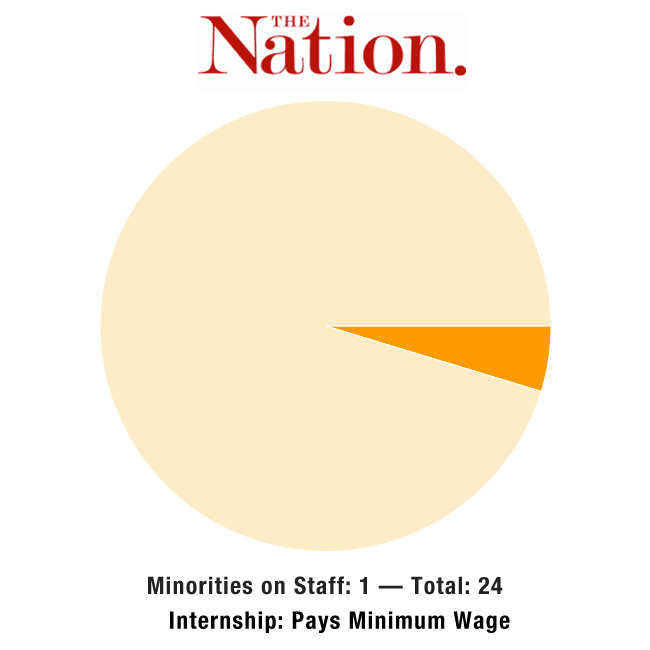
Gabriel Arana, the only member of an ethnic minority on the staff of The American Prospect, examines why the newsrooms of progressive publications’ are so monochromatic and how that undercuts their social mission:

Nearly 40 percent of the country is non-white and/or Hispanic, but the number of minorities at the outlets included in this article’s tally—most of them self-identified as liberal or progressive—hovers around 10 percent. The Washington Monthly can boast 20 percent, but that’s because it only has nine staffers in total, two of whom belong to minority groups. Dissent, like the Prospect, has one.

Given the broad commitment to diversity in our corner of the publishing world, why is the track record so poor? …

[T]he primary reason magazine staffs are so white is structural. “We practice fairly specialized form of journalism and the pool of people who do it isn’t terribly large to begin with, and then you look at the group of people who are practicing at a higher level and it’s just not a diverse pool,” [The New Republic editor Franklin] Foer says.

The road that ends with a spot on staff at places like The New RepublicThe Atlantic, or the Prospect is paved with privilege. It starts with unpaid internships, which serve both as training grounds and feeders to staff positions. “Most of our staff comes through our intern program,” says Harper’s editor Ellen Rosenbush. “Do we get as many applicants of color as we’d like? Probably not, but we do get them and we have hired them.” There’s a straightforward reason for the dearth of intern applications: Those who can afford to rely on mom and dad for a summer or a semester tend to be well-off and white.

Alyssa responds:

Relying on your network is a way to speed up the hiring process. You can discard résumés that do not come backed by personal recommendations, or skip reading résumés altogether and just start talking with candidates who have been identified for you.

If organizations could remove time pressure from the hiring process, that network would become less necessary. Hiring managers and editors could take the time to read résumés, cover letters and clips from a much larger pool of applicants. If someone promising does not come in during the initial wave of applications, the publication can repost or revise the job ad and reach out to more potential sources of candidates.

Better Not To Get HIV In America

HIV Chart

Last night saw the premiere of the HBO version of Larry Kramer’s The Normal Heart. It focuses on the very beginning of the epidemic. But in some ways, the American AIDS experience remains as different from the rest of the developed world now as it was back then. The world is transformed medically, of course, but the deeper pathologies of the American healthcare system have sustained more infections than in any other advanced country.

As Michael Hobbes explains in a must-read, America’s decentralized and haphazard patchwork of care is part of the problem:

In the United Kingdom and Germany, if you test positive for HIV, you’ll immediately be referred to an HIV clinic for tests to measure how much of the virus is in your blood and how well your immune system is holding up. Three-quarters of Brits diagnosed with HIV get to this next stage of care within two weeks, and 97 percent make it within three months.

This is not just some nationwide codification of English politeness. Clinics that provide testing are required to get HIV-positive people to the next round of tests or they don’t get fully reimbursed. If you screen positive and skip your viral-load test, you’ll get a call from the clinic asking why you didn’t show up. Some testing centers will walk you straight to the hospital to make an appointment.

In the United States, only 65 percent of people with HIV get linked to a hospital or clinic within three months. A survey in Philadelphia published in 2010 found that the median time between diagnosis and treatment was eight months. The effect of the wait can be devastating. A 2008 study found that gay men who had full-blown AIDS before they were diagnosed were 75 percent more likely to die within three years, even if they got on treatment. For people whose viral load is high and T-cell count is low, getting on HAART is like putting on sunscreen after they’ve already been at the beach for two hours.

(The above chart taken for an accompanying article)

The World’s Biggest Election Wraps Up

Exit polls from the last phase of India’s national election predict a major victory for the opposition Bharatiya Janata Party:

A poll by C-Voter, a research group, indicated the BJP and its allies could win 289 seats in Lok Sabha, India’s lower house of Parliament, giving the coalition the majority needed to oust the incumbent Congress Party and form the nation’s next government. A poll by ABP-Nielsen predicted the BJP-led coalition would secure 281 seats, according to Reuters. If the exit polls prove to be correct — which is no guarantee — they would put BJP leader Narendra Modi in pole position to become the next Prime Minister of India.

But Heather Timmons cautions that Indian exit polls are notoriously unreliable, and the final results could look very different when they come out on Friday:

Opinion and exit polls have been so inaccurate so often in the past that not only are they not taken seriously by analysts, but many in the general population believe they are wrong on purpose in an attempt to curry favor with politicians. Election opinion polls are viewed in India as “covert instruments used by media houses in collusion with political parties for falsely predicting their fortunes with the aim of influencing the electorate in India,” said Praveen Rai, a political analyst with New Delhi’s Centre for the Study of Developing Societies.

In the last national election in 2009, for example, television network NDTV, Hindi channel Aaj Tak, and media house Zee News predicted based on opinion and exit polls that the BJP and its allies could get between 230 and 250 seats, and Congress and its allies between 176 and 205. The actual number for the BJP group was 189, and Congress and its allies got 222.

Nonetheless, the commentariat is already talking about what a Modi premiership might look like. Harsh Pant explains why the BJP chief is such a big deal:

Modi’s rise has shaken the foundations of the Indian polity. You may not like his politics, but you cannot deny his impact. He has broken old norms, challenging the Gandhis openly, talking about them disparagingly, embellishing his record, sidelining the old guard within his own party, leading a tech-savvy campaign, reaching out directly to the people, and making a strong pitch for national leadership without inhibitions. He wants to be India’s next prime minister, he is telling his countrymen and women, and he is not ashamed to ask for their support. Modi’s ambition is his greatest asset in an increasingly ambitious India.

And it’s precisely because of this that Modi’s rise matters. The liberal intelligentsia continues to sound alarm bells, some even threatening to leave the country if Modi is elected. But they fail to comprehend how radically India has changed. Modi is a product of a contemporary India where the fault-lines of religion and caste, while important, are no longer the be all and end all of politics. An absence of leadership over the last decade has led to a craving for decisive leadership. Modi fills that vacuum.

Milan Vaishnav wonders if he can meet the public’s extremely high expectations, especially regarding the economy:

Yes, signs suggest the struggling Indian economy may be bottoming out. The International Monetary Fund recently announced that it expects India’s growth rate to recover from 4.4 percent in 2013 to 5.4 percent in 2014 and 6.4 percent in 2015. Consumer price inflation has come down from 11 percent in 2013 to 8 percent this March. The rupee, which experienced a free fall last summer after the Federal Reserve’s tapering talk, has since stabilized. Thus, with or without Modi, India may be able to muddle through.

But voter expectations are far greater; surveys suggest that they are flocking toward the BJP in the hopes that Modi can generate millions of new jobs, plug India’s infrastructure gap and attract the kinds of foreign money he has lured to Gujarat. Beyond voters, Modi is also moving stock markets: On the basis of pre-election polls projecting a BJP victory, India’s Sensex has risen more than 15 percent over the past six months. In meeting these expectations, Modi faces obstacles ranging from the difficult to the impossible.

William Inboden considers how the US should deal with Modi, who has been banned from visiting the US since 2005 over his role in a massacre of Muslims in Gujarat three years earlier:

Modi may not be the leader we want for India, but he will likely be the leader we get. Additionally, on the issue of religious toleration itself, the visa ban has outlived its effectiveness. Twelve years after the Gujarat massacres, there is little evidence that Modi’s continued blacklisting will do much to protect religious freedom in India.

But lifting the visa ban alone would be insufficient. The Obama administration should couple this with a series of other specific measures that show America’s willingness to work with Modi does not diminish our concern for religious freedom. While Modi has moderated some of his rhetoric, regrettably he seems to still embrace some of the more intolerant and toxic strains of Hindu nationalism. Many of India’s Muslims and Christians in particular fear that a Modi government could bring them increased discrimination and even persecution. The Obama administration should start communicating to India now its support for religious toleration, and should start developing specific policy initiatives to support religious freedom in India.

Previous Dish on Modi here and India’s elections here.

Quote For The Day III

jesus-QFTD

“Christianity is what we think it is; it has always been what we thought it was. But we almost unique among the Christian generations, have submitted it to the principle that Christianity is what someone else thought it was – what Jesus, the Apostles, Paul, Augustine, Luther, thought it was … What we must do now is to follow, like good conservatives, the generations before us & make our Christianity, as they made theirs. There is no external test – an external test of truth is a figment of false logic. A thing is what it develops into – & this development at this point is in our hands … It is a work of apologetic; but with a new principle of apology – i.e. to admit everything that must be admitted, but to enquire into its bearing. To reconstruct rather than to buttress; to rebuild rather than to reconstruct; to reform rather than to rebuild.

One of our problems – by what criterion are we to decide whether a certain growth belongs to the main stem, or whether it is parasitic? For all religions & moral ideas which have currency in Western Europe are somehow attached to or derived from Christianity: ours is a Christian civilization in that its formative conceptions, its atmosphere, etc are derived from Christianity. I do not mean that every idea we have can be traced to a definite source: I mean that the whole to which our ideas belong is dominated by the name Christianity. And those who have rejected the particular brand or phase of Christianity professed by their generation are not less influenced by it, than those who accept it.

But which is apple-tree & which is mistletoe?

The mistletoe feeds on the same sap – though it may modify it at the last moment – & is organically attached to the main stem.

Is Nietzsche mistletoe or apple-tree?” – Michael Oakeshott, unpublished Notebooks, (11, 11-14).