A sobering reminder from North Carolina:
Category: The Dish
Study Links Success To Hard Work, Asians
Natasha Loder parses a new study that seeks to explain why Asian-Americans tend to do so well in school:
Although Asian Americans do often come from better educated and higher income families, socio-demographic factors could not explain the achievement gap between Asians and whites. … Being brainier isn’t the answer either. When the pair looked at cognitive ability as measured by standardised tests, Asian-Americans were not different from their white peers. Instead Dr [Amy] Hsin and Dr [Yu] Xie find that the achievement gap can be explained through harder work—as measured by teacher assessments of student work habits and motivation. (Although the authors warn that this form of assessment will capture both true behavioural differences as well as a teacher’s perception of differences.)
What might explain harder work? The authors point to the fact Asian-Americans are likely to be immigrants or children of immigrants who, as a group, tend to be more optimistic. These are people who have made a big move in search of better opportunities. Immigration is a “manifestation of that optimism through effort, that you can have a better life”. Added to this mix is a general cultural belief among Asian-Americans that achievement comes with effort. We know that children who believe ability is innate are more inclined to give up if something doesn’t come naturally. An understanding that success requires hard work—not merely an aptitude—is therefore useful. This finding is worth bearing in mind when considering the current fuss over new tests in mathematics, as some parents complain that they are now too hard.
Tom Jacobs examines how the study squares with the prevailing theories:
So what about the “tiger mom” hypothesis, which suggests Asian mothers demand more of their kids, and see to it that they achieve?
The study suggests it is, indeed, one factor in their academic success, although—contrary to the stereotype—this approach appears to be more prevalent among immigrants from India than those from China. “South Asian parents have the highest educational expectations relative to whites,” they write, “followed by Filipinos, Southeast Asians, and East Asians.”
Beyond strict mothers, the drive for academic success “is sustained and reinforced” by other factors, including “ethnic communities that offer newly arrived Asian immigrants access to … resources such as supplemental schooling, private tutoring and college preparation,” the researchers add.
Alice Park considers the findings through the lens of her own experience as an Asian-American:
Hsin also found that Asian-American students were more likely to have more self-image problems and more conflicted relationships with their parents than their white counterparts. The pressure to perform seems to take a toll on those who fail to meet expectations as well as those who do – for the latter, the expectation to be successful makes the achievement less satisfactory and less fulfilling.
So Tiger Moms may be on to something, however obvious it may seem: hard work does pay off, albeit at the cost of some self-esteem. But it may be giving them too much credit to say they do it alone. And looking back, I have to admit, however begrudgingly, that all that discipline has probably made me a more organized and confident adult. But don’t tell my mom.
In any case, noted “tiger mom” Amy Chua is feeling pretty vindicated, Max Ehrenfreund reports:
Chua and her husband Jed Rubenfeld, both professors at Yale Law School, contend the study is evidence that aspects of Asian-American culture are partly responsible for Asian children’s good grades. The couple published a new book earlier this year arguing that certain cultural traits can explain the successes of various immigrant groups in the country’s history.
“There can be no doubt that these practices and attitudes are not exclusive to Asians, and can be incredibly helpful to people outside those communities,” Rubenfeld said. The couple added that a mere change in attitude would not be enough to eliminate the obstacles confronting black children. “When it comes to America’s poorest groups, it’s pretty clear what the true causes of poverty are. You have to start with history, you know, centuries of slavery and mass incarceration,” Chua said.
Subversion For Sale
Henry Stewart has an uneasy feeling about Ai Weiwei-branded merch:
[T]he commodification of Ai Weiwei is more intense than that of any other living artist, rivaled only, maybe, by, like, Van Gogh. You can buy Ai Weiwei smart phone cases and tablet skins; you can buy Ai Weiwei snap bracelets; you can buy mugs and buttons and wallets and scarves and skate decks and tea towels and handkerchiefs and luggage tags and an umbrella with his middle finger printed on the top. Most of these items include a quote from the Larry Warsh-edited 120-page book (also for sale!) Weiwei-isms, which, according to marketing copy, “demonstrates the elegant simplicity of Ai Weiwei’s thoughts on key aspects of his art, politics, and life.”
Troublingly, for me, most of these quotes alienate Ai from his politics and turn him into a vaguely political aphorist whose pithy observations could be co-opted by the Communist censors themselves. They’re too simple. “My favorite word? It’s ACT,” is the one most printed on stuff you can buy, though other popular ones are “My activism is a part of me” and “Everything is art. Everything is politics.”
Who Should We Let In?
Freddie deBoer advocates for an open border policy as a form of humanitarian intervention:
For gay, transgender, and bisexual people in places like Russia and Uganda; for Syrians of all stripes; for those in Crimea and eastern Ukraine who fear either Putin or reprisals against linguistically and ethnically Russian Ukrainians; for those in Venezuela who agitate against the Maduro government; for women in Saudi Arabia; for liberal dissidents in Iran; for oppressed people the world over, legal entrance into the United States would represent protection against those forces that some would have us defeat with force of arms. The beauty of it is that we can accept people without having to stake a claim on every legitimate internal controversy; we merely can do so out of a desire to prevent the violence that often attends internal strife that we have no business adjudicating. I don’t suggest this as a panacea, but then, if the last decade should teach us anything, it’s the inability of military intervention to secure humanitarian outcomes. I’m willing to guess that the odds for success with this kind of humanitarian intervention are far, far higher than freedom delivered via smart bomb.
David Frum, on the other hand, wants talent-focused immigration reform:
Americans console themselves that second and third generations of immigrants will do better than the first. Many immigrants do rise in just this way. Yet the evidence for many of the largest immigrant groups—immigrants from Mexico and Central America—is not encouraging. The second generation does better than the first … but progress stalls after that. Even in the fourth generation, Mexican-American education levels lag far behind those of Anglo Americans, according to the definitive study by Edward Telles and Vilma Ortiz, Generations of Exclusion.
What holds back immigrant progress? Discrimination? Inherited cultural patterns? The economic and cultural obstacles of a society where unskilled labor no longer pays a living wage? Whatever the reason, the outcome is the same. Human capital extends across generations. Those who arrive possessing that capital bequeath it to their descendants. Those who arrive lacking it bequeath that same lack. Progress across generations is slow at best and non-existent at worst—especially as low-skilled migrants to the United States adopt the same single-parent family pattern that prevails among the poorer half of the native-born population.
The End Of The American Entrepreneur?
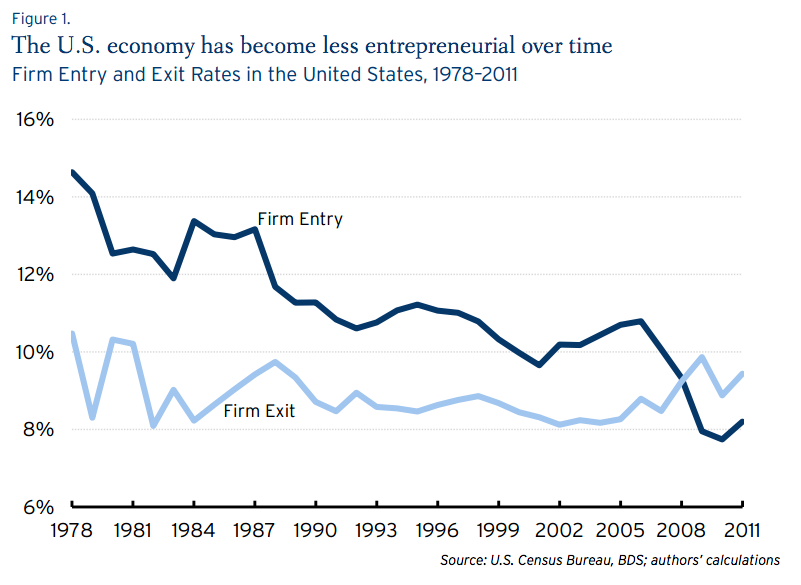
A new Brookings report warns that business dynamism and entrepreneurship are on the decline throughout the US. Danielle Kurtzleben explains why this is cause for concern:
[T]he idea at work here is the economic concept of creative destruction. New, more productive firms replace older firms, and workers get matched with better jobs over time when there’s more of this business “churn,” the authors write. A more stagnant business atmosphere, in other words, can lead to a more stagnant economy. Exactly why it’s happening, however, is more of a mystery. …
The jump in the exit rate has likely been a function of the recession, says says Robert Litan, one of the study’s co-authors and a nonresident senior fellow at Brookings, but the factors behind the falling entry rate are foggier. The fact that the trend is so long-standing, for example, suggests that it’s not one presidential administration or another that’s at fault, nor is it the recession. What’s behind it may be something less concrete are more ephemeral — an economy-wide decision to play it safe, from the richest CEOs to the plucky wannabe entrepreneurs.
Drum suspects that the proliferation of national chains is largely to blame for this trend:
I’d really like to see a breakdown of what kinds of business creation have declined. My first guess here is that the decline hasn’t been among the sort of Silicon Valley firms that drive innovation, but among more prosaic small firms: restaurants, dry cleaners, hardware stores, and so forth. The last few decades have seen an explosion among national chains and big box retailers, and it only makes sense that this has driven down the number of new entrants in these sectors. When there’s a McDonald’s and a Burger King on every corner, there’s just less room for people to open up their own lunch spots. But if there’s been a decline in the number of new small retailers, that may or may not say anything about the dynamism of the American economy. It just tells us what we already know: national chains, with their marketing efficiencies and highly efficient logistics, have taken over the retail sector. Amazon and other internet retailers are only hastening this trend.
Morrissey, however, fingers regulation for the culprit:
The reasons can’t be that unknown. Since the 1970s, the federal regulatory environment has grown exponentially, with its power amplified by the federal courts. Even short eras of regulatory reduction resulted in only moderate reversals of that decline, which quickly disappeared. Look, for instance, at the period between 1983-88 during the heyday of Reaganomics and deregulation, and the shallower gains during the George W. Bush administration.
Richard Florida notes one of the study’s main limitations:
The authors caution that their data cover the period through early 2011, so it’s possible that “these trends have reversed—or at least stabilized—since then.” The late economist Christopher Freeman, invoking Schumpeter’s “creative destruction,” long ago argued that economic crises set the stage for great bursts of innovation. Patent activity has ticked up since the crisis, and venture capital activity has surged in recent years.
But there are long lags between the onset of crises and these rebounds in innovation and entrepreneurial activity that power long-run economic growth. These Great Resets are generational events, with much longer time lines than typical business cycles.
The World Is Losing Its Eyesight
More and more individuals need glasses:
Over the past 15 years, the world has witnessed an explosion of cases of myopia, or nearsightedness. A quarter of the world’s population, or 1.6 billion people, now suffer from some form of myopia, according to the Myopia Institute. If unchecked, those numbers are estimated to reach one-third of the world’s population by 2020. While myopia has always affected a fraction of the population, at least in countries that have kept records, the condition has recently reached unprecented rates among children and young adults.
A National Institutes of Health study published in 2009 showed that myopia prevalence in the United States increased by 66 percent between the early 1970’s and the early 2000’s.
Too much time indoors could be part of the problem:
Kathryn Rose, a researcher of visual disorders at the University of Sydney’s college of health sciences, recently concluded that spending too much time indoors also has a huge impact on eyesight deterioration. Rose said in a CNN interview that she was not sure how time spent using digital media relates to myopia progress, but that outdoor light has been shown to have a positive effect on vision. Studies from the U.S., Singapore, and China confirm a link between the time spent outdoors and the prevention of myopia, Rose said.
The Villainous Comics Code Authority

Saladin Ahmed provides a brief history of comic book censorship. He claims that during a “15-year span beginning in the late 1930s, the comic book racks of America’s newsstands were bursting with four-color contradictions.” But this state of affairs “was swiftly and mercilessly dismantled in 1954 by the newly formed Comics Code Authority”:
Spurred in part by the sensationalist book Seduction of the Innocent (a ridiculous sort of Reefer Madness for comic books), the Senate Subcommittee on Juvenile Delinquency turned an angry eye toward comics, and most publishers felt that heavy-handed regulation — perhaps even outright banning — was imminent. Comic book publishers, in consultation with right-wing politicians, formed the Comics Code Authority, a self-censorship group, in the hopes that this would forestall government intervention in the industry. New York Magistrate Charles F. Murphy, a “specialist in juvenile delinquency” (and a strident racist), was chosen to head the Authority and to devise its self-policing “code of ethics and standards.”
What this meant in practice:
The Code … contained the surprising provision that “ridicule or attack on any religious or racial group is never permissible.” Given the countless depictions of monkey-like Japanese and minstrel-show black people in Golden Age comics, one might think this provision a good thing. But Murphy soon made it clear that this provision really meant that black people in comic books would no longer be tolerated, in any form. When EC Comics reprinted the science fiction story “Judgment Day” by Al Feldstein and Joe Orlando (which had originally been printed to little controversy before the Code), Murphy claimed the story violated the Code, and that the black astronaut had to be made white in order for the story to run.
EC defiantly ran the story anyway, but Murphy had made a target of them, and the company was essentially forced out of the comics business. The message was clear: If comics were to be tolerated in this new postwar order, they had to be purged of assertive women, of people of color, of challenges to authority, and even of working-class, urban slang. And so the Comics Code hacked and mangled comics until they fit into the patriarchal, conservative, white suburban social order that was taking over every other sphere of American life.
Update from a reader:
This is a classic anti-comic book propaganda. Scare tactics are classic!
(Image: Panels from the original “Judgment Day” comic)
Rapes vs College Rankings
Ann Friedman argues that, if we’re going to address the problem of sexual assault on college campuses, we have to force reputation-conscious college administrations to get over themselves:
[M]aking colleges get serious about addressing sexual assaults will probably take more than just urging them to mend their ways. One of the institutional deterrents to encouraging more assault survivors to come forward is that it often means a marked increase in crime statistics. Last week the Pentagon reported that, after a similar campaign to change the way the military handles assault, reports of sexual assault jumped more than 50 percent. This is actually good news for survivors: It means more of them feel comfortable coming forward. But it doesn’t look good for the institutions involved. Universities are eager to please parents and woo new students, which has often led them to prioritize their own reputations above survivors’ needs.
Amanda Hess adds that this is especially important given that many of the trouble spots are among the most elite schools in the country. She worries about the obstacles students face when reporting rape:
In order for the federal government to learn that something may be amiss in a college’s handling of sexual assault, rape victims need to report their assaults to their schools in the first place—no guarantee, given the rampant underreporting of sexual assault in America. Then, when they feel that their colleges have not properly adjudicated their cases, those victims need to launch another complaint against the process itself, and take their cases to the Department of Education’s Office for Civil Rights. The very purpose of these complaints is to prove that colleges are denying some students equal access to education by failing to properly discipline rapists and support victims. Living through an assault, pursuing a complaint against your attacker, and then furthering a civil rights agenda—while also studying organic chemistry—is an almost unthinkable feat for an undergrad. Students who are incapable of juggling those outsized responsibilities may never be heard.
But Lauren Kirchner notes that victims do have ways of reporting rape even if their school is uncooperative:
One small comfort for college kids today is that, if they’re unsatisfied with their schools’ response to a crime, they’re just a Google search away from getting help in filing a report. Networks that span campuses and countries have sprung up to provide support and inform students about their rights—sites like End Rape on Campus (EROC) and Know Your IX (KYIX), and others. (In fact, the White House’s new NotAlone.gov mimics these smaller, non-profit organizations that have been providing the same support and services for years—not that the federal attention and funding isn’t welcome.)
Souvenir Shopping In Pyongyang

It’s no easy feat, as Adam Johnson discovered:
I was dying to buy something, anything that would help my wife and children understand the profound surrealism and warped reality I’d experienced on my research trip to North Korea. But there was nothing to buy. The stores were filled with cheap Chinese goods, grey-market medicines and out-of-date foreign snacks and candies. North Korea produced only durable goods like Vinalon overcoats, shovel handles and work boots. I might have actually bought a Vinalon blazer or a North Korean skillet. But the regime didn’t offer these at their tourist shops.
I couldn’t even buy a painting or a ceramic bowl made in North Korea. Arts and crafts there are required to glorify the regime, yet it’s forbidden for a foreigner to possess images of the Dear Leaders, DPRK flags or nationalist iconography like the Chollima (a mythical winged horse that symbolizes the rapid advancement of the society), a double rainbow over Mount Paektu (the ‘official’ setting of Kim Jong-il’s illustrious birth) or some Taepodong missiles blazing upward. Hence the selection of a Beijing dollar store.
(Photo: A North Korean woman works as a shopkeeper in a Pyongyang knickknack shop on September 18, 2013. By Jonas Gratzer/LightRocket/Getty Images)
Ladies’ Home Journalism
As Ladies’ Home Journal shifts from a monthly to a quarterly publication, Harold Pollack looks back on the serious journalism that occasionally graced its pages over the past 130 years, and highlights the role women’s magazines have played in bringing important issues to light:
In the 1890s, LHJ exposed fraudulent patent medicines and refused to print advertisements for these products. The Feminine Mystique was excerpted there and in McCall’s.
Recent journalism in women’s magazines has explored surrogacy, use of anti-depressants during pregnancy, sexual harassment in higher education, Bill Clinton’s newfound role as a political spouse, even insurers’ unethical rescission of health coverage. My brilliant dissertation advisor Richard Zeckhauser told me to read Ann Landers and Dear Abby with special care. I found much good material there. When the moment is right, women’s magazines could contribute something more, too. One such moment occurred on May 1, 1950, when Ladies Home Journal printed a taboo-breaking article by Pearl Buck called “The child who never grew.” Buck recounted her gradual discovery of her daughter Caroline’s intellectual disability, and describes her painful decision to institutionalize Caroline at the age of nine within the Training School at Vineland, New Jersey.
 The Dish
