Human Science Is Only Human

Jerry Adler reports on how fabricated studies and manipulated data have created a crisis in the experimental social sciences:

Amid a flurry of retracted papers, prominent researchers have resigned their posts, including Marc Hauser, a star evolutionary psychologist at Harvard and acclaimed author, and Diederik Stapel, a Dutch psychologist who admitted that many of his eye-catching results were based on data he made up. And in 2012, the credibility of a number of high-profile findings in the hot area of “priming”—a phenomenon in which exposure to verbal or visual clues unconsciously affects behavior—was called into question when researchers were unable to replicate them. These failures prompted Daniel Kahneman, a Nobel Prize–winning psychologist at Princeton, founding father of behavioral economics, and best-selling author of Thinking, Fast and Slow, to warn in an email to colleagues of an impending “train wreck” in social psychology. …

[T]he current critique of experimental social science is coming mainly from the inside. [Nina] Strohminger, [Joseph P.] Simmons, and a handful of other mostly young researchers are at the heart of a kind of reform movement in their field. Together with a loose confederation of crusading journal editors and whistle-blowing bloggers, they have begun policing the world of experimental research, assiduously rooting out fraud and error, as if to rescue the scientific method from embarrassment—and from its own success.
The Science Of DJing

Virginia Gewin checks in with a couple of scientists who bring data to the dance floor:

It may just seem like people having simple fun at a club, but there’s something deeper going on. “We use the crowd to communicate with each other,” says [DJ Johan] Bollen. “We’re encoding information in the crowd.” Bollen cites a technical term for this: stigmergy, a form of indirect coordination of actions. The term describes, for example, how ant colonies make effective “decisions” in complicated situations, even though each ant’s behavior is very simple. The ants use pheromones to exchange information; the environment serves as their shared memory. Complexity spontaneously emerges from simplicity.

Bollen and [Luis] Rocha are experts on stigmergy—for real.

They DJ by night, but by day they study cybernetics—how people, animals, and machines control and exchange information—at Indiana University in Bloomington. A focus on feedback runs through their both their research and DJing. And while they really just want to orchestrate a raging party, the crowd is, in a sense, an experiment. …

Songs are categorized along two primary dimensions: energy level (bpm) and “valence”—the feeling of the music, consisting of a spectrum of universal emotions, from dark or edgy (cold) to inviting or velvety (warm). At [a] February show, for example, Bollen picked up on the crowd’s vibe, ramped up the energy level, and, at 124 bpm, played “The Feeling” by Eden—a warm, inviting song that signaled that the party was truly underway. “Our research—the notion of feedback and complex systems—informs everything we do,” says Bollen. “A DJ and an audience are a cybernetic system, controlling each other’s state.”

(Video: Live mash-up of “Pop Culture” by Madeon)

Language Doesn’t Make The Man

John McWhorter objects to the notion, first expounded by linguist Benjamin Lee Whorf in the 1930s, that different languages produce different worldviews:

Some languages are more telegraphic than others. For an English speaker, to a large extent, learning Mandarin is a matter of learning how much is unnecessary to still communicate effectively. No articles. No way to express the past tense. It’s quite common not to mark things as plural. The first words of the Bible can be rendered as “Start-start God achieve-make sky-earth.” If we are to suppose that this aspect of Mandarin creates a “worldview”—if two blues means Russians see more blue—then can’t we assume that the Chinese aren’t seeing, well, as much as we are? …

There are many languages in New Guinea and Australia in which there is one word that means eat, drink, and smoke. Are we to designate these people as less attuned to gustatory pleasures than us? They give little evidence of it, and note how distasteful it feels to even suggest it. Or, Swedish and Danish have no single word for what we call wiping. You can rub, erase, and such, and the word they spontaneously give as a translation means dry—but there is no word that means, specifically, what we mean by to wipe. Yet we shall neither tell Scandinavians that they do not wipe nor even imply that the act is less vividly important to them than to the rest of us.

The Terror Report Is Terrifying

terrorism_figures

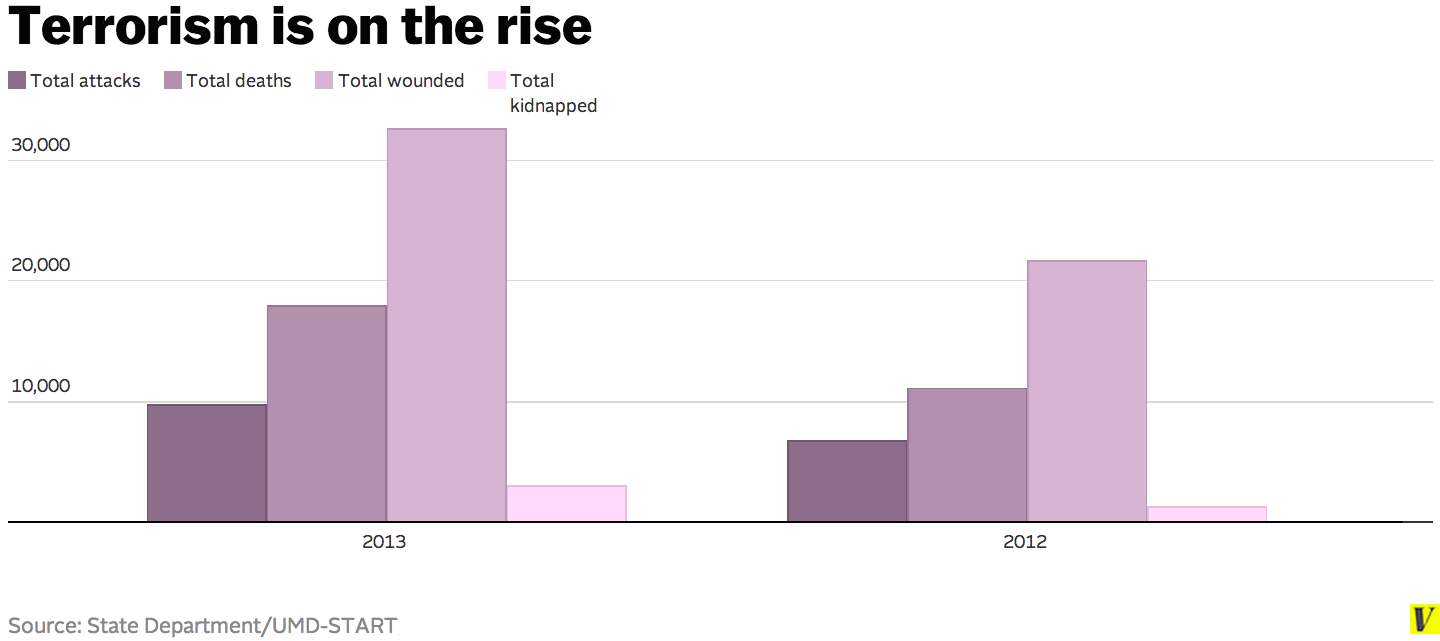
Catherine Traywick looks over the State Department’s annual terrorism report, which came out on Wednesday:

All told, the State Department found that worldwide terrorist attacks rose by 40 percent over the past year, from 6,771 in 2012 to 9,707 in 2013. Two-thirds of the strikes occurred in Iraq, Pakistan, Afghanistan, and India, resulting in the deaths of more than 11,000 people. A total of 17,891 people died in terrorist attacks in 2013, up from 11,098 in 2012.

The report attributed much of the violence to sectarian strife in Syria, Lebanon, and Pakistan, which have been riven by brutal fighting between the countries’ religious and ethnic populations. Iraq has been hit particularly hard, with Sunni militants slaughtering thousands of Shiite civilians, but Syria’s brutal civil war has begun to morph from a rebellion against Syrian strongman Bashar al-Assad to ongoing communal violence between the country’s Alawite and Sunni populations. Islamist militants in Syria, the report says, are increasingly “motivated by a sectarian view of the conflict and a desire to protect the Sunni Muslim community from the Alawite-dominant [Assad] regime.”

Providing the above chart, Zack Beauchamp digs deeper into what the report has to say about Iraq and Syria:

“The [country] that accounts for nearly half of the increase in the two years is Iraq,” Gary LaFree, the University of Maryland researcher whose institute compiled the raw data for the State Department, told me. Moreover, since attacks in Iraq were more frequent and deadlier than in the other 9 nations with the most terrorist attacks, it’s responsible for much larger percentages of the increases in deaths and injuries.

LaFree told me his numbers undercounted attacks in Syria, as it’s hard to verify responsibility for any one attack in the midst of a civil war. But the State Department sees a classic al-Qaeda pattern. “Thousands of foreign fighters traveled to Syria to join the fight against the Assad regime,” the 2013 report warns. According to State’s counterterorrism coordinator, Tina Kaidenow, “we’re concerned over the long term that [Syria] will attract individuals who will be radicalized.”

How Reliable Are Online Reviews?

Josephine Wolff investigates:

While the cacophony of voices may be overwhelming, the percentage of customers who write reviews is actually quite low. In a 2014 study that analyzed data from a private apparel retailer’s website, [MIT professor Duncan] Simester found that only about 1.5 percent of customers, or 15 out of 1,000, write reviews. “And these customers aren’t representative, they tend to buy more niche items,” he says. Simester also discovered that about 1 in every 15 reviews of an item—about 5 percent—are written by people who haven’t purchased it. “And the problem is the other 985 customers rely on the reviews written by these 15 people.”

Some reviews, in fact, may be entirely false. Others may be planted by businesses to burnish their own reputations or tarnish those of competitors. … Bing Liu, a professor of computer science at the University of Illinois, who has studied review sites, estimates that roughly 30 percent of all reviews online may be fraudulent.

When Mental Illness Is A Gift, Ctd

Elyn Saks, author of The Center Cannot Hold: My Journey Through Madness, shares her thoughts on the connection between creativity and a mental illness like her schizophrenia:

The book she mentions is Touched with Fire: Manic-Depressive Illness and the Artistic Temperament. Yesterday’s introductory videos from Saks are here. Readers continue the thread:

I’ve struggled with severe panic and anxiety issues for years. I take an SSRI every day and have for probably a dozen years. If I go off of it four or five days, I’m in real trouble. It is not a pleasant feeling.

However, if I am off for a few days, that second and third day give me a huge burst of creativity. In college when I had a big paper due, I would start the outline on day one, put together some paragraphs on day two, and then on day three I would bang out 20 pages effortlessly. This is something I stopped doing years ago. It wasn’t healthy mentally or physically. But there is something to it.

Another who struggles with mental illness:

A quick comment about mental illness being some sort of gift from someone who has been wrestling with PTSD, a mild form of bi-polar disorder and a dissociative disorder for decades. Like so many things that are out there that can give you a temporary ability to exceed your relatively normal operating envelope, there are negative tradeoffs – many of which lead to agonizing self-destruction behaviors. This is very well known, but I think bears repeating. Glamorizing and romanticizing the occasional exceptionally high-functioning moment while ignoring the agony and constant struggle each day usually is just continues to marginalize those of us who suffer from profound and usually very difficult to diagnose disorders.

China’s Demographic Timebomb

An aging population, rapid urbanization, and a skewed sex ratio could spell trouble down the line for the world’s largest country:

China is different from the other aging countries of the world in that a) it is not yet fully developed, b) most of its population is still poor, and c) it has the highest sex ratio in the world.

By 2055, China’s elderly population will exceed the elderly population of all of North America, Europe and Japan combined, and this is exacerbated by the now declining working-age population. China’s impressive economic growth has been facilitated by its expanding working-age population: The population ages 15-64 increased by 55 percent between 1980 and 2005, but this age cohort is now in decline due to the declining fertility rate. In 2012, the working age population declined by 3.5 million and is expected to continue to decline unless there is a dramatic shift in China’s fertility rate.

Aging will have a negative effect on economic growth through higher pension and healthcare costs, fewer low-income jobs, increased wage depression, slowing economic growth and job creation, declining interest from foreign investors, lower entrepreneurship, and higher budget deficits. Labor force declines also translate into lower tax revenues for governments, and if these governments are tempted by deficit financing, global financial stability may be compromised, according to the Center for Strategic and International Studies (CSIS) Commission on Global Aging.

Only A Fraction Of College Men Are Rapists

Marcotte stresses that the high rates of sexual assault on college campuses don’t mean there are as many assailants as you might assume:

Let’s be clear: No one is saying that the high rates of victimization among college women mean that all men are rapists. That 1 in 5 college women have been assaulted doesn’t mean that 1 in 5 men are assailants. Far from it.

A study published in 2002 by David Lisak and Paul Miller, for which they interviewed college men about their sexual histories, found that only about 6 percent of the men surveyed had attempted or successfully raped someone. While some of them only tried once, most of the rapists were repeat offenders, with each committing an average of 5.8 rapes apiece. The 6 percent of men who were rapists were generally violent men, as well. “The 120 rapists were responsible for 1,225 separate acts of interpersonal violence, including rape, battery, and child physical and sexual abuse,” the researchers write. A single rapist can leave a wake of victims, racking up the numbers rapidly, as the victim surveys are clearly showing.

Update from a reader:

Can I possibly be the only one just flabbergasted by the line in this post that “only about 6 percent of the men surveyed had attempted or successfully raped someone”? The idea that 6 guys out of a group of 100 being rapists is a small number shocks the hell out of me. I am a straight white male with a college fraternity background I am not particularly proud of, but even with that life experience, had you asked me to guess the percentage of guys who had actually raped or attempted to rape a woman, I would have suggested some tiny fraction less than 1%. I mean, who the hell RAPES someone? I accept the positive aspect of the larger point – that the number of rapists is smaller than the number of victims – but that seems obvious to me, and way less shocking (and frankly depressing) than the “good” news that “only” 6/100 guys is a rapist.

Recent Dish on campus rape here and here.

Testosterone Ad Absurdum

It still amuses me to read blank-slate lefties insisting that gender difference is a function of culture alone. To me, it’s the same kind of scientific know-nothingism that you find on the right with respect to evolution. Note I’m not saying that culture has nothing to do with it – that would be know-nothingness of a reverse kind. But the power of testosterone as a hormone should never be under-estimated.

And the funny thing is: testosterone exists across the entire animal kingdom and correlates very highly with what we think of as culturally masculine attributes: physical strength, risk-taking, competitiveness, ego and the constant desire to fuck. So when I came across this fascinating article on the marsupial, antechinus, I had to chuckle. During the mating season, the males’ testosterone levels go through the roof. The result is sexual mayhem:

Males relentlessly bound from partner to partner, as massive hormone releases in their bodies cause their immune systems to crash and their fur to fall out. They bleed internally. Some males even go blind, yet still stumble around the leaf litter hoping for one last tryst. In a few short weeks, every single male lies dead, leaving the females to raise their offspring …

While [testosterone] mobilizes all the sugars in the antechinus’ body so it doesn’t need to feed for the three-week orgy, it also glitches the mechanism responsible for regulating the production of cortisol, a stress hormone that in small amounts results in bursts of energy and higher pain tolerances. With runaway levels of cortisol, though, the males’ bodies literally begin to fall apart. Bone density plummets and blood-sugar levels go nuts. Their immune systems essentially degrade to worthlessness, as open sores form and never heal.

That’s a dystopian vision of untrammeled maleness if ever there was one. It reveals what we cannot deny about our nature almost as baldly as it wants us to keep it under control.