Sanctions Redux, Ctd

Julia Ioffe reviews the reasoning behind the new sanctions we imposed on Vladimir Putin’s cronies yesterday:

The psychological factor of naming these [Russian “crony banks”] is not to be underestimated. First of all, it removes the curtain cloaking this shadowy “crony economy,” full of small, strange banks whose business is far from obvious. It shows the Russians that we know how and by whose hands the economy runs. Furthermore, says prominent Russian economist Sergei Guriev, “the continuation of adding companies and banks indicates that future sanctions may include certain truly systemic financial institutions.” …

“I don’t think the Russians quite understand the extent to which the world financial system is integrated with the dollar and the U.S. financial system,” says one administration official involved in the sanctions deliberations. “I don’t know if these people have assets in the U.S. I always suspected most of their assets are in Europe. But once the U.S. banking system has redlined you, it’s hard to do business. You’re radioactive.”

Which is why it’s starting to work. Western financing in Russia has seized up.

But Bershidsky thinks the sanctions are too weak:

The banks are too small to matter: At worst, the holders of almost $2 billion in private deposits at SMP Bank will have to find a new bank if they plan to use their debit and credit cards overseas. Some significant omissions suggest that the list’s drafters intentionally avoided Putin’s friends’ major possessions. Volga Group, for example, holds a 23 percent stake in Novatek, Russia’s biggest independent natural gas producer, and a 32.3 percent stake in Sibur, a major petrochemical producer. Kovalchuk’s Abros holds stakes in a large pro-Putin media holding as well as one of Russia’s biggest insurance companies, Sogaz. Sechin runs state-owned Rosneft, Russia’s biggest oil company. And though Washington officials earlier suggested Gazprom chief Alexei Miller would be mentioned, he is conspicuously absent. So is his company, long used to make Ukraine toe Russia’s line.

Keith Johnson complains that the sanctions don’t hit Russia’s energy sector:

Seriously targeting the energy sector would be crucial, though, because energy exports make up more than half the Russian government’s revenue. Gas sales to Europe, in particular, are a point of vulnerability for Gazprom, since about three-quarters of its sales go to Europe. But Russia’s oil firms, especially Rosneft, are also huge producers and long-time partners of big Western firms, with ambitious expansion plans. …

Big Oil firms continue to talk up their investments in Russia, and some, such as Royal Dutch Shell, plan to ramp up investments in major energy projects in Russia. European countries continue to plan major deals with Russian nuclear power firms. Big European companies that have long-standing trading ties with Russia, meanwhile, are arguing against a ramping-up of sanctions.

So why bother with sanctions at all? Keating’s take:

The best reason for sanctioning Putin that has little to do with influencing his decisions on Ukraine may be that, as Dan Drezner argued the last time around, it will gain the U.S. some leverage for the future. Indeed, sanctions are generally pretty bad at deterring bad behavior by hostile regimes, but the carrot of lifting sanctions has been pretty effective lately. It’s hard to believe that the U.S. could have made as much diplomatic progress as it has with countries like Iran or Myanmar if it hadn’t been able to offer sanctions relief in exchange for concessions.

The relationship between the United States and Russia has been profoundly damaged, probably for years to come, by the Ukraine crisis. Even if the U.S. may not be able to do much to influence Putin now, it’s seems basically inevitable that the two superpowers will face another crisis soon and it could certainly help to have something concrete to offer Russia’s most powerful people in exchange for cooperation.

Granted, in the short term, that’s pretty cold comfort for Ukraine.

Fred Kaplan makes a moral case, even as he acknowledges that sanctions don’t often work:

Sometimes, as with South Africa’s apartheid system, sanctions are worth imposing on moral grounds. And, in that case, because the sanctions were so deep, widespread, and long lasting, they finally paid off.

In this sense, sanctions against Russia are worthwhile, too. First, the West has to do something about Putin’s incursions and threats in Ukraine, and the fact is, there’s not a lot it can do. Second, if Putin isn’t determined to invade Ukraine outright, the pain of the sanctions to date—and the threat of more pain to come if he escalates—might affect his calculations on the costs of going ahead and the benefits of keeping still.

However, it’s illusory to think that these or any other sanctions will have more than a marginal impact on Putin’s behavior, especially when it comes to Ukraine, which has been integral to Russia—as a market, a supplier, and a security buffer—for centuries. If Putin decided that it was in his vital interest to chop off eastern Ukraine and call it a part of “New Russia,” then no economic sanctions—none that the United States and Western Europe can plausibly impose—would dissuade him from doing so.

John Cassidy wonders whether Putin will respond rationally:

[I]f the previous round of sanctions—which extended travel bans and asset freezes to a number of people and institutions close to Putin—did not change Putin’s behavior, it’s questionable whether these new measures, which are basically more of the same, will have much impact. Indeed, Putin’s failure to rein in the pro-Russian forces that have seized buildings in Donetsk and other cities raises three disturbing possibilities: first, that he is not fully in control of the local militants; second, that his cost-benefit analysis doesn’t weigh the economic costs imposed by the sanctions very highly; and third, that he’s not the wily rational actor everybody has assumed him to be. He might be something else.
The Healthcare.gov Hangover

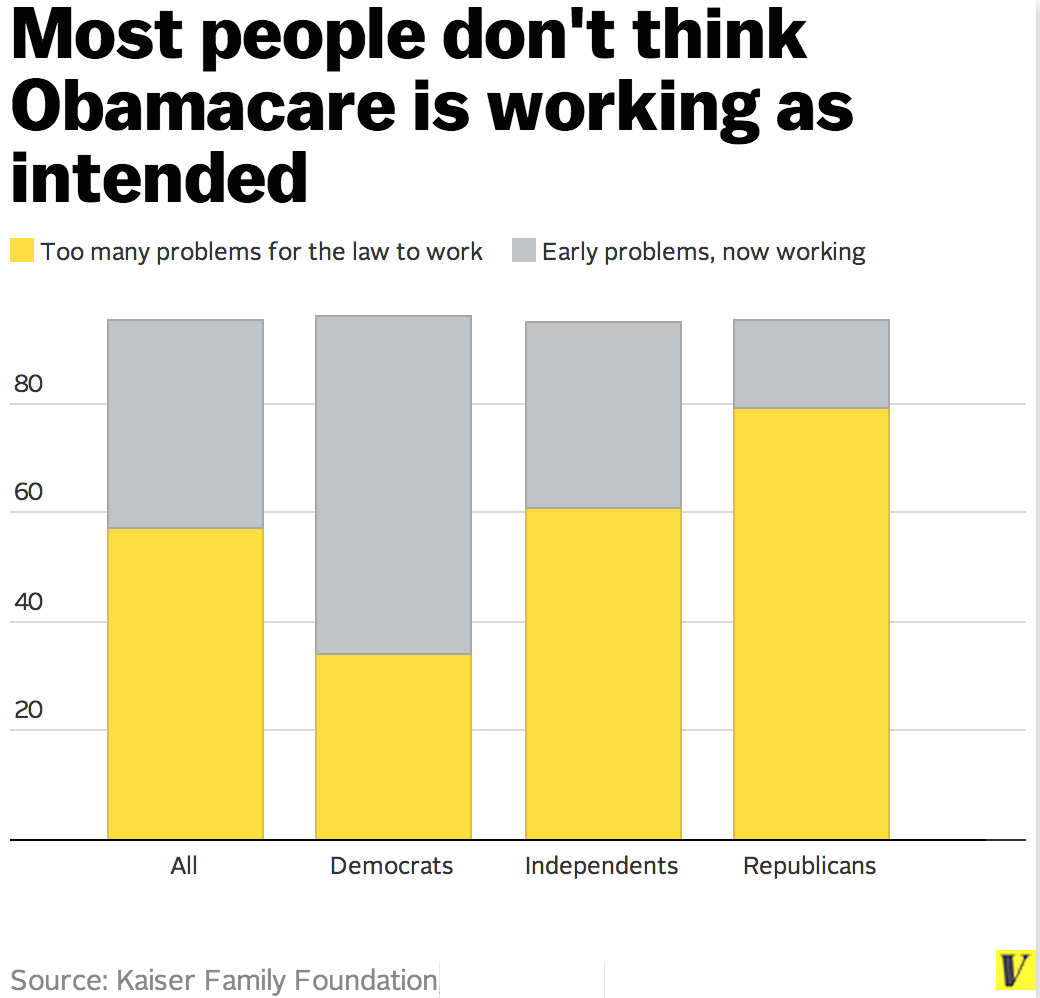
Obamacare Not Working

Kliff contemplates the disconnect between Obamacare’s success and the perception of that success. One big reason for it: Heathcare.gov:

“News about the problems with the exchanges was on a lot longer than any discussion of beating the enrollment goal,” [Kaiser’s Liz] Hamel says. “It’s possible that all the reports were still in the forefront of people’s minds.”

And its likely that most Americans are gauging their understanding of how well — or poorly — Obamacare is going from the news coverage. Most Americans already have health insurance, and aren’t shopping on the exchanges for new policies. So even if the Obamacare experience improves, most people won’t necessarily notice.

“So many people are not impacted by the law that they’re more likely to respond to messages in the media than they are to evaluate their own experience,” Hamel says. “That makes me think it will be a while before there’s any shift in how people think the law is going.”

Relatedly, Ezra listens to Scott Brown’s anti-Obamacare rhetoric:

Scott Brown, who’s now running for Senate in New Hampshire, has found the perfect position on Obamacare. He’s for it. He’s just not for calling it Obamacare.

In an interview with WBUR, he called Obamacare a “disaster.” Then he was asked what he’s for  — and he went on to describe Obamacare. … [T]he polls are clear. The American people don’t want Obamacare. However, they like what’s in Obamacare. And they don’t like it when Republicans try to get rid of Obamacare. Brown’s position shows Republicans a way out: a rebranding of Obamacare, accompanied, perhaps, by some vague tweaks and changes to be named later. Fauxbamacare, in other words.

Another Staggering Death Sentence

Egyptian judge Saed Youssef, who infamously sentenced 529 people to death last month for their alleged roles in the death of one police officer, outdid himself yesterday when he condemned another 682 defendants, including Muslim Brotherhood Supreme Guide Mohamed Badie, to hang for the same crime:

Those found guilty have been charged with contributing to the death of a police officer during a raid on a police station in August. But their individual crimes were all relatively minor, like committing acts of violence or inciting violence, and none of the 683 was charged with participating in the officer’s murder. Badie, in fact, was advocating for nonviolence during the tumultuous aftermath of former Egyptian President Mohamed Morsi’s ouster.

Badie also happened to be in a different city during the incident. … The trial itself lasted a matter of minutes, and most of the accused were tried in absentia.

Bel Trew looks at Youssef’s record:

Judge Youssef first rose to prominence in 2012 when he took over the second district of the criminal court in his hometown of Beni Suef, some 100 kilometers north of Minya. It was there he earned the nickname “The Butcher” for bending the law with his notoriously harsh verdicts:

He once sentenced a man to 40 years in jail for possessing a gun. “He gave him 15 years for the weapon, 15 years for the bullets, then 10 years for getting into the gunfight,” said lawyer Mohamed El-Zanaty, based in Beni Suef, who has worked extensively in Youssef’s courtrooms.

But Youssef only gained international notoriety last year, when he acquitted the area’s security chief and 10 of his policemen accused of killing protesters on January 28, 2011, dubbed the “Friday of Rage,” one of the bloodiest moments of the 18-day uprising that overthrew President Hosni Mubarak.

Karl Vick notes that this level of judicial complicity in oppression is unprecedented in the country:

During the rule of President Hosni Mubarak and his predecessors, Anwar Sadat and Gamal Abdel Nasser, “the judiciary sometimes acted as a brake on the government’s most authoritarian impulses,” Nathan J. Brown and Michelle Dunne of the Carnegie Endowment for International Peace recently wrote, “Now, all the instruments of the Egyptian state seem fully on board. Whereas Nasser had to go to the trouble of setting up kangaroo courts, today there is no need.” Judges have outlawed the Muslim Brotherhood, the Palestinian militant group Hamas, and now the liberal April 6 Movement, named for the date of a planned 2008 public strike in an industrial town that grew into a nationwide protest movement.

The editors at Bloomberg decry the direction Egypt is headed in and say it’s time to cut off the aid:

Egypt’s government says about 500 people have been killed in terrorist attacks since the coup, mainly security personnel. That violence flared in response to draconian policies that offered Islamists no peaceful avenue. Previous attempts to crush the Muslim Brotherhood in Egypt, notably under President Gamal Abdel Nasser, failed miserably. [Yesterday’s] death sentence against the leader of the Muslim Brotherhood, which claims membership of up to a quarter of Egypt’s population, will further aid recruitment for radical Islamist groups that preach violence. …

Al-Seesi’s Egypt is measurably more bloody and repressive than either the Muslim Brotherhood government it replaced or any of Egypt’s previous dictatorships. It’s not enough for the U.S. to merely condemn the mass trials. If the U.S. truly supports the spread of democracy and individual rights in the Middle East, as it claims, then it cannot provide the means to suppress them.

What Is Justice For Child Porn Victims? And From Whom?

Last Thursday, the Supreme Court issued a 5-4 ruling in Paroline v. United States. The court decided that, while a victim of child pornography is owed restitution from any and every person who has viewed it, a single individual cannot be held liable for the entire sum of that restitution. Lyle Denniston explains:

The decision clearly will spare a Tyler, Texas, man, Doyle Randall Paroline, from paying all of the nearly $3.4 million that lawyers for a young woman identified only as “Amy” had demanded from him.  Paroline had two images of her being photographed as her uncle sexually abused her when she was eight years old.  Now a young woman, she had testified that “My life and my feelings are worse now because the crime has never really stopped and will never really stop.”

The Court ruled that a federal district court judge must calculate how much to assess against Paroline personally.  There is no doubt, Justice Kennedy wrote, that Paroline “was part of the overall phenomenon” of distributing and keeping images of the abuse of Amy.  He should have to pay his share and, Kennedy said, it must be enough to send the message that his part in the crime was not victimless. Lawyers for “Amy” had insisted that Paroline, like everyone who has her images and looks at them, contributes to her continuing injury, so each of them should be required to pay the full amount for her losses, in whatever multiples of individuals are found and prosecuted for having the pictures.

In a dissent joined by Scalia and Thomas, Roberts argued that as the statute in question provided no formula for how to calculate such restitution, “Amy” should get nothing from Paroline. Sotomayor dissented in the other direction, arguing that Paroline should pay the full sum or collect it from other offenders himself. Rick Pildes notes that this is all Congress’s fault:

As eight Justices saw it, the text of the law suggested Congress had created a messy situation:  (1) Congress intended to ensure that victims like Amy receive some restitution; (2) Congress did not intend that they receive as much as $3.4 million in restitution from someone who possessed two images of the victim, which is what the victim sought; (3) and Congress had not provided any direct guidance in the statute itself for how courts ought to determine the point between $0 and $3.4 million at which restitution ought to be set.  Congress must have meant something between $0 and $ 3.4 million, but provided no road-map for even generally figuring out how much.  All eight Justices presumably agree it would be better for Congress to address and resolve the general policy issues.  The question is what to do when Congress hasn’t — and, perhaps, what decision from the Court makes it most likely that Congress will do so.

But Paul Cassell, one of “Amy’s” lawyers, argues that the law’s intent was already clear:

[T]he text of the statute makes clear that Congress wanted child pornography victims like Amy to recover “the full amount of their losses” — not some partial, fractional amount.  Moreover, the Court entirely ignored an amicus brief filed seven Senators who were in Congress in 1994, when the provision was enacted.  As Senators Hatch, Feinsten , Grassley, Markey, McCain, Murray, and Schumer explained in their brief, “Congress really did mean what it said.”  They provided drafting history showing that Congress had specifically decided not to include a “proximate result” limitation in the other parts of the statute — only subsection (F).  In other words, Congress meant for victims like Amy to recovery the full amount of their losses from each defendant.

Either way, it seems the matter won’t be settled until Congress amends the statute. Marci Hamilton urges them to make the perps collect the restitution money, in line with Sotomayor’s position:

There is a simple two-part fix, if you parse Justice Kennedy’s and Justice Sotomayor’s views closely enough: (1) Congress should enact a federal rule of contribution among child pornography defendants and (2) replace “proximate cause” with “aggregate causation.”  That would make it possible for the many Amys of our world to obtain restitution from even one perpetrator in the marketplace and obtain full restitution.  The best part of this solution is that it would then incentivize the one defendant forced to pay it all to identify others as contributors.  Let the defendants go after their many contacts in the market for contribution.  That reduces the restitution, even if levied against a single person, from an excessive personal fine, and puts the burden of parsing out blame on the bad guys, not the victims who never asked to be on the Internet in the first place.

Posner proposes an alternative that he considers more just:

The problems with Kennedy’s and Sotomayor’s approaches stem from the same source: When Congress drafted the provision about restitution in the Violence Against Women Act, it thought about traditional types of harms—when one person directly injures another—and not the unusual collective injury in this case. That’s why the justices’ efforts to twist the statutory language lead to unfair and bizarre outcomes.

Congress created this mess, and only Congress can fix it. Every person who is convicted of child pornography should pay a large fine into a government trust. The fine would be tailored to the wealth of the defendant and the magnitude of his wrongdoing. Then this fund would be used to compensate all the identified victims of child pornography, who would share it in proportion to the severity of their injuries. That way, not Kennedy’s or Sotomayor’s, lies fairness.

(Video: Clip from the Law and Order: Special Victims Unit episode “Downloaded Child”, based on the case of “Amy”. It envisioned a much different result than the ruling in Paroline.)

Which On-Screen Violence Is More Senseless?

Game Of Thrones author George R.R. Martin compares the violence in the series to that of drone warfare:

Taking human life should always be a very serious thing. There’s something very close up about the Middle Ages. You’re taking a sharp piece of steel and hacking at someone’s head, and you’re getting spattered with his blood, and you’re hearing his screams. In some ways maybe it’s more brutal that we’ve insulated ourselves from that. We’re setting up mechanisms where we can kill human beings with drones and missiles where you’re sitting at a console and pressing the button. We never have to hear their whimpering, or hear them begging for their mother, or dying in horrible realities around us. I don’t know if that’s necessarily such a good thing.

Zack Beauchamp thinks this is mistaken:

Martin is certainly not alone in questioning the implications of drones, and exploring the human impact of war is a major part of his work. As he’s said repeatedly, his work is designed to be a criticism of war as a human institution, the base cruelty of characters like Joffrey Baratheon and Ramsay Snow exposing what happens during episodes of organized violence. Still, Martin’s own books allow for a lot more nuance around the morality of medieval warfare than he seems to see in its more modern incarnation. The idea that killing in war is somehow better when done with a sword rather than a missile seems to cut against his critique of war itself.

What’s really troubling about both the drone program and slaughter on Game of Thrones isn’t the technology people are using to kill each other. It’s the reasons that they decide to deploy it. On the show, it’s mostly a pointless struggle over which royal family gets to wield power. In real life, it’s the willingness to kill civilians to achieve arguably dubious gains against al-Qaeda. The problem in both cases is the policy of people in power, not the weapons they use to pursue it.

Overreach For America?

Alexandra Hootnick notes that in some districts, Teach For America corps members are competing with traditional teachers for jobs:

When Teach For America started up, [founder Wendy] Kopp prioritized sending its energetic but inexperienced corps to public schools lacking licensed educators – the schools often too poor or too dangerous to attract teachers. But since the recession, with education funding across the country drying up, teacher layoffs have become more of an issue than teacher shortages. Between 2008 and 2013, 324,000 teaching positions in local school districts were eliminated, according to the Center on Budget and Policy Priorities. With TFA’s expansion outpacing needs, it has been forced to find new places for its recruits. In the process, the organization has come under increasing fire, not just from outside critics but from its own alumni ranks, which include former recruits who believe the organization’s aggressive growth strategy has compromised its mission.

One of TFA’s controversial moves has been to seek placements for recruits in wealthier school districts like Seattle’s, where teaching jobs – not teachers – are scarce. … Meanwhile, the cost of recruiting, training and supporting corps members – which is partly subsidized by taxpayers – has more than doubled over the past decade, from $22,000 to at least $47,000. (TFA disputes this, claiming that it has revised its method of accounting for these costs.) And informal data that the TFA used to track its teachers’ performance indicates that their students aren’t making as much progress as they were a few years ago.

Update from a reader:

The Onion nailed this one, of course: “My Year Volunteering As A Teacher Helped Educate A New Generation Of Underprivileged Kids vs. Can We Please, Just Once, Have A Real Teacher”

Rethinking Hip-Hop

Questlove bemoans the state of hip-hop, “an entire cultural movement, packed into one hyphenated adjective”:

These days, nearly anything fashioned or put forth by black people gets referred to as “hip-hop,” even when the description is a poor or pointless fit. “Hip-hop fashion” makes a little sense, but even that is confusing: Does it refer to fashions popularized by hip-hop musicians, like my Lego heart pin, or to fashions that participate in the same vague cool that defines hip-hop music? Others make a whole lot of nonsense: “Hip-hop food”? “Hip-hop politics”? “Hip-hop intellectual”? And there’s even “hip-hop architecture.” What the hell is that? A house you build with a Hammer? …

On the one hand, you can point to this as proof of hip-hop’s success. The concept travels. But where has it traveled? The danger is that it has drifted into oblivion.

He relates an encounter he had with a fan:

The other day, we ran into an old man who is also an old fan. He loves the Roots and what we do. Someone mentioned the changing nature of the pop-culture game, and it made him nostalgic for the soul music of his youth. “It’ll be back,” he said. “Things go in cycles.” But do they? If you really track the ways that music has changed over the past 200 years, the only thing that goes in cycles is old men talking about how things go in cycles. History is more interested in getting its nut off. There are patterns, of course, boom and bust and ways in which certain resources are exhausted. There are foundational truths that are stitched into the human DNA. But the art forms used to express those truths change without recurring. They go away and don’t come back. When hip-hop doesn’t occupy an interesting place on the pop-culture terrain, when it is much of the terrain and loses interest even in itself, then what?

Update from a reader:

I would like to challenge Questlove’s assertion that “the only thing that goes in cycles is old men talking about how things go in cycles.” I would challenge him to listen to the music and experience the persona of Jerron Paxton, a musical prodigy who wears tuxedo overalls and interprets the music of early American musicians such as Blind Blake, Jelly Roll Morton, and other luminaries of American folk, blues, and ragtime music. Jerron is part of a resurgence of black stringband music also reflected by the music of the Grammy winning Carolina Chocolate DropsDom Flemons, as well as talented white bands such as the Crow Quill Night Owls and many other more obscure musicians. See an interview with Jerron here. You can hear him playing banjo, fiddle, guitar and piano all over Youtube.

Now, perhaps Questlove means that a particular type of music only enters the popular consciousness once, but that’s certainly not the case. Take, for instance, the time in the late nineties when bands like the Brian Setzer Orchestra and Squirrel Nut Zippers brought big band swing music back into the popular consciousness and the pop charts. When you consider such recurring trends in American popular music, Questlove’s assertion that “the art forms used to express those truths change without recurring. They go away and don’t come back.” is sheer nonsense. There are many thousands of living American folk and blues musicians such as myself who recognize that “the art forms used to express those truths” are constantly echoing and re-hashing one another.

(Video: “The Roots: History of the Hip Hop Band”)

The Smearing Of Ryan As A Racist, Ctd

In a lengthy profile of Paul Ryan, McKay Coppins suggests that last months “dog-whistle” controversy has genuinely shaken the congressman’s confidence:

He is like a singer who has suddenly discovered his lack of relative pitch while on stage, and now worries that every note he’s belting out is off-key. As we talk, he chooses his words with extreme care, and is prone to halting self-censorship. At one point, as he tells me about his efforts during the presidential race to get the Romney campaign to spend more time in urban areas, he says, “I wanted to do these inner-city tours – ” then he stops abruptly and corrects himself. “I guess we’re not supposed to use that.” …

It would be easy to use stuff like this to ridicule him for his tone-deafness, his white-guyness, his sheltered cluelessness. But Ryan, by his own admission, is receiving his sensitivity training in real time. He has charged headfirst into the war on poverty without a helmet; zealously and clumsily fighting for a segment of the American public that his party hasn’t reached since the Depression-era shantytowns that lined the Hudson River were named after Herbert Hoover. It is frequently awkward and occasionally embarrassing, but it is also better than staying on the sidelines.

Yglesias snarks that the article has everything “except for even a teeny tiny shred of insight into how Paul Ryan’s policy ideas will impact poor people”:

For example, what does Ryan’s budget mean for the poor? Well it turns out that the majority of his budget cuts come from programs that benefit poor people.

He wants to reduce spending on poor people’s Medicaid benefits. And on their nutrition assistance. And on their college tuition assistance. And on their access to subsidized private health insurance. Ryan does cut some programs that aren’t aimed at helping low-income Americans, but mostly he cuts programs for the poor.

At the same time as it cuts spending on the poor, Ryan’s budget also has tax provisions. Specifically he calls for $5.7 trillion worth of tax rate cuts. That money, he says, will be made up through unspecified reductions to tax credits and tax deductions. When the Tax Policy Center analyzed the distributive implications of this kind of plan, they found that it increases the after-tax income of the rich while raising taxes on the working- and middle-class.

Meanwhile, Chait sees Ryan “altering the basis for his public appeal in a significant way”:

Ryan burst upon the national scene by presenting himself as a wonk’s wonk, the concerned, helpful man with the calculator here to help America avoid its fiscal crisis. Ryan the Wonk did not always know what he was talking about, but the important thing is that he looked like he did.

The newer iteration wants to make his case in non-pecuniary terms. Point out that his budget enacts a massive upward redistribution of income, and he will tell you about his soul. It is very much the same method used by George W. Bush to ward off criticisms of his fiscal priorities. (When Al Gore stated during a 2000 presidential debate that Bush had taken funding from children’s health insurance in order to cut taxes for oil companies, Bush replied, “If he’s trying to allege that I’m a hard-hearted person and I don’t care about children, he’s absolutely wrong.”) It’s a tactic that meets both Ryan’s needs and the needs of journalists possessed of great confidence in their ability to judge the sincerity of political theater.

An Ocean Of Foam

Andy Cush captions:

36 ventilators, 4.7m3 packing chips, a new installation from the Swiss artist Zimoun, does what it says on the tin. The artist filled a space inside Switzerland’s Museo d’Arte di Lugano with lots and lots of polystyrene packing peanuts, and uses 36 fans to whip them into a stormy frenzy.

bitforms gallery elaborates on Zimoun’s mission:

Using simple and functional components, Zimoun builds architecturally-minded platforms of sound. Exploring mechanical rhythm and flow in prepared systems, his installations incorporate commonplace industrial objects. In an obsessive display of simple and functional materials, these works articulate a tension between the orderly patterns of Modernism and the chaotic forces of life. Carrying an emotional depth, the acoustic hum of natural phenomena in Zimoun’s minimalist constructions effortlessly reverberates.

Why Net Neutrality Matters

Alexis Madrigal and Adrienne Lafrance explain why advocates of net neutrality approach the issue with such great passion:

This idea of net neutrality—this cherished idea, even, among Internet entrepreneurs and activists—has a long history, roughly as long as the commercial world wide web. It is, Harvard law professor Lawrence Lessig has argued, what makes the Internet special. He used to call the principle e2e, for end to end: “e2e. Not b2b, or b2c, or c2b, or b2g, or g2b, but e2e. End to end. The core of the Internet, the core value that defined its power, the core truth that made innovation around it possible, is this e2e,” Lessig said in a 1999 talk. “The fact – a fact – that the network could not discriminate in the way that AT&T could.”

Comcast couldn’t privilege its own content over Netflix’s or PBS’ or Disney’s or your blog’s. He explained: “The network was stupid; it processed packets blindly,” he said. “It could no more decide what packets were ‘competitors’ than the post office can determine which letters criticize it.”

This was not just a nice thing, it was the very nature of the Internet. Without it, the Internet will become, as Tim Wu put it, “just like everything else in American society: unequal in a way that deeply threatens our long-term prosperity.”

But Jimmy Wales, the founder of Wikipedia, tells Jemima Khan that he’s not that worried about it:

I differ from many of my colleagues, in that I don’t think net neutrality is super-important. The fear is that companies which control the “last mile” to the consumer will leverage that choke point to stifle innovation (unless they get paid extra for it happening). And that’s not an entirely crazy thing to fear, particularly because much last-mile infrastructure remains under inappropriate, government-granted monopoly privileges—or derived from those privileges in the first place years ago.

But if we are worried about a handful of companies getting control of a choke point and using it to squeeze out competitors and make massive profits, we don’t need to look at the layer of network infrastructure and network neutrality. We just need to look at the Apple App Store (and similar), where everything that runs on your iPhone or iPad has to be approved by Apple, with them taking a huge cut of the revenue at every step, with no real competition in sight. Consumers should be very worried about that.

Can you imagine the outcry if 20 years ago Microsoft had decreed that no third-party software could run on Windows without being approved by them, and bought through their proprietary stores? Yet today we accept this model on mobile devices (and soon, I fear, on our computers) without blinking.

Barbara van Schewick discusses some of the dangers she sees in imposing access fees for Internet content:

Why should we care if start-ups or other innovators without significant outside funding cannot pay these fees and therefore lose the ability to innovate? Throughout the history of the Internet, innovators with little or no outside funding have developed many important innovations (including E-Bay, Facebook, Yahoo, Google, Apache Web Server, the World Wide Web, Flickr and Blogger), and there is no reason to believe this would change in the future. Thus, removing (or at least impeding) the ability of this important subgroup of innovators to develop new applications will significantly reduce the overall amount and quality of application innovation.

Finally, access fees may impose serious collateral damage on values like free speech or a more participatory culture by making it more difficult for individuals or non-profits to be heard or to find an audience for their creative works.

And Timothy B. Lee blames Congress for tying the FCC’s hands on net neutrality, noting that the relevant law predates the concept:

The 1996 Telecommunications Act prohibits the FCC from imposing common carrier regulations on “information services,” which (according to the FCC) includes broadband internet access. The law says that information services can’t be subject to common carrier regulations. In its January ruling, the court said that the FCC’s 2010 net neutrality rules constituted common carrier regulation and was therefore illegal. But the court signaled that it would accept a revised set of rules that only prohibited discrimination if it was “commercially unreasonable.”

Is that the result Congress intended? No one really knows. The term “network neutrality” hadn’t been coined yet in 1996. Cable modems and fiber optic services like FiOS were still in the future. Unsurprisingly, Congress wasn’t clear about how to handle concepts and technologies that didn’t exist yet, so the courts have had to make up the rules as they went along.