
Munich, Germany, 7 pm
Munich, Germany, 7 pm
Razib Khan asks why discussions of resegregation focus on the South:
The South has a particular history with race, and that is an important history. But the continuous focus on this region of the country is I think driven in part by the reality that the cultural elites, often white progressives, are not keen on shining a light on the segregation which they themselves have passively accepted in their own lives.
In fact the worst segregation of blacks and whites is in major urban areas of the Great Lakes. According to the Census the most segregated cities are Detroit, Milwaukie, New York, Newark, and Chicago. But for some reason there are fewer exposes on how upper middle class, usually white, couples in major “Blue America” urban areas flee racially diverse public schools for the suburbs or private schools. The reasons for these actions are defensible in my opinion, but one should probably admit that these are likely the major causes of resegregation in the South as well.
To further his argument, Khan cites Reihan Salam’s recent piece on interracial dating. Reihan argues that intermarriage is an important social good:
There are good reasons to question the moral appropriateness of strong same-race preferences and their close cousin, in-group favoritism.
In The American Non-Dilemma, Nancy DiTomaso argues that persistent racial inequality in the United States is not solely or even primarily a reflection of racism and discrimination. Rather, it reflects the fact that whites tend to help other whites without ever discriminating against or behaving cruelly toward blacks and other nonwhites. As long as whites tend to dominate prestigious occupations, and as long as they control access to valuable social resources like access to good schools, the fact that whites, like all people, will do more to help family, friends, and acquaintances than strangers will tend to entrench racial inequality, provided that white people choose to associate primarily with other whites. DiTomaso observes that while Americans place very high value on the idea of equal opportunity, virtually all of us seek “unequal opportunity” in our own lives by leveraging our intimate relationships to achieve our goals, including our professional goals. Yet most of us don’t see the help of family and friends as an unfair leg up. This kind of “opportunity hoarding” is accepted as par for the course.
We could make an effort to eliminate in-group favoritism, but such an effort would inevitably fail, as in-group favoritism is a powerful human impulse. A more sensible course of action would be to do our part to expand the boundaries of the in-group.
Khan adds:
What if in fact most racial inequality is a function of social-cultural racism, rather than institutional racism?
Buffalo Bills cheerleaders won't perform after suit alleging unpaid work, sexual harassment http://t.co/Msg25KvG1G pic.twitter.com/rZPiGfgCU1
— Palm Beach Post (@pbpost) April 25, 2014
Emily Shire lists the grievances of the former Buffalo Bills cheerleaders who are suing the franchise for minimum wage violations and a host of other indignities:
[T]he alleged exploitation was more than just unpaid labor. The Buffalo Jills allege that Stejon [Productions Corp] and Citadel [Communications Co.] essentially ran a racket, forcing the women to buy calendars and other Bills-related items out of pocket and then sell them on their own time. They even imposed damages if they failed to sell their quotas, according to the suit. Each woman was required to buy 50 to 75 Buffalo Jills swimsuit calendars at $10 each and sell them. If she did not sell them, she was left in the red and “subject to further penalties at the discretion of defendants.” The same went for Jills golf tournament tickets and gift baskets, which could cost each woman $590. Other out-of-pocket expenses included travel and hotel accommodations for the events they had to attend and $650 in uniform costs, the suit says.
That’s not all. From exposure to sexual harassment to menstrual hygiene instructions, the alleged physical appearance rules paint a deeply disturbing picture of archaic, invasive, and manipulative requirements. According to the lawsuit, the Buffalo Jills were given a list of 17 rules governing “general hygiene and body maintenance.” They included “how to properly wash ’intimate areas’ and how often to change tampons.”
Noting that the Jills’ lawsuit comes on the heels of similar actions by the Oakland Raiderettes and Cincinnati Ben-Gals, Amanda Hess asks why these women’s poor pay and exploitation are only just now coming into the spotlight:
Professional cheerleaders have always presented a dilemma for the traditional feminist movement. On the one hand, feminism is committed to fighting for fair pay for women in all areas where they are discriminated against because of their gender. On the other hand, this particular kind of labor—one where women, not men, are enlisted to jiggle their assets at the local golf tournament—suggests another kind of gendered exploitation, and one that’s hard for some feminists to rush to defend. (Headlines about the recent spate of cheerleader lawsuits may focus on the scandalous details, but looking sexy for men is a feature of the job, not a bug.) Lately, it seems the feminist movement has caught up to the cause; it’s no longer particularly controversial to stand up for the legal rights of the women who perform work that nevertheless fails to reflect the ideal, gender-equitable society.
Back in January, Billy Haisley also covered the mistreatment of cheerleaders. He spoke with a former Ravens cheerleader:
For cheerleaders, the real money comes from appearances. It’s still not all that great. If the appearance is for charity, the team will charge $175 per cheerleader per hour; otherwise, it’s $300 per hour. Of that money, our tipster explains, each cheerleader takes home around $50 an hour. Sounds good, but in an average season, a cheerleader will make only 30 or so appearances, and many of those don’t pay at all. For certain charity events, like those set up in the NFL’s or the team’s own name, cheerleaders are expected to attend without compensation, and rules require them to attend charity events at least twice monthly, depending on availability.
After investigating the role of terrorism in civil wars in Africa, Jakana Thomas comes away with the sobering conclusion that it’s often a successful tactic:
The popular adage that governments “do not negotiate with terrorists” appears to be untrue, at least in civil war. In a new study published in the American Journal of Political Science, I find that governments embroiled in domestic conflicts in Africa between 1989 and 2010 are more likely to hold negotiations with rebel groups when they engage in more acts of terrorism. Rebels are also likely to gain more concessions from their governments when they execute more terror attacks. …
Instead of asking whether terrorism is effective, we should be concentrating on when and for what purpose is terrorism effective, especially since the empirical record shows that terrorism has both hurt and helped the causes of violent organizations that have employed the tactic. Very little extant research, however, helps us understand this variation.
Reed Wood, co-author of a similar study, makes related points:
Attacks on civilians, we argue, hurt the state more than the rebels — even where the rebels are the ones committing most of the violence. In part, this occurs because maintaining order is central to the state’s victory whereas disorder, instability, and the erosion of state control directly benefit insurgents. When insurgents rely on civilian victimization, they impose significant costs on the state and send credible signals about their willingness to continue fighting a long, costly, and brutal war. The effect is that governments are increasingly likely to make concessions to violent groups, thus permitting the group to attain some of its political goals.
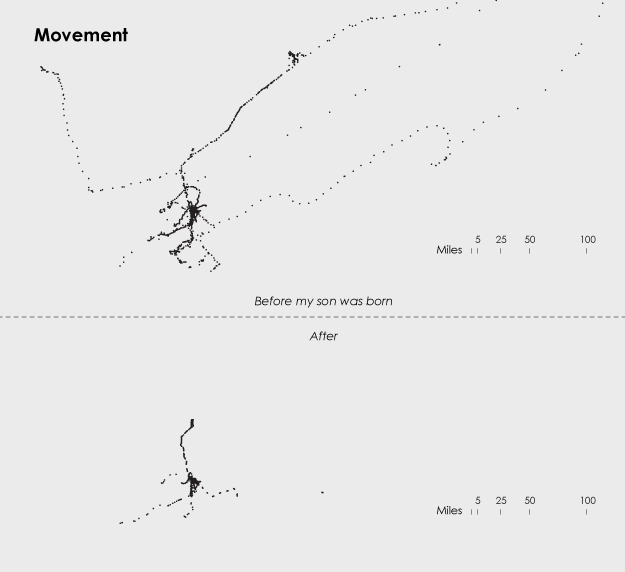
Using a series of charts, Nathan Yau examines the impact his son’s birth has had on his life over the past six months:
I started with location, which I began to collect mid-2012. The top portion shows location before my son was born, and below shows after. I work from home, so I tend not to drive much to begin with, but as you’d expect, I don’t travel too far from home these days.
There is of course the caveat that the pre-baby portion covers a longer timespan, so maybe it’s not a completely fair comparison. I can tell you though that the farthest trip I’ve gone on with my son is about 50 miles.
The main point: I spend my time very differently now.
Brian Doyle, a practicing Catholic, can’t help smiling at the beliefs of other faiths – “did Joseph Smith really see galaxies in his hat?” – but he suggests a little irreverence can go a long way:
For all that religion has been a bloody enterprise through history, and for all that religious people seem often the most almighty easy people to offend, and for all that there are many people in my faith tradition who think I am an idiot to grin over the most colorful of our traditions, I think we should grin over the more colorful parts of our faith traditions. For one thing, they are often funny—imagine the wine steward’s mixed feelings at Cana after the miracle, for example—and for another, it seems to me that real honest genuine spirituality is marked most clearly by humility and humor. The Dalai Lama, Desmond Tutu, Meher Baba, Flannery O’Connor, Sister Helen Prejean, Pope Francis—all liable to laughter, and not one of them huffy about his or her status and importance. Whereas all the famous slimy murderers of history—Hitler, Pol Pot, Stalin, Mao, bin Laden—what a humorless bunch, prim and grim and obsessed with being feared. Can you imagine any one of them laughing, except over some new form of murder? Think about it—could laughter be the truest sign of holiness?

Hayley Birch tries to figure out why she finds distance running so appealing:
When you’re training for a marathon, you make up reasons for why your body isn’t performing the way you want it to. You didn’t stretch properly after your last run. Your shoes are getting old. It was windy. Muddy. Below zero. You’re still congested after that cold you had two weeks ago. Um… It’s January? The truth is you’re tired. You’re really, really tired. By Friday, a rest day, the lethargy of the week’s training – the hills session, the night at the track, the core strength exercises, the stretching, the 15 km ‘easy’ run at 6.30am – it takes its toll, and you start to doubt whether the 30 km run you have planned for the weekend is a good idea. …
It’s difficult to explain what’s going on in the head of someone who has committed to training five, sometimes six, days a week, to running hundreds of kilometres every month. It’s difficult to explain, even when that person is you. … What I come to accept is that the race itself is just an excuse for all the rest of it. For venturing outside more than once a fortnight, for staying on top [of] my life, for preventing each week from disintegrating into a sea of unanswered emails, unwashed coffee cups and unopened post. For guilt-free time out. For solace.
(Photo by Giorgio Galeotti)
A reader writes:
Hopefully numbers like the price of the hep-C drug will remind us that when it comes to pharmaceuticals, the US is basically subsidizing the rest of the world (and I’m talking to you, countries with nationalized healthcare that negotiate much lower prices than the US). This is just foreign aid, in another guise, whether it goes to Sweden, France or Egypt. When we hear about the “efficiencies” and prices of other healthcare systems, let’s remember that part of the reason is coming right out of our pockets.
Another elaborates:
American citizens bear the costs (taxes, military, rule of law, patent system, education of scientists, etc.) of supporting the environment which makes possible the innovation these drug companies achieve. Then our reward for our collective largesse is that we as consumers get to pay more, by an order of magnitude, for the same drugs than consumers in other countries. How is that fair?
Another adds:
“For patients with a strain that is more difficult to treat, the regiment is 24 weeks. That comes in at $168,000.” Or $1,680 in Egypt – wouldn’t it be more cost effective for insurers to send US patients to “rehab” in Egypt? That price difference is enough that building a residential clinic from scratch, and flying all of the patients first class to Cairo, is likely to be more cost effective than treating them here. There is something economically perverse about that.
Update from a reader:
To the reader who suggested sending US patients to rehab in Egypt to take advantage of lower drug costs: It won’t work for the same reason we can’t all take advantage of lower costs of more run-of-the-mill drugs in Canada. It’s not as if Canada has a cornucopia drug supply. Canadian pharmacies buy the stuff from U.S. manufacturers. If the purchasing behavior of a large portion of the U.S. customer base migrated to another country, the drug companies would know, and they would adjust their pricing or their shipping policies.
Medical tourism can work for the individual when there is incentive for individuals to participate (ie, the cost is out of pocket. My daughter had excellent emergency dental work done while studying in Ghana, good enough and cheap enough that if I needed major work done on my mouth, I might consider a long vacation to Accra -because I don’t have dental insurance.) But it is problematic for an institution as large as an insurance company, and it certainly can’t work for a nation.
A reader sent me the above Youtube today. It made me miss Hitch a little more acutely than usual. To see why, go to 48:00 and stay for a few minutes. Watching Hitch stick up for gay love in front of an arch-Catholic audience while debating Bill Donohue all those years ago brought a lump to my throat. He is laughed at and jeered for saying what he says. And so he repeats it. This is the way to counter bigots – by fearless debate and relentless engagement. Hitch had no time at all for nasty bigots. But the last thing he’d ever want is to shut them up.
Leon Wieseltier, meanwhile, has written the same column again! But this time, it does include one pertinent aside:
[Obama] has been trying to escape the Middle East for years and “pivot” to Asia, as if the United States can ever not be almost everywhere, leading and influencing, supporting or opposing, in one fashion or another.
Really? The US must always be “almost everywhere“. Are there no places where the US can express disinterest or indifference or merely concentrate on safeguarding its vital interests? Apparently not. Somehow, the US has to actively stop Russia from meddling – as it has always done – with its near-abroad. How? Ay, that is the question. Wieseltier doesn’t say and never has to say. 1200 words is only ever enough for an indictment, after all.
But this is a live issue. If elected, Hillary Clinton or Marco Rubio or Jeb Bush may well resuscitate the Washington elite’s addiction to saving the world in classic neocon/liberal internationalist fashion. It doesn’t matter that in the last decade, we’ve endured the chaotic consequences of the Libya intervention, the ongoing catastrophe of the Iraq invasion, the impossibility of the Afghan occupation, and the near nightmare of plunging the US into the Syrian vortex (which Wieseltier enthusiastically endorsed). It doesn’t matter that the US is buried in debt, that the public’s opposition to hegemonic meddling is deep and broad, that there is no global ideological struggle to wage, and no genuine external state threats to counter. We just have to be everywhere.
Letting go of empire is never easy. But the prudent, minor unwinding of global hegemony that Obama has managed deserves more respect than this.
Meanwhile, the most popular post of the day was on the humiliation of Sean Hannity in the Cliven Bundy affair. Hannity has since done a triple lutz in distancing himself from his heretofore hero. On his radio show he declared that Bundy’s remarks
are beyond repugnant to me. They are beyond despicable to me. They are beyond ignorant to me,
I just can’t wait to watch the Daily Show tonight, can you?
Runner-up was my post yesterday on Obama’s unsung progress on WMDs in Syria and Iran. Other popular posts were Chad Griffin’s attempt to make amends for the Becker book and Chait’s bon mots about the right and racism. And, er, pseudo-penises.
Our Book Club discussion kicked off – and you can join in by emailing us at bookclub@andrewsullivan.com. You can also leave your unfiltered comments at our Facebook page and @sullydish.
20 27 more Dishheads became subscribers today. You can join them here.
And see you in the morning.
[Re-posted from earlier today]
That may seem a rather strange way to kick off discussion of a book about the beliefs of Christians in the decades and first few centuries after the death of Jesus of Nazareth. But it’s the question that lingers in my head after reading Bart Ehrman’s How Jesus Became God: The Exaltation of A Jewish Preacher From Galilee.
What Ehrman does in this book – as he did most memorably in Misquoting Jesus – is explain how the texts that we have about the life, death and resurrection of Jesus came to be written. I am not qualified to judge the details of the scholarship – my knowledge of such matters is a tiny fraction of Ehrman’s. I know no Aramaic or Hebrew and very little Ancient Greek. Readers with more expertise may well, with any luck, deal with some of the specific controversies – such as the notion that Jesus probably wasn’t buried at all – as we go along.
But the book’s main claims about the origins and nature of the texts are not in any scholarly doubt. And  they challenge the traditional and reflexive mental universe that most Christians, and all fundamentalists, share. For many Christians in the modern world, there is an unchallenged notion of an inerrant text that contains what we have even come to call the “gospel truth.” It is entirely inspired by God. It has complete authority in Protestant circles and shared authority in Catholicism (along with church teaching and the sensus fidelium). It is the sole authorized account of the extraordinary story that changed the world.
And yet it isn’t the only account – we have many other extant Gospels that never made the cut. Those Gospels are not as compelling or as coherent or as influential – but they sure do exist. That very fact – established in the 20th Century – explodes any idea of “orthodoxy” among the first Christians. Like any human beings trying to grapple with grief and empowerment and fear and supernatural experiences, they did not understand them fully at first or ever. They disagreed among themselves about them. They had very different perspectives and interactions with Jesus. In the Gospels themselves, Jesus’ disciples are a mess half the time – misunderstanding him, betraying him, frustrating him, and abandoning him at critical moments throughout. Whatever else the Gospels teach us, they sure teach us not to trust Jesus’ followers for either truth or morality. Peter disowned him three times in his hour of greatest need. And most fled after his crucifixion.
And the Gospels offer radically different accounts of what Jesus did, said and meant. There is no single coherent account, for example, of Jesus’ last words in the cross, or of his first appearances after his death – critical moments that you might think would have been resolved as fact early on, but weren’t. If I were to come up with a phrase to describe what has been handed down to us in these texts, it would be a game of Chinese whispers.
Does this rebut Christianity in a decisive way? For many orthodox Christians, wedded to the notion of a single, coherent and inerrant text, it must. But since the scholarship is pretty much indisputable, it seems to me that it is not Christianity that should be abandoned in the wake of these historical revelations, but a false understanding of what the Gospels and Letters actually are. In the end, the sole criterion of a religion is whether it is true. And if you’re misreading its core texts and failing to understand their origins and nuances, you’re not committed to the truth. You’re committed to a theology that has become more important than the truth.
And I’d argue that seeing them in this flawed and human way does not reduce their power. In fact, their very humanness, their messiness, their reflection of competing memories and rival understandings and evolving theologies make the Gospels a riveting tapestry of anecdotage and love and grief. I think that when you treat these texts that way, the figure of Jesus does not become more opaque. He becomes more alive in moving and marvelous detail through the distorted memories of those who loved him and through the stories that the generations that never saw or knew him in the flesh told each other about who he was. Is this human mess guided by the Holy Spirit? That’s obviously a question only Christians can answer.
My own view is that the sheer vibrancy, power, shock, detail and beauty of these stories – and their enduring resonance over the centuries – makes the presence of the Holy Spirit obvious. In fact, if we want to understand how God interacts with human beings, these Gospels show the way. Even through their obvious literal imperfections, a deeper perfection shines. Agnostic and atheist readers will of course disagree. But my point is simply that, for Christians, there is no need to be afraid of the truth about these texts. Because as Christians, there can never any need to fear the truth. In fact, fear of what such scholarship might reveal exposes a defensive crouch and a neurotic denialism that can only lead us away from Jesus rather than toward him.
The truths of this book that only the neurotic or defensive Christian will deny are the following:
Jesus was not the only first-century figure who was deemed to have a virgin birth, martyrdom and resurrection. In fact, these were quite common tropes in the Greek and Roman world at the time. Jesus was far from unique in being seen as part human and part divine in his time. The understanding of his divinity evolved over the years, as his followers argued among themselves and tried to make sense of the incarnational mystery that emerged from his first followers. Jesus himself was clearly an apocalyptic Jewish preacher who believed that the entire world was about to end, to usher in a new kingdom of heaven on earth. The Gospels are a mishmash of competing memories filtered through decades of repetition and translation and manual transcription. The followers of Jesus in his lifetime were primarily illiterate rural Galileans – far removed from the Greek and Roman sophisticates who later tried to make sense of them. All of this comes down to these peasants’ memories and the stories they told each 0ther and then the world.
We see, in other words, through a glass darkly when we look at these texts. But through that darkness, one palpable truth also emerges. It’s a truth that Ehrman once didn’t believe but now does. There is no question that the very first Christians only truly realized the full import of what they had seen and witnessed after it was too late. Their beloved teacher and friend was dead – and executed in a brutal, if conventional, way. But something happened to them after his death. They believed that they had seen him again alive! The revelation of the incarnation of God was a very early Christian conviction – not something that emerged much later, as was once thought. And in that astonishing vision of a Jesus fully alive after death, so much that had mystified his disciples in Jesus’ life and teachings suddenly became clear. This man truly was God. And his teachings and actions in retrospect suddenly took on a deeper and more cosmic and even more urgent meaning.
To kick off the Book Club discussion, I thought it would be helpful to grapple with the core question of these Biblical texts and how they can be integrated (or not) into orthodox Christian belief and practice. Does this book effectively debunk Christianity’s core claims in modernity … or does it point to a new way of understanding and believing them?
Email us your response to this email address: bookclub@andrewsullivan.com. Please keep them to a 500-word maximum, so we can better cope with the curating and editing. We can tackle more specific arguments and themes as the next week goes by.
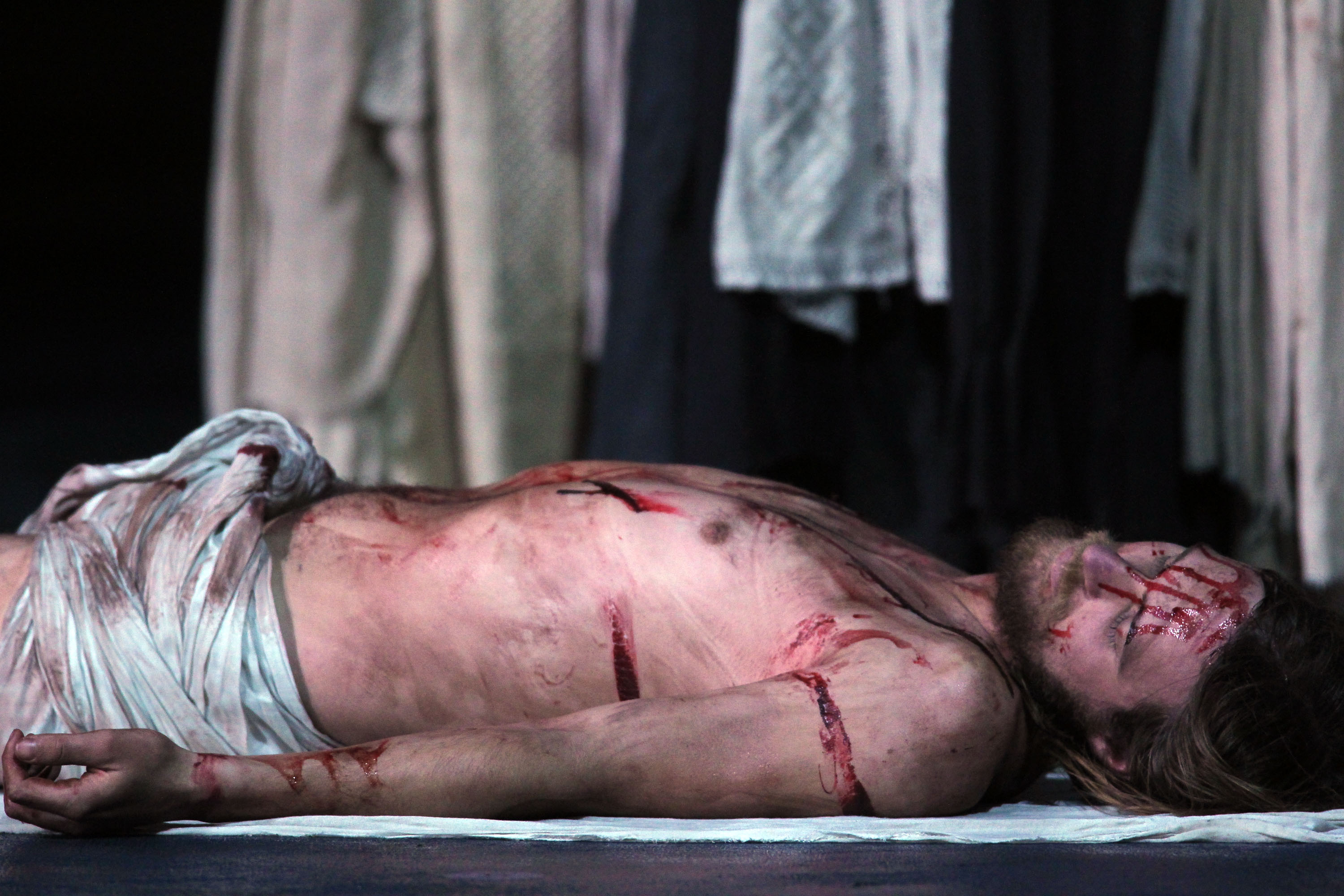
(Photo: Frederik Mayet as Jesus Christ performs on stage during the Oberammergau passionplay 2010 final dress rehearsal on May 10, 2010 in Oberammergau, Germany. By Johannes Simon/Getty.)
 The Dish