420 MIX from Eclectic Method on Vimeo.
Category: The Dish
She Has Her Mother’s Eyes And Her Father’s Trauma
Researchers in Switzerland are closer to understanding why extreme stress appears to have second-generation effects:
The researchers studied the number and kind of microRNAs expressed by adult mice exposed to traumatic conditions in early life and compared them with non-traumatized mice. They discovered that traumatic stress alters the amount of several microRNAs in the blood, brain and sperm – while some microRNAs were produced in excess, others were lower than in the corresponding tissues or cells of control animals. These alterations resulted in misregulation of cellular processes normally controlled by these microRNAs.
After traumatic experiences, the mice behaved markedly differently: they partly lost their natural aversion to open spaces and bright light and had depressive-like behaviors. These behavioral symptoms were also transferred to the next generation via sperm, even though the offspring were not exposed to any traumatic stress themselves.
Virginia Hughes adds:
The study is notable for showing that sperm responds to the environment, says Stephen Krawetz, a geneticist at Wayne State University School of Medicine in Detroit, Michigan, who studies microRNAs in human sperm. (He was not involved in the latest study.) “Dad is having a much larger role in the whole process, rather than just delivering his genome and being done with it,” he says.
Faces Of The Day
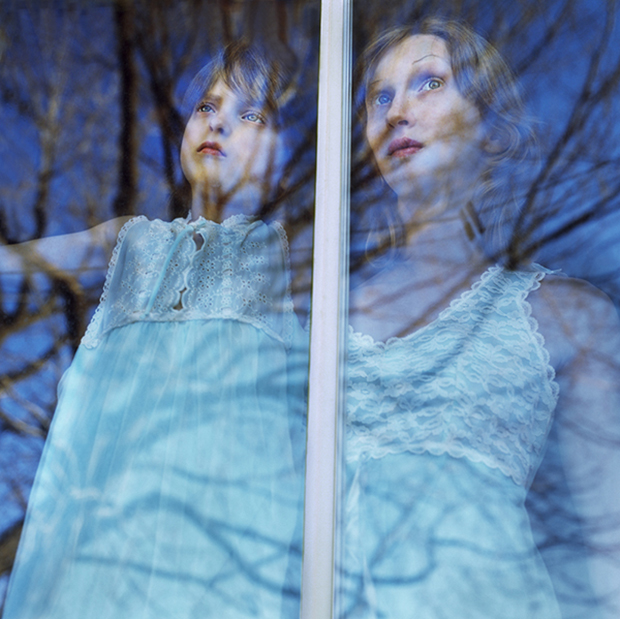
Viktoria Sorochinski describes her project Anna & Eve, which profiles a mother and daughter:
I first met Anna and Eve in Montreal where I used to live…. They drew my attention because of the unusual dynamic of their relationship. They seemed to interact like two sisters rather than like a mother and a daughter. The little Eve had this incredible power and maturity which one can very rarely encounter in a 4-year old child. The mother, on the other hand, seemed to be much more childish and naive for her age. They were both in the process of growing up and discovering this world. They were both learning from each other.
See more of Sorochinski’s work here.
Dwelling Together In Love
Michael Brendan Dougherty reflects on the way Christians celebrate Easter, finding that the patterns of Holy Week reveal “a larger, more comprehensible story about God’s covenant with man.” How he describes the movement from Good Friday to Resurrection Sunday:
We gather at the edge of sanctuary, which is the symbol of the heavenly Holy of Holies, and re-enact the part of the vicious mob in Jerusalem who called for the death of God for the sake of God’s name. We become the Roman torturers who mocked the King of the universe with a crown of thorns. We play the roles of the screaming and vain religious men, who work themselves into a fury. Our pastor intones the hysteria of the chief priest who condemned God Himself as a blasphemer. We once more present to God (and to ourselves) the bitter betrayals, laziness, and weakness of the Apostles after whom our priests are modeled — and who too often imitate their bad example.
And after all this, our own Via Dolorosa, we are finally prepared to hear the words, “Father, forgive them for they do not know what they do.”
This re-enactment — in which reality is suffused with divine meaning — does not end with the liturgy at our Church and is not reserved for the devout or even the believing. Once this vocabulary for understanding the universe seeps into the imagination, the world takes on the same patterns.
After God builds a three-story home at Creation he deputizes Adam as a kind of junior architect, another gardener who will “till and keep it,” verbs used later to describe the duties of priests in the Temple. We are to imitate God, to build our houses and make covenants with one another. To create children and make them our sons and daughters, to gather the orphans into our own homes, to dwell together in love, to sacrifice for each other, to fight for each other as God has for us. And we’re to have fun, too; to sweat over the ovens and feast together.
On this Good Friday morning I will go to the butcher and buy racks of lamb at an extortionate price. On Sunday, we will return from Mass to my father-in-law’s home, which, like the sanctuary, is a place of love. And I’ll prepare the offering. The ribs will remind me of Christ’s side, the side of the Temple, and the smoke will come like a wild offering from the oven. The devout and prodigals of our family will gather together for the holiday and to mark a few birthdays. We will put aside any previous hurts. There will be inside jokes, more good food, more games to play, more communion than any of us could have on our own. And around my father’s table, well-fed, well-loved, and well-understood, we will have made an image of the heavenly banquet, of a New Jerusalem, of a paradise filled with laughter, forgiveness, the smell of spices, with play and rest. Heaven is a homecoming.
American Is A Christian Country
At least when it comes to demographics:
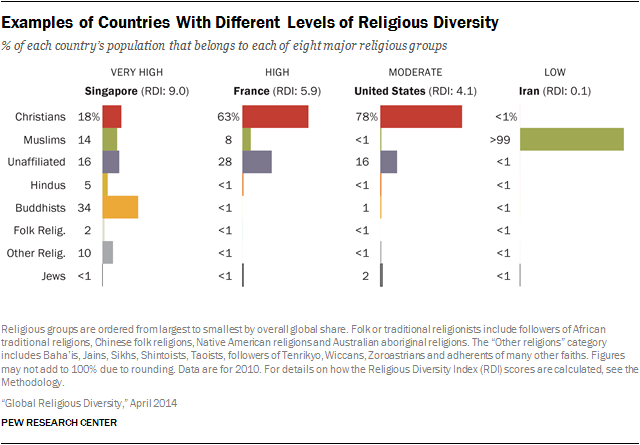
Max Fisher unpacks the above chart from a Pew study, which shows that the US is “lower than most Western European countries [in religious diversity] and 68th in the world overall”:
Maybe the most surprising thing here is that most of the US’s religious diversity comes not from religious minorities, who in total are only 5.3 percent of the population, but from the 16 percent of Americans who are unaffiliated. Part of that has to do with the fact that, for all of the US’s racial diversity, many of those racial minority groups tend to Christian: most African-Americans, certainly most Latinos, and a significant share of Asian-Americans.
Now compare the US to France and you’ll see two things: that France has almost twice as many unaffiliateds, as a share of … overall population, and eight times as many Muslims. This comparison also gets to a shortcoming in Pew’s metric, though. Something this data does not show is intra-Christian diversity: the US has lots of different Christian groups, whereas French Christians are overwhelmingly Catholic. Diversity between Catholics and Protestants alone has been hugely important for US religious history. While Americans may not be super-diverse along broader religious categories, that intra-Christian diversity has been a real challenge in the US, and one that the country has done an unusually good job of dealing with.
Emma Green connects these findings to another Pew study on religious violence, noting that “some of the least religiously diverse countries also experience some of the most religious violence”:
According to Pew’s recent analysis of religion-related social hostilities, Pakistan, Afghanistan, India, Somalia, and Israel top the list of countries with the most conflicts motivated by faith, which include “armed conflict or terrorism, mob or sectarian violence, harassment over attire for religious reasons, or other religion-related intimidation or abuse.” In terms of religious diversity, Afghanistan and Somalia are among the 10 least-diverse countries in the world, and Pakistan was also given a rating of “low” diversity. Israel and India are both considered only moderately diverse. …
This trend seems to be the most prevalent in Southeast Asia and the Middle East. Countries like Bangladesh, Indonesia, Papua New Guinea, and Thailand have among the lowest levels of religious diversity and highest levels of religious hostilities in the world. Similarly, Egypt, Iraq, Sudan, Syria, and Yemen rank at the bottom of the global diversity ranking but at the top of the religious hostilities list.
Making Room For Many Values
Elizabeth Corey reviews Marc DeGirolami’s recent book, The Tragedy of Religious Liberty, which offers an approach to disputes about the First Amendment that “does not rank [competing] values, but rather sees that all of them may well be more or less important, depending on the circumstances”:
Tragedy in the ancient sense, observes DeGirolami, moves not from joy to sorrow but from “struggle to unresolved struggle.” Its essence lies in recognizing fundamentally competing goods and the consequent realization that the conflict between them is permanent. Thus in Aeschylus’ Agamemnon, for example, Clytemnestra can never be at peace with Agamemnon’s sacrifice of their daughter, even as Agamemnon understands his civic duty as king to require the terrible deed. Both characters act on their respective notions of good, which are partial and incomplete. Both, in taking the action they do, fail to recognize and value something else of great importance.
In just this way, DeGirolami points out that the pursuit of a single value necessarily sacrifices the other goods that have not been chosen.
She goes on to connect this style of thinking to Oakeshott’s:
Oakeshott famously argued that people—especially elites in politics and academics—are driven to systematize human experience, to formulate precepts that promise regularity and consistency, and to prefer a neatly constructed ideology to the messiness of actual human relations in politics, law, or any other field. This is just what takes place among the “comic” theorists, who desire elegance and theoretical parsimony at the expense of truth and lived experience.
However, Oakeshott, DeGirolami, and others like them show that this desire tends to result in a Procrustean bed, where all that does not fit the favored theory is either ignored or explained away. It is a reduction of human experience that promotes a false idea of (and hope for) coherence.
The Wright Way To Read St. Paul

In November, the Dish noted the publication of N.T. Wright’s 1700-page, groundbreaking exploration of St. Paul and the origins of Christianity, Paul and the Faithfulness of God. In a profile of the Anglican priest and scholar, Jason Byassee takes the measure of his intellectual ambitions:
Wright’s goal in his teaching and writing is to massively revise the way Christianity has been articulated for generations. Christian faith, for Wright, is not about going to heaven when you die. It is not about the triumph of grace over the law of the Old Testament. He says its key doctrine is not justification by grace alone, the cornerstone for the Protestant Reformers. The church has misread Paul so severely, it seems, that no one fully understood the gospel from the time of the apostle to the time a certain British scholar started reading Paul in Greek in graduate school.
“Apologist” and “revisionist” usually don’t fit on the same business card. A significant New Testament scholar told me of the time he first heard Wright speak. “He sounds like the voice of God,” he told a friend on the way out. Then he overheard someone else leaving the same lecture quip, “That guy thinks he’s the voice of God.”
He goes on to highlight Wright’s contributions to the “New Perspective on Paul” (NPP), described as “a relatively recent theological discussion about what Paul really taught about salvation”:
According to the NPP (a phrase coined by Wright), Paul was not worried about where believers’ souls would go after death. Christians of the late medieval period were worried about hell and felt they had to earn entry to heaven with works. This is the theology Martin Luther taught and wrote against, helping to ignite the Protestant Reformation.
But Jews of Paul’s time were nowhere near so individualistic, so obsessed with the next life, so unfamiliar with grace as were the late medieval Christians. Instead of teaching about souls being saved from hell, say the NPP scholars, Paul is centrally teaching about God’s faithfulness to Israel. He is showing that Yahweh is a God who keeps his promises, and so can be trusted to fulfill his promises in history. NPP scholars actually think the works commanded in the law are good gifts from God. Paul doesn’t say not to do them because you’ll go wrong and think you’re earning salvation. He says not to do them because the Messiah has come and the world is different now. All people can worship Israel’s God and should do so together without ethnic division.
Update from a reader:
I used to work at the Museum of Fine Arts in Houston, where Saint Paul Writing His Epistles is on view. The fascinating story behind the work is that there are several under paintings on the canvas, most visible to the naked eye if you look carefully at the writing desk. The head of Jesus, crowned with thorns (from an earlier painting), feels as though it is staring up at Paul while he composes. An x-ray of the painting reveals an earlier self-portrait, one of the artist at his easel.
While the artist most likely did this because he could not afford to buy more canvas, it sets up a nice metaphor for the conversation about Paul. There’s Paul, Jesus, and finally the individual layered over one another, leaving the rest of us to hash what it means. Here’s more from the MFAH website. It was always one of my favorites, and I miss visiting it in the gallery.
(Saint Paul Writing His Epistles, most likely by the 17th century French painter, Valentin de Boulogne, via Wikimedia Commons)
Bringing Joy To Life
In an interview, the poet Christian Wiman, whose work often grapples with doubt and death, turns his attention to joy:
I feel that there is a great deal of joy in my work of the past ten years, but I do get letters from people telling me to ditch the sackcloth and ashes, and I get tired of my own grimace in mirrors. Can one really just decide to be more joyful, though? One aspect of joy is the suspension of will—the obliteration of will, really—though probably there is an element of discipline in being prepared for joy, just as there is in being prepared for poetry. “Iridescent readiness,” W. S. Di Piero calls it. And there are these lines from Richard Wilbur:
Try to remember this: what you project
Is what you will perceive; what you perceive
With any passion, be it love or terror,
May take on whims and powers of its own.The thing is, we are always going to feel God’s absence more than his presence. We are always going to feel the imprint and onslaught of necessity, which is the crucifixion, more than we feel the release and freedom of pure joy, which is the resurrection. The first we experience; the second, even when it emerges out of experience, we believe. In that tiny gap of grammar is an abyss of difference. Suffering we know and share intimately with Christ (it’s how we bear it). Faith and hope are always imaginative—that is to say, projective—acts: “Tomorrow I shall wake to welcome him.”
Previous Dish on Wiman here, here, here, here, here, and here.
Would You Notice Jesus?
Jeremy Polacek notes a new and disruptive sculptural incarnation of Jesus Christ:
Lying blanketed and forlorn on a [Davidson, North Carolina] bench, “Homeless Jesus” has inspired a conversation about homelessness in general, appropriate depictions of Christ and at least one call for his arrest. The life-size statue is the work of Canadian sculptor Timothy Schmalz who in his artist statement says he’s “devoted to creating artwork that glorifies Christ.” His “Homeless Jesus” is controversial for many reasons; most importantly because of the pose. The figure depicts Jesus as a man under a blanket, with only his exposed feet, wounded by crucifixation, to give away his identity — a starkly different image than the images Christ on the cross, Christ at the nativity or Chris the redeemer that we are used to seeing.
The idea seems to be catching on:
Davidson’s “Homeless Jesus” is the first “Jesus the Homeless” statue on display in the U.S., but more might be on the way. While not entirely a unanimous opinion (St. Michael’s Cathedral in Toronto and St. Patrick’s Cathedral in New York rejected installing the works largely due to cost), a number of religious officials and bodies have expressed interest and support for the work.
Long before it came to Davidson, Pope Francis was presented with a wooden model of the work, which he blessed and prayed over. Catholic Charities of Chicago intends to install the work later this year, while the Archdiocese of Washington, D.C., and the city of Rome have also discussed the possibly. If it so, it would appear on Via della Conciliazione, in sight of St. Peter’s Basilica.
Turning The Nones Toward Faith
Damon Linker argues that it won’t happen until religion “comes to grips with and responds creatively to the fact of pluralism”:
[P]erhaps the most daunting obstacle to getting the nones to treat traditional religion as a viable option is the sense that it simplifies the manifest complexity of the world. Yes, we long for a coherent account of the whole of things. But we don’t want that account to be a fairy tale. We want it to reflect and make sense of the world as it is, not as we childishly wish it to be.
The tendency toward oversimplification is a perennial temptation for all forms of human thinking, but it’s especially acute in matters of religion … There is a whole, and it can be grasped. But it is a complex whole. A pluralistic whole. A differentiated whole shot through with contradiction and paradox. This is something that modern men and women intuitively understand, even if they’ve never read a word of the great philosophical pluralists (Daniel Bell, Isaiah Berlin, and Michael Oakeshott), and even if they choose to devote their lives to fighting it in a futile and self-defeating embrace of fundamentalism.
 The Dish
