Will The NYPD Finally Stop Spying On Muslims?

Making good on one of his campaign promises, Mayor de Blasio has shuttered an infamous police unit:

Referred to as the “Demographics Unit,” the unit, advised by an official from the Central Intelligence Agency, had engaged in broad surveillance of Muslim communities, such as neighborhoods, mosques, businesses in New York and New Jersey, without specific evidence of criminal behavior. Testifying under oath, an NYPD official admitted that the program had not lead to a single terrorism investigation. Nevertheless, former New York City Mayor Michael Bloomberg had defended the unit’s operations, saying, “We have to keep this country safe.” The unit was first revealed as part of a Pulitzer prize-winning investigation by the Associated Press.

As a candidate, de Blasio had said that “we need to do a full review of all surveillance efforts, and anything that is not based on specific leads should not continue.” Yet the Center for Constitutional Rights and the Muslim civil rights group Muslim Advocates said they were uncertain whether the end of the Demographics Unit means the end of what they called “the practice of suspicionless surveillance of Muslim communities.”

Cue Pamela Geller, with the headline “De Blasio Surrenders New York To The Jihad.” But Rachel Gillum, the principal investigator of the Muslim American National Opinion Survey, explains how closing the unit might actually help anti-terrorism efforts:

The Muslim-American community has served as a major resource for law enforcement since 9/11, with some scholars citing Muslim-Americans as the single largest source of initial information leading to disrupted terrorism plots since 2001. Such community assistance is particularly important in stopping homegrown attacks which tend to involve more “lone wolf” actors, making them more difficult to detect by law enforcement. Indeed, it was a Muslim immigrant who first reported suspicious activity in the 2010 case of Faisal Shazad, convicted in the Times Square bombing attempt.

The NYPD’s spying tactics, guided by a former CIA official, stirred debate over whether the NYPD was infringing on the civil rights of Muslims and illegally engaging in religious and ethnic profiling. Findings from recent studies based on MANOS data– a nationally representative survey of 500 Muslim-American respondents collected online by YouGov in March 2013 –suggest that such programs that unfairly target Muslim communities can create feelings of cynicism and reduce Muslims’ willingness to voluntarily assist police in criminal investigations.

But Matt Taylor warns that this doesn’t mean the NYPD is going to stop spying on Muslims altogether:

The fear is that the dissolution of the most infamous piece of the spying apparatus might serve as a pretext for [Police Commissioner Bill] Bratton’s NYPD to continue some of [former commissioner Ray] Kelly’s worst policies, like designating entire mosques as terrorist organizations (and using that as an excuse for spying on everyone who frequents them) as well as infiltrating Muslim student groups on college campuses. After all, the NYPD’s budget for counterterrorism and intelligence in 2010 was over $100 million, and the two divisions employed about 1,000 officers. The Zone Assessment unit itself never included more than about 16 detectives at any given time, meaning tens of millions of dollars and hundreds of bodies are still available to spy on targeted ethnic groups, Muslim or otherwise.
Jo Becker Responds – By Lying About Her Own Book

Politico’s Dylan Byers managed to get an email from Jo Becker on her book. Here’s what she sent back (and it’s the same response she gave to HuffPo):

Many people have contributed to the success the movement has experienced. I have the upmost [sic] respect for all the people who contributed to that success. My book was not meant to be a beginning-to-end-history of the movement. It’s about a particular group of people at an extraordinary moment in time, and I hope that people will be moved by their stories.

My italics. It’s interesting that rather than defend her insane core thesis, she just lies about it. She claims that her book never pretends to be a beginning-to-end history of the marriage equality movement. And yet the book starts thus:

This is how a revolution begins … It begins with a handsome bespectacled thirty-five year old political consultant named Chad Griffin … on election night 2008.

Does she think we cannot read? The title of the book is “Forcing The Spring.” Not plucking the fruits of autumn. And if you think I’m just grabbing a few sentences, here’s how Becker introduces Evan Wolfson, the architect of the entire movement, just pages after she begins her cringe-inducing hagiography of Griffin. She frames him as an old, out-of-touch obstructionist who just never got it, unlike Hollywood’s Dustin Lance Black (!):

Hours earlier, Black had been confronted in the hotel’s courtyard by Evan Wolfson, the fifty-two-year-old founder of a group called Freedom to Marry and the primary author of the cautious state-by-state strategy that the gay rights movement had been pursuing. Wolfson had berated the younger man over his Oscar speech, explaining as though to a willful but ignorant child his on-going twenty-five year plan to build support for marriage equality nationwide. Twenty-five years? Black had practically gasped.

Get the picture? Black had to shove the cautious, delaying, hide-bound oldie, Wolfson, out of the way for the “revolution” to “begin”.  And look at the contempt in the notion that he had spent a quarter century building support and winning equality in several states by 2008. The movement before then – which had achieved extraordinary results against enormous odds – was marked, Becker has a colleague of Griffin say, by “political ineptitude and dysfunction. It was filled with impassioned activists, but what it needed, she believed, was skilled political operators like Chad.” If that’s respecting those who contributed to the success of the movement, what would be disrespect? And if she truly respects those who contributed to the movement’s success, why did she not call us and ask for our perspectives? Evan Wolfson and Mary Bonauto – critical figures in this struggle – got one brief call each. I got none.

And as the book continues, this framework of dissing the people who did the real work only deepens:

Wolfson was quietly seething. The idea that this newcomer thought his strategy timid and incremental infuriated him … “Chad was saying ‘Oh my God, we are going to be loathed and hated.” … If Griffin and Black proceeded, they would do so in the face of the full-throated opposition of the gay rights community. It was not the best of outcomes, but neither was it a real deterrent. They did not need the gay establishment. They had already put in place an organization with the wherewithal to go it alone.

If you don’t recall the “full-throated opposition of the gay rights community” to the Perry case, you aren’t alone. I don’t either.

They got $3 million via David Geffen in an afternoon, after all. Is David not part of the gay rights establishment? Yes, there were divisions about the timing of such a move. But there always were with every legal case. Picking the right one in the right state with the right plaintiffs is a very difficult thing to get right in a moving landscape. Personally, I was thrilled by the case and said so at the time. But again, those who believed that Perry was not a panacea turned out to be correct, which guts the entire premise of Becker’s argument. The Perry case only affected California, and did not give us the federal breakthrough Griffin had promised. But for Becker, there was no marriage movement until Perry and Griffin.

She then ascribes to Griffin the idea that the marriage movement had to be bipartisan. Seriously. Griffin is quoted in the book as saying that Olson would go a long way “in terms of recasting same-sex marriage as a civil rights issue, rather than a partisan one.” Griffin and Becker seem utterly unaware that one of the remarkable features of the movement from the late 1980s onward was its bipartisan cast and its insistence on the civil rights rubric. Among the most aggressive advocates from the get-go were conservatives like me, Bawer, Rauch, or Log Cabin. And throughout the 1990s and 2000s, gay and straight Republicans and conservatives had risked careers and obloquy to make the conservative case. We were ridiculed as “Homocons” for our efforts. Yet again, in Becker’s telling, we didn’t exist. In fact, it was only after Griffin hired Olson, in Becker’s account, that the movement, including Evan, started “to borrow from Chad’s bipartisan playbook:”

Chad’s unique ability to leverage the legal proceedings into front-page attention and rebrand a cause that for years had largely languished in obscurity … had gone a long way to bringing the establishment gay rights community around.”

If you really believe that the marriage equality movement had languished in obscurity for years by 2008, then you might appreciate this book. If you woke up after a long sleep in 2009, and suffer from total memory loss, it makes some sort of sense. But if you know anything about the subject or any history before 2008 or know anyone in the movement before then or even now, this book is as absurd as it is stupid. And no lies and spin from Becker about what she actually wrote will change that.

A French Stereotype That’s True

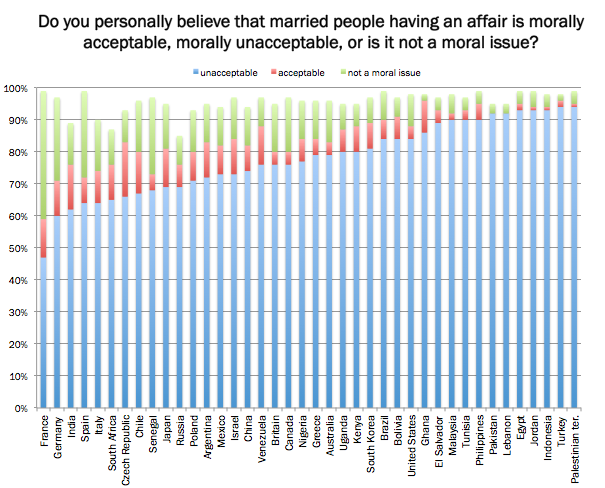
Catherine Rampell charts a finding from Pew’s report on morality around the globe:

France Affairs

Dylan Matthews captions:

Basically everyone thinks it’s not cool to cheat on your wife. The only country surveyed where a majority did say cheating is acceptable was France; there, about 47 percent disapproved, 12 percent approved, and 40 percent said it’s not a moral issue at all.

The Economist highlights the same report:

Americans are far more likely to disapprove of adultery than people in other rich nations, especially the French. They have grown more likely to frown at cheaters over the years—in contrast to their attitudes to gay sex, which have softened enormously. The data on international attitudes come from an interactive report released this week by the Pew Research Centre. It looks at how 40 countries judge the morality of controversial issues from abortion and premarital sex to contraception and divorce.

Jesus Became God, Or God Became Jesus?

A Book Clubber writes:

I just want to say how fascinating I’m finding Ehrman’s book. Can hardly wait for the discussion!

Another:

Dear Professor: The book is great. I love it. But I haven’t had much time to read, what with work and house hunting and 420 coming up here in Denver. I bet we’d all appreciate one more week to read about the Jesus transformation. It will make a more lively debate and we’d all be so impressed by your leniency.

with 41% of the book read …

Heh. Well I just had to absorb the Becker book in around 24 hours … so I’m a little behind myself. I plan to post my review of How Jesus Became God next week, and start the discussion with readers thereafter, so buy the book here if you still want to join. There’s still time. Another reader:

I don’t have an e-reader, so I bought the hardbound book1/2 finished – a good read. How do I join the book club? I want to play too!

You join simply by reading the book, in any form, and participating in the reader thread next week, if you like. Another:

I suggest you refer your readers to Harper Collins’ companion/response book, How God Became Jesus. bookclub-beagle-tr It sounds like you could benefit from reading it yourself, after your somewhat surprising admission that Ehrman’s book “may not be the most spiritually sustaining text for Holy Week.” Seeing that the only reason Ehrman has been noticed in the popular realm is for his (somewhat tired yet passed off as something new) arguments denying the truth of traditional Christianity, I wonder exactly what you thought the book would offer. That’s not to say that Ehrman’s work shouldn’t be recommended or discussed, only that a more interesting conversation might come from providing your audience with a more comprehensive understanding of the subject and the arguments on both sides.  After all, I imagine that for many of your readers, the assumption is that Ehrman, like Reza Aslan most recently, is offering some fresh insight, when in reality, as Father Robert Barron notes here, it’s a more of the same old same old.

We actually made a quick mention of the response book in a previous post, but many readers may have missed it, so here’s the link to purchase that book as well, if you’re interested. Its counterpoints will certainly come up in the discussion thread, but the primary focus will be Ehrman’s book.

Update from a reader, who gets into the Book Club spirit already:

You quote a reader: “his (somewhat tired yet passed off as something new) arguments denying the truth of traditional Christianity.” I think you should encourage such responders (on both sides, of course) to cite specific instances from the book that support their charges.

I myself did not get the impression that there was much if anything new in the book, but rather that the author learned much of what he presents from others in his undergraduate and graduate studies, twenty and thirty years ago, and well-known in historical circles for much longer, although bolstered in living memory by the discovery of the Dead Sea Scrolls and other artifacts. What did he pass off as something new?

That is, new to experts in the field. Your readers can speak for themselves as to whether the material is new to them or not. Speaking for myself, in 19 years of Sunday School classes, Sunday morning sermons, evening “Youth Services”, summertime Daily Vacation Bible School, and Thursday Release-Time Religious Education (one class for Protestants and one for Catholics – probably not done anymore since it seems illegal, but done in my high-school years), I had not heard a word of it. However, I had noticed some of the rather glaring biblical inconsistencies for myself, and reached the same general conclusion.

It seems to me that rarely does a year go by without some “new” book of religious apologetics/proselytism/propaganda. I wonder does the quoted reader apply the same criticism to them? I often walk past a church which has a signboard out front. A few days ago it carried this message:

DON’T BE FOOLED BY THE WORLD
JESUS IS THE ONLY TRUTH

That sums up religion in general to me. Adherence to it demands a rejection of objectivity and ignoring conflicting evidence. After all, such evidence is not new.

Another:

Some of your readers seem to assume that Ehrman is making the case against religion. I disagree. The question he is trying to answer is one I have puzzled over for a long time, and one that I assume that the most religious of people might puzzle over. Because the question is NOT how Jesus became God. The question is how his followers, and those who followed them, came to BELIEVE (a believer would say “came to REALIZE”) that he was God.

Of course, some will insist that God simply put the truth into their heads. But many will think that God does not work that way, and that he let the early Christians work it out for themselves – just as he did not create the world in seven earth-days, but enlisted the Big Bang to take care of part of it, and evolution to work out the part most relevant to us. I’m grateful to Ehrman for making the work of scholars on this question accessible to the rest of us.

My one, mild complaint is that it would have been useful to have seen the various steps in the progression tied to things that we’re going on in the world outside the Church. He does some but not much. Of course he can reasonably reply that it wasn’t his intention to write THAT book.

Another:

This reminds me of “Is an object holy because God loves it, or does God love it because it’s holy?” from your “Lecture FAIL” post, perhaps my favorite Dish video of all time …

The Putin Way Of War

Anne Applebaum outlines his innovative tactics, which she characterizes as “old-fashioned Sovietization plus slick modern media”:

Thirteen years ago, in the wake of 9/11, the United States suddenly had to readjust its thinking to asymmetric warfare, the kinds of battles that tiny groups of terrorists can fight against superior military powers. We relearned the tactics of counterinsurgency in Iraq.

But now Europe, the United States, and above all the Ukrainians need to learn to cope with masked warfare—the Russian term is maskirovka—which is designed to confuse not just opponents, but the opponents’ potential allies. As I’ve written, the West urgently needs to rethink its military, energy, and financial strategies toward Russia. But more specific new policies will also be needed to fight the masked invasions that may follow in Moldova or, in time, the Baltic states if this one succeeds.

Americans and Europeans should begin now to rethink the funding and the governance of our international broadcasters in order to counter the new war of words.

Kevin Rothrock points out how badly we are screwing up the information war:

The biggest fumble came this week, when the White House confirmed that CIA Director John Brennan traveled to Kiev last weekend. The Russian government and media have been loudly insisting that American spies orchestrated the overthrow of the Yanukovych government. And now it looked like Russian claims that the U.S. government was helping Kiev crack down on separatists in the Donbas region were true.

For its part, the State Department has been trying to reach out to Russian speakers on the Internet for years, but the crisis in Ukraine has highlighted just how clumsy those efforts are. Earlier this month, Russia’s Foreign Ministry went so far as to lampoon the U.S. embassy to Russia, which tweeted—to the amusement of many—a misspelled hashtag that was supposed to say “the isolation of Russia.” Russia’s diplomats warned the U.S. that it ought to learn how to spell a country’s name before spreading “spam” and offered their proofreading services to the State Department’s press office.

James Bruno compares the Russian and American approaches to diplomacy:

Russia has always taken diplomacy and its diplomats seriously. America, on the other hand, does not. Of this country’s 28 diplomatic missions in NATO capitals (of which 26 are either currently filled by an ambassador or have nominees waiting to be confirmed), 16 are, or will be, headed by political appointees; only one ambassador to a major NATO ally, Turkey, is a career diplomat. Fourteen ambassadors got their jobs in return for raising big money for President Obama’s election campaigns, or worked as his aides. A conservative estimate of personal and bundled donations by these fundraisers is $20 million (based on figures from the New York TimesFederal Election Commission and AllGov). The U.S. ambassador to Belgium, a former Microsoft executive, bundled more than $4.3 million.

By contrast, all but two of Moscow’s ambassadors to NATO capitals are career diplomats. And the two Russian equivalents of political appointees (in Latvia and Slovakia) have 6 and 17 years of diplomatic experience respectively. The total number of years of diplomatic experience of Russia’s 28 ambassadors to NATO nations is 960 years, averaging 34 years per incumbent.

Chart Of The Day

Uninsured Rates

Kliff relays Gallup’s latest numbers:

The polling firm’s data shows states that set up their own exchanges and expanded Medicaid had their uninsured rate fall by 2.5 percent, compared to a 0.8 percent drop in states that have opted out of at least one of the health law programs. Separate federal data has shown that states expanding Medicaid have had faster growth in the public program than those that have opted not to participate. States that do not expand Medicaid essentially leave those in poverty in a coverage gap because they are too poor to qualify for the private insurance subsidies offered to people above the poverty line.

Cohn adds:

As readers of this space know, the Gallup results are very imprecise, enough that nobody should take specific figures too seriously. And these aggregate totals surely mask all sorts of variation among the states. But the overall pattern—a sharp divergence between the two groups of states—is almost certainly real. It’s also very tragic.

Drum piles on:

These numbers will change a bit over the next couple of months as things settle down and signups are complete, but the relative differences will almost certainly remain huge. Republican governors have been almost unanimously dedicated to sabotaging Obamacare and withholding health care from their own residents, and they’ve been successful. I hope they’re proud of themselves.

Douthat, meanwhile, lays down a marker:

If, in 2023, the uninsured rate is where the C.B.O. currently projects or lower, health inflation’s five-year average is running below the post-World War II norm, and the trend in the age-adjusted mortality rate shows a positive alteration starting right about now, I will write a post (or send out a Singularity-wide transmission, maybe) entitled “I Was Wrong About Obamacare” — or, if he prefers, just “Ezra Klein Was Right.”

The Neocons And The Putin-Netanyahu Alliance

Michael Brendan Dougherty notes the many differences between Israel’s and Russia’s predicaments and foreign policies, but he also sees a deep neocon dilemma:

For some neoconservatives, Benjamin Netanyahu is the totem of “moral clarity” on the international scene. And yet, these same writers will say that Obama is being played for a fool over Crimea. If Obama is a fool for not opposing Putin strongly enough, what does that make of Bibi’s moral clarity? Bill Kristol worries that Obama is placating Russia, and has said that Obama’s “weakness” has invited Russia’s aggression in the Ukraine. What has Israel’s silence done? When Kristol says that America should be making Putin’s friends pay a price, surely he doesn’t mean Israel.

Here’s a thought experiment. Imagine if France or Britain or Germany had abstained in the UN vote on the annexation of Crimea, and robbed the US of international support. Do you think Bill Kristol would not have mentioned it? Of course not. We’d be reading the umpteenth Weekly Standard piece on the feckless appeasers and ninnies of Old Europe. But when Israel does the same thing … crickets. Or even, in fact, lionization of Netanyahu as a strong figure on the world stage – compared, of course, with president Obama. After a while you notice something about this faction: when they are engaged on obvious inconsistency, Israel – not America – is almost always the reason why. And they will always, in that instance and that instance alone, blame America first.

Dissents Of The Day

A reader quotes me:

Even as the truth now is that no one with undetectable virus can infect anyone, and no one on Truvada can get infected. Instead of embracing that, we shy from it.

This seems optimistic to me in a way that borders on foolish. Where did you learn this?  I’d love to read the scientific papers or studies that come to that conclusion.  My memory of articles I have read about truvadaTruvada say that in the study group, it prevented infection at a percentage in the high 90s, which is pretty darn good.  But that doesn’t mean “no one on Truvada can get infected.”  I have no beef with anyone who wants to take it to reduce their risk, but you can’t make the claim that a very effective pharmaceutical can protect a person from infection in the same way that a physical latex barrier can.  (I’ve never agreed with your hatred of condoms and side with Dan Savage: If condoms break without people noticing, they can’t make that much of a difference.)

Not to mention that saying a person with undetectable viral load cannot infect anyone also sounds irresponsible at best.  From the CDC website: “However, sexual transmission of HIV from an infected partner who was on ART with a repeatedly undetectable plasma viral load has been documented.”

All that said, wider use of PrEP should be considered, but honesty and facts are called for in discussing its potential.  I think if it were true that no one on Truvada could get infected, you’d see every public health department clamoring to offer it to high-risk populations.

We’ve covered this ground already. Here’s the key study on the impact of undetectable viral loads in preventing transmission. Money quote:

Statistical analysis shows that the maximum likely chance of transmission via anal sex from someone on successful HIV treatment was 1% a year for any anal sex and 4% for anal sex with ejaculation where the HIV-negative partner was receptive; but the true likelihood is probably much nearer to zero than this. When asked what the study tells us about the chance of someone with an undetectable viral load  transmitting HIV, presenter Alison Rodger said: “Our best estimate is it’s zero.”

In over 40,000 unprotected sex acts, no negative partner was infected by a positive partner with undetectable viral loads. A key Truvada study found more than 90 percent effectiveness in preventing HIV infection even among those not fully compliant with the one-pill-a-day regimen. Another study showed that “parti­ci­pants could re­duce their risk of HIV by 76 pe­r­cent tak­ing two doses per week, 96 pe­r­cent by tak­ing four doses per week, and 99 pe­r­cent by tak­ing se­ven doses per week.” 99 percent may not be 100 percent, but it’s pretty damn close. And it’s not that different from condom use in HIV prevention. Condoms are not 100 percent effective either; you need to use them correctly; they can break; and so on. Moreover, stopping sex and putting on a rubber in the heat of the moment may not be as easy as taking one pill a day outside the experience of sex.

Another reader is “horrified that you are using your influence to pass off opinion as science in regards to the prophylactic use of Truvada”:

I’m not an expert, a patient, an advocate, or a physician – I just work for the pharmaceutical industry and I sat through the FDA Advisory Committee hearing on Truvada PrEP in May 2012. I assure you that experts on that panel were concerned about Truvada and resistance – particularly when not taken as prescribed.

Furthermore, the claim that “maintaining a Truvada prescription requires a comprehensive HIV test every three months” is simply false. This is recommended by FDA, but there is no process in place to ensure that prescribers test patients every three months. We must depend upon physicians to follow these recommendations – and even the most conscientious prescriber might fill a prescription for the patient who is about to leave on vacation and needs a refill “just this once.” Contrast this to a drug like thalidomide, for which FDA requires the prescriber to submit a negative pregnancy test result before the drug is dispensed.

Finally, no one knows what side effects might result from long-term use of Truvada – or what will happen when the drug is not taken as recommended. The FDA approval was based on results seen in a small number of patients in carefully controlled clinical trials. Oftentimes it takes years after approval before dangerous side effects of drugs are discovered. This is particularly true for drugs taken long term.

Celebrate that Truvada is on the market. Celebrate that Truvada represents a major development in HIV-prevention, but please don’t pass off opinion and conjecture as scientific fact. You have so much influence, please be careful!

Here [pdf] is the FDA’s Risk Evaluation and Mitigation Strategy for Truvada for PrEP. It describes many of the concerns about Truvada. And here [pdf] is a transcript of the advisory committee hearing. It’s really long, but search this for “resistance” – and you’ll see that it was a major concern among the experts on the panel.

I’ve noted that resistance is a worry. But insurance companies won’t cover the drug outside the three-month protocol, require an HIV test to start it, can catch an HIV infection before it has a chance to mutate, and the small chance of resistance if the patient is not taking it regularly in those three months can be overcome by other HIV drugs in a different class than Truvada. As for side-effects, it is not true that we know nothing about it. Truvada has been around for quite a while. No drug is without side effects. But the side-effects of HIV are brutal and the side-effects of the full cocktail much more punishing to the body. The truth is: the risks of Truvada are minimal compared with the risk of HIV and the toll of the cocktail. No of course it isn’t fail-safe. But the actual risks of this are trivial, when you abandon the irrational fear and panic inherited from the past and look at the entire picture. Another reader:

In the past I have found your attitude toward HIV to be a little cavalier, to be honest. So when you talk about Truvada, I take it with a grain of salt. I am 29, of the generation that was a little child when the worst was happening and was basically taught to fear sex, condom or not, ESPECIALLY GAY SEX. This was of course on top of all the traditional moralizing against sex, coupled with “abstinence only” sex ed. To this day, even after learning the truths, I can’t have sex without the worry in the back of my mind of whether this will be it. I had resigned myself to it for the rest of my life.

So now I am hearing that that there’s a drug that could be almost the vaccine we have all been hoping for. The first thing that happens is massive amounts of moralizing (on both sides), judgement and a big heaping spoon of FUD [fear, uncertainty, doubt]. What I need are trusted, independent, verifiable facts. And right now, I don’t know who the fuck to believe.

So my question is: Where the hell are the doctors? Why aren’t we hearing from independent medical professionals? Where is the Surgeon General issuing a recommendation? The AMA? All I have to go on right now is figures from one side, figures from the other side, and all the screaming in between.

My attitude is not cavalier. It comes from two and a half decades of study and more than two decades with the virus. My attitude is based simply on taking seriously the value of intimate, gay sex as a human good, not a lamentable evil. And on trying to see the actual, practical ways we can deploy to reduce infection and transmission. From sero-sorting to Truvada, I’ve been thinking about this for a long time – in part out of a duty to my friends and lovers who died agonizing deaths. I don’t think they would want us infecting each other at the rates we are, or would regard this breakthrough as anything other than a Holy Grail of sorts. And don’t throw up your hands at arguments back and forth. I’ve offered the data and the facts. Check out the links I’ve provided and ask your doctor if it works for you.

What Does Bud Do To Young Brains? Ctd

Maia Szalavitz works to debunk the study we flagged yesterday:

The 20 marijuana-smoking participants, who took the drug at least once a week, were deliberately selected to be healthy. If they had any marijuana-related problems—or any psychiatric problems or other issues—they were excluded from participating.

Are you beginning to see what’s wrong? Although the pot-smoking participants showed brain differences in comparison to the controls who were also selected to be normal— both groups were normal! If the smokers had any marijuana-related problems or any type of impairment, they would not have been included in the first place. Therefore, the brain changes that the researchers found were—by definition—not associated with any cognitive, emotional, or mental problems or differences.

“I’m disappointed that scientists are still able to publish high profile papers that only look at neuroimaging without a behavioral endpoint,” says Carl Hart, an associate professor of psychology at Columbia University who was not associated with the research (Disclosure: he and I worked on a book project together). Hart compares the findings to brain differences found between the genders. “There are structural differences between men and women in certain areas,” he says, but they don’t predict differences in ability. “We don’t say this means women are impaired,” he adds.

German Lopez points out other limitations of the research:

[R]esearchers never analyzed if the detected differences persisted over time. Blood acknowledges the issue as one of the study’s limitations, but she cautions that it’s rare the brain fully reverses major changes. The study also didn’t identify whether marijuana caused the detected differences. It’s possible, for example, that people with different brain structures are more likely to use marijuana. But because the amount of marijuana use correlated with more variations in brain structure, Blood says she’s fairly confident the two factors are linked.