The End-Times And Sarah Palin

Yes, she believes in them. Of course she believes in them. Her former pastor believes that Alaska will be the refuge for the faithful in the lower 48 states when the Rapture comes. She is a Biblical literalist who denies evolution – who has to deny evolution – to remain in her church. She believes – because she has to believe – that the earth was created 6,000 years ago. And she believes that the Apocalypse will start in the Middle East. Sam Harris sees it clearly, as usual:

Palin’s spiritual colleagues describe themselves as part of "the final generation," engaged in "spiritual warfare" to purge the earth of "demonic strongholds." Palin has spent her entire adult life immersed in this apocalyptic hysteria. Ask yourself: Is it a good idea to place the most powerful military on earth at her disposal? Do we actually want our leaders thinking about the fulfillment of Biblical prophecy when it comes time to say to the Iranians, or to the North Koreans, or to the Pakistanis, or to the Russians or to the Chinese: "All options remain on the table"?

It is now 24 days since she was announced as a potential president of the United States next January and she still hasn’t given a news conference or has any plans to hold one. This black-out of all serious press access has never happened in modern American political history before.

If that doesn’t concern you, what will?

Email Of The Day

A reader writes:

It is not often we (my husband and I) find ourselves hearing real logic and human concern from a conservative  these days.  Though we know you all are out there, few examples seem to make it to the political shows or within sight of the media.  We also found ourselves listening intently to your, and the young musician’s feelings and thoughts on faith.  As religious skeptics who believe in a higher power (yet reject organized religion) we are often appalled by our country’s religious right.  But we understood and empathized with both your views.   It was a great moment – we found ourselves, as Democrats in our early 40’s,  having  common beliefs with a conservative and a Rapper.  We are desperately hoping to have more of these moments in the near future. 

We will be voting for Senator Obama.

“Trust Us”

Paulsonjimwatsonafpgetty

I’m more than a little queasy about this bail-out and this reader sums up my feelings almost perfectly:

After nearly eight years, the phrase "trust us" no longer works.  Now we’re presented with a historically unprecedented bailout proposal for the nation’s financial institutions.  I have a jumble of differing reactions to this. First, for years  the Republicans have sold us a deregulation mantra and suggested that any form of regulation is "socialism." But anyone who’s actually read Adam Smith knows that he and other philosophers of free markets made plain from the outset that the state needs to guard the integrity of the marketplace.  Smith says that there is a dark side to the entrepreneurial spirit that the state must guard against.  This is not a rejection of market economics–it’s a protection of the market place against those who abuse the freedoms it offers.

Second, we are as usual placed in a position in which great pressure is brought to bear to quickly accept a deal which will reverberate for decades without close inspection.

We are again told that things are vastly complicated and we should trust Treasury and the Fed to do the right thing.  My trust reservoir is exhausted.  I actually respect Paulson, but I also believe he is "playing the hand he’s been dealt," as he said.  This is not the way decisions should be taken that have long-term consequences for the nation’s future.  If in fact all of this bubbled to the surface quickly, without being anticipated, then the folks at Treasury are incompetent.  However, I don’t believe that for a second–I am convinced that in this case, again, the Bush Administration knew what was up and calculated that it could just muddle through until after the elections.  We should all be apprehensive about what is coming after election day.

Third, the administration’s proposals continue a process of socializing loss and preserving profits and distributions, many of which were made with full knowledge of the pending losses. When management distributes illusory profits to insiders in full knowledge of a massive loss, this is called a fraudulent conveyance, and in equity proceedings such distributions are routinely recovered for the creditor mass. There should therefore be a careful scrutiny of distributions of profits and bonuses by failed firms.  The bailout we now see may mean effectively that taxpayer money is subsidizing the purchase of macmansions and Bentleys by investment managers who behaved irresponsibly.  How can that happen?  Only in the age of Bush.

Fourth, I really started steaming this morning reading the NYT article about the participation of foreign banks in the bailout. Granted that the US has an interest in protecting financial markets, but why should the US be bailing out German and UK firms?  At least this should be a burden shared with their own governments. This really needs to be subject to some probing questions. What’s going on here?

(Photo: Hank Paulson by Jim Watson/AFP/Getty.)

Will The Dems Cave?

Yglesias, drunk-blogging the bailout proposal:

…if congressional Democrats manage to acquiesce in a plan that spends $700 billion on a bailout while doing nothing for average working people and giving the taxpayer virtually no upside in a way that guarantees that even electoral victory would give an Obama administration no resources with which to implement a progressive domestic agenda in 2009 then everyone’s going to have to give serious consideration to becoming a pretty hard-core libertarian.

Between Filkins And Goldberg

Baghdad08waithiqkhuzaiegetty

In trying to understand where we are in Iraq, what our realistic options are and what either candidate really believes, two must-reads jointly present the case for staying in Iraq indefinitely. Dexter Filkins’ report from some of the previously most devastated parts of that blighted country is a beautifully nuanced, rich, and persuasive portrait. Reading the piece, you can sense both his immense joy at seeing some kind of normalcy return to places where hell recently resided but also, to his immense credit, an unbending intellectual resistance to false hope and unreasonable expectations. What Filkins reports is what so many others testify to: that the combination of the Sunni Awakening, the effect of widespread ethnic cleansing, the construction of massive walls throughout Iraq and especially in Baghdad, and the resilience and surge of American troops have all managed to keep the vile Jihadists at bay, to win hearts and minds against them, as well as to calm the sectarian tensions that the Jihadists brutally exploited. No one should be anything less than overjoyed that this very-fragile but very-real progress (which I, among many, didn’t expect) has taken place. But as we must be open to good news we must not be blind to deeper realities. The trouble is: the critical rapprochement between the Sunni Awakening and the Shiite government in Baghdad has only happened very superficially or locally, if at all. And the critical disputes between the Kurds and the rest of the country in the north are also unresolved. The Iraqi army, although larger and stronger than before, has not yet become a non-sectarian national entity; it is still overwhelmingly Shiite and understandably suspicious of integrating former al Qaeda murderers into its ranks. There are a few signs of local reconciliation, and some tentative saplings of a post-sectarian future sprouting through the corpses, but the fundamental shift we need – integration of the Awakening into the Iraqi army and provincial elections to move the stagnating political process forward – is not here yet. It is not on the horizon. It may be on the horizon over the horizon. But it may also never come. This is what it means to live history. It means not knowing.

Yes, the US forces have drawn down somewhat, although to nowhere near the levels that anyone could describe as "withdrawal".

And, yes, Petraeus became the commander who might have been able to save this misadventure at the start. But the Petraeus lesson is that we cannot leave a security vacuum; and we do not have the kind of government in Iraq capable of filling it in a non-sectarian way yet. Reading Jeffrey Goldberg’s superb profile in the current Atlantic, McCain is clearly committed to keeping US troops at whatever level is necessary to retain this calm permanently. And what that must mean is that unless there is a political breakthrough at the national level, it is unrealistic to believe that McCain will be able to withdraw any serious number of troops in his first term. That is what commitment to "victory" means. We need to be very clear about this. It could very well mean a heavy military presence in Iraq for the rest of our lives.

The difference between McCain and Obama on this, I think, is that Obama wants to see a time when there are no US troops in Iraq (which was the case until 2003)  and this fiasco, like the Vietnamese occupation, can become a part of history. McCain wants the US to stay in Iraq for ever if necessary, in some capacity, as the neo-imperial power devotes its maximum resources to integrating the heart of the Arab-Muslim world into secular modernity. Obama doubts that this can be done and that if it could be done, its price would be worth it; and so his goal is a realist minimizing of the damage, while attempting to reallocate American resources more rationally. McCain simply insists that war can work and occupations can pacify counties never truly pacified in history before if done competently and if backed with enough raw national will.

This, I think, is the core foreign policy difference in this election. I do not think it is an easy one to resolve. As readers know, I started this war believing in John McCain’s vision of the future. I would still like to. At least McCain did not deny the incompetence and derangement of the initial occupation strategy. And I do not want to succumb to defeatism any more than I want to engage in denialism. There is a moral responsibility to cope with the chaos we have wrought and the nightmare our departure could mean; but there is also a moral responsibility to the American people not to sacrifice their young and squander what’s left of their treasury on a fool’s errand. No path is morally pure. And neither offers a clear path to security.

But take a few steps back and see where we are: a deeply divided country with only the most fragile national institutions, held together by exhaustion, oil money, ethnic cleansing and American troops. Currently, I believe that Obama is the one who is seeing the world and US interests more clearly and rationally. Withdrawal is essential; and yet it is currently impossible without serious risk. Staying, however, is another form of risk, the risk of permanent enmeshment in a hell-hole from which there is no ultimate way out. To escape from this trap will require more dexterity and pragmatism than McCain believes in – especially when McCain doesn’t view it as a trap at all, but as the final occasion for him to exorcize the ghost of Vietnam.

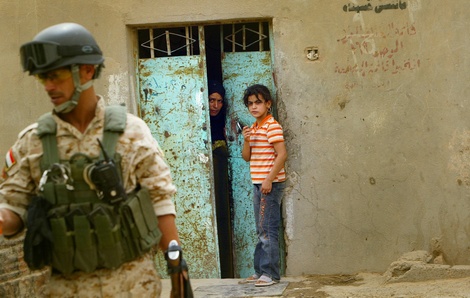
(Photo: An Iraqi army solider stands guard as Iraqis watch September 10, 2008 in Gazaliyah neighborhood north west of Baghdad, Iraq. By Wathiq Khuzaie/Getty).
Dealing With Afghanistan

From a smart dispatch by Fred Kaplan:

Pakistan is not a sideshow to Afghanistan. It is the main show, dwarfing every other problem in the region. To deal with it, we can do one of two things. We can declare war on Pakistan—an option for which we lack the will, the allies, the resources, the troops, and (let’s hope) the sheer suicidal idiocy. Or we can coordinate a region-wide campaign of pressures and incentives—political, economic, diplomatic, and military—with as many concerned powers as possible, including, yes, the Shiite leaders of Iran, who must have less interest than even we do in seeing radical Sunni jihadists take over huge chunks, if not all, of Pakistan.

His recommendation for Afghanistan after the jump:

…unlike in Iraq—where sectarian clashes required U.S. troops to step in (Sunnis wouldn’t trust Shiite troops, and Shiites wouldn’t trust Sunni troops)—the Afghan army is seen as, and actually is, a national institution. Given the right resources, it could do the job.

And that leads to something that we and other countries could do—pour lots and lots of money into Afghanistan, so the government can equip, train, and pay a much larger national army. (Most of the NATO allies don’t want to fight in Afghanistan, for understandable reasons; but maybe they could be persuaded to help fund the fight.) Some foreign troops would still be necessary, to train, advise, and provide intelligence and air support—but this is, and can only be, the Afghan people’s fight.

Quote For The Day

"I suppose the McCain campaign’s hope is that when there’s a big crisis, people will go for age and experience. The question is, who in this crisis looked more presidential, calm and un-flustered? It wasn’t John McCain who, as usual, substituting vehemence for coherence, said ‘let’s fire somebody.’ And picked one of the most experienced and conservative people in the administration, Chris Cox, and for no apparent reason… It was un-presidential behavior by a presidential candidate … John McCain showed his personality this week and it made some of us fearful," – George F. Will, This Week.

There’s only one first class temperament in this race.

Another Massive Bush Gamble

Dicebrunovincentgetty

Some reaction around the web to the Bush administration’s latest bout of socialism. Bryan Caplan:

If a Democratic president were backing a $700B bail-out, I have to think that Republicans would be crying "Socialism!" But if a Republican president does the same, the bail-out’s natural enemies keep silent out of loyalty or in-group bias. It’s a lot like the contemporary Republican reaction to Nixon’s price controls – if our boy is doing it, how bad can it be?

Hmm. Conservatives abandoning all principle and intellectual honesty because of Republican in-group bias? Couldn’t happen in America in the 21st century, could it? Mark Thoma:

To me, what’s important is to get this rescue in place as soon as possible, to compensate taxpayers for any risk they are assuming, and to be sure that if the bailout does cost money, that the people who did nothing to cause the crisis and who did not benefit from it are insulated from paying for it. The particular mechanism for extracting payment for the bailout is less important and will likely be dictated by the politics, some solutions will be more politically viable than others.

Arnold Kling:

1. We are not "giving" people anything. We are taking money from taxpayers and spending it on other taxpayers. Again, I feel like I need to say that to keep my libertarian union card.

2. Bernanke and Paulson don’t think of what they are doing as charity. It’s more like an entrepreneurial business, where they intend to buy what they think are undervalued mortgages assets, which they believe they can finance profitably.

They may be right, but if they took their business plan as written to any bank or VC, they’d be laughed out of the office. The plan is utterly vague, untested, and there is no proof that they have or can find the executive talent needed to run a pilot program of this kind, much less scale it up to $700 billion.

Tyler Cowen:

Count me in too, among those screaming "no!"

CalculatedRisk:

In an effort for transparency, I’d like to see a website that listed each transaction purchased by the government. This could list the details of the asset, the PAR value, the selling institution, the underlying characteristics, the originators of the loans, the price the government paid (and eventual sold the asset for) and any other relevant detail.

Paul Krugman:

Let’s not be railroaded into accepting an enormously expensive plan that doesn’t seem to address the real problem.

(Photo: Bruno Vincent/Getty.)