McCain is massively outspending Obama in many swing states.
Category: The Dish
Obama’s Street Money
No more Mr Clean in Philadelphia.
McCain Responds, Again
Goldfarb, at the McCain Report, talks to another POW, Bud Day, one of McCain’s closest allies, who backs McCain’s story:
"We were bringing each other up to date, he was telling me how he [McCain] had been tortured," Day said. The guards had "busted his arm," and "John was complaining that they’d treated him like an animal." Day said "the only friendly thing the [guards] ever did was hit me on the leg instead of on the head." But, according to Day, McCain wouldn’t condemn them all, telling the other men of the occasional act of decency he’d witnessed from his captors. Day says McCain told him how one of those guards had "made a cross with his foot and wiped it out."
So the ad imagery with the stick is wrong, according to Day. And no Christmas dating.
Does Bush Believe McCain Was Tortured?
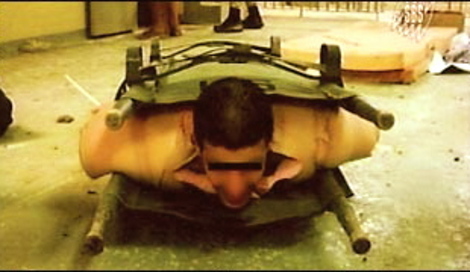
In all the discussion of John McCain’s recently recovered memory of a religious epiphany in Vietnam, one thing has been missing. The torture that was deployed against McCain emerges in all the various accounts. It involved sleep deprivation, the withholding of medical treatment, stress positions, long-time standing, and beating. Sound familiar? According to the Bush administration’s definition of torture, McCain was therefore not tortured.
Cheney denies that McCain was tortured; as does Bush. So do John Yoo and David Addington and George Tenet. In the one indisputably authentic version of the story of a Vietnamese guard showing compassion, McCain talks of the agony of long-time standing. A quarter century later, Don Rumsfeld was putting his signature to memos lengthening the agony of "long-time standing" that victims of Bush’s torture regime would have to endure. These torture techniques are, according to the president of the United States, merely "enhanced interrogation."
No war crimes were committed against McCain. And the techniques used are, according to the president, tools to extract accurate information. And so the false confessions that McCain was forced to make were, according to the logic of the Bush administration, as accurate as the "intelligence" we have procured from "interrogating" terror suspects. Feel safer?
The cross-in-the-dirt story – although deeply fishy to any fair observer – is in the realm of the unprovable. But the actual techniques used on McCain, and the lies they were designed to legitimize, are a matter of historical record. And the government of the United States now practices the very same techniques that the Communist government of North Vietnam once proudly used against American soldiers. When they are used against future John McCains, the victims will know, in a way McCain didn’t, that their own government has no moral standing to complain.
Now the kicker: in the Military Commissions Act, McCain acquiesced to the use of these techniques against terror suspects by the CIA. And so the tortured became the enabler of torture. Someone somewhere cried out in pain for the same reasons McCain once did. And McCain let it continue.
These are the prices people pay for power.
“A Good Man”
But a fellow POW in Vietnam won’t vote for him.
Atlantic Readers
You are, according to Pew, the best informed audience in the country. Like I didn’t know that already.
Swift-boat? Moi?
It’s worth noting that pursuing the cross-in-the-dirt evangelical parable as it might have happened to McCain is in no way impugning anyone’s war record. No one is disputing in any way what McCain did in Vietnam, his heroism, his sacrifice or any jot and tittle of his combat in arms and time in captivity. What we’re curious about is how an urban legend in Christianist circles (attributed to Solzhenitsen but originating, so far as one can tell, in Chuck Colson) reshaped and altered an actual, utterly believable story of rare humanity in a prison camp. And how a campaign not only adopted the improved story but then wielded it in a campaign ad and as a critical message to evangelicals. If that ad is not actually true – and its depiction of the cross in the dirt we know is false (according to McCain, it was done with a sandal; in the ad it is done, as in Colson’s account, with a stick) – it’s a question of challenging a campaign’s veracity, and what can only be called a cynical use of religion. Could the campaign confirm that the ad itself is visually incompatible with the Salter story? Or were they unconcerned with such detail, assuming no one would be foolish enough to question a war hero’s unconfirmable anecdote – and eager merely to show the deeper (and true) point that McCain relied on God to survive the unimaginable?
This incident is not part of McCain’s military service – certainly not one he thought was in any way salient in his first 12,000 word account of his experience. It is part of his 2000 and 2008 campaigns and the religious mythology they coopted in order to appeal to a very specific audience. If a blogger cannot raise factual questions about a campaign ad and a campaign narrative, he’s not really worth much.
If you want a simple campaign question how’s this: why did John McCain approve a message about a searing event in his life when the image in the ad is not compatible with what he said happened?
Is Obama Vulnerable On Chicago Crime?
Floyd Brown lurks in the shadows.
Clichés, Giant Flags, Funny Hats
William Galston proposes one way to improve conventions:
The public always claims to be hungry for user-friendly information about what candidates and parties stand for … so, why don’t we allocate primetime slots at each convention to a reasonably detailed presentation of the party platform? Immediately afterward, the networks would feature panels of experts discussing the basis, significance, and feasibility of its principal proposals. Not only could this proposal help create a somewhat better informed electorate, but it would also force the parties to take their platforms more seriously. Concessions to organized interests now made in coded language that few notice or understand could be exposed to national scrutiny, and historically informed commentators could highlight subtle but significant shifts in long-held positions.
I think that’s a convention only Bill Galston would enjoy.
The Vietnam Christmases McCain Recalled In 1995
Three compelling memories:
The chapter is titled "’Tis the Season to Be Jolly." It says that on Christmas Eve 1968, a guard tried to compel McCain to attend a church service that was being staged for the benefit of visiting photographers. McCain decided "to ruin the picture," letting out a series of curses ("’Fu-u-u-u-ck you, you son of a bitch!’ shouted McCain, hoisting a one-finger salute whenever a camera pointed in his direction"). There’s certainly no mention of a cross in the sand in this account.
On Christmas Eve 1969, we’re then told, McCain had a civil conversation with the Cat, the one guard he’s said in other accounts was considerate to him — but again there’s no mention of a cross in the sand.
(Timberg tells us that McCain and the Cat discussed the Cat’s tie clip and cigarette lighter, as well as McCain’s decision not to accept early release.)
On Christmas 1970, Timberg writes, McCain was transferred to a cell with his friend Bud Day — "the perfect Christmas present" because he’d just spent two and a half years in solitary. Again, no cross.
But he will never forget what Orson Swindle vaguely recalls.

