Contrasts

David Corn says the Edwards endorsement doesn’t matter much:

Having John Edwards at his side during the general election will help Obama to a limited degree. But that won’t do much to populist-ize the likely Democratic nominee. Obama–as would practically any Democrat–will come across as a populist and working-class advocate not by campaigning with Edwards but by campaigning against McCain.

But it would be a mistake for Obama to adopt any of the anger of Edwards’ 2008 run. 2004? Sure. But there’s a difference, and an Obama lunge for the Shrum line would be disastrous.

Edwards’s Working Class Pull?

Not so fast says 538:

It seems to be taken for granted that John Edwards had some stranglehold on the working class white vote. But this was not really the case. The working class vote was not a particular strength of John Edwards in either relative or absolute terms.

Plubius adds:

Edwards’ working class appeal is more limited than it appears. Appearances, however, are important. While the endorsement may not help Obama with actual working class voters, it will help in the realm of media perceptions, which is the only game that matters at this point (sadly). The chattering classes perceive Edwards as having significant working class appeal. Thus, we’ll hear over and over this week about how Edwards — West Virginia aside — strengthens Obama’s working class street cred. This chatter, in turn, will help strengthen the resolve of superdelegates and other party establishment figures who are beginning to coalesce around Obama.

“Unacceptable”

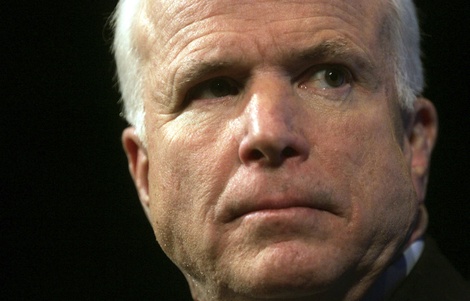
Mccainmariotamagetty

The possibility of talking to Iran’s leadership is regarded by the Republican nominee as "unacceptable":

"The belief that somehow communications and positions and willingness to sit down and have serious negotiations need to be done in a face to face fashion as Senator Obama wants to do, which then enhances the prestige of a nation that’s a sponsor of terrorists and is directly responsible for the deaths of brave young Americans, I think is an unacceptable position, and shows that Senator Obama does not have the knowledge, the experience, the background to make the kind of judgments that are necessary to preserve this nation’s security."

Obama should not, in my view, concede the premise here. He should have a debate about whether in fact it is a good idea for the president of the United States to keep dialogue with our enemies as an option. What you see in McCain’s and Bush’s rhetoric is an idea that diplomacy and statecraft are somehow about conferring legitimacy on people and regimes anathema to us, as opposed to advancing the West’s interests by a variety of methods: force of arms, diplomacy, alliances, etc. They seem wedded to a dramatic rather than pragmatic view of foreign policy.

But the result of Bush-McCain’s position these past seven years has been the empowerment of Iran in the region, a vast increase in Tehran’s pull in Baghdad, and Iran’s rapidly advancing admission to the nuclear club. How could talking actually make things worse than they have gotten under Bush? What I’m saying is just that these are debatable issues – and McCain’s desire to rule them out of bounds is an attempt to prematurely shut down a debate the American people have every right to have.

(Photo: Mario Tama/Getty.)

Email Of The Day

A reader writes:

My Beloved, Samantha, just asked me to update my Facebook page to confirm that I’m engaged to her. My mother just called for the third time this morning and choked out through her tears, "I promise this is the last time I’ll call this morning, but I understand that the proper Westlinds_smaller protocol is that the mother of the bride pays for the wedding." I’ve left a message for our minister to see if he is available in 30 days to officiate our wedding.

This marriage will allow us to be recognized within the state as we are recognized in our neighborhood, in our church, and with our friends: as a family with all the rights, protections, and responsibilities that come with that commitment. This marriage would allow us to expect acceptance rather than anticipate discrimination of our family. Marriage would protect our children. Marriage would attach recognition to what we know is true, that the love that brought us together as a couple and binds us a family matters just as all families matter. Families comprise neighborhoods, churches, friends, and the state. Families are why we have civil marriage in California and why our family deserves the same recognition.

I’m attaching a photo of our family. From left to right is Sophie (turned 8 last Friday), Samantha, Anneliese (4.5), and me. I figured since I’ve viewed your wedding photos, you should see a photo of my family. We are all looking forward to our marriage next month!

Why 2008 Is Not 2004

David Weigel on the marriage ruling:

Politically, I suppose this is bad news for the Democrats, but not nearly as much as in 2004. For one, it’s not coming out of a candidate’s home state. (How lucky was John Kerry to come from Massachusetts in the year of Goodridge?) For another, John McCain voted against the Federal Marriage Amendment: He can’t demagogue this, and he won’t. And finally, the issue’s simply becoming less volcanic as the issue is normalized. The way things are going, Mitt Romney will be leading a pro-gay marriage campaign by 2016 or so.

Sorting Through The Legalese

Eugene Volokh looks at the California opinion:

The opinion is entirely based on claims under the California Constitution, and does not rely on federal constitutional claims. This means that the U.S. Supreme Court cannot review this; and it also means that a state constitutional amendment — which seems likely to be on the ballot this November — could overturn the decision.

Here’s the court’s reasoning, in a nutshell:

1. The California Constitution’s Due Process Clause and Privacy Clause (there’s an explicit one in California) secure a right to marry, which extends to same-sex marriages as well as opposite-sex marriages. The limit of marriage to opposite-sex couples thus must be reviewed under strict scrutiny (i.e., must be narrowly tailored to a compelling state interest).

2. The California Constitution’s Equal Protection Clause treats sexual orientation as a suspect classification. Any discrimination against gays and lesbians thus must be reviewed under strict scrutiny, and the opposite-sex-only rule is indeed such a discrimination.

3. The opposite-sex-marriage-only rule does not constitute presumptively impermissible sex discrimination, only sexual orientation discrimination.

4. The ban on same-sex marriage can’t pass muster under strict scrutiny (pretty much a foregone conclusion, given how demanding strict scrutiny generally is).

Did McCain Make Obama Possible?

Without McCain-Feingold and without the Internet, Clinton would have crushed the opposition. But she didn’t. And Obama caught the next generation’s wave. Josh Green has a great article in the June Atlantic on Obama’s fundraising. Full of new reporting, it helps put into focus the extraordinary breakthrough the Obama campaign represents in online campaigning. I learned an awful lot. Money quote:

Obama is a gifted politician by anyone’s measure, but what distinguishes him from earlier insurgents is his ability to fully harness the excitement that his candidacy has created, in votes and in dollars. Three forces had to come together for this to happen: the effect of campaign-finance laws in broadening the number and types of people who fund the political process; the emergence of Northern California as one of the biggest sources of Democratic money; and the recognition by a few Silicon Valley entrepreneurs and venture capitalists that the technology and business practices they had developed in their day jobs could have a transformative effect on national politics.

Polling Marriage In California

The Field Poll’s last measurement was in 2007:

The Field poll questions have remained the same during the six surveys analyzed here. In 1985, only 30% of those polled supported same sex marriage. This increased to 38% in 1997, and the average for surveys in 2003-2006 showed support by 43%.

While only 25% of those born before 1940 are in support, that number has grown by 5% over these years. Those born in the 1940’s are supportive at 40%, also a gain of 5%. Similar 7 and 8% increases are found for those born in the 1950’s and 1960’s, reaching above the 40% threshold. Those born in the 1970’s and 1980’s are in support by 51% and 58%.

There is no question what the future will be like. The question is whether the court has catalyzed it. The good news is that the Obama candidacy will doubtless increase the number of younger voters in California; the bad news for marriage equality is that will increase the number of African-American voters. Maybe the court’s invocation of the anti-miscegenation precedent will help. But we have a big task on our hands – a $20 million minimum commitment. The prize is immeasurable: the establishment of equality in the most populous state of the union.