Email From Indiana

A reader writes:

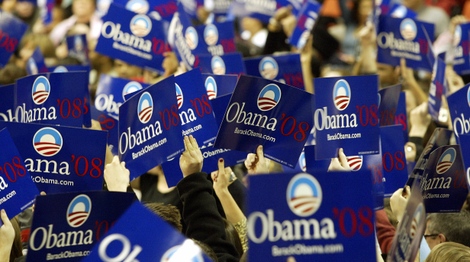
Like you, I’ve been down-in-the-dumps regarding all the peripheral noise (Rev. Wright controversy) regarding Sen. Obama. I decided to go downtown yesterday to hear him speak.  Let me tell you, once I came back from the event I feel even more enthusiastic regarding his candidacy. While I waited in the crowd (around 10,000 or so) I talked with a number of younger voters.

The repeating theme I heard was that Obama had drawn their interest into the political process and that he was the only candidate who they didn’t feel was the same old politician. When I was their age (I’m 42) I voted but was never overly enthusiastic about any particular candidate—ok, maybe Reagan.  I told them a lot of pundits don’t think they’re serious and won’t show up to the polls.  Something tells me from all the support I witnessed, and the young people I talked to yesterday, this will change. This is something Hillary Clinton or John McCain lack: a link to the future generation. 

Clinton especially needs to tread lightly on these newly potential voters.  If she and Bill take this fight to the convention and some how take the nomination by force over the super delegates I’m afraid that not only will the Democratic Party falter but they’ll alienate a new generation of voters. It’s amazing how much positive influence I felt yesterday.  Emotions swept over me as I witnessed the crowd embrace the senator.  Not once did I hear any divisive arguments from Sen. Obama.  I could see from the gathering many different people from all walks of life.  Perhaps I’m being naive or emotional but what I felt yesterday did in fact give me, what you call “know hope!”

And of course, it was great to hear Stevie Wonder.

The Clinton-Bush Overlap II

David Brooks has another perceptive column today – on the very different temperaments of the two candidates left in the Democratic race:

The implicit Clinton argument is that politics is an inherently nasty business. Human nature, as she said Sunday, means that progress comes only through conquest. You’d better elect a leader who can intimidate. You’d better elect someone who has given herself permission to be brutal.

Obama’s campaign grows out of the longstanding reform tradition. His implicit argument is that politics doesn’t have to be this way. Dishonesty and brutality aren’t inevitable; they’re what gets in the way. Obama’s friend and supporter Cass Sunstein described the Obama ideal in The New Republic: “Obama believes that real change usually requires consensus, learning and accommodation.”

That’s regarded as naïve drivel in parts of Camp Clinton.

Temperamentally, I’m much more like Clinton, and admire pugnacity in politics, if carefully honed. But in our current post-9/11, post-Iraq debacle world, which approach is likely to benefit the US more in foreign policy? Here’s Fareed, a chastened interventionist like so many of us, reflecting on the challenges of this moment. From Kakutani’s review:

In his new book, “The Post-American World,” Mr. Zakaria writes that America remains a politico-military superpower, but “in every other dimension — industrial, financial, educational, social, cultural — the distribution of power is shifting, moving away from American dominance.”

With the rise of China, India and other emerging markets, with economic growth sweeping much of the planet, and the world becoming increasingly decentralized and interconnected, he contends, “we are moving into a post-American world, one defined and directed from many places and by many people.”

One core reason I believe we are lucky to have Obama at this moment in history is that he not only has the potential to calm some of the polarizing paralysis on our domestic politics – the kind of red-blue culture war that has made it very hard to focus on pragmatic solutions to pressing problems – but because his approach and biography make possible a new un-Bush reorientation to the rest of the world.

If you want another "with us or against us" president, a resurgence of aggression as the chief weapon of US foreign policy, then Clinton and McCain are your candidates. If you think we need a new direction – one that is less defensive, less force-oriented, more interested in dialogue, Obama is the obvious choice. There are times for both impulses. The question is: after eight years of Bush-Cheney, what is right for the US now?

How Smart Is Too Smart?

Eddysun

In his article today, Carl Zimmer quotes a fly intelligence researcher:

“If you’re using your intelligence to outsmart your group, then there’s an arms race,” Dr. Kawecki said. “So there’s no absolute optimal level. You just have to be smarter than the others.”

At his blog, Zimmer adds:

Scientists and the rest of us are obsessed with intelligence–not just the intelligence of our own species, but any glimmer of intelligence in other animals. I’ve written plenty of stories myself on this research, from the social brilliance of hyenas to the foresight of birds. But if these faculties are so great, then why aren’t more animals smart? The answer, experiments suggest, is that learning and memory have nasty side-effects. They can even shorten your life (at least if you’re a fly).

Beagles have it all figured out: get someone to look after you, eat, chase a few squirrels, and nap.

1.5 Million

2340664539_5fe4148210_2

That’s how many people have now donated to Obama. No one has ever come close to this in history. And it was done by the Internet, destroying the power of major donors to control a candidate, empowering so many to make a difference and altering the face of campaign finance for ever. And yet the Democrats are seriously considering rebuking this astonishing achievement in favor of an old nepotistic pol whose campaign, when it hasn’t been incompetent and complacent, has been straight from the Rove playbook.

Any Democrat who spurns this achievement is destroying their own party, and its future. This has been a revolutionary campaign already. Because it has been built as much from below as from above. And because it has brought so many to believe in their country and its politics again. I don’t care if I am thereby tarred as an Obama kool-aid drinker. The facts remain, and one day, the MSM will absorb them.

(Photo Illustration of Obama using the flags of all fifty states from the BHO Flickr Stream.)

Thanks, Arianna

Arianna claims that McCain told her he didn’t vote for Bush in 2000 (the McCain camp denies it). Allahpundit wonders if this could help McCain:

That our nominee is, shall we say, less than a fully devout Republican is something already well known to the base. A new tale of party betrayal will hurt him — but a tale of Bush betrayal, specifically? Dubya’s approval rating is 28%; according to the new Gallup, he’s a bigger liability for McCain than Wright is for Obama (although, surprisingly, only slightly). Conservatives who don’t want to believe the story can simply discard it based on the source and independents who do want to believe it can accept it as proof that McCain’s not the Bush clone the left wants him to be. Thanks, Arianna!

When To Take Photographs

Tyler Cowen answers whether it is better to take a photo of an event or view it unmediated:

If you take photos you will remember the event more vividly, if only because you have to stop and notice it.  The fact that your memories will in part be "false" or constructed is besides the point; they’ll probably be false anyway.  In other words, there’s no such thing as the "one-time in-person viewing," it is all mediated viewing, one way or the other.  Daniel Gilbert’s book on memory is the key source here.

But why is remembering an event the key to experiencing it fully? Sometimes, being there, without mediation, without worrying about whether one day it will be forgotten, just being there is what matters. Life is now; and when we obsess about storing it for the future, we forget to experience it in the only way we truly can: in the present.