Ross on McCain’s policy problem.
Category: The Dish
What The Old Farts Don’t Get
A reader writes:
Your old farts really do miss the point completely, don’t they? These younger people were convinced that political involvement was useless because the the system was so broken. They came of age anywhere from the second Clinton term (Lewinsky) through the disaster of the Bush years. They have no reason to believe that politics can work, or that it is possible to effect any large scale change, so they work locally or just opt out.
This is what Obama has tapped into. The reason all those thousands of young Dems registered for the first time and voted in a primary was because he made them believe honorable politics was possible. And if someone like Obama gets chewed up by the system because the
forces arrayed against him are too strong — just look at the sworn enemies who are teaming up to bring him down, united by nothing more than a vested interest in the status quo — then they will conclude that the system is as broken as they thought it was.
The mistake is reading this as an Obama personality cult, in which case "grow up" would be appropriate. But the Obamaniacs I meet are nothing like that…
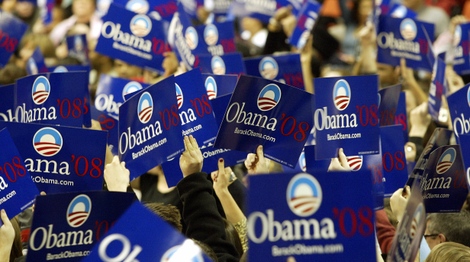
they don’t sing his praises, they sing their own. They are intoxicated by the idea of a politics where things they thought were not possible become possible, and people talk to each other like adults. They don’t think he’s going to fix things, they think they are.
What the old farts might want to consider is that these young people who have no particular vested interest in the current system might be seeing the rot much more clearly than the fogeys who have been entangled in it for decades. And the mature folk might want to accept that the burden of proof is on them to show why such a viscerally disgusting political game is worth playing.
Opting out of that is not immaturity, it’s intelligence.
Dissent Of The Day
A reader writes:
You wrote about abortion:
"The argument is that life-taking of the innocent is the deepest moral evil."
Actually, this is false–and false for a reason that bears on our political culture.
Suppose that through no fault of your own you fall from a great height and that I happen to be beneath you. Looking up, I see that you are headed straight for me and will crush me to death when you land. Suddenly I notice off to my left a red button and a nearby sign that reads "Push red button to disintegrate any object above you." Thinking fast, I push the red button, you are disintegrated, and I am spared from being crushed to death.
Have I done anything wrong? No: morality permits me to kill you in order to save myself–this is a self-defense killing. But notice that you were completely innocent. The conclusion, then, is that morality permits, at least in certain cases, the killing of innocents.
So "life-taking of the innocent" is *not* "the deepest moral evil." Some life-takings of the innocent certainly are, but not all.
This matters for a *hugely important* reason. Pro-lifers, when pressed to explain themselves, almost always say that they oppose abortion because abortion is the taking of innocent life. This argument usually leaves pro-choicers stammering about a woman’s right to control her own body, a consideration which strikes pro-lifers as beside the point–after all, innocents are being killed!
A better response to the pro-lifer is to point out that his premise–that "life-taking of the innocent is the deepest moral evil"–is false: sometimes the killing of innocent human lives is morally permissible. Are any abortions among the cases where morality permits killing the innocent? *That’s* the issue. Here is where the hard work of arguing, case-by-case, for the morality of abortion comes in. But it only comes in once the pro-lifer appreciates that moral grandstanding about "killing innocents" rests on an inadequate conception of what morality demands of us.
What do you think, Andrew? Are any cases of abortion–which is, no doubt about it, the taking of innocent life–among the cases where morality permits killing the innocent? It’s a hard question, isn’t it?
If this simple point, a point which has been a staple of the philosophical literature on abortion for decades, were more widely known, the abortion debate–and hence the entire political climate–would be transformed.
The Next American
A British toddler decides to emigrate:
The Most Unpopular President In Modern Times
President Bush sets a new polling record: a 71 percent disapproval rating:
CNN Senior Political Analyst Bill Schneider adds, "He is more unpopular than Richard Nixon was just before he resigned from the presidency in August 1974." President Nixon’s disapproval rating in August 1974 stood at 67 percent.
And we have months and months to go.
Chait vs Media Matters
TNR’s TRB is told it’s "unethical" to write that Clinton has no chance of becoming the nominee.
In The Tank
It seems to me that if ABC News wants to retain any credibility, they have to yank Stephanopoulos from hosting a Clinton town hall event. The pro-Clinton bias is getting ridiculous.
Yglesias Award Nominee
“Some people say John McCain isn’t conservative enough. But there’s more to conservatism than low taxes, Jesus, and waterboarding at Gitmo," – P.J. O’Rourke.
I wish that didn’t come across as a brave statement. But for the next generation in particular, conservatism has become synonymous with debt, torture and bigotry. It will take another generation to repair the damage to the brand that Bush, Cheney and Rove have inflicted.
Lose-Lose at Gitmo
A depressing but vivid report from the Hamdan "trial":
This week’s proceedings have demonstrated once again that in the military commission system, both sides surely can lose. Hamdan loses no matter the outcome: in the "tales I win, heads you lose" world of Guantánamo detention, even an unlikely acquittal at trial would not lead to release, but to continued indefinite confinement as an "unlawful enemy combatant." And the United States loses by squandering a historic opportunity to demonstrate to the world that it can provide impartial justice instead of pressing forward in a fatally flawed system that permits conviction by hearsay statements extracted through techniques long considered torture by civilized nations.
More here.
A Recession Or Not?
A reader writes:
If you define a recession as two consecutive quarters of real GDP declines (as most do), you have to look at what the government uses as their number for inflation. For the past two quarters, the government has used an inflation number that is in the mid-2% range. If you used a number that actually reflected inflation (the government’s official inflation number has been adjusted numerous times since the 1970s), real GDP would have been negative for both quarters.
Another adds:
I learned in ECON 101 back in 1979 that it constituted back to back negative growth quarters and to be determined by some panel many months or years into the future. So the actual meaning has no real life application. Further, the definition itself is rather arbitrary and archaic in modern times due to rapid fluctuations. In my view, economic conditions should not be constrained by arbitrary dates, if the economy is not growing, then it is a recession; and I would add that if the economy is not growing in pace with population growth then we have what many economists call a growth recession since the per capita GDP is contracting.

