Stalled Uprising

The situation in Burma is still dire:

It was hard to imagine a Burma worse off than it was in September 2007 but it has come about because all of the frustrations that drove the demonstrators on to the streets last year have redoubled. Food and transport prices are higher than ever, political oppression is greater and the violent treatment of the country’s revered monks has increased popular contempt for the regime.

But, for all their bravery, opposition activists in Burma are in disarray.

Their figurehead and icon, Aung San Suu Kyi, who was awarded a Nobel Peace Prize, has spent 12 years under house arrest and, after the crackdown in September, the remaining senior leaders have nearly all been arrested.

Those who remain at large are in hiding, their networks broken or in the hands of young and inexperienced activists. And having been physically crushed they face the danger of being politically outflanked after a remarkable move by Than Shwe’s government — in February it announced a national referendum will be held on a new constitution, to be followed by a general election in 2010.[…]

It is expected that it will guarantee 25 per cent of parliamentary seats to the military and to disbar Ms Suu Kyi from politics on the basis that she was married to a foreigner — Michael Aris, the late, British academic.

Gauging Iraq Now

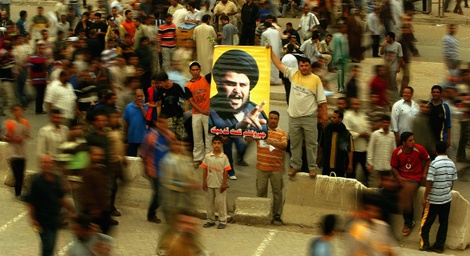
Sadr2wathiqkhuzaiegetty

Is it me or is the beginning of the end of the Bush-Cheney nightmare beginning to focus minds across the spectrum on more pragmatic, realistic and less partisan approaches? I hope so. A McCain-Obama race could help us a lot. Here’s a round-up of various views of what the current flare-up may portend or require:

Phillip Carter:

It’s difficult to see how this ends well. This is some of the nastiest intra-sectarian fighting we’ve seen in Iraq. Second, it looks pretty clear that Maliki is using the Iraqi security forces to consolidate his own power and eliminate his rivals. Third, I can only imagine the trepidation being felt by Sunni leaders who are watching this and wondering whether they’re next on Maliki’s hit list. For now, the heavy fighting remains limited to Basra, although skirmishes have erupted throughout the country. If this clash in Basra lasts longer than a week, that’s going to be really bad for the Maliki government. If the heavy fighting spreads, that’s going to be even worse.

Alex Knapp:

The fact of the matter is that this armed struggle for power is, in part, a result of the bizarre nature of Iraqi elections, which do more to promote political parties, rather than individual candidates, which makes the dominance of one party over another nationwide a priority, as opposed to a system where candidates from parties compete head to head.

While similar systems to work in more stable parliamentary systems, it’s a less satisfactory solution in Iraq, where “political party” is pretty much a synonym for “armed militia”, and “winning elections” comprises “killing people who vote for the other party.”

Spencer Ackerman:

Withdrawing without any political strategy, as the British did from Basra, leads to a vacuum like the one we’re seeing now. Sadr rushes in. The Islamic Supreme Council of Iraq rushes in. The Fadhila party maneuvers between the two. Forces ostensibly loyal to the government, pinioned between all sides, find ways to accommodate the existing power on the streets. In other words: chaos. So to avoid chaos — and I recognize this is banal and generic — you can’t just pull up stakes.


Some sort of political accommodation has to occur alongside a strategy of extrication. There will be some good suggestions coming out of various think tanks and government offices over the next several months that put flesh to bone here. But the broader point is this: if we decide we’re just going to order the post-surge forces out of Iraq in X number of months/years, and nothing accompanies that decision on the political-diplomatic end, then yeah, Basra probably will be a prologue. But if we spend the time between now and then — say, a new Democratic president’s Inaugural — working on some Undefined Diplomatic Strategy, then we have our best shot — and it’s not a sure shot; I’ll be the first to admit — at extracting ourselves with a minimum of chaos.

(Photo: Iraqi supporters of Shiite cleric Moqtada al-Sadr carry his picture on March 27, 2008 during a protest in the Sadr city Shiite district in Baghdad, Iraq. Thousands of Sadr’s supporters demonstrated in the Sadr city against a crackdown on militiamen loyal to Sadr in Basra and Baghdad by Iraqi government forces. By Wathiq Khuzaie/Getty Images.)

Maliki vs Sadr

Anthony Cordesman, national security analyst at the Center for Strategic and International Studies, offers his take on the violent power struggles now unfolding in Iraq:

Much of the current coverage of the fighting in the south assumes that Muqtada al-Sadr and the Sadr militia are the "spoilers," or bad guys, and that the government forces are the legitimate side and bringing order. This can be a dangerous oversimplification.

Here, Fishy, Fishy

From the science as science-fiction department:

Call them Pavlov’s fish: Scientists are testing a plan to train fish to catch themselves by swimming into a net when they hear a tone that signals feeding time.

If it works, the system could eventually allow black sea bass to be released into the open ocean, where they would grow to market size, then swim into an underwater cage to be harvested when they hear the signal.

Now if only someone could find a way to do that with voters. Oh, wait! Karl Rove already did.

Quote For The Day

Mccaindavidmcnewgetty

Why we should not dismiss the McCain candidacy:

"The United States cannot lead by virtue of its power alone. We must be strong politically, economically and militarily. But we must also lead by attracting others to our cause, by demonstrating once again the virtues of freedom and democracy, by defending the rules of international civilized society and by creating the new international institutions necessary."

I am waiting to see how the candidates respond to shifting and currently impenetrable events in Iraq. There are no good options. To my mind, the criterion must be who can most prudently and effectively get us out of there as swiftly as possible. But that will not be easy, whoever is president. And we will owe any of them patience and support if they accord the American people candor for the first time and offer the world an acknowledgment that the darkest days of Bush-Cheney are over.

(Photo: Republican presidential candidate Sen. John McCain (R-AZ) gives an address to the Los Angeles World Affairs Council March 26, 2008 in Los Angeles, California. McCain spoke on U.S. foreign policy at the breakfast event hosted by the Los Angeles World Affairs Council. By David McNew/Getty Images.)