by Chris Bodenner
Floating and flying through space:
float from haruki kawanaka on Vimeo.
Regulations in the US prohibit the recycling of implanted medical devices after their owners die, but Frank Swain reports that there’s “a growing trend to recover them for use in the developing world”:
At $4,000 for a pacemaker and $20,000 for an ICD [internal cardiac defibrillator], a second-hand implant is the only way that millions of people will be able to afford this life-saving equipment. In the UK, charity Pace4Life collects functioning pacemakers from funeral parlours for use in India. In a similar effort, the journal Annals of Internal Medicine recently published the results of a US programme called Project My Heart Your Heart, which found that 75 patients who received second-hand ICDs showed no evidence of infection or malfunction. The group are now applying for FDA approval to send recycled heart devices overseas.
Back in Nashville, Standing With Hope has adopted a similar approach by shipping prosthetic limbs to Ghana.
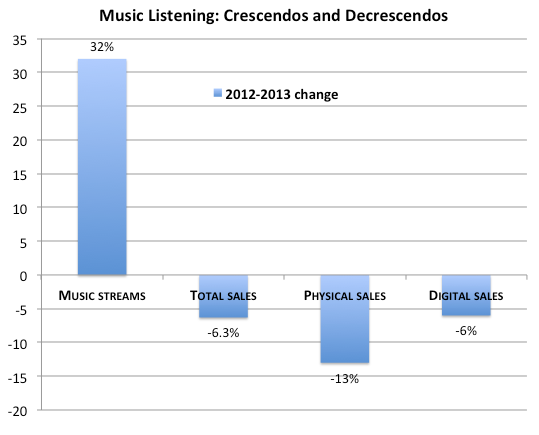
Derek Thompson covers the growth of music streaming:
This is at least the third destructive wave for the music industry in the last decade and a half. First, Napster and illegal downloading sites ripped apart the album and distributed song files in a black market that music labels couldn’t touch. Second, Apple used the fear and desperation of the record labels to push a $0.99-per-song model on iTunes, which effectively destroyed the bundling power of the album in the eyes of millions of music fans (even though country album sales are still pretty strong). For a decade, music sales plummeted. Third, digital radio and streaming sites got so good that now many music fans wonder why they need to buy albums in the first place. So, they don’t.
James Hamblin sinks his teeth into the so-called “silent pandemic” of toxins hidden in our everyday items. A team of researchers identified a dozen common poisons – such as ethanol, lead, and mercury – that leech IQ points:
The greater concern lies in what we’re exposed to and don’t yet know to be toxic. Federal health officials, prominent academics, and even many leaders in the chemical industry agree that the U.S. chemical safety testing system is in dire need of modernization. Yet parties on various sides cannot agree on the specifics of how to change the system, and two bills to modernize testing requirements are languishing in Congress. [Mount Sinai’s Philip] Landrigan and [Harvard’s Philippe] Grandjean’s real message is big, and it involves billion-dollar corporations and Capitol Hill, but it begins and ends with the human brain in its earliest, most vulnerable stages. …
Economist Elise Gould has calculated that a loss of one IQ point corresponds to a loss of $17,815 in lifetime earnings. Based on that figure, she estimates that for the population that was six years old or younger in 2006, lead exposure will result in a total income loss of between $165 and $233 billion. The combined current levels of pesticides, mercury, and lead cause IQ losses amounting to around $120 billion annually—or about three percent of the annual budget of the U.S. government.
Low-income families are hit the hardest. No parent can avoid these toxins—they’re in our couches and in our air. They can’t be sweated out through hot yoga classes or cleansed with a juice fast. But to whatever extent these things can be avoided without better regulations, it costs money. Low-income parents might not have access to organic produce or be able to guarantee their children a low-lead household. When it comes to brain development, this puts low-income kids at even greater disadvantages—in their education, in their earnings, in their lifelong health and well-being.
Hans Madsen from Yorkton, SK here for the tournament. Best fan beard, ever! #NB pic.twitter.com/8RBxykUi6S
— Matt Bingley (@mattybing) March 15, 2014
A reader passed it along:
I thought you might want this as a Beard of the Week. My colleague Matthew Bingley took the photo while covering the World Women’s Curling Championship in Saint John, New Brunswick.
Previous BOTWs here. And, because Andrew’s away from the blog, here’s a babe of the week.
Nineteen years after her friend Sangeeta Lal was murdered by her ex-boyfriend, Erika Hayasaki connected with Brian Post, the police officer who responded to the shooting. Over the years, the beat has taken a serious toll on Brian’s health:
In squad rooms full of cops, Brian would compare blood pressure meds with his colleagues. Most, if not all, of the police he knew with more than 10 years of service were dealing some kind of medical or psychological issue.
At night, Brian would hide his drinking from his wife. He went from sipping whiskey, to downing cheap 100-proof vodka.
“You see nothing but bodies, I swear, dead people,” he said. “Car accidents, hangings, suicides, murders, SIDS deaths.” He remembered a diabetic who killed himself by overdosing on chocolate. And then there was the conversation with a tongue-pierced meth user with an enlarged heart who had told Brian, “I’m white trash until the day I die.” He assaulted people in a parking lot and died in custody after deputies restrained him. The next day, Brian found himself close to fainting after viewing the autopsy photos of the same kid’s esophagus, and pierced tongue.
“I was so angry at this one woman for dying, that I yelled at her,” he said. “I just didn’t want to see another dead body…I should have recognized at that point, it’s time for me to back up.”
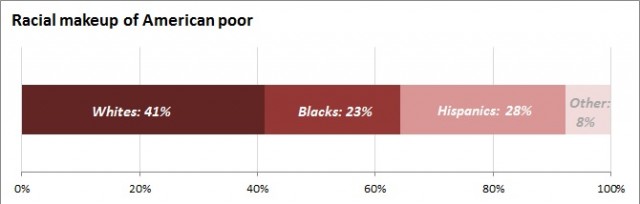
Yesterday, a reader took Paul Ryan to task for ignoring rural poverty. Waldman makes related points:
Everyone knows that minority populations in America, particularly blacks and Hispanics, suffer from disproportionate levels of poverty. For the moment, we don’t have to go into why that is and what can be done about it. I just want to note something that seldom gets mentioned: the actual racial makeup of America’s poor. In fact, when I tried to find a chart laying it out to paste into this post, I couldn’t find one. So I took poverty data and population data and made one myself (this is as of 2012) … The point of this chart is that even though blacks and Hispanics are disproportionately poor, the largest group of poor people in America is … white people.
Despite that fact, when you say “the poor,” what pops into most people’s heads is an image of a black person, probably due in no small part to the fact that poverty in America is represented in the media as a largely black phenomenon (I’m not just saying that; there’s research backing that up).
On Sunday, Robert Costa floated a new Republican GOP health care plan. Kevin Drum points out that the proposal is nothing the GOP hasn’t proposed a thousand times. Jonathan Cohn focuses on the interstate insurance sales component:
[I]f the GOP were to get its way, scrapping Obamacare and replacing it with the yet-unpublished plan Costa describes, the insurance industry would likely evolve just like the credit card industry did, with carriers relocating to states with the least regulations. That would be good news for healthy people willing to carry bare-bones coverage, and for people with enough money to pay for a plan, would love this arrangement. But people with preexisting conditions, the ones who were only able to buy coverage thanks to the ACA’s rules, would be back to the bad old days.
Bob Laszewski piles on:
A new carrier could conceivably come into the market with much lower rates––because it is offering fewer benefits––attracting the healthy people out of the old more regulated pool leaving the legacy carrier with a sicker pool. Stripping down a health plan is a great time tested way for a predatory insurance company to attract the healthiest consumers at the expense of the legacy carrier who is left with the sickest.
He suggests that “supporters of this idea first ask the leaders of the insurance industry if they would even do this under the best of circumstances.”

The Department of Education on Friday proposed new regulations (pdf) intended to address the high rate of student loan defaults among graduates of for-profit colleges. Ashlee Kieler outlines the proposal:
Programs would be deemed failing if loan payments of typical graduates exceed 30% of discretionary income or 12% of total annual income. Programs would be given a warning if a student’s loan payments amount to 20 to 30% of discretionary income, or 8 to 12% of total annual income. Discretionary income is defined as above 150% of the poverty line and applies to what can be put towards non-necessities.
Passing along the eyebrow-raising chart above, Danny Vinik praises the crackdown on for-profit colleges:
Students at for-profit colleges drop out at an alarming rate and those that do graduate have much higher levels of debt than students in public and private non-profit colleges. For-profits also receive a substantial share of their revenue—more than 80 percent to be exact—from loans and grants from the federal government. In 2012, the Senate Health, Education, Labor and Pensions Committee, led by Senator Tom Harkin, completed a two-year report into for-profit universities to investigate whether this taxpayer money was being well spent. Across the board, degrees and certificates from for-profit colleges cost significantly more than those from non-profits[.]
Those extra costs are not leading to high graduation rates though. Fifty four percent of students who enrolled during the 2008-2009 school year had withdrawn from the institution by 2010. Only 18 percent had earned their degree or certificate.
If America and Europe have failed to adequately defend Ukraine, it’s not for lack of guns. It’s for lack of money. Over the last year, the real contest between Russia and the West hasn’t been a military one (after all, even McCain knows that risking war over Ukraine is insane). It’s been economic. In part because of two wars that have drained America’s coffers, and in part because of a financial crisis that has weakened the West economically, the United States and Europe have been dramatically outbid. …
Whenever the United States debates using its money to buttress democracy and Western influence in a strategically important part of the world, commentators offer comparisons with the Marshall Plan that America offered Europe after World War II. But in today’s dollars, according to one estimate, the Marshall Plan would total roughly $740 billion. That kind of money would certainly enable far-reaching economic reforms in Ukraine, and likely anchor the country in the West for years to come. But, of course, the suggestion is absurd. Today’s Senate can barely pass an aid package 740 times as small.
 The Dish