Romney vs McCain In New Hampshire

The war hero versus the marketing tool. The Union Leader:

In this primary, the more Mitt Romney speaks, the less believable he becomes. That is why Granite Staters who have listened attentively are now returning to John McCain. They might not agree with McCain on everything, as we don’t, but like us, they judge him to be a man of integrity and conviction, a man who won’t sell them out, who won’t break his promises, and who won’t lie to get elected.

Voters can see that John McCain is trustworthy. Mitt Romney has spent a year trying to convince Granite Staters that he is as well. It looks like they aren’t buying it. And for good reason.

Myths About Iraq

Baqubaremainsafpgetty

For some, the war is over, victory has been achieved, and the only task now is to elect a new Decider to conduct a victory parade. Sadly, this seems to me to be verging on clinical denial. There is no question that General Petraeus, for the first time, has instituted a competent, if ad hoc occupation, by doing pragmatic deals in local areas and regions, constructing massive walls in Baghdad to keep warring sects apart, effectively bribing other areas with new investments and providing sufficient troops in some places to maintain a lull in the massive bloodletting that the US invasion unleashed. But in the next few months, the troop levels will be reduced, or the US military will be broken. They key to sustaining a national peace in Iraq is some level of sectarian integration in the police and army, some reconciliation between national Sunni and Shiite political parties, some resolution of the remaining trouble spots in the north, such as Kirkuk, and some kind of political leadership able to reach across the bloody divide. It is very hard to see any of these things happening.

A salutary read today is Juan Cole’s latest. I’ve learned to discount some of Cole’s gloom, but his current analysis is factually crammed with data and news that suggest what we are experiencing right now is not peace but a lull. Much of the evidence suggests a deepening of the sectarian divide, not a lessening, despite some local cooperation:

UN polling among Iraqi refugees in Syria suggests that 78% are from Baghdad and that nearly a million refugees relocated to Syria from Iraq in 2007 alone. This data suggests that over 700,000 residents of Baghdad have fled this city of 6 million during the US ‘surge,’ or more than 10 percent of the capital’s population. Among the primary effects of the ‘surge’ has been to turn Baghdad into an overwhelmingly Shiite city and to displace hundreds of thousands of Iraqis from the capital.

Violence has indeed gone down dramatically since the peak of the hot civil war but it has not disappeared:

In the past 6 weeks, there have been an average of 600 attacks a month, or 20 a day, which has held steady since the beginning of November. About 600 civilians are being killed in direct political violence per month, but that number excludes deaths of soldiers and police.

I don’t believe Iraq will be a minor issue in the coming election. It certainly shouldn’t be. The burden of proof needs now to be overwhelmingly on those arguing against a swift withdrawal. Governing an ungovernable failed state for the indefinite future, when the U.S. is already facing the $32 trillion of extra debt president Bush has saddled us with in a scant seven years, is a luxury we cannot afford. Most Americans know this – most conservatives know this. The question is simply how vast and continuing will be the cost of denial.

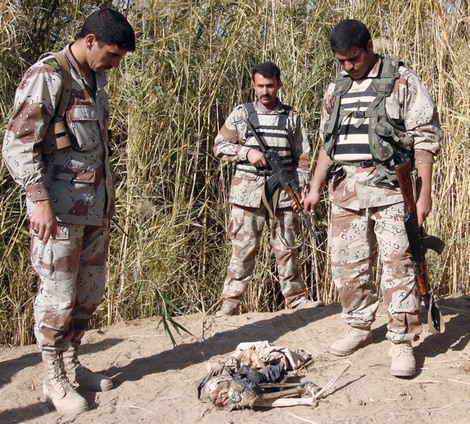
(Photo: Iraqi soldiers look at human remains in al-Hedid, 10 kms away from the restive city of Baquba, 45 kms northeast of Baghdad, 26 December 2007. Iraqi forces found 17 unidentified bodies allegedly killed by al-Qaeda fighters. AFP/Getty Images.)

Mission Accomplished Watch

If you believe that "victory" has somehow been achieved in Iraq, that we have done much more these past few months than keep the lid on a smoldering failed state, or that we can start withdrawing at any point soon without watching the whole thing go up in smoke again, a cautionary read in the NYT today is well worth your while. Pacifying the country by dismembering and dealing with local tribes and militias is fine as long as we are there in force for ever. But the minute you have to allow the Shiite government to take over, you could have another outberak of hot civil war. Only this time, the US will have ensured, by arming and training the Sunnis, that the war will be more brutal, longer and protracted than it might otherwise have been.

I don’t want to be gloomy at this time of year, and Petraeus’ extraordinary efforts to achieve a miracle deserve support and hope. But equally, we need to keep our eyes open. If we do, I fear this is only getting us in deeper, or leading to something even darker.

I Guess Not All “Fascists” Are “Liberal”

Or not according to the American Conservative. The piece is an intemperate attack on neoconservatives around Giuliani, but it also includes some sharp details. Here’s one:

Giuliani’s senior defense advisor is my old colleague from Harvard’s Olin Institute of 20071221magcoverlg Strategic Studies, Stephen Peter Rosen. He qualifies as a movement neocon, having signed many of the Project for a New American Century’s ukases, such as the Sept. 21, 2001 letter arguing, “even if the evidence does not link Iraq directly to the attack, any strategy aiming at the eradication of terrorism and its sponsors must include a determined effort to remove Saddam Hussein from power in Iraq” and the April 3, 2002 letter baldly declaring, “Israel’s fight against terrorism is our fight.” Not surprisingly, given his experience on the National Security Council during the early years of the Reagan military build-up, Rosen supports increased defense spending and the expansion of our ground forces. He is also an unabashed advocate of American primacy, arguing in a recent piece in The National Interest, “successful imperial governance must focus on maintaining and increasing, if possible, the initial advantage in the ability to generate military power.”

But Rosen’s view of international politics goes beyond renascent Reagan-era hawkishness and embraces a social Darwinistic framework for understanding hegemonic America’s challenges. Rejecting Bush’s pre-9/11 argument that America needed a “humble foreign policy,” Rosen wrote:

Humility is always a virtue, but the dominant male atop any social hierarchy, human or otherwise, never managed to rule simply by being nice. Human evolutionary history has produced a species that both creates hierarchies and harbors the desire among subordinates to challenge its dominant member. Those challenges never disappear. The dominant member can never do everything that subordinates desire, and so it is blamed for what it does not do as much as for what it does.

One response to being an unloved global hegemon, I suppose, is to focus on "successful imperial governance." I admire the honesty of the phrase. Another is to do less and allow other great powers some field of influence, and to stop the economic and moral hollowing out from within. At some point, on current trends, the US may be forced to do so – if only because its accumulated debt will demand it. Perhaps it’s better to let go a little while you’re ahead. Call it – oh, I don’t know – prudence?

The WaPo And The Dish

The Post finally picks up on some black disaffection with Clinton that the Dish highlighted a week ago. And, of course, I wouldn’t have noticed were it not for vigilant African-American readers and the black blogosphere. That cocaine-dealer meme was truly dumb on the Clinton campaign’s part. It may not hurt in Iowa, but it sure will in South Carolina.