Quote For The Day

RUSSIA-UKRAINE-POLITICS-UNREST

“All the important is yet to come. We do not expect a quick victory. Everything is to be paid for. Now we are witnesses of a birth of a new political reality, that is why everything acquires a special significance. This is not a technical enterprise, not a bargain. This is history itself. The struggle for Ukraine – is a struggle for reunification of Slavic peoples. Today it is clear that this reunion should be geographically different. Galicia and a number pro-western areas, and as well a large part of Kiev do not strive to Unity. We understand that. We won’t drag anyone by force. But we will not leave nor betray ours. However, for everything you have to fight and struggle to create a new political and historical reality …

If we win, we will begin the expansion of liberational (from Americans) ideology into Europe. It is the goal of full Eurasianism – Europe from Lisbon to Vladivostok. Great Eurasian Continental Empire. And we will build it. This means European Revolution will be Eurasian Revolution. This is our last horizon,” – Alexander Dugin, one of Vladimir Putin’s favorite polemicists. 

More on Dugin here.

(Photo: Pro-Kremlin activists hold Russian national, Russian and Soviet naval flags and orange-black flags made of the St. George’s Ribbons, a well-known Russian symbol of military valor, during a rally in support of ethnic Russians in Ukraine in central Moscow, on March 10, 2014. By Dmitry Serebryakov/AFP/Getty Images.)

Sanctions For Sanctions’ Sake

Fred Kaplan thinks the sanctions the US imposed on Russia last week were a mistake:

[I]f Putin had been looking for some way out of this mess, he certainly wouldn’t be looking any longer, because de-escalating now would make it seem that he was backing down under Western pressure. Obama has had two long phone conversations with Putin in recent days, but as long as he insists on preconditions for renewed diplomacy (Putin must return his troops to their base, he must sit down with Ukrainian officials), Putin has no reason to comply. Russia has deeper interests in Ukraine than the West does—and more localized sources of pressure to make those interests felt.

That being the case, Putin can sit and wait. He has the upper hand in this game—and the more the West plays on his terms, the stronger his hand will seem. Sanctions won’t change his behavior, except to stiffen it—and once that becomes clear, Putin will seem stronger, the West will seem weaker, and a solution to the Ukraine crisis will recede in the distance.

Larison questions the utility of sanctions:

In general, trying to bludgeon another government into changing its behavior very rarely achieves anything positive, and the danger in trying this against a larger power is that it could then retaliate with punitive measures of its own. That would make the crisis harder to resolve and inflict damage on Western economies in the process, which would in turn spur demands for still harsher measures. Russia is already threatening to block inspections for the current arms reduction treaty, and it could choose to make things more difficult for the U.S. on other issues as well. Many Westerners seem very eager to demand economic punishment of Russia, but I suspect very few actually want to pay the price that could be associated with it.

Drezner approaches the issue from a different angle:

The first thing to understand about sanctioning Russia over its incursion into Crimea has nothing to do with the impact of the sanctions and everything to do with what is being demanded of Moscow. The United States wants Russia to withdraw military forces from a piece of territory they have long coveted. However much Russia has contravened international law over the past week, they’ve changed the facts on the ground. They control Crimea, and public opinion in that autonomous republic is pretty Russo-friendly. The current status quo for Russia is that they control that territory. In world politics, there is no greater demand to ask of a government than to make de facto or de jure territorial concessions. The domestic and international ramifications of such a concession are massive — especially after force was used to occupy the territory. So recognize that the demand being attached to the sanctions is so large that success is extremely unlikely.

Drum agrees:

For my money, the biggest price Putin is paying comes not from any possible sanctions, but from the very clear message he’s now sent to bordering countries who have long been suspicious of him anyway. Yes, Putin has shown that he’s not to be trifled with. At the same time, he’s also shown every one of his neighbors that he can’t be trusted. Two mini-invasions in less than a decade is plenty to ramp up their anti-Russian sentiment to a fever pitch.

Wise or not, sanctions are the most popular course of action, a new poll finds:

While almost 59 percent of Americans do support the U.S. and its allies imposing sanctions on Russia slightly over half oppose sending economic aid to Ukraine, and over 75 percent are against sending military supplies to Ukraine.

When it comes to possible military responses to the Ukraine crisis Americans are overwhelmingly opposed, with only 12 percent of respondents saying they would support having American troops on the ground in Ukraine and 17 percent saying they would support U.S. airstrikes on Russia forces in Ukraine.

Previous Dish on sanctions here, here, and here.

Hathos Red Alert

Charles Pierce unloads on the barrel:

A friend bailed on the speech, making the very plausible case that Palin is simply another political celebrity freakshow, like Donald Trump. I can see the point there but, with Palin, and watching the hysterical reception her puerile screed received, there is something more serious going on. She is the living representation of the infantilization of American politics, a poisonous Grimm Sister telling toxic fairy tales to audiences drunk on fear, and hate and nonsense. She respects no standards but her own. She is in perpetual tantrum, railing against her betters, which is practically everyone, and volunteering for the job of avatar to the country’s reckless vandal of a political Id. It was the address of a malignant child delivered to an audience of malignant children.

Update from a reader:

My eyes actually bugged out when she said, “I do not like ‘Oh yes we can.'” Is it just me or was that a little bit of “sassy black woman” finger-snapping, head-swiveling, lip-pursing?

Another notes further:

Man, Sarah Palin even plagiarized that Dr. Seuss bullshit from an email meme that was popular three years ago.

Plus, there’s the irony that at the end of Green Eggs and Ham, the narrator does a total about-face and it turns out that he actually loves the very thing he’d just been railing against out of complete ignorance. Maybe Sarah never made it that far.

Ask Rob Thomas Anything

Rob Thomas is an American producer and screenwriter, best known as the creator of the critically-acclaimed TV series Veronica Mars and co-creator of Party Down. One year ago this week, he launched one of the most successful Kickstarter campaigns of all time in support of a Veronica Mars film (our discussion thread of the innovative, Dish-like project is here). The film is now finished and will be out in theatrical release and video-on-demand this Friday.

Let us know what you think we should ask Rob via the survey below (if you are reading on a mobile device, click here):


This embed is invalid

Has The Web Made Us Freer?

Linda Besner wonders if the promise of an Internet as a great cultural leveler – granting an audience to obscure artists as well as to the well-known and well-funded – might be wildly overstated:

In The People’s Platform, [author Astra] Taylor discusses how the supposedly open, free, and hierarchy-busting world wide web has failed to do better than a roomful of public television commissioners in encouraging the production or consumption of risky independent cultural products. In fact, it does significantly worse. Internet traffic follows a statistical pattern known as power law distribution; essentially, while there is a wide range of available options, almost everyone is crowded together at the most popular end of the spectrum. It’s a problem that’s getting worse: “In 2001, ten Web sites accounted for 31 per cent of U.S. page views,” Taylor writes, “by 2010, that number had skyrocketed to 75 percent.” Most nights, 40 per cent of the U.S.’s bandwidth is taken up by people watching Netflix movies.

In a similar vein, Dougald Hine challenges notions of the Internet as an agent of “liberation from the boredom of industrial society, a psychedelic jet-spray of information into every otherwise tedious corner of our lives”:

At best, it allows us to distract ourselves with the potentially endless deferral of clicking from one link to another. Yet sooner or later we wash up downstream in some far corner of the web, wondering where the time went. The experience of being carried on these currents is quite different to the patient, unpredictable process that leads towards meaning.

The latter requires, among other things, space for reflection – allowing what we have already absorbed to settle, waiting to see what patterns emerge. Find the corners of our lives in which we can unplug, the days on which it is possible to refuse the urgency of the inbox, the activities that will not be rushed. Switch off the infinity machine, not forever, nor because there is anything bad about it, but out of recognition of our own finitude: there is only so much information any of us can bear, and we cannot go fishing in the stream if we are drowning in it.

The Male Biological Clock, Ctd

Kathleen Goodwin summarizes a recent paper that examined how paternal age affects children:

[R]esearchers found that in a sample size of over 2.6 million, advanced paternal age has a detrimental effect on the mental health of offspring, with a greater risk for autism and attention-deficit/ hyperactivity disorder, as well as likelihood of suicide attempts and low educational attainment, even when controlling for multiple other factors.

She considers the implications:

Until now, the onus of choosing when to prioritize career and when to attempt pregnancy was ultimately a woman’s to bear. While men are undoubtedly affected by their partners’ decision to delay pregnancy and the ensuing fertility issues and health risks that accompany this decision, they were free of the worry that their aging sperm would have any negative consequences on their unborn child. Anecdotally, there are many examples of successful men have married younger women and thus been able to avoid the complications of advanced maternal age (Donald Trump comes immediately to mind—his current wife Melania Knauss-Trump is 23 years his junior and he was 59 when their son Barron was born). The publication of this study puts the age of a father into the list of factors that parents must balance when deciding to begin a family. If this study is able to be replicated with the same results and becomes part of the public health lexicon, men will be forced to consider their own age when it comes to planning their careers and choosing when to have children with their partners.

Previous Dish on the subject here.

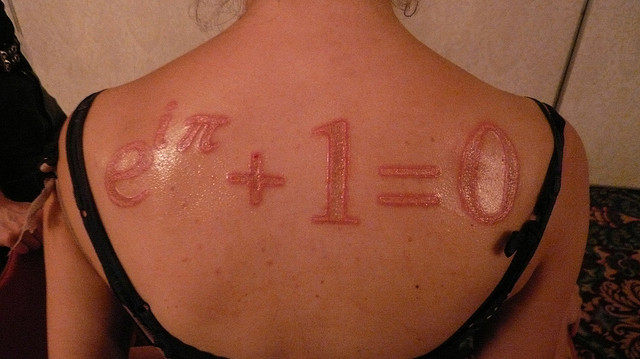
The Most Beautiful Equation?

dish_euler

There was an objective way to find the answer:

[R]esearchers led by Semir Zeki of University College London asked 16 mathematicians to rate 60 equations on a scale ranging from “ugly” to “beautiful.” Two weeks later, the mathematicians viewed the same equations and rated them again while lying inside a functional magnetic resonance imaging (fMRI) scanner.

The scientists found that the more beautiful an equation was to the mathematician, the more activity his or her brain showed in an area called the A1 field of the medial orbitofrontal cortex. The orbitofrontal cortex is associated with emotion, and this particular region of it has shown in previous tests to be correlated with emotional responses to visual and musical beauty. …

The study found … that the beauty of equations is not entirely subjective. Most of the mathematicians agreed on which equations were beautiful and which were ugly, with Euler’s identity, 1+e=0, consistently rated the most attractive equation in the lot. “Here are these three fundamental numbers, epi and i,” [mathematician Colin] Adams says, “all defined independently and all critically important in their own way, and suddenly you have this relationship between them encompassed in this equation that has a grand total of seven symbols in it? It is dumbfounding.”

(Image of Euler’s Identity scarification via Flickr user gruntzooki)

Subatomic Free Will

David Graeber considers the possibility:

Is it meaningful to say an electron “chooses” to jump the way it does? Obviously, there’s no way to prove it. The only evidence we could have (that we can’t predict what it’s going to do), we do have. But it’s hardly decisive. Still, if one wants a consistently materialist explanation of the world—that is, if one does not wish to treat the mind as some supernatural entity imposed on the material world, but rather as simply a more complex organization of processes that are already going on, at every level of material reality—then it makes sense that something at least a little like intentionality, something at least a little like experience, something at least a little like freedom, would have to exist on every level of physical reality as well.

Why do most of us, then, immediately recoil at such conclusions? Why do they seem crazy and unscientific? Or more to the point, why are we perfectly willing to ascribe agency to a strand of DNA (however “metaphorically”), but consider it absurd to do the same with an electron, a snowflake, or a coherent electromagnetic field?

The answer, it seems, is because it’s pretty much impossible to ascribe self-interest to a snowflake. If we have convinced ourselves that rational explanation of action can consist only of treating action as if there were some sort of self-serving calculation behind it, then by that definition, on all these levels, rational explanations can’t be found. Unlike a DNA molecule, which we can at least pretend is pursuing some gangster-like project of ruthless self-aggrandizement, an electron simply does not have a material interest to pursue, not even survival. It is in no sense competing with other electrons. If an electron is acting freely—if it, as Richard Feynman is supposed to have said, “does anything it likes”—it can only be acting freely as an end in itself. Which would mean that at the very foundations of physical reality, we encounter freedom for its own sake—which also means we encounter the most rudimentary form of play.

Update from a reader:

I’m a grad student in evolutionary biology and currently TA an introductory evolution course. I had a strong reaction to your post – one surely expected by Mr. Graeber, but perhaps worth airing.

First, the scare-quotes around “metaphorically” are misplaced. This usage is the literal definition of metaphor. Evolutionary biologists talk about the agency of DNA as useful conceptual shorthand, which accurately describes the outcomes of genetic evolution while grossly misrepresenting the mechanism. “The allele wants to help the copies of itself carried in other individuals,” is easier to say and is more intuitive to communicate than “the frequency in the population of alleles encoding for behaviors that harm the individual but help close relatives will increase if the cost to the individual’s reproductive output is less than the benefit to reproduction received by the relative multiplied by the probability a copy of the allele is also carried by the relative.” The statistical sorting leaves behind genes suited for propagation, so the ‘selfish’ analogy works better for genes than for snowflakes.

Second, the evolutionary explanation for consciousness and free will isn’t really addressed. Like so much of biodiversity, it can be seen as an adaptive emergent trait. Behavioral plasticity is a huge advantage. Deterministic links between particular stimuli and behaviors are widespread across the tree of life, but cannot accommodate novel stimuli and likely do not scale to the number of relevant stimuli encountered by complex animals. Breaking the deterministic links in favor of flexible decision making is exactly the kind of solution consistently ‘discovered’ by natural evolution. The emergence hypothesis seems to me more plausible than particular agency, for at least two reasons.

One is that, while the behavior of electrons cannot only be predicted probabilistically, there are many levels of biological organization between electrons and humanity that behave in an exceptionally predictable manner. In the lab, I use enzymes to manipulate DNA molecules; no such science would be possible if these proteins were not reliable replicating, cutting, and ligating machines.

Second, I suspect most people would agree that consciousness is present in non-human animals, and would further agree that, whatever it is, there is more of it in an ape or octopus than a fly, jellyfish, or sunflower. Agency as we observe it correlates strongly with neural complexity, which fits well with the notion that a sense of self emerges from the billions of neural connections housed in large-brained animals.

I don’t mean to go full “dick-head athiest” on you. The piece certainly is interesting, thought provoking, and the sort of thing that brings me back to your blog (and reupping my subscription any day now). It reminds me of my go-to response if I’m asked about my belief in God, to avoid the unfortunate conversation that can so easily follow: No I don’t believe in God, but I do believe in electrons.

The Ways Guns Kill People

A reader writes:

I’m disappointed that you only put up the numbers from accidental gun deaths. It seems a bit disingenuous, as the number of non-accidental car deaths, pool deaths, etc., are, of course, dramatically lower. In 2010 the FBI recorded 12,996 homicides. Of those, 8,775 were committed with guns. That compares to 1,704 with knives, the next closest, 540 with blunt objects, and 11 with poison. Even if you would argue that, of those killed by guns, many would have been killed with another guns-cmbn11weapon, it’s hard to see how that would directly play out. How many drive-by knifings can you have? How many people can get hit by crossfire from a baseball bat?
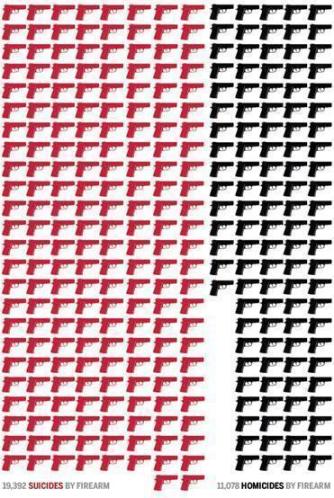
How about suicide? In 2010, we had 19,392 gun suicides. Not so many with cars. And for those who would argue that guns don’t matter when it comes to suicide (i.e. people will kill themselves regardless of what tools they have to accomplish the deed), multiple studies have proven that access to guns dramatically raises the risk of a successful suicide attempt.

But if you want to stick with just accidental deaths, as you’ve done, let’s contextualize it a bit. From 2005-2010, almost 3,800 people in the US died from unintentional shootings. 1,300 of those were under the age of 25. 31% of those shootings could have been prevented by the addition of two devices: a child-proof safety lock and a loading indicator. And 8% of those shootings (that’s 304) were carried out by shots fired from children under the age of six. How many accidental road deaths are caused by drivers who are under the age of six?

So, yes, lots of stuff can kill you. No surprise. But in the US, we’re at a much higher risk of death by firearm because of the lobbying efforts of the industry whose product is design to kill.

Another reader, from the other side of the debate, quotes Waldman:

On one hand, there are over 300 million of us, so only one in 500,000 Americans is killed every year because his knumbskull cousin said “Hey Bert, is this thing loaded?” before pulling the trigger. You can see that as a small number. The other way to look at is that each and every day, an American or two loses his or her life this way. In countries with sane gun laws, that 606 number is somewhere closer to zero.

That sentence encapsulates what I hate about the anti-gun crowd.

While Waldman is ahead of the game in that he at least admits that at .5% of all accidental deaths make accidental gun deaths a pretty low priority, he goes on to say that we should eliminate all personal gun ownership to take care of it anyway. Why does this bother me? Well, because it says that he doesn’t value my desire to own a gun to the point where he would take my gun to solve a problem he just admitted was insignificant.  So by extension, what I want is even less significant than this insignificant issue.

Look, as a responsible gun owner I want to reduce the number of gun deaths, and there are many ways of doing this, from requiring guns to be locked up when not in use so that minors cannot accidentally shoot somebody, to universal background checks to at least make it difficult for criminals to get their hands on guns.  The problem is that it is difficult to work with somebody who puts such a low value on something that you value that they see no reason why anybody would even want what you want.

If you want to know why it is so easy for the NRA to sell the idea that some people want to take your guns away look no farther than Paul Waldman (and Obama, Bloomberg, Feinstein and others) who on one hand say they don’t want to take your guns while making statements that make it clear they don’t value you having one.

Update from a reader:

Your reader wrote, “While Waldman is ahead of the game in that he at least admits that at .5% of all accidental deaths make accidental gun deaths a pretty low priority, he goes on to say that we should eliminate all personal gun ownership to take care of it anyway.” I read the Waldman atricle you posted, and it mentions no such thing. I started reading other articles Mr. Waldman has written and it’s clear he favors more gun control laws (expanded background checks, limits on amounts of ammunition which can be purchased, are two examples I found), but nowhere have I seen a claim to eliminate all personal gun ownership – and he certainly doesn’t “go on to say” that in the linked article.

In the article he does mention other countries with “sane gun laws.” Few countries totally ban the ownership of guns. There is some chance that Mr. Waldman is speaking of Japan, which does come close to forbidding ownership, but, for example, most of Europe allows private gun ownership. It’s really hard to conclude that elimination of all gun rights is what Mr. Waldman means by the phrase.

Your reader seems to equate any talk of “sane gun laws” with a prohibition of ownership, but goes on to advocate for laws such as “requiring guns to be locked up when not in use so that minors cannot accidentally shoot somebody, to universal background checks to at least make it difficult for criminals to get their hands on guns” which are actually to the left of the Toomey-Manchin bill, which the NRA fought so hard against. The reader seems to have more in common with Mr. Waldman then the NRA, but sees his ally as the enemy.

(Chart based on data compiled by the Centers for Disease Control and Prevention, via Leon Neyfakh)