
Huntsville, Alabama, 12 pm
Huntsville, Alabama, 12 pm
Do authors betray their loved ones with fictionalized accounts of their lives – and does the answer matter for the reader? Tim Parks explores the morally murky territory between fiction and memoir:
The question is: Can a novel that will affect the author’s closest relationships be written without any concern for the consequences? Will the story perhaps be “edited” to avoid the worst? Or is awareness of the possible reaction part of the energy feeding the book?
Italo Svevo’s Coscienza di Zeno begins with a hilarious account of Zeno’s attempts to stop smoking, always stymied by his decision to treat himself to l’ultima sigaretta, the last cigarette, usually one of the highest quality. Friends were aware this was largely autobiographical.
The novel continues with Zeno’s courting of three sisters; eventually rejected by the two prettiest, he marries the plain one. Again his wife would have been aware of elements from his own life. And now we have the story of a love affair, its various stages recounted in the most meticulous and again hilarious, all-too-convincing psychological detail. Finally, we proceed to chapters on Zeno’s business life, which much resembles Svevo’s own running of a paint company. Nevertheless the author’s wife always stated with great serenity that she was sure her husband had never betrayed her, nor was she shaken in this belief by the fact that his last words, when pulled out of a car accident were, reputedly, “Give me l’ultima sigaretta.”
So, was the introduction of the affair into the novel a kind of trial for her? She had to believe it was just made up. Or was there an agreement between them, explicit or otherwise, that whatever they knew would be kept to themselves, any truth in the matter forever denied? Did Svevo have to introduce the mistress because the shape of the novel required it? If so, wouldn’t there be a certain anxiety that his wife wouldn’t see it that way, and wouldn’t that affect the way he wrote these chapters? What I am suggesting is that in the genesis of a novel, or any work of literature, there will often be private tensions that the general reader will not be aware of playing a part in the creative decisions made. If, then, a reader becomes aware of these tensions, that awareness will inevitably alter the way the book is read.
You know him for his classic novels and searching essays, but Nikky Finney argues that poetry – which Baldwin wrote “throughout his life” – was at the heart of his self-understanding:
Baldwin wrote poetry because he felt close to this particular form and this particular way of
saying. Poetry helped thread his ideas from the essays, to the novels, to the love letters, to the book reviews, stitching images and feeling into music, back to his imagination. From the beginning of his life to the very end, I believe Baldwin saw himself more poet than anything else: The way he cared about language. The way he believed language should work. The way he understood what his friend and mentor, the great American painter Beauford Delaney, had taught him — to look close, not just at the water but at the oil sitting there on top of the water. This reliable witnessing eye was the true value of seeing the world for what it really was and not for what someone reported, from afar, that it was.
When Baldwin took off for Switzerland in 1951, he carried recordings by Bessie Smith, and he would often fall asleep listening to them, taking her in like the sweet black poetry she sang. It must have been her Baby don’t worry, I got you voice and their shared blues that pushed him through to finish Go Tell It on the Mountain in three months, after struggling with the story for ten years. Whenever Baldwin abandoned the music of who he was and how that sound was made, he momentarily lost his way. When he lost his way, I believe it was poetry that often brought him back. I believe he wrote poetry throughout his life because poetry brought him back to the music, back to the rain. The looking close. The understanding and presence of the oil on top of the water. Compression. Precision. The metaphor. The riff and shout. The figurative. The high notes. The blues. The reds. The whites. This soaking up. That treble clef. Bass. Baldwin could access it all — and did — with poetry.
Check out Baldwin’s poetry in the volume Jimmy’s Blues and Other Poems. Recent Dish on Baldwin here, here, and here.
(Photo of Baldwin in 1971 via Wikimedia Commons)
Popova captions the above short film:
From my friends at PBS Digital Studios and filmmaker James W. Griffiths comes A Solitary World — a breathtaking homage to H.G. Wells, with text adapted from five of his most celebrated works: The Time Machine (1895), The Island of Dr. Moreau (1896), The First Men in the Moon (1901), In The Days of the Comet (1906), The World Set Free (1914). Read by Terry Burns and featuring an appropriately haunting score from the young British composer Lennert Busch, the film belongs to — pioneers, perhaps — an emerging creative genre: the cinematic poem.
Neil Gaiman’s 1200 word short story, “Down to a Sunless Sea,” makes for a perfect quick dive into fiction. It begins:
The Thames is a filthy beast: it winds through London like a snake, or a sea serpent. All the rivers flow into it, the Fleet and the Tyburn and the Neckinger, carrying all the filth and scum and waste, the bodies of cats and dogs and the bones of sheep and pigs down into the brown water of the Thames, which carries them east into the estuary and from there into the North Sea and oblivion.
It is raining in London. The rain washes the dirt into the gutters, and it swells streams into rivers, rivers into powerful things. The rain is a noisy thing, splashing and pattering and rattling the rooftops. If it is clean water as it falls from the skies it only needs to touch London to become dirt, to stir dust and make it mud.
Read the rest here. For more, check out Gaiman’s most recent novel, The Ocean at the End of the Lane. Previous SSFSs here.

You have until noon on Tuesday to guess it. City and/or state first, then country. Please put the location in the subject heading, along with any description within the email. If no one guesses the exact location, proximity counts. Be sure to email entries to contest@andrewsullivan.com. Winner gets a free The View From Your Window book or two free gift subscriptions to the Dish. Have at it.
Media coverage of the 1964 murder of Kitty Genovese famously implicated dozens of the victim’s neighbors in Kew Gardens, Queens – none of whom, according to a front-page NYT story, phoned the police despite witnessing the brutal attacks over the course of half an hour. Nicholas Lemann investigates how the now-debunked “apathy narrative” took hold, tracing its influence to NYT editor A. M. Rosenthal:
Stories like that of the silent witnesses to Kitty Genovese’s murder represent the real danger zone in journalism, because they blend the power of instinct—which is about whether something feels true, not about whether it is true—with the respectable sheen of social science. In his book [on the murder, Thirty-eight Witnesses: The Kitty Genovese Case], Rosenthal groused, “I did not feel, nor do I now, that the sociologists and psychiatrists who commented contributed anything substantial to anybody’s understanding of what happened that night on Austin Street.” But, if he hadn’t assigned a second-day story consisting of quotes from such people, his version of the Genovese murder would not have taken the shape that it did. The experts transformed a crime into a crisis.
The manufacturing of the thirty-eight-witnesses myth had generally benign social effects. Yet there are many examples in which tendentious public renderings of violence have set off more, and worse, violence. (Many of the lynchings in the South during the Jim Crow era were undertaken to avenge a crime that the mob, confirmed in its rage by the local press, felt certain had taken place.) The real Kitty Genovese syndrome has to do with our susceptibility to narratives that echo our preconceptions and anxieties. So the lesson of the story isn’t that journalists should trust their gut, the way Abe Rosenthal did. Better to use your head.
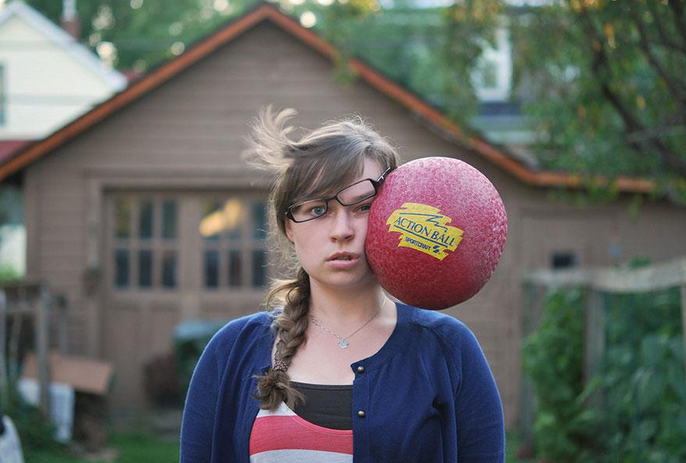
Kaija Straumanis’s self-portraits capture the moment of impact:
Literary translator, editor, and grad student Kaija Straumanis has a keen eye for photography, as can be seen from her Flickr gallery. This series of self-portraits, which Straumanis humorously refers to as “stuff being thrown at my head” moments, stands out in particular. In each image, Straumanis is in the process of being hit in the face by some object, whether it is a dodgeball, a book, or even a jack-o’-lantern.
Maria Konnikova searches for a fix:
The ubiquity of modern music and the resulting proliferation of earworms raise [a] question…: How do you dislodge one? In a study that [researcher Lauren] Stewart and the psychologist Victoria Williamson just published in the journal PLoS ONE, they examined thousands of survey responses to see what, if anything, was an especially effective method.
While people’s strategies for ridding themselves of unwanted aural guests fell into one of two broad categories—distraction or coping—the most successful way to remove an earworm, they found, was to deal with it head on, by intentionally listening to the song or singing it out loud, no matter how embarrassing the song.
But it may be futile to try to resist completely, if Stewart is correct about why we get earworms in the first place. In ongoing research with a team of neuroscientists at the University of Western Ontario, she says, “we’re working with the hypothesis that people are getting earworms to either match or change their current state of arousal—or a combination of the two.” She adds, “Maybe you’re feeling sluggish but need to take your child to a dance class, so it could be that an earworm pops into your hear that’s very upbeat, to help you along. Or working in reverse, can earworms act to calm you down?” It would explain why we sometimes get earworms even when we haven’t been listening to music at all, or why people who spend a great deal of time in nature often report beginning to hear every sound—wind blowing, leaves rustling, water rippling—as music, which their brain spontaneously plays over and over. Just as important, it would help explain why our brains often seem to linger on music that we don’t particularly care for.
Previous Dish on earworms here and here. Update from a reader:
For some reason I am highly susceptible to earworms. Once a melody is in my head, it will play on repeat forever. I have been known to lose sleep when an especially pernicious little melody gets its hooks into my gray matter. My wife and kids know this and have to be careful what they sing around the house and how often.
I’m not sure what it is about my brain. I am easily distracted by music and can only play certain kinds of music when I work or read. It is usually extremely minimal ambient music with little melodic or dynamic variation to grab the brain’s attention (I actually run an online label for such music). Of course the brain just loves to find patterns and a simple melody (quite appropriately called a “hook”) is something that the brain just seems to love. The good news is that I have the cure.
Jazz.
Not necessarily any jazz. It should be at least somewhat melodic and instrumental. Standards are great because they have the right combination of familiarity and novelty due to the interplay between melody and improvisation. If an earworm is crawling around in the brain, its little barbs have attached themselves to the part of the brain that wants patterns. The new melody of the jazz tune will sneak it’s way in and replace the earworm melody in the brain. Then as the song develops and improvisation takes over, the melody is basically broken apart and dissipates. Several jazz tunes in a row should work well enough to dissolve even the most pernicious melody (think Pharrell’s blissfully obnoxious “Happy”).
Try it, you’ll thank me.
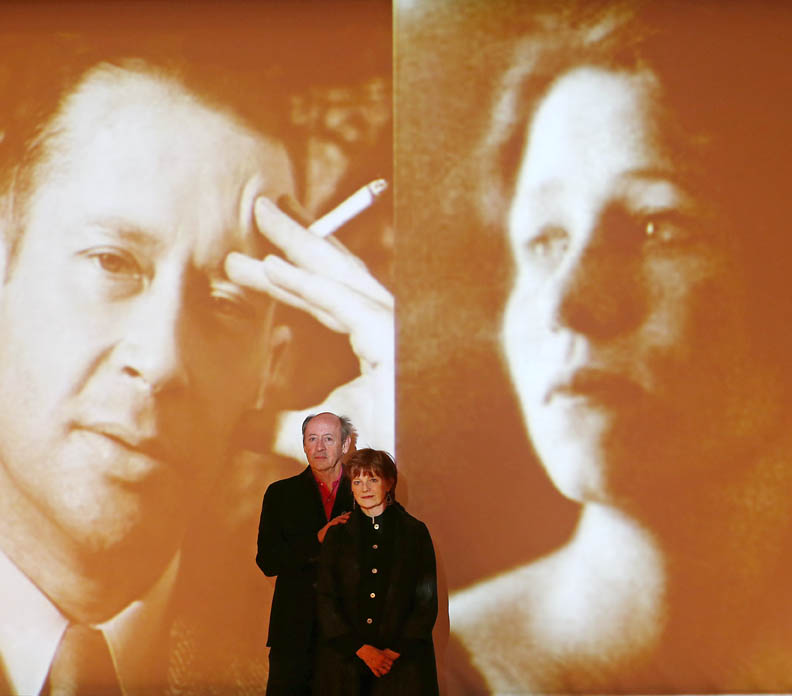
Dish poetry editor Alice Quinn writes:
On the evening of March 6th, the Poetry Society of America partnered with The New York Public Library for the Performing Arts at Lincoln Center to present e.e.cummings and Edna St. Vincent Millay: Two Mid-20th Century Stars, featuring the authors of biographies of the poets, Nancy Milford, whose Savage Beauty: The Life of Edna St. Vincent Millay, garnered praise from (among many others) Lorrie Moore and Toni Morrison, and Susan Cheever, whose new book, e.e.cummings: A Life has just been published by Alfred A. Knopf. The actress Blair Brown read poems by Millay and Billy Collins read poems by e.e.cummings, and the audience was enthralled. This weekend, we’ll feature some of the poems by Cummings read at the event. The first, “maggie and milly and molly and may” has been brilliantly set to music by Nathalie Merchant in her marvelous two-CD set, Leave Your Sleep. We also recommend the rain is a handsome animal, a sequence of 17 songs from the poetry of Cummings set to music by the San Francisco band, Tin Hat.
“maggie and milly and molly and may” by e.e. cummings:
maggie and milly and molly and may
went down to the beach(to play one day)and maggie discovered a shell that sang
so sweetly she couldn’t remember her troubles,andmilly befriended a stranded star
whose rays five languid fingers were;and molly was chased by a horrible thing
which raced sideways while blowing bubbles:andmay came home with a smooth round stone
as small as a world and as large as alone.For whatever we lose(like a you or a me)
it’s always ourselves we find in the sea
(From Complete Poems: 1904-1962 by E.E.Cummings, edited by George J. Firmage © 1950,1952, 1956, 1978, 1980, 1984, 1991 by the Trustees for the E.E.Cummings Trust. © 1979 by George James Firmage. Used by permission of Liveright Publishing Corporation. Photo of Billy Collins and Blaire Brown in front of Cummings (left) and Millay, at the PSA event described above © Lawrence Schwartzwald. No reproduction without express permission of the photographer.)

 The Dish
