Jane Austen vs Feminism

Terry Castle, a professor at Stanford who has written controversially about Austen, muses about the enduring appeal of her novels as stories of “Upwardly-Mobile-Hetero-Girl-Love-Fantasy”:

My female students—the ones who claim to be besotted by Austen and her books—tell me that even now, in 2014, they read her and watch the movies not for the social comedy or the brilliant style or the moral themes, but for the ‘love stories’.

Getting to kiss the hero. Or not. Such readerly euphoria can maybe seem regressive or childish but probably has everything to do, I’m thinking, with the so-called ‘post-feminist’ world we are all now said to inhabit. In some saddening, hugely entropic sense, feminism appears to be ‘gone’ or ‘over’ for these young women—or else never really existed for them. If they think about feminism at all, it’s merely as a sentimental vestige some long-ago-concluded sociopolitical readjustment carried out by no doubt distinguished but nameless female worthies.

[So] bizarre though it sounds, I think reading Austen’s fiction acts for them as a displaced surrogate for a feminist point of view—a more wholesome way of rebelling and resisting than bulimia or cutting yourself with a razor blade. A novel such as Emma or Pride and Prejudice represents an imaginary realm in which, however inchoately or metaphorically, female rage and desire—ongoing longings for power, physical safety, intellectual and moral authority, social acceptance, emotional freedom and fulfillment—can all be dramatized at once. My students don’t ‘get’ feminism, but they sure do ‘get’ Jane Austen.  She’s like swallowing a happy pill for them. The spectacular pop-culture fetishisation of Austen’s fiction in print and on film in recent decades may reflect what feminism itself has become in the early 21st century—a sort of amnesiac, occluded, teacup-filled, muslin-skirted version of itself.

Previous Dish on Austen here, here, and here.

A Secret Stash

Adam Baran’s Jackpot depicts a teenager’s quest to acquire a treasure trove of gay porn magazines (the movie takes place in 1994, when Internet porn wasn’t so accessible). Scott Beggs calls the film “simple and sweet”:

It stops just short of being schmaltzy due to a genuinely likable hero in Ethan Navarro’s Jack, and a comic relief porn-star-of-many-wardrobe-changes played by Adam Fleming. Plus, as bully-dodging stories go, this one feels a bit more honest when it comes to danger, consequences and the anticipated payoff. It’s a warm look at the complicated problem of learning about your own sexuality — which probably felt world-collapsingly insurmountable when we were all that age — that’s pulled off with a large heart and a rebellious attitude.

TV vs Literature

Novelist Moshin Hamid is awed by advances in TV storytelling (NYT):

Recently we’ve been treated to many shows that seem better than any that came before: the brilliant ethnography of “The Wire,” the dazzling sci-fi of “Battlestar Galactica,” the gorgeous period re-creation of “Mad Men,” the gripping fantasy of “Game of Thrones,” the lacerating self-exploration of “Girls.” Nor is TV’s rise confined to shows originating in only one country. Pakistani, Indian, British and dubbed Turkish dramas are all being devoured here in Pakistan. Thanks to downloads, even Denmark’s “Borgen” has found its local niche.

I now watch a lot of TV. And I’m not alone, even among my colleagues. Ask novelists today whether they spend more time watching TV or reading fiction and prepare yourself, at least occasionally, to hear them say the unsayable.

Adam Kirsch, meanwhile, insists on a distinction between novels and TV shows:

Spectacle and melodrama remain at the heart of TV, as they do with all arts that must reach a large audience in order to be economically viable. But it is voice, tone, the sense of the author’s mind at work, that are the essence of literature, and they exist in language, not in images. This doesn’t mean we shouldn’t be grateful for our good TV shows; but let’s not fool ourselves into thinking that they give us what only literature can.

Gary Shteyngart reflected on similar themes in a recent interview:

Why and to where do you think our attentions have shifted?

The need for stories is always there, but what is the water cooler conversation now? It’s beautiful shows like Breaking Bad, or Mad Men, or Girls. That’s where it’s migrated, and I’m not against any of that—in fact, they’re trying to turn [my book Super Sad True Love Story] into a TV series. I love those shows. But I do feel that because they satisfy a certain need for narrative, they’ve pushed books out of the way. Also, our attention span has shrunk to such an extent and it’s harder to concentrate on text for a very long period of time, especially when it’s not on a screen. People lack that capacity.

I lack that capacity. I was doing a reading in upstate New York, way up in the mountains, and I started out from New York, of course checking my iPhone while trying to read a beautiful Chinese novel in translation. I had so much trouble getting into the book because it was in a different culture with all these other signifiers. Meanwhile, the iPhone is just pinging with messages and I’m answering and tweeting like crazy, all while trying to read this book. Then we got into the mountains and the signal died, and when the signal died, I remembered what it’s like to read a book and I started really getting into the book. I started inhabiting the world of the book until everything else was crowded out except for the book and the characters in it. I thought “So that’s what reading is.” Fifteen years ago, that was how I read. Now I have to end up surrounded by mountains to do it. I do this professionally—what is it like for the casual reader.

The View From Your Window Contest

vfyw_

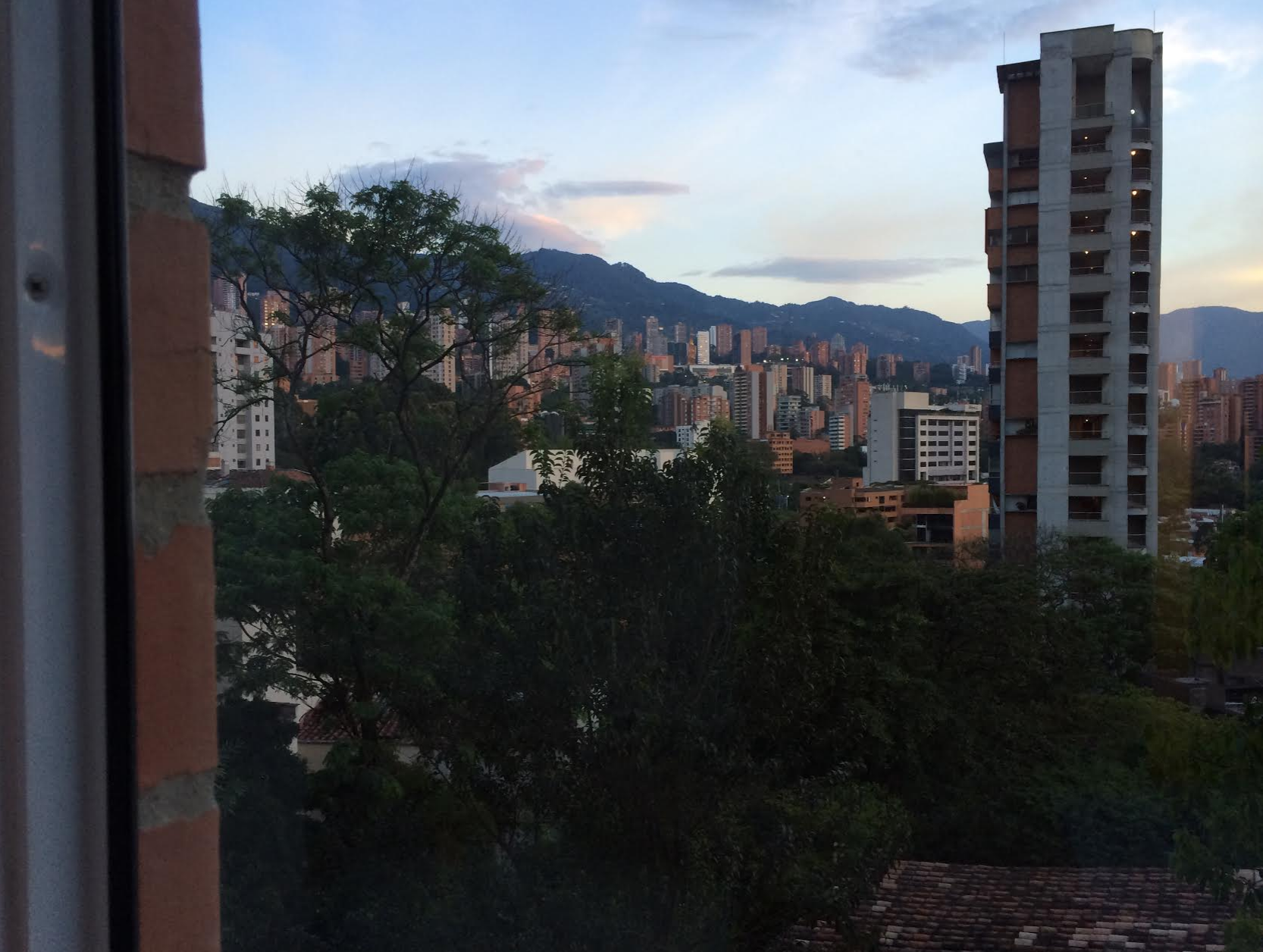
You have until noon on Tuesday to guess it. City and/or state first, then country. Please put the location in the subject heading, along with any description within the email. If no one guesses the exact location, proximity counts.  Be sure to email entries to contest@andrewsullivan.com. Winner gets a free The View From Your Window book or two free gift subscriptions to the Dish. Have at it.

The Cost Of Convenience

Tim Wu worries that convenience technologies (“like instant mashed potatoes or automatic transmissions”) intended to provide “more space in our lives for other things, like thought, reflection, and leisure … have somehow failed to deliver on the central promise of free time”:

Convenience technologies supposedly free us to focus on what matters, but sometimes the part that matters is what gets eliminated. Everyone knows that it is easier to drive to the top of a mountain than to hike; the views may be the same, but the feeling never is. By the same logic, we may evolve into creatures that can do more but find that what we do has somehow been robbed of the satisfaction we hoped it might contain.

The project of self-evolution demands an understanding of humanity’s relationship with tools, which is mysterious and defining. Some scientists, like the archaeologist Timothy Taylor, believe that our biological evolution was shaped by the tools our ancestors chose eons ago. Anecdotally, when people describe what matters to them, second only to human relationships is usually the mastery of some demanding tool. Playing the guitar, fishing, golfing, rock-climbing, sculpting, and painting all demand mastery of stubborn tools that often fail to do what we want. Perhaps the key to these and other demanding technologies is that they constantly require new learning. The brain is stimulated and forced to change. Conversely, when things are too easy, as a species we may become like unchallenged schoolchildren, sullen and perpetually dissatisfied.

I don’t mean to insist that everything need be done the hard way, or that we somehow need to suffer like our ancestors to achieve redemption. It isn’t somehow wrong to use a microwave rather than a wood fire to reheat leftovers. But we must take seriously our biological need to be challenged, or face the danger of evolving into creatures whose lives are more productive but also less satisfying.

A Poem For Saturday

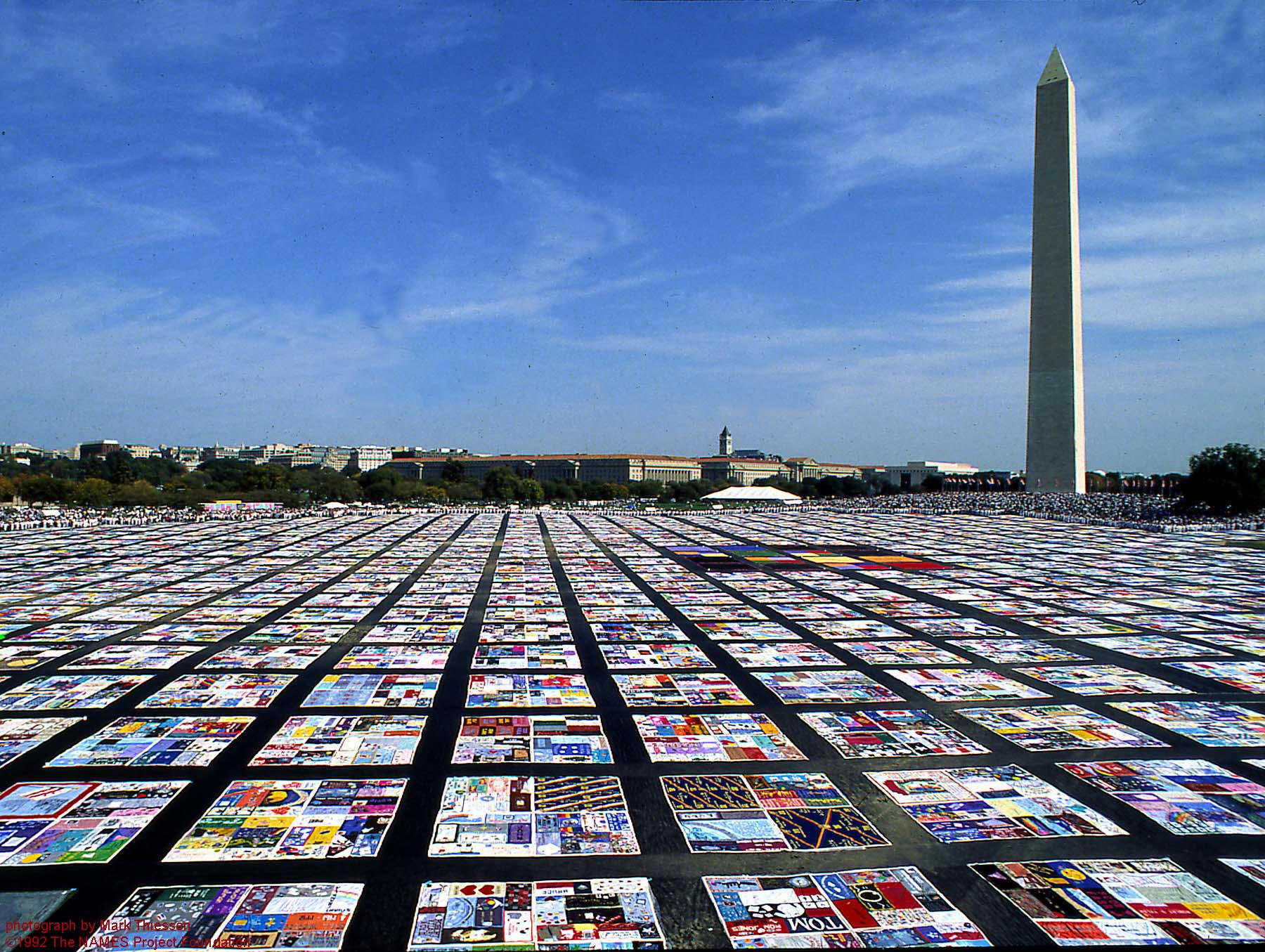
Aids_Quilt

Frank Bidart’s “Hunger for the Absolute” was featured as one of the Dish’s “Poems from the Year” in December, when we looked back at some our favorite poems that we ran in 2013. This weekend we’re again celebrating Bidart’s work, with two poems from his latest collection, Metaphysical Dog, which will be published in a paperback edition this spring by Farrar, Straus and Giroux. Here is “For the AIDS Dead”:

The plague you have thus far survived. They didn’t.
Nothing that they did in bed that you didn’t.

Writing a poem, I cleave to “you.” You
means I, one, you, as well as the you

inside you constantly talk to. Without
justice or logic, without

sense, you survived. They didn’t.
Nothing that they did in bed that you didn’t.

(From Metaphysical Dog by Frank Bidart © 2013 by Frank Bidart. Reprinted by kind permission of Farrar, Straus and Giroux. Photo of the AIDS quilt from the National Institutes of Health, via Wikimedia Commons)

Whitewashing Agent Orange

A new study suggests Agent Orange may have endangered Americans who worked with contaminated aircraft long after Vietnam:

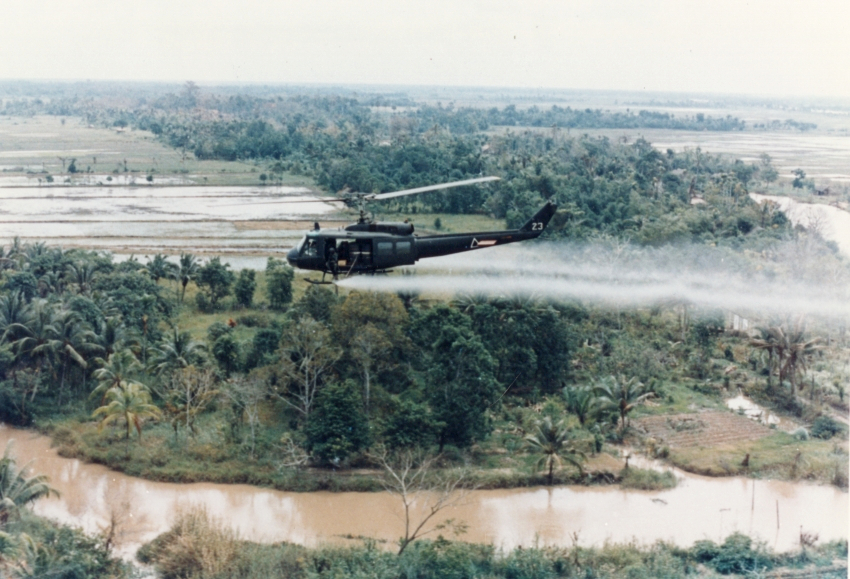
new study published in the journal Environmental Research reveals that Air Force reservists were exposed to higher levels of the toxic chemical than previously known (or dish_agentorange admitted). Many of the same aircraft that dispersed Agent Orange during the war were later used as transport vehicles during (relative) peacetime, primarily between the years 1971 and 1982. And tests taken many years after those transports show the planes still contained dangerous levels of the chemical. Initial testing of the planes after the war and before peacetime service was nonexistent.

The US Air Force and Department of Veterans Affairs have previously denied benefits to those exposed to the chemical from these planes, claiming it wasn’t a harmful level of exposure. Researchers have now proven this to be false. The study used the US Army’s own algorithms and samples taken from the aircraft to estimate how much the post-war level of exposure would have affected the body, with the results demonstrating that the levels in those aircraft were unacceptable under USAF and VA policies.

Lynne Peeples explains the implications:

Veterans who sprayed or handled Agent Orange herbicide during the war, or who spent any time on the ground in Vietnam, are automatically eligible for health care and disability compensation under federal Agent Orange legislation. The government presumes that certain conditions such as prostate cancer, Parkinson’s disease and Type 2 diabetes are a result of exposure to the chemical.

Linda Birnbaum, director of the National Institute of Environmental Health Sciences, told The Huffington Post that, in her opinion, the VA’s presumption should be expanded to include those who flew in the post-war planes. … “[I]t would be reasonable to assume that those who flew in these planes after the war were more likely to be exposed than those servicemen who had boots on the ground in Vietnam.”

Jim Stevenson recently spoke with Peter Sills, an attorney who wrote the book Toxic War:

STEVENSON:  How were American veterans at that time being exposed [to Agent Orange] in harmful ways?

SILLS:  When you start spraying towns and villages, there are American soldiers there too. That is part of it. The food that people ate became poisoned, and the water that people drank. There is another surprising thing: herbicides came in 50-gallon barrels. When they were emptied, they were not really empty. There were two or three gallons of herbicide left in the barrels. Soldiers used them for showers, for bar-b-ques (grills for cooking). Vietnamese used them to hold gasoline and wound up spraying dioxin all over Vietnam. The cities became defoliated even though they were never sprayed (from U.S. planes). They were sprayed by Vietnamese automobiles and motorcycles. No one could figure it out for a while. So people were exposed in surprising and unexpected ways.

STEVENSON:  How many U.S. veterans are we talking about looking for some sort of compensation because of exposure to Agent Orange?

SILLS:  Hundreds of thousands, possibly over a million. That is muddy unfortunately because there are so many people who are sick for reasons other than herbicide exposure. The symptoms of dioxin exposure, the poison in the herbicide, are not very different from what people get normally, heart attacks, diabetes, lung cancer, liver problems, neurological problems, things that people just get.

Previous Dish coverage of health risks in the military here.

(Image of U.S. Huey helicopter spraying Agent Orange over Vietnam via Wikimedia Commons)
Invasion Is Imminent

https://twitter.com/ARothNYT/status/439783262987485184

https://twitter.com/shaunwalker7/status/439768671058419712

The Guardian is live-blogging. More Dish updates soon.

Steve Jobs, Fashion Icon?

Fiona Duncan assesses a new fashion trend called “normcore,” which captures “self-aware, stylized blandness”:

By late 2013, it wasn’t uncommon to spot the Downtown chicks you’d expect to have closets full of Acne and Isabel Marant wearing nondescript half-zip pullovers and anonymous denim. Magazines, too, had picked up the look. T noted the “enduring appeal of the Patagonia fleece” as displayed on Patrik Ervell and Marc Jacobs’s runways. Edie Campbell slid into Birkenstocks (or the Céline version thereof) in Vogue Paris. Adidas trackies layered under Louis Vuitton cashmere in Self Service. A bucket hat and Nike slippers framed an Alexander McQueen coveralls in Twin. Smaller, younger magazines like London’s Hot and Cool and New York’s Sex and Garmento, were interested in even more genuinely average ensembles, skipping high-low blends for the purity of head-to-toe normcore.

Jeremy Lewis, the founder/editor of Garmento and a freelance stylist and fashion writer, calls normcore “one facet of a growing anti-fashion sentiment.” His personal style is (in the words of Andre Walker, a designer Lewis featured in the magazine’s last issue) “exhaustingly plain”—this winter, that’s meant a North Face fleece, khakis, and New Balances. Lewis says his “look of nothing” is about absolving oneself from fashion, “lest it mark you as a mindless sheep.”

Tori Telfer calls the trend both “refreshingly non-ironic” and “incredibly pretentious”:

People have been dressing à la normcore for years — they’re called parents, at least in popular clichés.

They dress like this because they genuinely don’t have time to think about fashion, not because they’ve decided not to care. And of course, fashion is an art form with a rich historyet cetera; implying that fashion is for anti-intellectuals is a pretty ignorant stance to take.

The true irony of normcore, like everything adopted by hipster-ish society, is that once you start to talk about it, it loses its authenticity. Steve Jobs was the apex of genuine normcore — he wore the same thing every day because it was convenient, which freed him up to change the world. But as soon as normcore is labeled, hashtagged, and analyzed, its idealism fails.

Jon Moy, meanwhile, is so annoyed by the trend that he turns to all-caps:

The only thing worse than making the argument that this is some sort of rally against the commodification and label-happy world of high fashion, is saying how you think “normal people” are more stylish than “fashion people”. Let me clear that up for you—STYLISH PEOPLE ARE STYLISH NO MATTER THEIR BACKGROUND. An editorial that features random people caught on Google Maps? Cool. Because if there’s one thing people love, it’s patronizing observations like “OMG normal people are so interesting.” NO THEY AREN’T. NO ONE WANTS TO BE REMINDED OF HOW THEIR LIVES HAVE GOTTEN AWAY FROM THEM AND HOW THEIR JOBS AND FAMILY RESPONSIBILITIES DON’T AFFORD THEM THE TEMPORAL AND MONETARY LUXURY TO OVERTHINK THEIR OUTFITS.

The truest and realest conclusion of Normcore? That we really are all the same no matter what we wear.