It Gets Worse

From Senate hearings yesterday:

Senator Lindsey Graham: You mean you’re not equipped to give a legal opinion as to whether or not Iranian military waterboarding, secret security agents waterboarding downed airmen is a violation of the Geneva Convention?

Brigadier General Thomas W. Hartmann, the legal adviser at Guantanamo Bay: I am not prepared to answer that question, Senator.

I’m not sure the United States would be able to invoke the Geneva Conventions in defense of its own servicemembers any more without universal laughter.

Sleep Deprivation As Torture

A reader writes:

I just came across this fascinating piece of historical evidence in a recent ‘Cambridge in America Newsletter’ (Issue 13, Autumn 2007):

For centuries, a fragile, 1,500-page memoir by a politically active, Cambridge-educated Puritan chaplain, covering the years 1677 to 1691, lay unread in a little-known London library. Nearly a million words in length, some 40,000 of which were written in impenetrable code (to protect the author from the King’s agents), the ‘Entring Book’ of Roger Morrice has long tantalized scholars … Writing twenty years after Pepys, Morrice depicted a darker England, thrown into a great crisis of "popery and arbitrary power."

Morrice wrote about the persecution faced by those who refused to abide by the laws of the Stuart state and the established Church and who, like the Quakers and Puritans, persisted in illegal worship … In October 1684 he tells of one victim whom soldiers were ordered to "keep him from sleeping, which they did without intermission for nine or ten days.  When he was ready to die … the balls of his eyes swollen as big as tennis balls … they tormented him by the thumbs".

The means of torture are as old as the nature of the human body and psyche. No modern president can abolish it by the abuse of the English language.

Lost

An artefact of how the Bush administration has eviscerated the rule of law:

Q But when you have a former CIA officer, John Kiriakou, now saying that waterboarding was used — since you’re saying the interrogations were legal; he’s saying on the record now, waterboarding was used in at least one case. You’re saying waterboarding is legal?

MS. PERINO: Ed, I’m saying I’m not commenting on any specific technique. I’m not commenting on that gentleman’s characteristics of any possible technique. I’ve given you a very general statement about interrogations being legal, limited and –

Q You just said it was legal.

MS. PERINO: I’m sorry?

Q You said it was within the legal framework.

MS. PERINO: Yes.

Q Everything that was done.

MS. PERINO: Yes.

Q So waterboarding is legal.

MS. PERINO: I’m not commenting on any specific techniques.

Just weep, ok?

Soyster Speaks

The former head of the Defense Intelligence Agency, Lieutenant General Harry Soyster pushes back against the torture-advocates:

"Experienced military and intelligence professionals know that torture, in addition to being illegal and immoral, is an unreliable means of extracting information from prisoners.  Much is being made of former CIA official John Kiriakou’s statement that waterboarding "broke" a high-value terrorist involved in the 9/11 plot.  There are always those who, whether out of fear or inexperience, rush to push the panic button instead of relying on what we know works best and most reliably in these situations. I would caution those who would rely on this example. It is far from clear that the information obtained from this prisoner through illegal means could not have been obtained through lawful methods. The FBI was getting good intelligence from this prisoner before the CIA took over.

And there are numerous examples of cases where relying on information obtained through torture has disastrous consequences.  The reality is that use of torture produces inconsistent results that are an unreliable basis for action and policy.  The overwhelming consensus of intelligence professionals is that torture produces unreliable information.  And the overwhelming consensus of senior military leaders is that resort to torture is dishonorable.  Use of such primitive methods actually put our own troops and our nation at risk."

What Torture Is

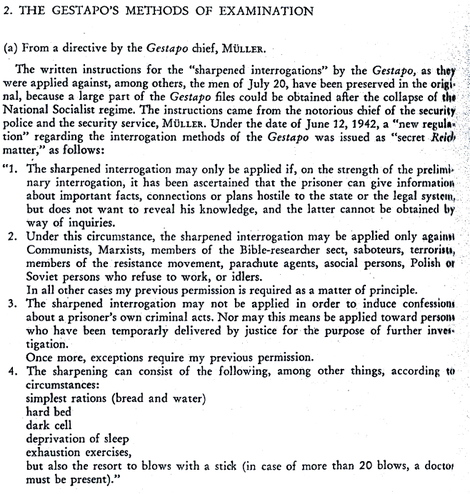
Translationofmuellermemo

The legal definition is clear enough: the infliction of severe mental or physical pain or suffering to extract information. But the notion of "severe" has obviously been interpreted to mean different things, to carve out a zone where prisoners can be subjected to pain and suffering to elicit information that is not somehow torture. You’ve heard all the euphemisms by now: "enhanced interrogation"; "coercive interrogation"; "aggressive questioning"; "harsh interrogation." Not only have leading politicians and torture apologists used these terms but the mainstream media have adopted them as well, as if writing news stories in which the United States is described as practicing torture is so unimaginable a concept that it requires obfuscating.

To my mind, the biggest misconception has been the conflation of torture with sadism as it is understood in comic books or lurid spy novels. Throughout human history, some of the most disgusting torture has taken these forms: pulling out fingernails, drilling into skulls, electrocution, etc. But most human torture is less dramatic than this, even banal. Sleep deprivation, for example, can easily be dismissed as non-torture by those, like Rudy Giuliani, who have not taken the time to learn what it actually is.

In fact, many victims of torture describe it as among the worst. Menachem Begin, a terrorist and no softy, experienced it under Stalin and believed that "not even hunger or thirst are comparable" with the desire to sleep after a certain amount of time. The same can be said for being forced to stand for 48 hours. In his fascinating interview with Brian Ross, former CIA torturer Brian Kiriakou decribes how Abu Zubayhdah responded to these torture techniques:

JOHN: I recall the handful of times it was used on people it was usually 40 hours plus.  They just simply couldn’t take it anymore.

That last phrase seems to me to be the critical one:

They just simply couldn’t take it anymore.

This is the central criterion of torture. It takes sleep deprivation 40 hours to get there; and it takes water-boarding ten seconds. But the destination is the same: the surrender of will to another because of intolerable pain or suffering. That’s why a mock execution is also regarded as torture under the law – because it takes a person to the edge of psychological breakdown.

Or look at it this way. If a prisoner were subjected to electric shocks to get him to cooperate, how long would the process take? A matter of seconds, perhaps a minute. How long does it take when waterboarding someone? According to Kiriakou, who was there:

He was able to withstand the water boarding for quite some time. And by that I mean probably 30, 35 seconds –

So the mental and physical pain or suffering was so severe that it was an achievement for a prisoner to endure it for more than 30 seconds. Kiriakou says he lasted 5 seconds in a context where he knew he was safe.

This is not just torture; it is among the most severe forms of torture that we know. It is completely indistinguishable from non-fatally electrocuting someone. That it doesn’t leave physical marks is immaterial. That argument is one the Nazis used in defending the use of sleep deprivation and hypothermia. What matters is the severity of the suffering.

I wish these were not the facts. But they are. We now have a direct witness to the torture – and one who inflicted it – describing it as torture; we have all the legal precedents that do not begin to question whether waterboarding is torture; we know the president directly authorized it; we know the epidemic of torture that ensued. These are crimes, committed by the executive branch in full awareness of the law and with premeditation. They place the United States in violation of the Geneva Conventions. And the president bears the final responsibility.

I hate to ask the inevitable question: Who will now hold him criminally responsible?

The Witnessing Of American Torture

Ag21

The Brian Ross interview with former CIA interrogator, John Kiriakou, who tortured Abu Zubaydah, is well worth reading in full. You can download the transcript here and here. Among the things I learned: – According to Kiriakou, everything was very closely monitored and approved up the chain of command. The president absolutely knew and approved of the waterboarding. President Bush personally authorized the torture of a prisoner, via the Deputy Director for Operations of the CIA. This was not free-lancing:

BRIAN ROSS: And did you know the CIA officers feel without a doubt you had the legal right to do what you were doing?

JOHN: Absolutely.  Absolutely. I remember – I remember being told when – the President signed the – the authorities that they had been approved – not just by the National Security Counsel, but by the – but by the Justice Department as well, I remember people being surprised that the authorities were granted.

– Waterboarding was not the only torture technique. Sleep deprivation was integral to Zubaydah’s interrogation. And Kiriakou, like any other interrogator who has used sleep deprivation, and unlike Rudy Giuliani, understands that this is torture:

JOHN: You know, you may not think about it, but– but exhaustion is– is a very difficult thing to handle.  It’s one thing to be tired.  It’s another thing to be so tired that you begin to hallucinate.  And after a while some people just can’t take it anymore.  And they’ll tell you if– "Just give me an hour.  Give me two hours of sleep, I’ll tell you anything you wanna know."

BRIAN ROSS: Really?

JOHN: Uh-huh (AFFIRM)

BRIAN ROSS: And that’s after how long generally?

JOHN: I recall the handful of times it was used on people it was usually 40 hours plus.  They just simply couldn’t take it anymore.

– Kiriakou, in contrast with Ron Suskind’s reporting, says that the information Zubayhdah gave was legit and confirmed from other sources. But it is interesting to me at least that Zubaydah ascribed his decision to cooperate to a dream where Allah gave him permission to talk. I have no doubt it was related to the breakdown caused by waterboarding, but with religious fanatics, a religious sanction is also necessary. Torture alone was not enough.

– The nature of the attacks that Kiriakou says the CIA foiled because of torture was not cataclysmic. It was not the nuclear ticking time-bomb. It was more operational information, and in so far as some attacks were, according to Kiriakou, foiled,

To the best of my recollection, no, they weren’t on US soil. They were overseas.

If we are to have a serious debate about what to do about torture, all these facts need to be taken into consideration. The facts are these: the president of the United States directly broke the law and the Geneva Conventions by authorizing the torture of a prisoner; he did so in the absence of any actual knowledge of any actual, dire threat to the United States; the evidence of the torture has been destroyed.

The Zubaydah torture does not fit the category laid out by Charles Krauthammer as the criterion for legalized torture. It was done not because we knew something and needed to nail it down. It was done because we knew nothing and needed to find out more. The attacks it allegedly foiled were not catastrophic and not on the mainland of the United States. It was accompanied and monitored by medical professionals to ensure that the victim did not die. Those medical professionals need to be identified and stripped of their licences.

More important, the direct authorization of torture techniques by the president was not contained. Instead, incidents of torture and abuse were subsequently documented throughout the theater of war. We have evidence of over a hundred deaths in interrogation, of which less than a score have been acknowledged by the Pentagon a examples of torturing-to-death. Whatever moral decision we come to with respect to the torture of Abu Zubaydah, it is essential to understand that no authorized act of torture stands alone. By sending a clear signal that the United States has crossed the Rubicon of torture, the commander-in-chief told the entire military and intelligence world that the gloves are off.

There is a direct line from the president’s authorization of torture to the horrors of Abu Ghraib. Bush is responsible for Abu Ghraib.
Vive La Resistance

"I had instructed the prosecutors in September 2005 that we would not offer any evidence derived by waterboarding, one of the aggressive interrogation techniques the administration has sanctioned. Haynes and I have different perspectives and support different agendas, and the decision to give him command over the chief prosecutor’s office, in my view, cast a shadow over the integrity of military commissions. I resigned a few hours after I was informed of Haynes’ place in my chain of command," – Morris D. Davis, the former chief prosecutor for the Office of Military Commissions. Scott Horton comments here.